Roaring Bull o’ Bagbury

Tradition: English Mythology
Alternative names: The Roaring Bull of Bagbury
Category: Ghost, Cow


The Myth

A notoriously wicked man once lived at Bagbury Farm. According to the story, he had done almost no good in his life, with only two acts of kindness remembered: giving a waistcoat to a poor old man and giving bread and cheese to a poor boy.

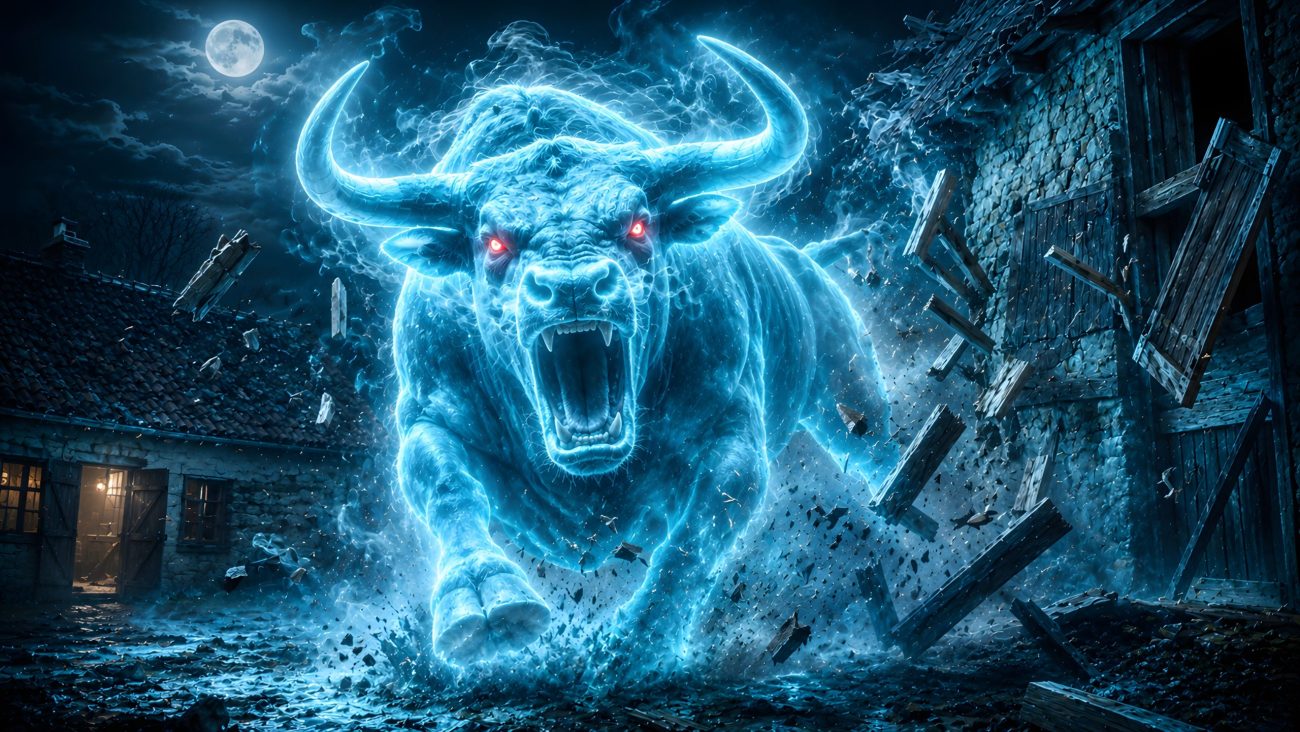
After his death, however, his ghost refused to rest. It began appearing in the buildings at Bagbury Farm in the shape of a bull, where it would roar so violently that boards, shutters, and roof tiles were thrown from the buildings. The haunting became so severe that nobody could live nearby.

The bull originally appeared around nine or ten at night, but eventually became so troublesome that it began arriving as early as seven or eight. Twelve parsons were summoned to lay the ghost. They managed to drive it, still in the form of a bull, toward Hyssington Church, but they struggled to contain it.

One of the twelve priests was an old blind parson who knew the ghost and anticipated its violent charge. He carried his candle inside his top boot. When the bull suddenly rushed at the priests, all their candles were extinguished except his. He then told the others to relight their candles from his.

Inside the church, the bull made such a tremendous burst that it cracked the church wall from top to bottom. According to the storyteller, the crack remained visible for years and was deliberately left unrepaired so that people could see where the supernatural bull had broken the church.

Eventually, the priests succeeded in forcing the bull into a snuff-box. The spirit then requested that it be buried beneath Bagbury Bridge, threatening that every mare passing over the bridge would lose her foal and every woman would lose her child. The priests refused this request and instead cast the bull into the Red Sea for a thousand years.

Even long afterward, people remained frightened of Bagbury Bridge. The storyteller recalled that the old clerk of Hyssington had personally remembered the blind parson. Decades after the bull had supposedly been confined in the Red Sea, people still crossed the bridge cautiously. One man recalled crossing it with horses and deliberately getting down from his horse, walking softly and making as little noise as possible, because he feared that the bull might hear him and emerge from beneath the bridge.


Sources

“Efft60.” Sacred Texts. Accessed August 29, 2026. https://sacred-texts.com/neu/eng/efft/efft60.htm

Gabriel Hounds

Tradition / Region: English Mythology
Alternate Names: Gabriel Ratchets, Gabble Retchets, Sky Yelpers
Category: Dog, Ghost, Death omen


The Myth

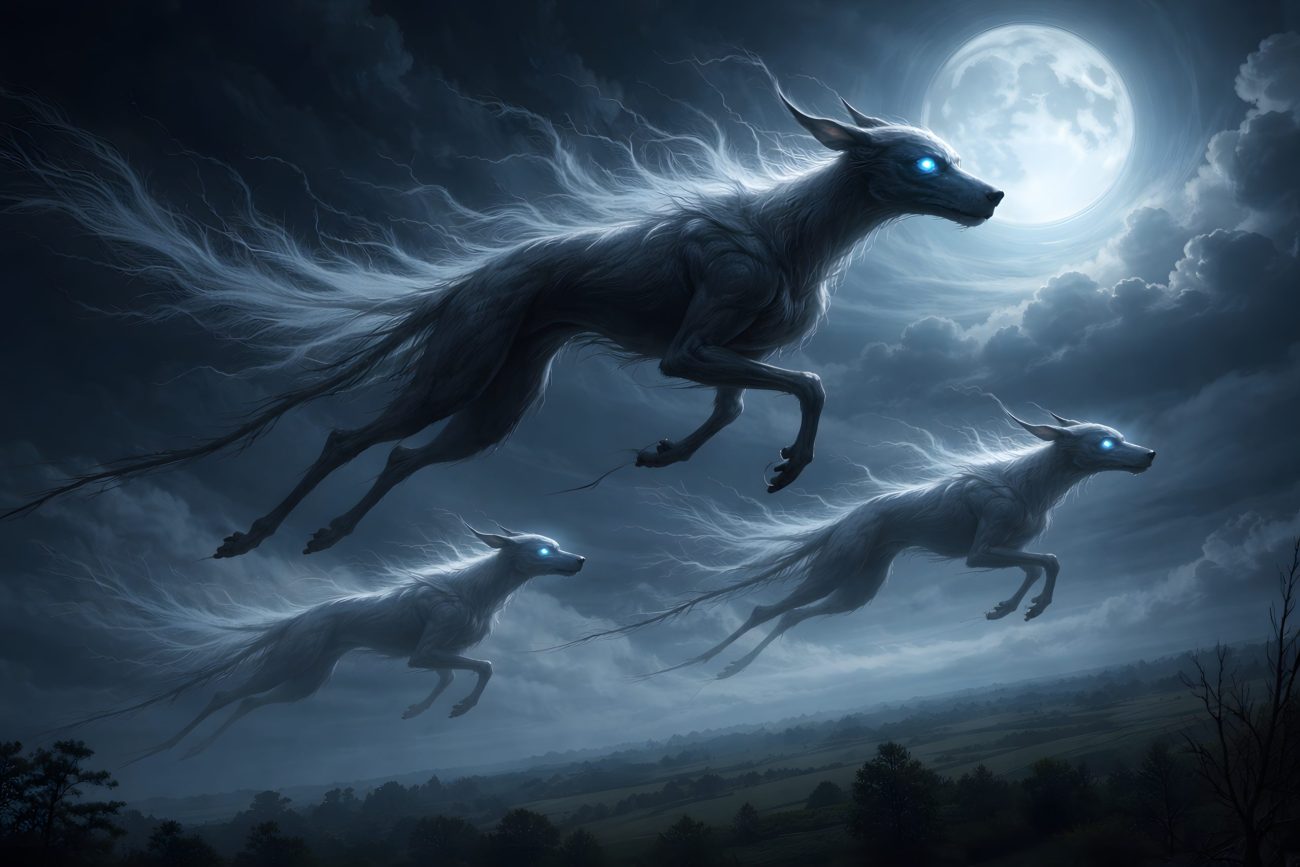
The Gabriel Hounds are said to be ghostly dogs that travel across the night sky.

They are rarely seen, but their cries are often heard — high, distant, and mournful, echoing above the land in darkness. Some describe them as dogs with human heads, flying through the air like a spectral hunt. When they pass over a house, it is said to foretell death or misfortune for those who live there.

In some traditions, the hounds are believed to be the restless souls of unbaptised children, wandering between worlds and crying through the night. In others, they belong to a supernatural hunt led by a figure named Gabriel, who is doomed to roam the skies with his dogs as punishment for having hunted on a holy day.

Their voices were sometimes explained by the sound of geese flying overhead at night, whose honking could resemble distant barking. Yet for many, the cries were not natural at all, but a warning from the unseen world.

Thus the Gabriel Hounds were remembered as sky-roaming ghost dogs — heard more often than seen, and feared wherever their eerie yelping was taken as a sign that death was near.


Sources

Wikipedia contributors. (n.d.). Black dog (folklore). In Wikipedia, from https://en.wikipedia.org/wiki/Black_dog_(folklore)


Dando’s Dogs

Tradition / Region: English Mythology
Alternate Names: Devil’s Dandy Dogs
Category: Dog, Ghost


The Myth

In English tradition there is a tale of Dando, a priest who loved hunting more than he loved the duties of his church.

One Sunday, after spending the day hunting instead of attending to sacred matters, he sat with his companions drinking. They gave him ale and wine, but he demanded more and more. At last he swore that if the drink he wanted could not be found on Earth, then it must be fetched from Hell itself.

At that moment a strange huntsman appeared among them. He offered Dando a flask and gave him drink, but then seized part of the priest’s game. Dando, drunk and furious, shouted that he would follow the huntsman even to Hell to recover it.

No sooner had he spoken than the huntsman carried him away, vanishing with him in an instant. Dando’s hounds gave chase, racing after their master, but they could not catch him.

From that time on, people said that Dando was lost, taken into the otherworld by the mysterious hunter. Yet his dogs never stopped searching. On certain mornings, especially early on Sundays, their howling is said to be heard in the distance, still hunting or still seeking their vanished master.

Thus Dando’s Dogs were remembered as ghostly hounds of the Wild Hunt — forever running across the unseen fields, chasing what they can never reach and echoing through the air as a warning against sin and excess.


Sources

Wikipedia contributors. (n.d.). Dando’s dogs. In Wikipedia, from https://en.wikipedia.org/wiki/Dando%27s_dogs


Black Dog of Newgate

Tradition / Region: English Mythology
Alternate Names: —
Category: Dog, Ghost


The Myth

At the old Newgate Prison in London, there was once said to haunt a terrible creature known as the Black Dog of Newgate.

The story tells that during a time of famine, when hunger and misery gripped the land, a scholar was imprisoned there. He had a reputation as a sorcerer, a man said to have practiced dark arts. The prison conditions were so dreadful that the inmates, driven mad with starvation, killed and ate him.

Not long after this deed, something began to move through the prison in the night.

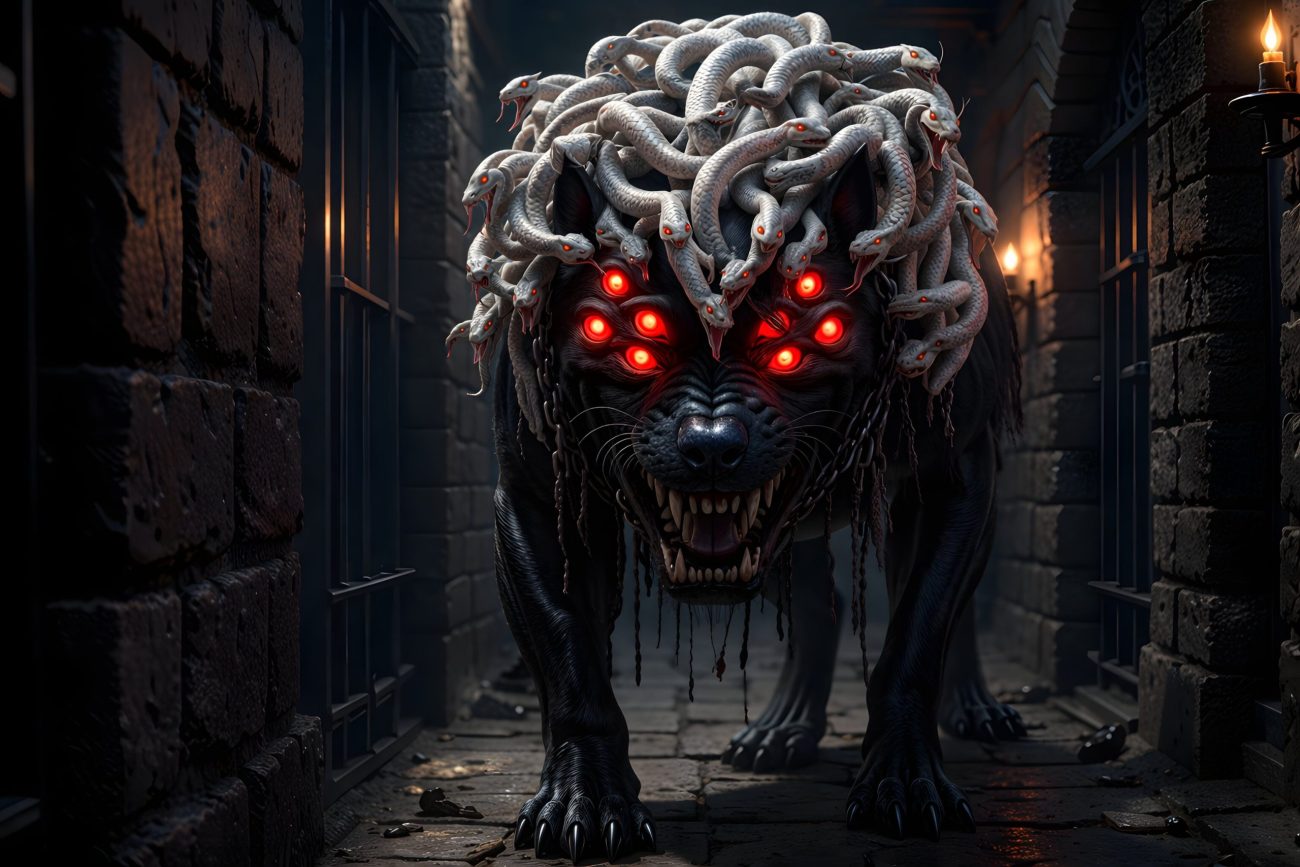
Prisoners reported seeing a monstrous black dog pacing the corridors and the cells. It appeared suddenly and vanished just as quickly, but its presence filled the place with dread. Those who had taken part in the killing believed the creature was the spirit of the murdered man, returned in a new form to avenge himself.

One by one, the prisoners who had been involved were said to die horribly, as though hunted down by the spectral beast. Fear spread through the prison until the survivors, half-mad with terror, broke out and fled.

But the story says the black dog did not stop there. It followed the escapees wherever they tried to hide, pursuing them until each had paid for the crime.

The tale was later told as a warning about cruelty, sin, and the brutal life within the prison walls. Some even doubted whether the beast was real at all, claiming the only “black dog” in the prison was a dark stone in the dungeon where condemned prisoners sometimes dashed out their brains in despair.

Yet the legend endured, and the image remained of a great black hound stalking the halls of Newgate — a spirit born from murder, hunger, and guilt, returning to claim the lives of those who had done wrong.


Sources

Wikipedia contributors. (n.d.). The Black Dog of Newgate. In Wikipedia, from https://en.wikipedia.org/wiki/The_Black_Dog_of_Newgate