On the Moselle River, at a place called ob em Meilesteen a short distance upstream from Mertert, fishermen who worked at night often heard a strange sound. It resembled the splashing of countless carp striking the water with their tails, and the noise drifted downstream toward Mertert and beyond. Near Wasserbillig it suddenly ceased, and people said it stopped where the old Moselstadt once stood, for it was believed that a great town of that name had existed there long ago.
The fishermen said the splashing was caused by the Moselgeist, the spirit of the Moselle.
Others told that at the same place, in the darkness of night, they had seen an unknown boatman crossing the river. He rowed silently across the water, and just as suddenly as he had appeared, he vanished into the river and was gone.
Tradition / Region:Luxembourg Mythology Alternate Names: River Stone Man, Sempchen Steipmännchen Category: River dweller
The Myth
One evening, as a man was traveling from Ahn to Wormeldange, he saw in the Sempchen river a small, bony old man struggling to force a boat against the current. Moved by pity, the traveler went down to the bank and called out to him, offering to help and asking the old man to throw him a rope so he could pull the boat toward Wormeldange.
But the little figure had only pretended to struggle in order to lure him. Instead of tossing a rope, the Steipmännchen suddenly struck the man with a violent blow from his oar. The traveler fell to the ground, stunned, while the deceitful river spirit had accomplished his trick.
Tradition / Region:Luxembourg Mythology Alternate Names: Little Rock Man, Stone Man of the Moselle Category: River dweller
The Myth
In earlier times, a malicious spirit known as the Steipmännchen lived near Ehnen along the Moselle. He delighted in teasing the boatmen who traveled the river and in playing tricks on them.
On stormy nights he was said to sail a half-boat near the Ehnen weir, splashing loudly with oar and pole while crying out again and again, “Help, help, or I will perish!” If a compassionate boatman rowed toward the dangerous place to rescue him, he found no one in need. Instead, the Steipmännchen laughed and clapped from the rocky bank. Should the boatman grow angry and curse him, the spirit might capsize the boat, leaving the man to struggle in the cold water.
At other times the little being would call from the ferry on the opposite shore, begging to be taken across. When a boatman came to fetch the supposed traveler, he was met only by mocking laughter. As soon as he returned home, the drawn-out cry of “Carry me over!” would sound again from the nearby Braas forest.
People also told that at the witching hour a boat was often heard on the Moselle traveling up from Wormeldingen as far as the statue of Saint Nicholas. There it could go no farther and would suddenly turn back downstream, only to return again and again until the hour had passed. No one ever saw the Steipmännchen himself, but many claimed to have heard his ghostly passage upon the river.
Tradition / Region:Luxembourg Mythology Alternate Names: The Well Spirit of Gondelingen, The White Woman of the Sulphur Spring Category: Ghost
The Myth
In the forest between Dalheim and Waldbredimus lies an old spring known as the Sulphur Spring. Long ago, near this place stood the castle of Gondelingen, now almost entirely vanished. People have long believed that a restless spirit dwells at the spring and in the surrounding hills.
Once, several women gathering herbs near the spring saw their collected plants suddenly scattered by an unseen force, as if by an invisible hand. It was said that an underground tunnel once led from the spring to the castle, and that within the castle there was a chamber called the Green Chamber, feared by its inhabitants because the spirit sometimes haunted it at night.
Some described the spirit as a gaunt, slender woman who wandered between the spring, the ruins, and the nearby mountain called the Hurenstein. At midnight she was said to fight with a knight beneath a great beech tree and then, defeated, hurry back toward the castle, disappearing into the tunnel that led to the spring. Woe to anyone she met on the path.
One man from Dalheim told how, while out at night gathering pears, he saw a white female figure walking ahead of him. Though she seemed to move slowly, he could not catch her. He later heard the clock strike midnight, and the figure let out a piercing scream. When he returned to search for her with prayers and holy water, he experienced terrifying noises, crashing blows, and flashes of fire. When he regained his senses, he found himself near the Sulphur Spring, where he saw the white woman glide swiftly through the air and vanish into the spring with cries of lament.
Another man encountered the spirit during a storm near the old ponds fed by the spring. He followed a moving light, sank into swampy water, and saw the spirit rise in a burst of brightness, hovering above the banks and circling the air while wailing. A violent wind arose, and as he fled, he saw the apparition disappear toward the Hurenstein.
Since then, people say the spirit of the Sulphur Spring still wanders between the ruins, the hills, and the water, lamenting without rest.
Tradition / Region:Luxembourg Mythology Alternate Names: Birch Maiden, Birkenjungfer, Birch Damselfly, White Horse of the Birk Category: Swamp dweller, Ghost, Forest dweller
The Myth
In the birch forests and moors near Mutfort, Ötringen, and the Birk, there was said to wander a mysterious female spirit known as the Birch Maiden.
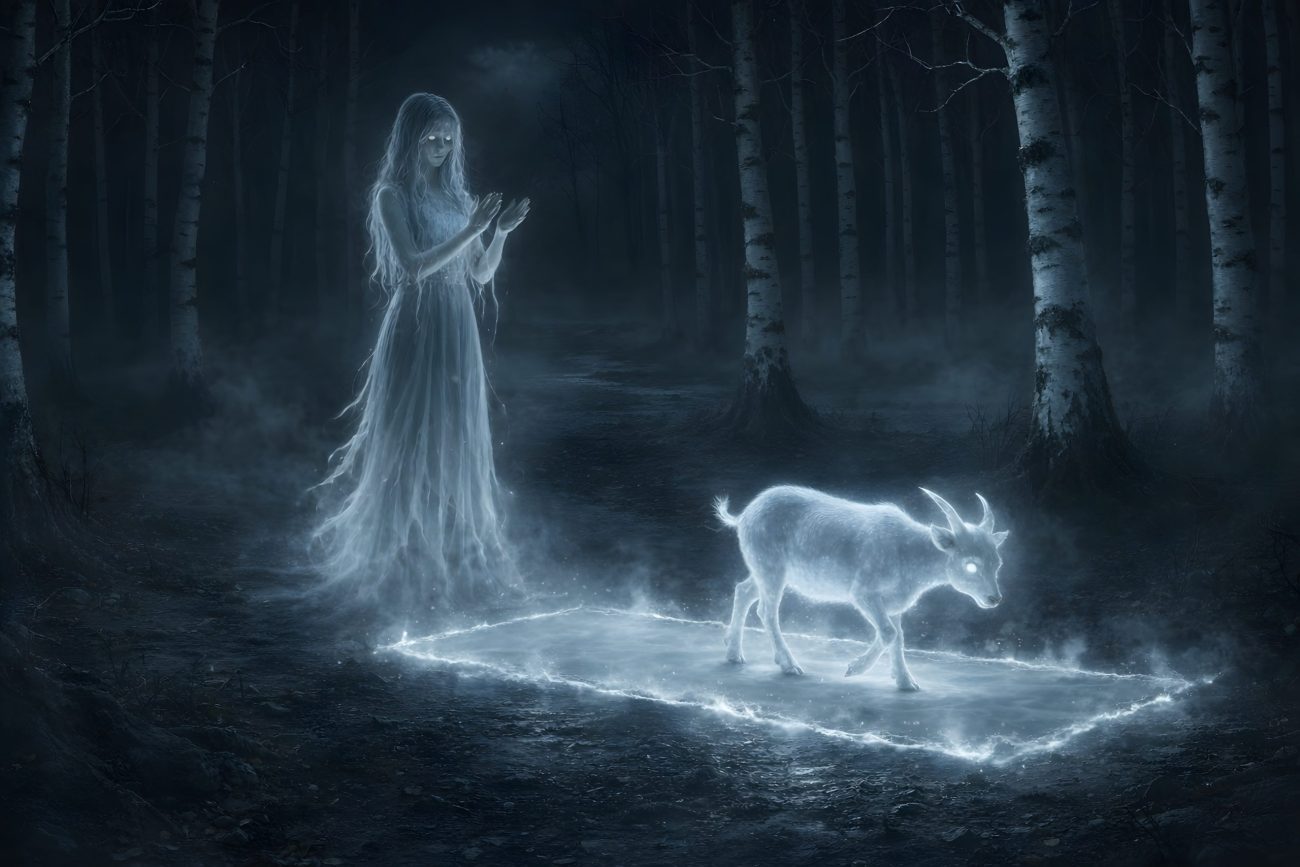
She often appeared as a young woman dressed in dazzling white. At times she spread a white carpet before travelers, upon which a small goat would suddenly appear. Others saw her walking silently along lonely paths, wearing a white skirt, sometimes with a red apron, or carrying a white switch. She would not answer greetings and vanished as suddenly as she appeared.
At the Birkengraben, many claimed to see her at dusk: a white figure who would utter a shrill cry, rise into the air, and disappear toward the birch moor while a terrible roaring swept through the forest. Some saw her carrying two burning candles, accompanying travelers through the night with a rushing noise in the air until she vanished near the village.
The tale says she had once been the daughter of a wealthy count whose castle stood near Ötringen. She wished to remain unmarried, but her father forced her toward a marriage she refused. On the morning of her wedding she fled into the nearby forest. Pursued by her father’s servants, she ran across the birch moor and vanished into its depths with a cry. Since then she has wandered the place as a restless spirit.
On certain nights before midnight, she is seen lamenting at the edge of the moor, clothed in white and carrying lights. If anyone dares to approach, she disappears with a scream. Should a person follow her to the edge of the bog, she may seize him and drag him down into the depths.
The Birch Maiden is also said to roam the area in another form. In the meadow called Lohkaul, a riderless white horse appears at night, bearing a shining saddle. It bursts from the forest, gallops to the banks of the Syr, and grazes there quietly. When a weary traveler passes, the horse comes tamely and seems to invite him to mount. But anyone who accepts is carried with great speed to the birch moor or to the Pleitringer pond and thrown into the water.
Thus the spirit of the Birch Maiden wanders the forest, the moor, and the meadows, appearing sometimes as a grieving woman in white and sometimes as the ghostly white horse that lures the unwary to destruction.
Near Ettelbrück there is said to appear at night a strange water-being known as the Baachjöfferchen. It emerges from the mill pond called Millewo, dressed in white.
From there it wanders along the stream beside Feulener Straße, babbling softly as it moves. After following the water for a time, it turns to the right across a gentle slope and makes a wide arc through the land.
At last it returns to the very place where it first appeared and slips back into the water, its murmuring voice fading as it disappears beneath the surface.
Tradition / Region:Luxembourg Mythology Alternate Names: Wild Woman of the Hedge Category: Forest dweller
The Myth
Between Böwingen and Useldingen there once lay a place known as the Wild Woman’s Hedge, where the road now runs.
People said that a wild woman lived there. Parents warned their children not to linger in that place, telling them it was not a good spot, for the wild woman dwelt there.
Thus the hedge was remembered as the haunt of a hidden female spirit who lingered in the landscape.
In the Beringer Forest stands a high rock known as Wölfraleh, the Rock of the Wild Woman. It is hollowed out into a roughly square chamber with one side open, and a narrow stairway leads up from below.
According to the old stories, a wild woman once lived there, alone in the stone chamber. Others say that it was not a spirit but a lonely, childless couple who once made their dwelling in the rock, cut off from the rest of the world.
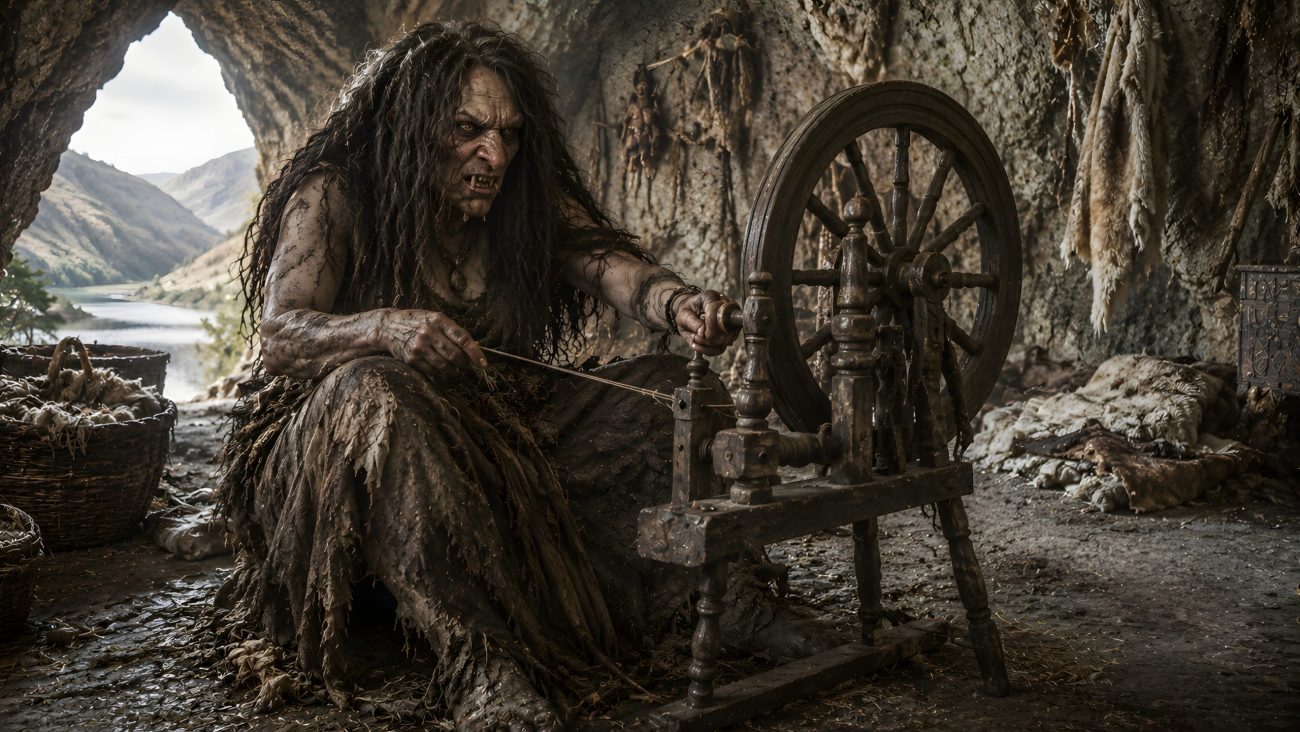
A similar tale is told of another hollow rock near Mersch, where a woman once lived entirely by herself. She did nothing but spin and lived in such isolation that people called her Wölfra, the solitary one.
Thus the rocks of the region were remembered as the homes of a lone woman who lived apart from all others, spinning in her stone dwelling.
Sources
sagen.at contributors. (n.d.). Die Wölfraleh bei Beringen. In sagen.at, from https://www.sagen.at/texte/sagen/luxemburg/woelfraleh.html
Before the ironworks of La Sauvage were built in the early seventeenth century, the valley was uninhabited and known as the Valley of the Wild Woman. The name came from a fearsome being said to live in a cave in the rock of La Cronnière.
She was said to feed on raw meat. Thick hair covered her entire body and hung down to her feet, serving as her only clothing. Her eyes, red-rimmed and buried deep beneath her hair, glowed like coals. From her wide mouth protruded double rows of teeth, and her voice sounded like the hooting of an owl. Her fingers ended in sharp claws with which she tore apart the game she hunted or the sheep she seized from the fields.
When the wild woman died, the tale says she was refused entry to Hell because she was mistaken for the female of a wild animal. Forced back to the earth, she returned as a dreadful ghost and wandered the valley by night, spreading terror throughout the surrounding region.
At last a pious hermit from the Selomon Forest drove her spirit away across the sea. He did so by invoking Saint Donatus and Our Lady of Luxembourg, and in remembrance of this deliverance, their holy images were placed upon the rock of La Cronnière.
Sources
sagen.at contributors. (n.d.). Die wilde Frau zu La Sauvage. In sagen.at, from https://www.sagen.at/texte/sagen/luxemburg/Wilde_Frau_La_Sauvage.html
In the valley of the Wôbâch, a small stream that flows into the Eisch between Simmern and Heckenhof, there once lived a wild woman in a cave. Because of her, the place came to be called Wölfragrond.
She was said to be completely covered in hair from head to foot. By day she hid in her cave, but as soon as night fell she came out and walked along the banks of the Eisch. There she attacked and strangled whatever she could seize, whether human or animal. Because of this, no one dared to pass through the place at night.
At last a knight from Simmer Castle set out to rid the region of the creature. Whether he ambushed her or met her by chance, he took the silver cross from his rosary, hammered it into a ball, and loaded it into his rifle. With this bullet he shot and killed the wild woman, and the valley was freed from her terror.
Sources
sagen.at contributors. (n.d.). Die wilde Frau in der Wôbâch. In sagen.at, from https://www.sagen.at/texte/sagen/luxemburg/Wilde_Frau_Wobach.html