Chagrin

Tradition: Romani Mythology, Russian Mythology
Alternative Names: Hāgrin, Chagrin Hedgehog
Category: Forest Dweller


The Myth

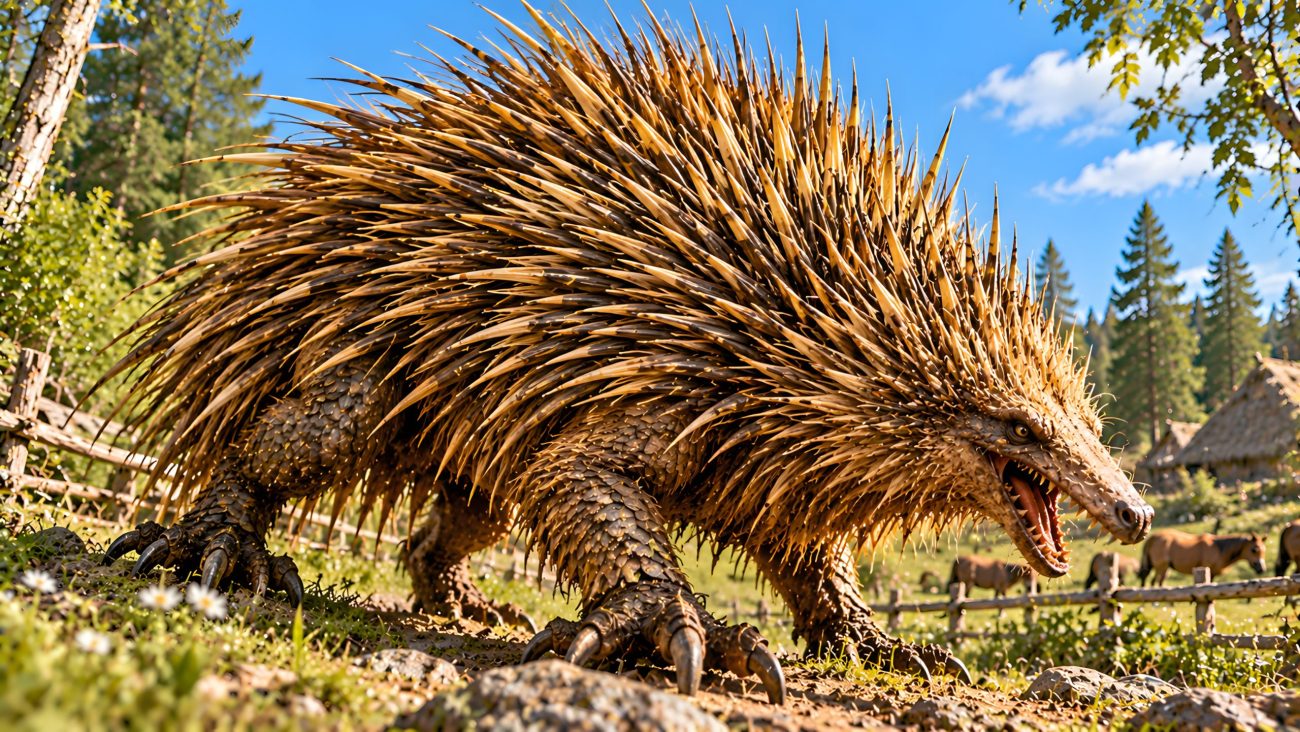
The Chagrin is a monstrous hedgehog or porcupine from Romani mythology, renowned for its extraordinary size, magical powers, and association with livestock diseases. It can grow to an enormous length, with a body covered in thick, sharp spines that shimmer like gold. Its long, pointed quills are said to resemble the thorns of a dragon, while its paws look like those of a dragon and are covered with scales. Some accounts describe the Chagrin as having a long, narrow snout and a fearsome appearance that makes it unlike any ordinary hedgehog.

The Chagrin is considered dangerous to livestock, particularly cattle and horses. It urinates on animals and the ground, causing red abscesses and painful ulcers to appear on the hides of affected animals. Its urine is believed to make horses lose their strength and develop sores. To protect their animals, Romani people use magical rituals and protective charms. They may collect the Chagrin’s burnt feathers or quills and scatter the ashes around livestock, believing this will repel the creature and prevent disease. Iron objects, such as nails or knives, may also be placed among the ashes to strengthen the protection.

The Chagrin can be driven away through spoken spells and ritual actions. One method involves burning its feathers and scattering the ashes over the ground, while another uses a rope smeared with garlic juice to create a protective circle. The rope is accompanied by a spell commanding the Chagrin to jump into a stream and drown. These rituals reflect the creature’s supernatural nature and the fear it inspires among those who depend on livestock for their livelihood. Its claws are also believed to possess magical properties, and rubbing the ashes of its middle claw onto a dead person’s body is said to increase sexual potency.


Sources

“Chagrin.” New Bestiary (Bestiary.us). Accessed October 12, 2026. https://www.bestiary.us/chagrin

Veshitko

Tradition: Romani Mythology, Russian Mythology
Alternative Names: Vošako manuš, Vošesko manuš, Vošetko, Vošetko
Category: Forest dweller


The Myth

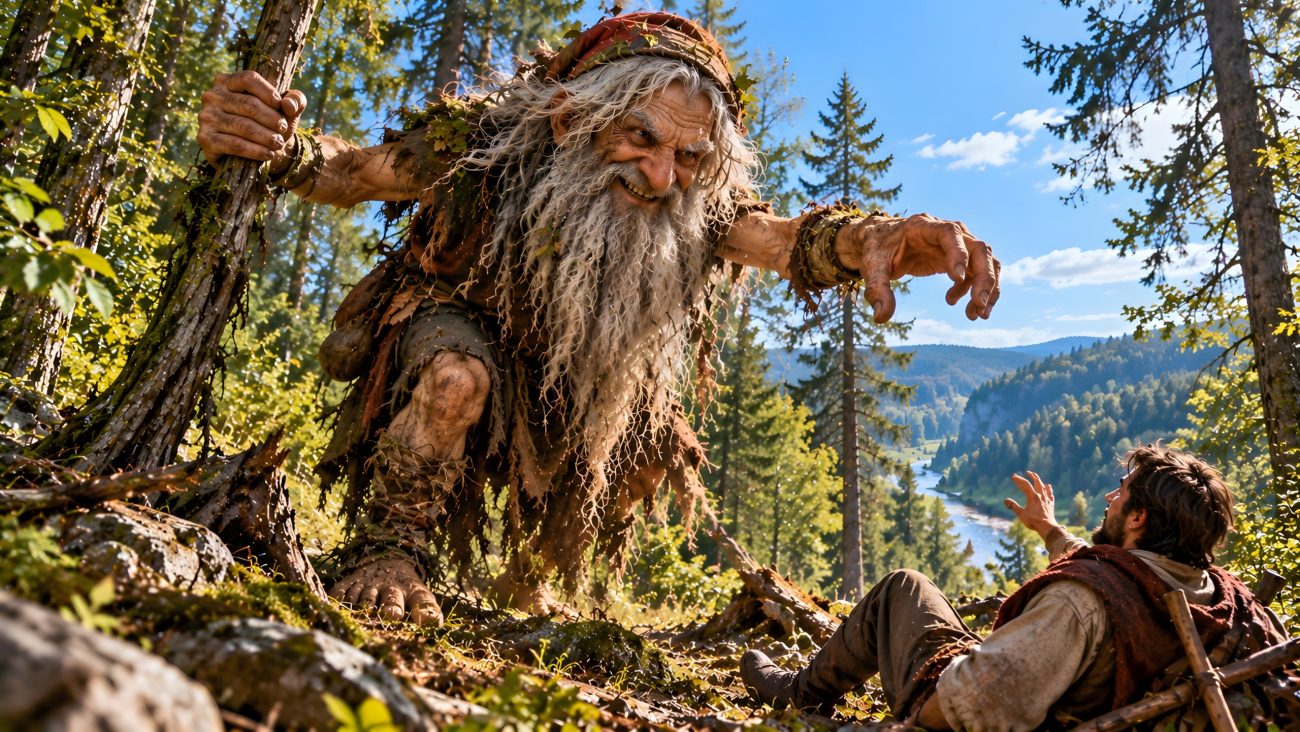
Veshitko is a forest spirit who appears as a short, grey-haired old man with a long beard and extraordinary strength. He wears simple clothing and has a playful, mischievous nature. Despite his small stature, he can grow until he towers above the tallest trees. He is closely associated with the forest, where he wanders among the trees and encounters travellers, woodcutters, and people who enter his domain.

The Veshitko is known for his fondness for teasing people, provoking arguments, and challenging others to tests of strength. He may appear beside a road or in the woods, growing taller and taller until his head rises above the treetops. He enjoys frightening those who mock him or attempt to challenge his power. Although he can be playful, his strength makes him dangerous, and those who disrespect him may find themselves helpless before him.

The forest spirit can also interfere with travellers by leading them into thickets, where he may torment or even kill them. Among the Romani, stories of Veshitko serve as warnings about the dangers of the forest and the consequences of treating its inhabitants with contempt. He is also known as the wood goblin, and some traditions associate him with horse thieves, Gypsy women, and the fate of travellers who disappear in the woods. In other tales, he is a protector of the forest, punishing those who steal horses or mistreat its inhabitants.


Sources

“Pfifar.” SAGEN.at – Traditionelle Sagen aus Österreich (Vorarlberg, Dornbirn). Reproduced by SAGEN.at. https://www.sagen.at/texte/sagen/oesterreich/vorarlberg/dornbirn/pfifar.htm


Poreskoro

Tradition / Region: Romani Mythology, Czech Mythology
Alternate Names: “The Tailed,” “The Caudate”
Category: Dog


The Myth

Poreskoro is the ninth and final child of Ana, the dread mother of disease in Romani tradition. Ana herself was born from the violent and unhappy union of the Queen of the Keshalyi and the King of the Loçolico, and her offspring were feared as embodiments of sickness and corruption.

After earlier attempts to prevent further monstrous births failed, the Keshalyi tried one last desperate measure. They fed their queen a potion made from cat hair, powdered snake, and hair taken from the hound of hell. From this dark mixture came Poreskoro.

The creature was unlike any of the others. It appeared as a strange birdlike being with four dog heads, four cat heads, and a snake’s tail ending in a forked tongue. It was both male and female, able to produce offspring without a mate.

Those offspring were not living creatures in the ordinary sense. They were the great diseases of the world — plague, cholera, smallpox, and countless other sicknesses that spread across humanity. Poreskoro dwells deep underground with these children, and when it rises to the surface its appearance is taken as a sign that pestilence and destruction will soon follow.

Even the King of the Loçolico was horrified when he saw this child. Realizing the union had brought only ruin, he and Ana separated. Ana withdrew to a remote mountain castle, kept alive by the Keshalyi, who visit her daily and give her drops of blood to sustain her. Sometimes she appears as a golden toad, but more often she is only heard whispering a single command — a word meaning “bring” or “pass.” Those who hear it must obey, tossing some small creature away, or risk being crushed by her unseen power.

Meanwhile, her children remain beneath the earth, and through Poreskoro the world’s diseases continue without end.


Gallery


Sources

A Book of Creatures. (2017, March 31). Poreskoro. From https://abookofcreatures.com/2017/03/31/poreskoro/


Interpretive Lenses

Religious Readings
  • Christian Ascetic Deep Dive
Philosophical Readings
  • Nietzschean Deep Dive
Psychological Readings
  • Jungian Deep Dive
Esoteric Deep Dive
  • Hermetic Deep Dive
Political / Social Readings
  • Marxist Deep Dive