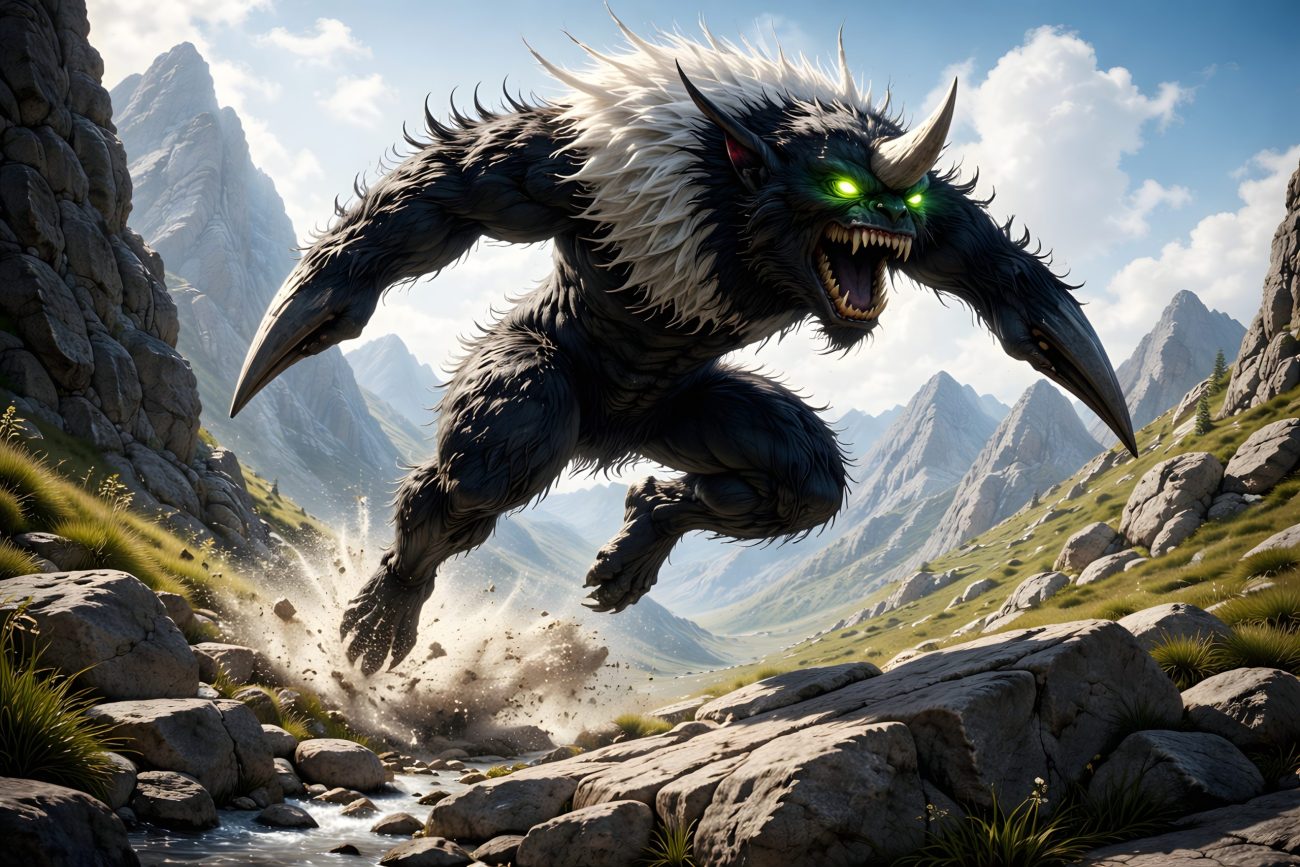
Adasbub

Tradition / Region: Austrian Mythology
Alternate Names:
Category: Mountain dweller, Giant


The Myth

About sixty years ago, in the valley of the Ötz near Lengenfeld, there lived a man of enormous height and terrifying strength known as the Adasbub. He was a monster in spirit as much as in body—a thief, a drunkard, a fighter, and a blasphemer. He had served as a soldier in many wars and returned more savage than when he had left. From foreign lands he brought home great sums of money, stolen and extorted, and with this wealth he bought himself a farm.

Yet he lived not like a Christian farmer, but like a pagan. He never went to church. Instead, he sat in the village inn boasting of his velvet jacket adorned with buttons hammered from old silver coins. The young men of the village, dazzled by his swagger and riches, grew ashamed of their simple clothing and sought to imitate him.

The Adasbub’s strength was legendary. It was said he had once defeated fifty men who attacked him at the same time. Those who offended him feared more than his fists. People whispered that he could divert mountain torrents onto a rival’s fields or send huge snowballs—packed with hidden stones—crashing down upon a roof. Whether by cunning or brute force, he was a man to be feared.

His pleasure lay in drink, oaths, and cruelty. He gathered around him a band of like-minded ruffians. Together they committed outrageous acts. They tore doors from their neighbors’ houses and dragged them into the forests. They lifted carts onto rooftops. They broke into sacristies to steal and drink the priests’ wine. They shut goats into roadside chapels and uprooted cemetery crosses, thrusting them upside down into graves, laughing that they had made Christendom stand upon its head.

At last, the Adasbub planned a new villainy involving the daughter of a farmer whose home stood on the Burgstein above Lengenfeld. But word of the plot reached the farmer. Rather than flee, he sharpened his axe and waited.

When the Adasbub entered the house, the farmer struck with all his strength. The axe split the giant’s skull, and the terror of the valley fell dead at his feet. Seeing their leader slain, his companions fled in panic.

The alarm spread quickly. People climbed up to the Burgstein from every direction and thanked the farmer for freeing them from their tormentor. They cut off the Adasbub’s head and dragged his body to the edge of a precipice, casting it down onto the road below near the sulphur baths of Rumunschlung.

The head was thrown into the charnel-house of the cemetery at Lengenfeld. There it is said to remain.

The skull, nearly cleft in two, does not always lie quiet. On certain midnights it is said to glow red-hot, terrible to behold. Some claim that when it burns, it rolls from the charnel-house into the chapel, whirling in circles before leaping back to its place. By morning it has cooled, appearing once more like any other skull.

Thus the Adasbub endures—not as a man, but as a warning.


Gallery


Sources

Günther, A. von. (1874). Tales and legends of the Tyrol. London: Chapman and Hall.


Interpretive Lenses

Religious Readings
  • Christian Ascetic Deep Dive
Philosophical Readings
  • Nietzschean Deep Dive
Psychological Readings
  • Jungian Deep Dive
Esoteric Deep Dive
  • Hermetic Deep Dive
Political / Social Readings
  • Marxist Deep Dive
Other
  • How to Invite The Adasbub

Barmanou

Tradition / Region: Pakistani Mythology
Alternate Names: Barmanu; Baddmanus
Category: Mountain dweller


The Myth

High in the mountains between the Pamirs and the Himalayas, in the lonely valleys of Chitral and the Karakoram, shepherds tell of a being called the Barmanou. It walks upright like a man, yet it is covered in hair like a beast. It moves silently among cliffs and forests where few dare to wander.

The Barmanou is said to dwell far from villages, appearing mostly at dusk or in the deep hours of night. Those who claim to have seen it describe a large, powerful figure with both human and apelike features. Some say it wears animal skins draped across its shoulders and head, as though imitating mankind. Others insist it is entirely wild, a creature of the mountains with no need for tools or clothing.

It is known in local lore as a dangerous being. Stories tell that it sometimes descends from the heights to approach isolated camps or grazing grounds. It has a fearsome reputation for abducting women and attempting to carry them back into the mountains. In some versions of the tale, it behaves like a beast; in others, it is more like a primitive man, capable of cunning and intent.

Shepherds speak of hearing strange guttural cries echoing through valleys at night—deep, throaty sounds unlike those of any known animal. These cries are said to roll across the mountainsides, warning intruders that the Barmanou is near.

In the folklore of northern Pakistan, the Barmanou stands between worlds—neither fully animal nor fully human. Some call it an ape. Others call it a wild man. But all agree that in the high, wind-swept ranges where glaciers cut the earth and the air grows thin, something ancient still roams beyond the reach of ordinary sight.


Gallery


Sources

Wikipedia contributors. (n.d.). Barmanou. In Wikipedia, The Free Encyclopedia. Retrieved February 13, 2026, from https://en.wikipedia.org/wiki/Barmanou


Interpretive Lenses

Religious Readings
  • Christian Ascetic Deep Dive
Philosophical Readings
  • Nietzschean Deep Dive
Psychological Readings
  • Jungian Deep Dive
Esoteric Deep Dive
  • Hermetic Deep Dive
Political / Social Readings
  • Marxist Deep Dive
Other
  • How to Invite The Barmanou

Skarbnik

Tradition / Region: Polish Mythology, Ukranian Mythology, Belarusian Mythology
Alternate Names: Kladenets; Dzedka
Category: Cave dweller


The Myth

Deep beneath the earth, in the winding tunnels of mines and forgotten shafts, dwells the Skarbnik—the Treasurer of the underworld. He is the unseen guardian of gems, crystals, and precious metals, watching over the hidden wealth buried in stone.

Miners speak of him in hushed voices. To those who work honestly and show respect, Skarbnik is a silent protector. When tunnels groan and timbers strain, he may guide a worthy miner away from danger. When a man loses his path in the dark labyrinth underground, a whisper, a faint glow, or the echo of a step may lead him safely back. At times, Skarbnik rewards diligence by revealing a rich vein of ore, leading the faithful straight to silver, coal, or gold.

But Skarbnik is not gentle with the wicked.

Those who curse in the tunnels, mock the spirit, or treat the mine with arrogance soon feel his wrath. It is forbidden to whistle underground, to hurl stones in anger, or to cover one’s head in disrespect. Such acts insult the Treasurer. First comes a warning—a sudden shower of loose soil striking the offender, small clods thrown from unseen hands. If the warning is ignored, harsher punishment follows. Tunnels collapse without mercy. Dark chasms open beneath careless feet. Stones fall from above with deadly aim.

To the greedy and cruel, Skarbnik is a relentless judge. To the humble and respectful, he is a guardian and guide.

Thus the miners say that no one truly works alone beneath the earth. The Treasurer watches always, weighing the hearts of men as carefully as the ore they seek.


Gallery


Sources

Wikipedia contributors. (n.d.). Karzełek. In Wikipedia, The Free Encyclopedia. Retrieved February 13, 2026, from https://en.wikipedia.org/wiki/Karze%C5%82ek


Interpretive Lenses

Religious Readings
  • Christian Ascetic Deep Dive
Philosophical Readings
  • Nietzschean Deep Dive
Psychological Readings
  • Jungian Deep Dive
Esoteric Deep Dive
  • Hermetic Deep Dive
Political / Social Readings
  • Marxist Deep Dive
Other
  • How to Invite The Skarbnik

Patupaiarehe

Tradition / Region: Māori mythology (Aotearoa / New Zealand)
Alternate Names: Pakehakeha; Tūrehu (in some traditions)
Category: Forest dweller, Mountain dweller


The Myth

In the deep forests and mist-covered mountains of Aotearoa dwell the patupaiarehe, a hidden people of pale skin and fair or reddish hair. They are of human stature, yet unlike humans they bear no moko upon their skin. They live in great communities in the hills and ranges, in places wrapped in fog and shadow. Their houses and villages cannot be seen by human eyes.

The patupaiarehe are creatures of the mist. They draw it about themselves like a cloak, and they walk most freely in darkness or on foggy days. The full light of the sun is deadly to them, and so they retreat before dawn. They eat raw food and shun steam and fire; when ovens are opened and clouds of steam rise, they hide themselves away.

At times their presence is revealed by music drifting through the forest—the sweet notes of kōauau and pūtōrino flutes, and their haunting waiata carried on the mist. Their music is said to be more beautiful than any played by mortals. Though they can be hostile to those who trespass upon their sacred mountains, it is also told that they may speak with humans, and sometimes even fall in love with them.

On Mount Moehau and in the Coromandel ranges they once dwelled in strength. Some say they were there before the ancestors of the Māori arrived, and that they were driven from their most sacred peaks. In anger they punished those who offended them. Hunters who stole from their lands found their game turned to skin and bone. Men who intruded upon their treasures were dragged away into the night.

Yet there are gentler tales. Kahukura once came upon them at night as they hauled in their fishing nets. He joined them in their labor, and though they fled at dawn when they discovered he was mortal, he had learned their methods and brought that knowledge back to his people.

There is also the story of Hinerehia, a patupaiarehe woman of Moehau, who fell in love with a mortal man while gathering shellfish in the mist. She lived with him and bore children, weaving beautiful garments—but only at night. When the villagers tricked her into weaving past dawn so they could learn her craft, the first light revealed their deception. Heartbroken, she rose within a cloud and returned to the mountains, leaving her husband and children behind.

In the mountains of Ngongotahā they were said to number in the thousands, their skin pale or ruddy, their hair glinting red or gold. They fetched water in gourds from sacred burial cliffs, avoiding the steam of cooking fires. Some among them desired human husbands or wives, yet unions between the two worlds rarely endured.

In the south, on the misty peaks of Tākitimu, a hunter once encountered Kaiheraki, a woman of the mountain. She shone with coppery hair and fair skin, claiming no people but the mountain itself as her mother. The hunter, knowing her nature, tried to bind her to the human world through fire. But when flame touched her skin and blood flowed, she fled back into the high places, vanishing forever among the ridges and cloud.

Thus the patupaiarehe remain—guardians of misty summits and shadowed forests, beautiful and perilous, glimpsed only in song, in fog, or in the edge of human memory.


Gallery


Sources

Wikipedia contributors. (n.d.). Patupaiarehe. In Wikipedia, The Free Encyclopedia. Retrieved February 13, 2026, from https://en.wikipedia.org/wiki/Patupaiarehe


Interpretive Lenses

Religious Readings
  • Christian Ascetic Deep Dive
Philosophical Readings
  • Nietzschean Deep Dive
Psychological Readings
  • Jungian Deep Dive
Esoteric Deep Dive
  • Hermetic Deep Dive
Political / Social Readings
  • Marxist Deep Dive
Other
  • How to Invite The Patupaiarehe

Puigmal

Tradition / Region: Catalan mythology, Spanish Mythology
Alternate Names:
Category: Giant, Mountain dweller


The Myth

In the high mountains above the valley of Ribes there once lived a giant named Puigmal.

He towered above the forests and peaks, a mighty being who watched over the trees and the wild animals. No hunter could loose an arrow without feeling his presence. No woodcutter could strike a trunk without sensing the mountain’s silent warning. Puigmal guarded nature fiercely, defending it from careless human hands.

One day, as he wandered the slopes, he milked a wild doe and made cheese from her milk. He brought this cheese to a human and offered it as a gift. “As long as you do not eat it all,” he said, “it will grow again and again. You will never hunger, and you will not need to hunt the creatures of these mountains.”

The gift was a covenant: live with restraint, and the mountain would provide endlessly.

But the balance between humans and nature is fragile. In time, the giant was turned to stone, his immense body becoming the very mountain that now bears his name—Puigmal. His stony form rises above the valley still, silent and watchful.

They say he remains there as guardian still, the mountain itself standing as his petrified body, overlooking the forests and animals he once defended.


Gallery


Sources

creatures-of-myth.fandom.com contributors. (n.d.). Puigmal. In creatures-of-myth.fandom.com, from https://creatures-of-myth.fandom.com/wiki/Puigmal


Interpretive Lenses

Religious Readings
  • Christian Ascetic Deep Dive
Philosophical Readings
  • Nietzschean Deep Dive
Psychological Readings
  • Jungian Deep Dive
Esoteric Deep Dive
  • Hermetic Deep Dive
Political / Social Readings
  • Marxist Deep Dive
Other
  • How to Invite The Puigmal

Cuegle

Tradition / Region: Cantabrian Mythology, Spanish Mythology
Alternate Names:
Category: Mountain dweller


The Myth

In the mountains and wild lands of Cantabria there is said to roam a dreadful creature known as the cuegle.

Though small in stature, it walks upright like a man. Its skin is black as soot, its beard long and tangled, its hair grey and unkempt. From its body sprout three arms—yet each ends bluntly, without hands or fingers. Upon its head sits a short, stunted horn, and in its face gleam three terrible eyes: one yellow, one red, and one blue. When it opens its mouth, five rows of teeth are revealed, layered deep within like the jaws of some monstrous trap.

Despite its size, the cuegle possesses enormous strength. It prowls at night, attacking travelers and livestock, dragging them down with ferocity. But most feared of all is its hunger for infants. The cuegle creeps silently into homes and steals babies from their cradles, vanishing into the darkness before anyone can stop it.

Families learned that the creature recoils from certain leaves. Oak and holly are hateful to it. So mothers would place fresh sprigs of oak or holly in the cradle beside their child. The sharp scent and sacred greenery drove the cuegle away, protecting the infant from its grasp.

Thus the people of Cantabria guarded their homes with leaves and vigilance, wary of the small, three-eyed horror that stalked the night.


Gallery


Sources

Wikipedia contributors. (n.d.). Zana (mythology). In Wikipedia, The Free Encyclopedia. Retrieved February 13, 2026, from https://en.wikipedia.org/wiki/Cuegle


Interpretive Lenses

Religious Readings
  • Christian Ascetic Deep Dive
Philosophical Readings
  • Nietzschean Deep Dive
Psychological Readings
  • Jungian Deep Dive
Esoteric Deep Dive
  • Hermetic Deep Dive
Political / Social Readings
  • Marxist Deep Dive
Other
  • How to Invite The Cuegle

Yama-otoroshi

Tradition / Region: Japanese mythology (Mount Tsurugi, Tateyama range)
Alternate Names: Otoroshi
Category: Mountain dweller, Yokai


The Myth

High in the rugged peaks of Mount Tsurugi in the Tateyama mountain range, there was once said to dwell a fearsome yōkai known as Yama-otoroshi.

For generations, climbers failed to conquer the mountain. The reason, people whispered, was not the sheer cliffs or treacherous winds, but the presence of this demon. Yama-otoroshi waited upon rocky outcrops, silent and unmoving like a statue. It resembled a red-skinned ogre, with two horns rising from its head. Yet unlike the usual oni, it carried no iron club.

When a climber ventured too near, the creature would suddenly spring to life. With terrifying strength it would seize the victim by the collar and hurl them down the mountain slopes, casting them into the abyss below. Many believed the mountain itself rejected intruders through the hands of this guardian.

After the Meiji period, it was said that Yama-otoroshi descended from the heights of Mount Tsurugi and took up residence at temple gates. There, it no longer needed the “Yama” in its name and was simply called Otoroshi. Instead of casting climbers from cliffs, it guarded sacred thresholds. Anyone who approached without faith—those who mocked or doubted—risked being seized by the collar and violently thrown back, barred from entry.

Illustrations show the red-faced, horned demon grasping a struggling climber and tossing him away with ease, its expression fierce and unyielding.

Thus Yama-otoroshi stood as a mountain terror and later as a stern temple sentinel—an ogre who cast down the unworthy, whether from the heights of stone or from the gates of the sacred.


Gallery


Sources

tyz-yokai.blog.jp contributors. (n.d.). Yama-Otoroshi. In tyz-yokai.blog.jp, from https://tyz-yokai.blog.jp/archives/1058924391.html


Interpretive Lenses

Religious Readings
  • Christian Ascetic Deep Dive
Philosophical Readings
  • Nietzschean Deep Dive
Psychological Readings
  • Jungian Deep Dive
Esoteric Deep Dive
  • Hermetic Deep Dive
Political / Social Readings
  • Marxist Deep Dive
Other
  • How to Invite The Yama-otoroshi

Kazou

Tradition / Region: Japanese Buddhist mythology
Alternate Names:
Category: Mountain dweller, Elephant


The Myth

In the depths of the Buddhist cosmos, beyond the human world and far below the mountains that encircle Mount Sumeru, lies the Fire Elephant Hell. There dwells the terrible beast known as Kazou.

This hell is reserved not for the ignorant, but for those who once knew the Dharma. They had entered the Buddhist path, shaved their heads, donned robes, and received the pure precepts of the Tathagata. Yet despite their vows, they succumbed to lust and desecrated sacred images. Their betrayal of faith cast them down into this inferno.

Between the vast Iron Encircling Mountains—those final barriers at the edge of the world—the Fire Elephant Hell burns without end. There stands the great fire elephant, enormous and dreadful. Smoke pours from its mouth and eyes. Flames surge from its body as though its flesh were a furnace.

When the condemned monks are brought before it, they are struck motionless by terror at its overwhelming presence. Paralyzed by fear and the heat of its blazing form, they cannot flee. Horse-headed jailers seize them and hurl them onto the elephant’s back.

With a roar like thunder, the fire elephant charges forward. Its burning hide scorches the sinners. The monks fall from its back into the flames below, where their bodies are crushed beneath its massive feet. Some are trampled into ash. Others are seized in its blazing jaws and devoured.

Yet death offers no release. Day and night, a thousand times over, they die and are reborn in that same place, only to suffer again. The elephant’s flames never dim, and its fury never tires.

Thus the Kazou stands as the terror of the Fire Elephant Hell—an embodiment of burning remorse and unending punishment for those who betrayed their sacred vows.


Gallery


Sources

tyz-yokai.blog.jp contributors. (n.d.). Kazou. In tyz-yokai.blog.jp, from https://tyz-yokai.blog.jp/archives/1010654402.html


Interpretive Lenses

Religious Readings
  • Christian Ascetic Deep Dive
Philosophical Readings
  • Nietzschean Deep Dive
Psychological Readings
  • Jungian Deep Dive
Esoteric Deep Dive
  • Hermetic Deep Dive
Political / Social Readings
  • Marxist Deep Dive
Other
  • How to Invite The Kuygorozh

Zana

Tradition / Region: Albanian mythology (Albania, Kosovo, northern highlands)
Alternate Names: Zanë, Zërë, Xanë, Zâna, Zónja, Jashtësme
Category: Mountain dweller, Mermaid


The Myth

High in the Albanian mountains, where cold springs run clear and forests cling to the slopes, dwell the Zana—wild and radiant maidens of the peaks. Each mountain is said to have its own Zana, who appears as a beautiful young woman with untamed hair and fearless eyes, often seen bathing in hidden streams or wandering among rocks and alpine flowers.

The Zana are guardians of nature—of forests, animals, springs, and the living strength that pulses through human beings. They walk accompanied by wild goats with golden horns, and the air grows tense with power wherever they pass. Though fair in form, they are fierce in spirit. Their courage is unmatched, and in Albanian speech it is said of a brave person: “He is as bold as a Zana.”

They favor warriors. In times of battle, a Zana may watch unseen from the mountainside. If she is pleased by a hero’s heart, she grants him strength beyond mortal limits. In the epic songs of the highlands, the young hero Muji was once found in the mountains by the Zana. They took pity on him and nursed him with their own milk. From that moment, Muji possessed the strength of many men, able to lift boulders and defeat giants. His power was the gift of the Zana.

Yet their favor is not lightly won, and their anger is dreadful. With a single glance, a Zana can paralyze a man, turning him stiff as stone. Those struck by such a gaze are said to be “touched by the Zana,” frozen in body and spirit.

In the northern highlands, the Zana also come by night in threes when a child is born. Like mysterious sisters of fate, they gather around the newborn and decide its destiny. One may grant fortune and health, another hardship and sorrow, and the third death itself. Their whispering shapes the path of a life before it has even begun.

Sometimes they reveal themselves to mortals. A soldier lost in the mountains may encounter a Zana at dusk. She may warn him of danger ahead—or lead him unknowingly toward it. In old tales, a captain once knelt before such a radiant being, believing her divine. She spoke to him gently, yet her words foretold tragedy, and fate unfolded as she had hinted.

The Zana are not bound by human law or morality. They belong to the mountains and to the older rhythms of the world. They can love, grieve, and rage. In epic song, when the maiden Tringa was slain, the Great Zana descended in fury, lifted her fallen companion, and called upon warriors to rise in vengeance. Her cry echoed through the valleys like a battle horn.

They are wild beauty and untamed force. Eternal maidens of the highlands, they move between tenderness and terror, between blessing and doom—spirits of the mountains who grant strength, shape destiny, and vanish like mist at dawn.


Gallery


Sources

Wikipedia contributors. (n.d.). Zana (mythology). In Wikipedia, The Free Encyclopedia. Retrieved February 13, 2026, from https://en.wikipedia.org/wiki/Zana_(mythology)


Interpretive Lenses

Religious Readings
  • Christian Ascetic Deep Dive
Philosophical Readings
  • Nietzschean Deep Dive
Psychological Readings
  • Jungian Deep Dive
Esoteric Deep Dive
  • Hermetic Deep Dive
Political / Social Readings
  • Marxist Deep Dive
Other
  • How to Invite The Kuygorozh

Shishikori

Tradition / Region: Japanese mythology
Alternate Names:
Category: Mountain dweller, Yokai


The Myth

In the village of Narabayashi in Buzen Province, a strange terror began to visit the people. Night after night, the peasants’ horses and cattle vanished without a trace. No broken fences, no blood, no tracks—only empty stalls and fear.

At first the villagers whispered of thieves. Then of wolves. But the disappearances continued, and dread settled over the village.

Only one farmer, a man named Fujisuke, had been spared—until the night his turn came.

As darkness fell, Fujisuke noticed a sharp, fishy odor drifting through the air. It grew stronger and stronger, thick and suffocating. Then, from the shadows, a monstrous shape entered his stable.

Before his eyes, the creature seized his cow and swallowed it whole.

Frozen in terror, Fujisuke could do nothing but watch. When at last he found the strength to move, he fled and ran to the village headman, breathless and pale, and told what he had seen.

At dawn, the villagers gathered for a mountain hunt. Armed with bamboo spears and driven by fear and anger, they followed the lingering stench into the hills.

Deep in the mountains, they found a cavern from which the same foul, fish-like odor poured. Inside, crouched in the darkness, was the monster.

It was enormous—six feet tall, with a mouth so vast it measured more than a meter across. Its presence filled the cave like a nightmare given flesh.

The men attacked together, thrusting their bamboo spears again and again until the beast collapsed.

When it lay dead, an old villager stepped forward, peered at the slain creature, and said quietly:

“This is the Shishikori.”

And so the name of the devourer of cattle was spoken, and the terror of Narabayashi came to an end.


Gallery


Sources

TYZ-Yokai Blog contributors. (n.d.). 獅子狩 (Shishikori). In TYZ-Yokai Blog, from https://tyz-yokai.blog.jp/archives/1010654244.html


Interpretive Lenses

Religious Readings
  • Christian Ascetic Deep Dive
Philosophical Readings
  • Nietzschean Deep Dive
Psychological Readings
  • Jungian Deep Dive
Esoteric Deep Dive
  • Hermetic Deep Dive
Political / Social Readings
  • Marxist Deep Dive
Other
  • How to Invite The Kuygorozh