Serles

Tradition: Austrian Mythology
Alternative Names: Serles, The King of the Mountains
Category: Giant


The Myth

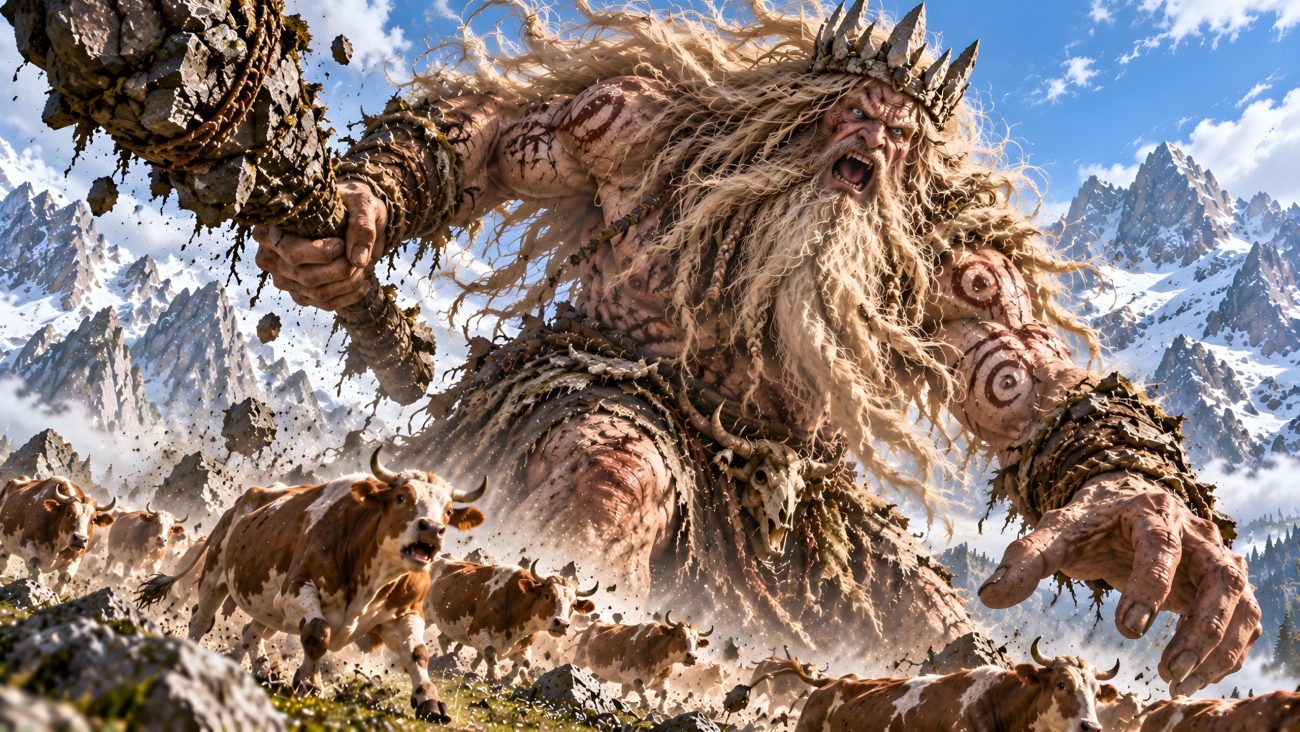
Serles was a giant known as a Wilder, or wild man, who lived in the valley of the Sin near Innsbruck, in the Austrian Alps. Feared as the King of the Mountains, he possessed an extraordinarily savage nature. His wife was equally cruel, while his secret counsellor was said to be even more wicked than either of them. Together, the three terrorized the mountain pastures, bringing death and destruction wherever they went.

Serles was passionately devoted to hunting, but he cared nothing for the lives of the people and animals caught in his path. When pursuing a fleeing stag, he would charge through flocks and herds with his followers and bloodthirsty hounds. If the hunted animal sought refuge among cattle, Serles would urge his dogs to attack everything around them. Herdsmen who attempted to protect their animals or protest against the destruction were themselves torn apart by the hounds. During these brutal hunts, Serles would shout, “Lustig gejaid!” meaning “Bravely on!” His wife and counsellor accompanied him, encouraging his cruelty and urging him to commit further atrocities.

One day, Serles and his companions pursued a stag that had taken refuge among a herd of cows. The giant’s hounds killed the stag and then attacked the cattle. Desperate to defend their animals, the herdsmen tried to drive the dogs away, and one of them shot a hound with his crossbow. Enraged by the death of his dog and encouraged by his wicked companions, Serles set the entire pack upon the herdsmen. He laughed as the men were torn limb from limb, showing no mercy to his helpless victims.

At the height of this terrible crime, divine punishment descended upon the giant and his companions. A tremendous thunderstorm erupted over the mountains. When the storm finally passed, Serles, his wife, and his counsellor had vanished. In their place stood three enormous glaciers, their icy peaks rising into the clouds. According to the legend, the central mountain represents the wicked Serles, while the formations to his right and left represent his cruel wife and inhuman counsellor. Their transformation into towering mountain formations serves as an eternal punishment for their brutality.

The supernatural legacy of the three figures supposedly persists in the surrounding mountains. Teamsters travelling along the Brenner Road on stormy nights are said to hear the unearthly howling of dogs, reminders of Serles’s savage hunting pack. During thunderstorms, lightning frequently strikes the towering rocky peaks known as the Rock Giants. The legend thus explains the striking mountain landscape as the remains of a wicked giant and his companions, condemned to endure the storms above the very lands they once terrorized.


Sources

Von Günther, Amalia, Countess. Tales and Legends of the Tyrol. London: Chapman and Hall, 1874.

Giant Jordan

Tradition: Austrian Mythology
Alternative Names: Jordan, The Wild Man of the Kohlhütte
Category: Giant


The Myth

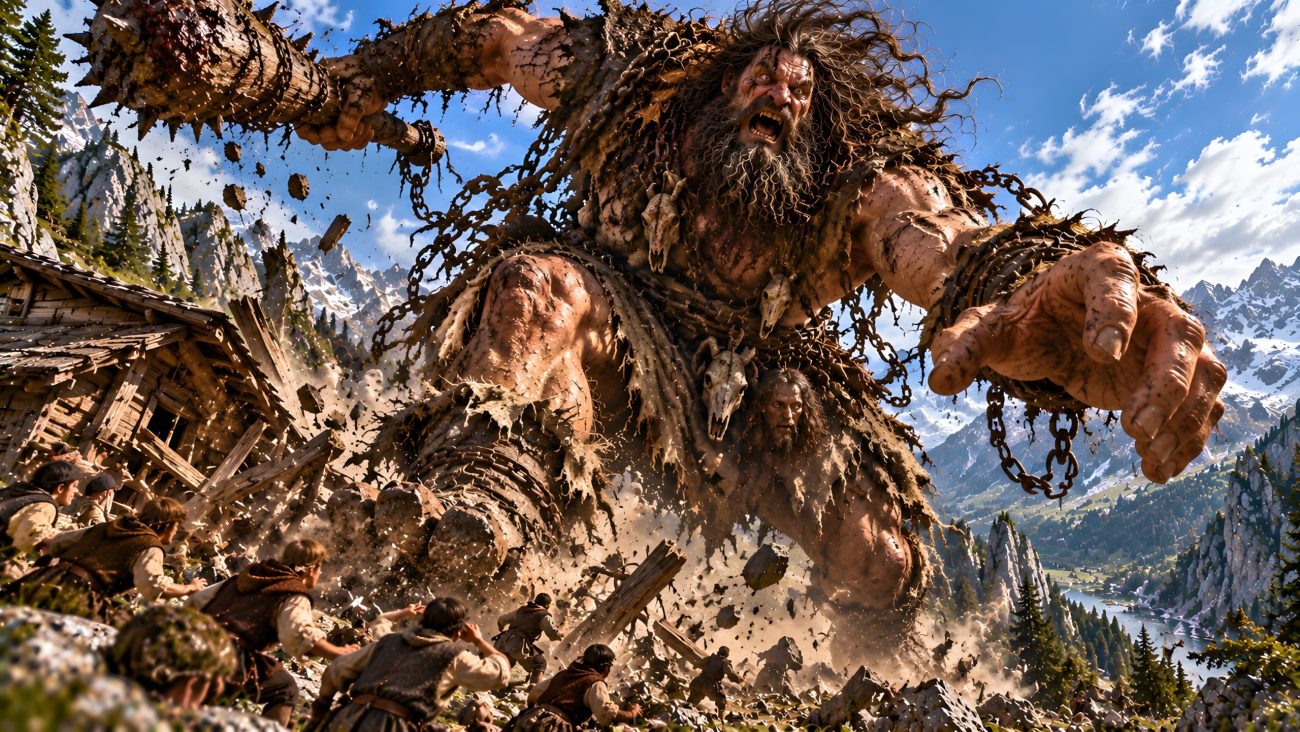
Jordan is a savage giant who once lived with his wife, Fangga, in the Kohlhütte, a remote hut situated high in the mountains near the Ungarkopf, above the cavern known as Eggerskeller. Surrounded by steep grey cliffs and a dangerous rocky chasm, the hut served as the lair of the monstrous couple. Jordan was notorious for stealing children and livestock to devour. He also hunted fairies, capturing and killing them or imprisoning them in underground cells.

One day, Jordan brought home a badly wounded fairy, intending to kill her. His wife, however, decided that the captive could be useful as a servant. The couple kept the fairy in their hut and called her Hitte Hatte. Forced to wear servants’ clothes and perform domestic chores, she worked so efficiently that Fangga was satisfied with her. Hitte Hatte also befriended a huge black cat that Jordan had previously captured in the mountains and given to his wife. She fed the animal regularly, allowed it to sleep in her bed, and grew deeply attached to it. Although she gradually adopted the habits of a human being, she longed to escape her captors.

When Jordan was away and Fangga was asleep, Hitte Hatte fled down into the valley, taking the black cat with her. She eventually reached the Seehaus farm near the village of Strad in the Gurgl Valley, where a kind but financially struggling farming couple named Krapf employed her without asking about her origins. Hitte Hatte proved to be an exceptionally capable and diligent servant, organizing the household with remarkable skill. She remained quiet and modest, and her only great attachment was to the cat. Although she feared that Jordan would come looking for her, she was protected in the valley by its Christian boundaries, which were blessed annually by the priest and marked by small crosses and chapels. The pagan giants were said to fear these sacred protections.

Jordan’s downfall began when two boys from Strad climbed the Ungarkopf to gather strawberries and accidentally approached his hut. Hungry and tired, they saw smoke rising from the chimney and hoped to obtain something to eat. Fangga invited them inside but, fearing her husband, instructed them to hide inside the stove. When Jordan returned, he immediately smelled human flesh and demanded to know where the boys were. Fangga angrily dismissed his suspicions, but the frightened children jumped out of their hiding place. Jordan seized them, locked them in a cupboard, and left to search for a missing goat. Although Fangga was cruel, she eventually took pity on the boys and forced the cupboard door open so they could escape.

When Jordan discovered their escape, he swore to kill them and pursued them through the mountains. The boys eventually reached a roaring torrent and crossed to the other side. Jordan, deceived by their directions, searched far upstream for a plank crossing and fell into the rushing water while attempting to cross a weak, bending board. He survived and continued the chase, eventually catching sight of the boys beyond a large lake. Unable to swim, he asked them how they had crossed it. The boys told him that they had tied large stones around their necks and used them to swim across. Jordan followed their instructions, tied a heavy rock around his own neck, and jumped into the lake. The weight dragged him under, and he drowned.

Some days later, Lorenz Mayrhofer, a friend of the Seehaus farmer, returned from the market at Imst. He recounted hearing a mysterious voice from the mountains telling him to inform Hitte Hatte that Jordan was dead and that she could now return home. When Hitte Hatte heard the news, she rejoiced, thanked the farmers for their kindness, and wished them good fortune. Before disappearing through the door, she urged them to take good care of the “hairy house-worm,” referring to her beloved black cat. She was never seen again.

The farmers regretted that they had not asked Hitte Hatte more about herself, believing that she might have revealed further secrets about the supernatural world. Her disappearance left the people of Strad wondering about the fairy who had lived among them, while Jordan’s death brought an end to the terror of the savage giant.


Sources

Von Günther, Amalia, Countess. Tales and Legends of the Tyrol. London: Chapman and Hall, 1874.

Heimo and Thürse

Tradition: Austrian Mythology
Alternative Names: Heimo, Heime, Heimo the Giant, Thürse, Tyrschen
Category: Giant


The Myth

Heimo and Thürse were two enormous mountain giants from the folklore of Tyrol, associated with the origins of Wilten Abbey near Innsbruck, Austria. According to legend, they lived during the period when Christianity first spread into the remote valleys of the Tyrol. Heimo was a cruel and savage giant whose extraordinary height forced him to raise the roof of his house so that he could stand upright. The surrounding inhabitants feared him so greatly that they offered him as much land as he desired in exchange for sparing their farms and homesteads.

Heimo declared that all the land he could encompass would belong to him if he carried a gigantic rock around it on his shoulders. He seized the stone and travelled along the River Sill, around the Patscherkofel mountain, through Igels and around Wilten, before returning to his starting point and hurling the rock westward. He then began constructing an enormous stronghold near the meeting of the Sill and Inn rivers, transporting massive stones from the surrounding mountains.

Another giant, Thürse, lived on the plateau of Seefeld, above Zirl and behind the steep peak of Solstein. He was even taller and stronger than Heimo and had cultivated the plateau where the hamlet of Tyrschenbach would later stand. Thürse hated Heimo and repeatedly sabotaged the construction of his stronghold. When Heimo discovered who was responsible, he armed himself with light armour and an enormous sword and went to confront his rival. Thürse took up a massive wooden beam, and the two giants fought with such violence that the earth trembled and enormous rocks broke away from Solstein and rolled into the valley. Eventually, Heimo’s superior weapons allowed him to defeat and kill Thürse.

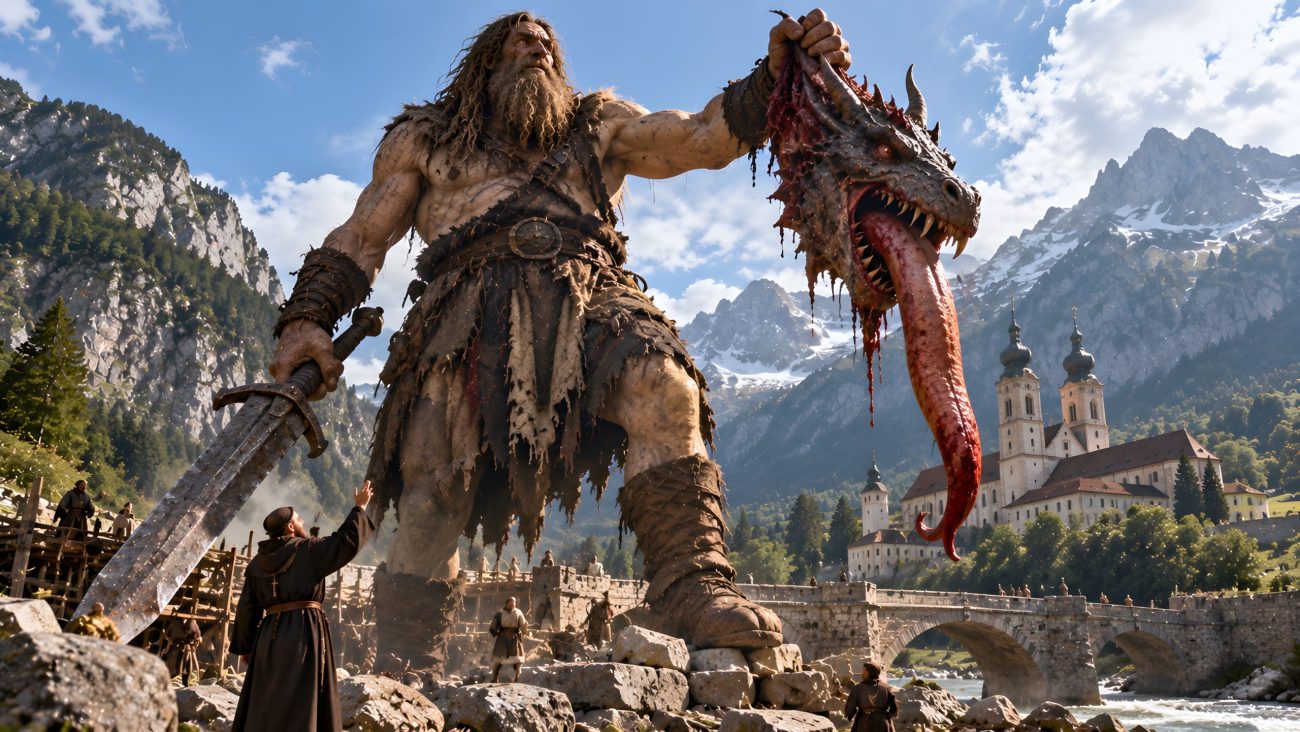
After the battle, Heimo heard a Christian monk preaching in the valleys of the Sill. Regretting that he had killed Thürse, he repented of his former savagery, converted to Christianity, and was baptized by the Bishop of Chur. He subsequently built a bridge over the River Inn, traditionally associated with the origin of Innsbruck’s name. Abandoning his plans for a stronghold, he instead founded a monastery at Wilten, which became Wilten Abbey.

The devil, angered by Heimo’s conversion and the construction of the monastery, sent a gigantic dragon to obstruct the work. Heimo fought and killed the dragon, cutting out its enormous tongue. In traditional representations, Heimo holds this tongue in his hand, and the legend claims that the preserved tongue was kept at the monastery. Heimo eventually became a monk at Wilten and lived a pious life until his death. According to the tradition, he was buried in a stone coffin measuring twenty-eight feet and three inches long, which was preserved at the monastery alongside an inscription recounting his story.


Sources

Von Günther, Amalia, Countess. Tales and Legends of the Tyrol. London: Chapman and Hall, 1874.

Upper Austria Giant

Tradition: Austrian Mythology
Alternative Names: Oberösterreichische Riesen, Giants of the Mühlviertel, Giant Imago, Giant Hans
Category: Giant


The Myth

Giants feature prominently in the legends of Upper Austria, where they are credited with shaping the landscape, building churches and castles, and leaving enormous stones and bones as traces of their presence. Their immense strength could explain violent storms, unusual rock formations, and the construction of buildings that seemed beyond ordinary human capabilities. Around Traunkirchen, people once said that giants were becoming angry whenever storms raged and roared across the area. Other traditions placed giants in underground passages and caves near Enzenberg, while reports of enormous human remains discovered near Kirchschlag were interpreted as evidence that giants had once lived there.

Many stories emphasize the extraordinary strength and appetite of individual giants. Giant Hans, a farmhand from the upper Mühlviertel, belonged to a family of giants and was hired by a farmer when he was seventeen. At breakfast, he ate two large loaves of bread, and when sent into the forest to gather wood, he simply pulled trees out of the ground by their roots. His enormous appetite frightened the farmer and his wife, who struggled to provide enough food for him. The farmer eventually attempted to kill Hans by throwing blocks of stone into a deep pit he was digging, but Hans remained unharmed and merely complained that the farmer was putting too much sand into the hole. Another legend tells of a giant sleeping in the Bohemian Forest whose body was mistaken for a mountain by a passing farmer. When the farmer accidentally drove his horses into the giant’s nostril, the giant sneezed so violently that the farmer and his team were hurled an hour away. The enormous giant Imago was likewise remembered for using high mountains as flint, with a fragment of one supposedly forming the Traunstein.

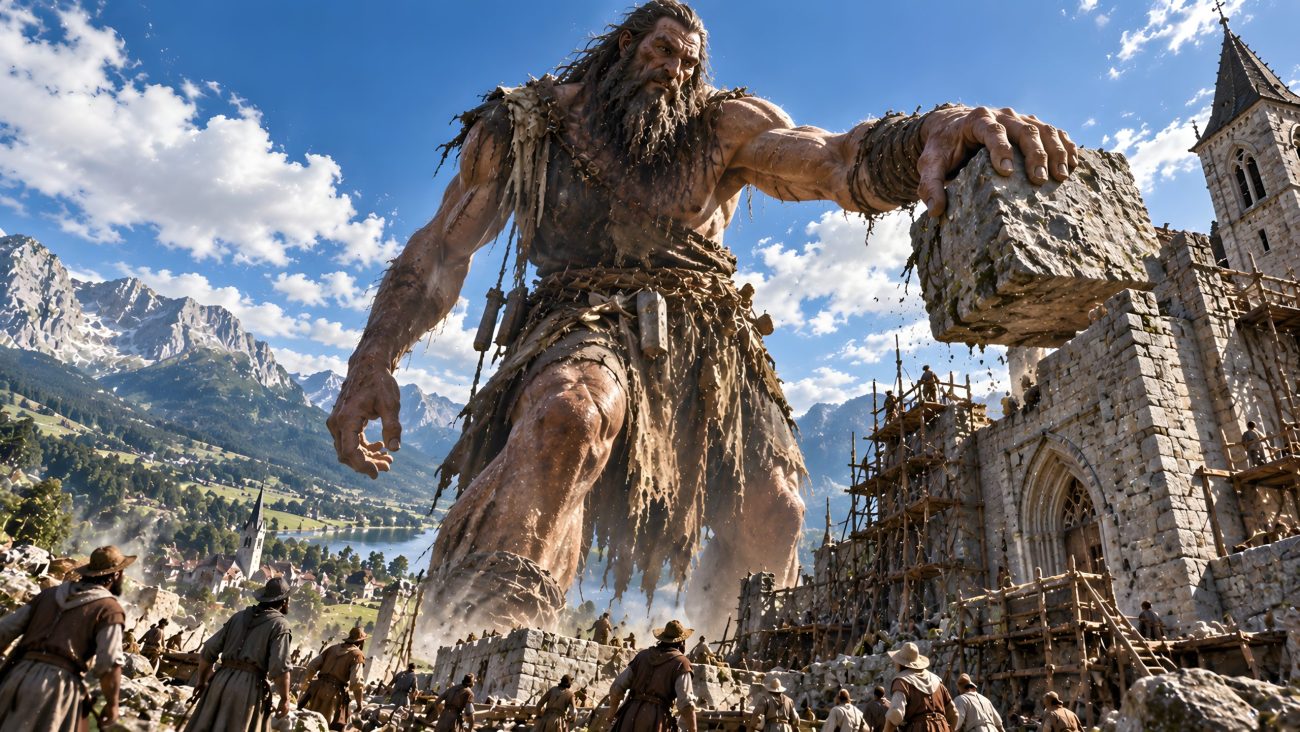
Giants were also credited with constructing important buildings and monuments throughout the region. Three giants supposedly helped build the church at Taufkirchen by throwing stones over great distances from the Rainbach stream to the construction site. Their heads were later associated with carved figures supporting the church’s vault, known as the Giants’ Heads. Giants from the Viechtau were said to have built the small church on Johannisberg near Traunkirchen, while a giantess helped construct the town tower of Enns by carrying a massive stone block in her apron. A rib attributed to the giantess reportedly hung from a chain in the tower for many years. Other legends credit giants with building Neuhaus Castle, Wolfsegg Castle, and Lichtenhag Castle. Enormous bones, handprints, knee impressions, and stones scattered along streams were interpreted as physical reminders of their work.

Some tales explain unusual geological formations through conflicts between giants and other supernatural beings. Near Natternbach, St. Ägidi, and Kopfing, a balancing stone known as the Wackelstein is also called the Maiden’s Stone. According to the legend, three pagan maidens carried it in their aprons to a wooded ridge to perform sacrifices. In the Katergebirge mountains, a giant once possessed a mighty hammer and lived near the Jochwand and the Ewige Wand, which were originally connected. After a dwarf living in Anzenau repeatedly mocked him, the giant hurled his hammer at the dwarf, shattering him and causing the ground beneath him to disappear into the depths. The two rock walls were separated, and the end of the Jochwand became known as Hammerberg.

Another legend from the Mühlviertel describes giants who attempted to build a castle where Freistadt now stands. They gathered stones from the Aist River, taking them from a wall that the devil was constructing to drown the inhabitants of Prägarten. The devil had intended to punish the inhabitants for stealing two of his souls, but the giants repeatedly disrupted his work by carrying away his building materials. In retaliation, the devil destroyed their castle and threw its enormous stone blocks into the Aist, where they supposedly remain. He later encountered one of the giants in the Thury Valley and transformed him into a boulder known as Devil’s Rock. Across these traditions, giants are powerful figures whose actions explain the origins of buildings, stones, mountains, and other striking features of the Upper Austrian landscape.


Sources

“Die Kraft der Riesen.” SAGEN.at – Österreichische Sagen aus Oberösterreich. Reproduced by SAGEN.at. https://www.sagen.at/texte/sagen/oesterreich/oberoesterreich/allgemein/kraft_riesen.html


Adasbub

Tradition / Region: Austrian Mythology
Alternate Names: —
Category: Mountain dweller, Giant


The Myth

About sixty years ago, in the valley of the Ötz near Lengenfeld, there lived a man of enormous height and terrifying strength known as the Adasbub. He was a monster in spirit as much as in body—a thief, a drunkard, a fighter, and a blasphemer. He had served as a soldier in many wars and returned more savage than when he had left. From foreign lands he brought home great sums of money, stolen and extorted, and with this wealth he bought himself a farm.

Yet he lived not like a Christian farmer, but like a pagan. He never went to church. Instead, he sat in the village inn boasting of his velvet jacket adorned with buttons hammered from old silver coins. The young men of the village, dazzled by his swagger and riches, grew ashamed of their simple clothing and sought to imitate him.

The Adasbub’s strength was legendary. It was said he had once defeated fifty men who attacked him at the same time. Those who offended him feared more than his fists. People whispered that he could divert mountain torrents onto a rival’s fields or send huge snowballs—packed with hidden stones—crashing down upon a roof. Whether by cunning or brute force, he was a man to be feared.

His pleasure lay in drink, oaths, and cruelty. He gathered around him a band of like-minded ruffians. Together they committed outrageous acts. They tore doors from their neighbors’ houses and dragged them into the forests. They lifted carts onto rooftops. They broke into sacristies to steal and drink the priests’ wine. They shut goats into roadside chapels and uprooted cemetery crosses, thrusting them upside down into graves, laughing that they had made Christendom stand upon its head.

At last, the Adasbub planned a new villainy involving the daughter of a farmer whose home stood on the Burgstein above Lengenfeld. But word of the plot reached the farmer. Rather than flee, he sharpened his axe and waited.

When the Adasbub entered the house, the farmer struck with all his strength. The axe split the giant’s skull, and the terror of the valley fell dead at his feet. Seeing their leader slain, his companions fled in panic.

The alarm spread quickly. People climbed up to the Burgstein from every direction and thanked the farmer for freeing them from their tormentor. They cut off the Adasbub’s head and dragged his body to the edge of a precipice, casting it down onto the road below near the sulphur baths of Rumunschlung.

The head was thrown into the charnel-house of the cemetery at Lengenfeld. There it is said to remain.

The skull, nearly cleft in two, does not always lie quiet. On certain midnights it is said to glow red-hot, terrible to behold. Some claim that when it burns, it rolls from the charnel-house into the chapel, whirling in circles before leaping back to its place. By morning it has cooled, appearing once more like any other skull.

Thus the Adasbub endures—not as a man, but as a warning.


Sources

Günther, A. von. (1874). Tales and legends of the Tyrol. London: Chapman and Hall.