Tradition: Austrian Mythology
Alternative Names: Serles, The King of the Mountains
Category: Giant
The Myth
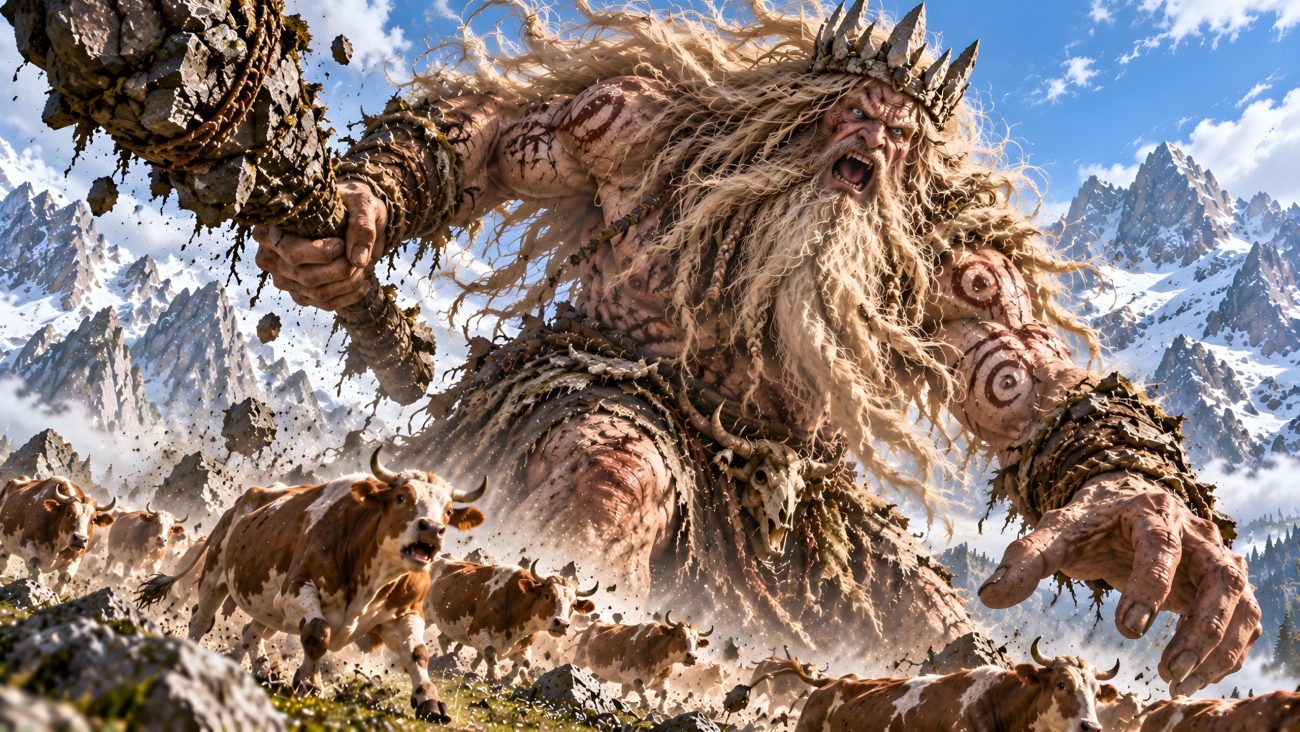
Serles was a giant known as a Wilder, or wild man, who lived in the valley of the Sin near Innsbruck, in the Austrian Alps. Feared as the King of the Mountains, he possessed an extraordinarily savage nature. His wife was equally cruel, while his secret counsellor was said to be even more wicked than either of them. Together, the three terrorized the mountain pastures, bringing death and destruction wherever they went.
Serles was passionately devoted to hunting, but he cared nothing for the lives of the people and animals caught in his path. When pursuing a fleeing stag, he would charge through flocks and herds with his followers and bloodthirsty hounds. If the hunted animal sought refuge among cattle, Serles would urge his dogs to attack everything around them. Herdsmen who attempted to protect their animals or protest against the destruction were themselves torn apart by the hounds. During these brutal hunts, Serles would shout, “Lustig gejaid!” meaning “Bravely on!” His wife and counsellor accompanied him, encouraging his cruelty and urging him to commit further atrocities.
One day, Serles and his companions pursued a stag that had taken refuge among a herd of cows. The giant’s hounds killed the stag and then attacked the cattle. Desperate to defend their animals, the herdsmen tried to drive the dogs away, and one of them shot a hound with his crossbow. Enraged by the death of his dog and encouraged by his wicked companions, Serles set the entire pack upon the herdsmen. He laughed as the men were torn limb from limb, showing no mercy to his helpless victims.
At the height of this terrible crime, divine punishment descended upon the giant and his companions. A tremendous thunderstorm erupted over the mountains. When the storm finally passed, Serles, his wife, and his counsellor had vanished. In their place stood three enormous glaciers, their icy peaks rising into the clouds. According to the legend, the central mountain represents the wicked Serles, while the formations to his right and left represent his cruel wife and inhuman counsellor. Their transformation into towering mountain formations serves as an eternal punishment for their brutality.
The supernatural legacy of the three figures supposedly persists in the surrounding mountains. Teamsters travelling along the Brenner Road on stormy nights are said to hear the unearthly howling of dogs, reminders of Serles’s savage hunting pack. During thunderstorms, lightning frequently strikes the towering rocky peaks known as the Rock Giants. The legend thus explains the striking mountain landscape as the remains of a wicked giant and his companions, condemned to endure the storms above the very lands they once terrorized.
Sources
Von Günther, Amalia, Countess. Tales and Legends of the Tyrol. London: Chapman and Hall, 1874.