Tradition: Austrian Mythology
Alternative Names: Oberösterreichische Riesen, Giants of the Mühlviertel, Giant Imago, Giant Hans
Category: Giant
The Myth
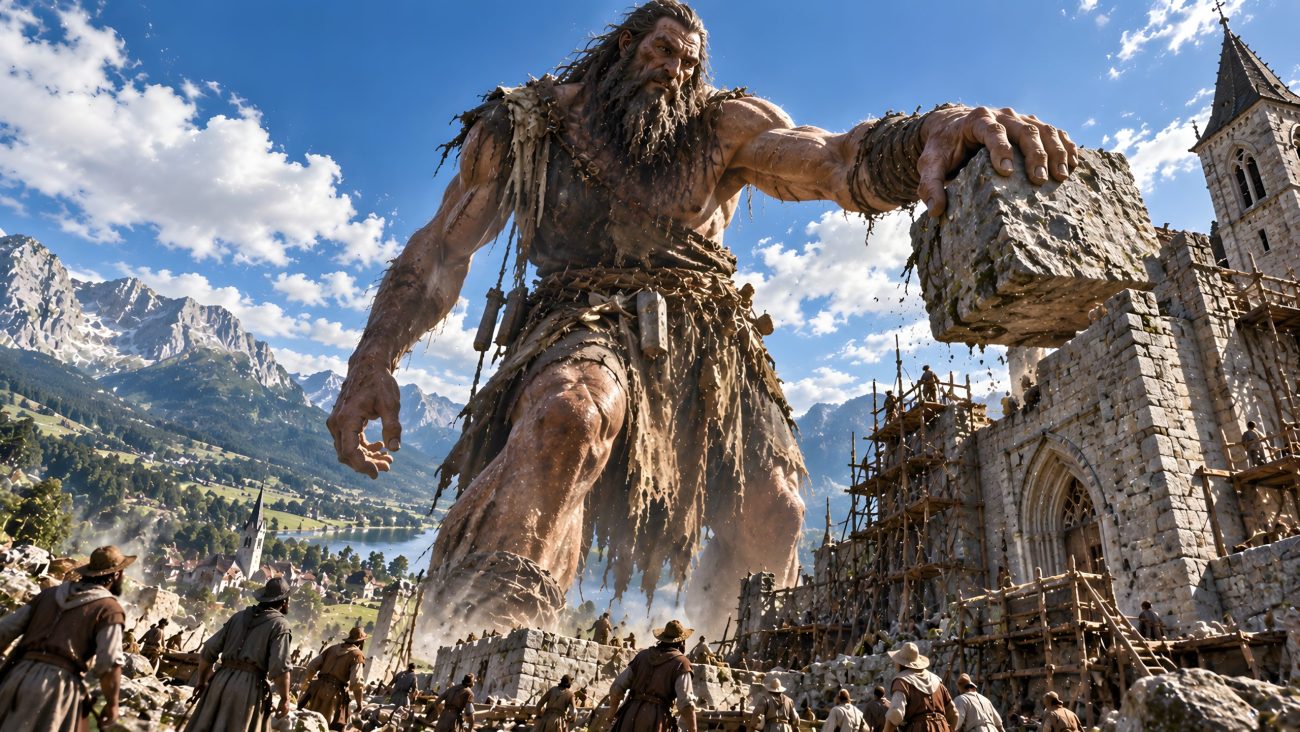
Giants feature prominently in the legends of Upper Austria, where they are credited with shaping the landscape, building churches and castles, and leaving enormous stones and bones as traces of their presence. Their immense strength could explain violent storms, unusual rock formations, and the construction of buildings that seemed beyond ordinary human capabilities. Around Traunkirchen, people once said that giants were becoming angry whenever storms raged and roared across the area. Other traditions placed giants in underground passages and caves near Enzenberg, while reports of enormous human remains discovered near Kirchschlag were interpreted as evidence that giants had once lived there.
Many stories emphasize the extraordinary strength and appetite of individual giants. Giant Hans, a farmhand from the upper Mühlviertel, belonged to a family of giants and was hired by a farmer when he was seventeen. At breakfast, he ate two large loaves of bread, and when sent into the forest to gather wood, he simply pulled trees out of the ground by their roots. His enormous appetite frightened the farmer and his wife, who struggled to provide enough food for him. The farmer eventually attempted to kill Hans by throwing blocks of stone into a deep pit he was digging, but Hans remained unharmed and merely complained that the farmer was putting too much sand into the hole. Another legend tells of a giant sleeping in the Bohemian Forest whose body was mistaken for a mountain by a passing farmer. When the farmer accidentally drove his horses into the giant’s nostril, the giant sneezed so violently that the farmer and his team were hurled an hour away. The enormous giant Imago was likewise remembered for using high mountains as flint, with a fragment of one supposedly forming the Traunstein.
Giants were also credited with constructing important buildings and monuments throughout the region. Three giants supposedly helped build the church at Taufkirchen by throwing stones over great distances from the Rainbach stream to the construction site. Their heads were later associated with carved figures supporting the church’s vault, known as the Giants’ Heads. Giants from the Viechtau were said to have built the small church on Johannisberg near Traunkirchen, while a giantess helped construct the town tower of Enns by carrying a massive stone block in her apron. A rib attributed to the giantess reportedly hung from a chain in the tower for many years. Other legends credit giants with building Neuhaus Castle, Wolfsegg Castle, and Lichtenhag Castle. Enormous bones, handprints, knee impressions, and stones scattered along streams were interpreted as physical reminders of their work.
Some tales explain unusual geological formations through conflicts between giants and other supernatural beings. Near Natternbach, St. Ägidi, and Kopfing, a balancing stone known as the Wackelstein is also called the Maiden’s Stone. According to the legend, three pagan maidens carried it in their aprons to a wooded ridge to perform sacrifices. In the Katergebirge mountains, a giant once possessed a mighty hammer and lived near the Jochwand and the Ewige Wand, which were originally connected. After a dwarf living in Anzenau repeatedly mocked him, the giant hurled his hammer at the dwarf, shattering him and causing the ground beneath him to disappear into the depths. The two rock walls were separated, and the end of the Jochwand became known as Hammerberg.
Another legend from the Mühlviertel describes giants who attempted to build a castle where Freistadt now stands. They gathered stones from the Aist River, taking them from a wall that the devil was constructing to drown the inhabitants of Prägarten. The devil had intended to punish the inhabitants for stealing two of his souls, but the giants repeatedly disrupted his work by carrying away his building materials. In retaliation, the devil destroyed their castle and threw its enormous stone blocks into the Aist, where they supposedly remain. He later encountered one of the giants in the Thury Valley and transformed him into a boulder known as Devil’s Rock. Across these traditions, giants are powerful figures whose actions explain the origins of buildings, stones, mountains, and other striking features of the Upper Austrian landscape.
Sources
“Die Kraft der Riesen.” SAGEN.at – Österreichische Sagen aus Oberösterreich. Reproduced by SAGEN.at. https://www.sagen.at/texte/sagen/oesterreich/oberoesterreich/allgemein/kraft_riesen.html