Tradition / Region: Māori, New Zealand Mythology Alternative names: Kurungaituku; Hine-ingoingo Category:Bird
The Myth
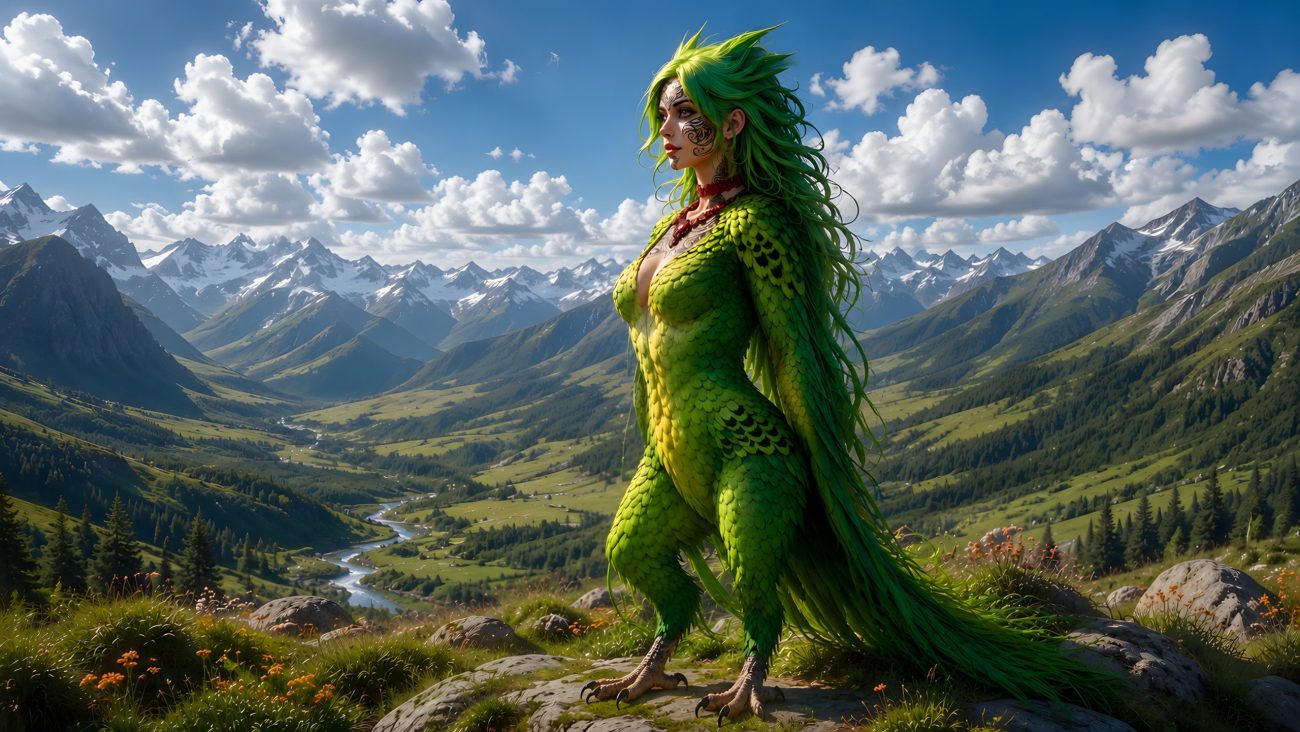
Kurangaituku is a supernatural woman with the wings of a bird, claws instead of fingers, and a beak in place of a human mouth. She is the guardian of birds and other creatures, keeping them in her forest home. In some traditions she is feared as an ogress or witch, while in others she is remembered as a compassionate being who shelters injured animals and nurses the wounded back to health.
One day the young hunter Hatupatu entered her domain. In some versions she captured him after he hunted her birds, while in others she found him injured and cared for him until he recovered. Hatupatu lived with her for a time, but eventually betrayed her by destroying or imprisoning her beloved birds and reptiles and stealing her treasured feather cloaks before fleeing.
A single small bird escaped and warned Kurangaituku of the betrayal. She pursued Hatupatu through the forests with incredible speed. During the chase, Hatupatu called upon a great rock to open and hide him, escaping her grasp. When he reached the geothermal lands of Whakarewarewa, he dodged between the boiling mud pools, but Kurangaituku rushed after him and was consumed by the scalding mud, bringing the pursuit to its tragic end.
In some Māori traditions, however, Kurangaituku is remembered not as a monster but as the wronged guardian of the forest, whose kindness was repaid with betrayal. Her story remains one of the best-known legends of New Zealand, preserving both versions of her character in Māori oral tradition.
Sources
Wikipedia contributors. (n.d.). Kurangaituku. In Wikipedia. Retrieved June 29, 2026, from https://en.wikipedia.org/wiki/Kurangaituku
Tradition / Region: Māori Mythology, New Zealand Mythology Alternate Names: — Category: Dog
The Myth
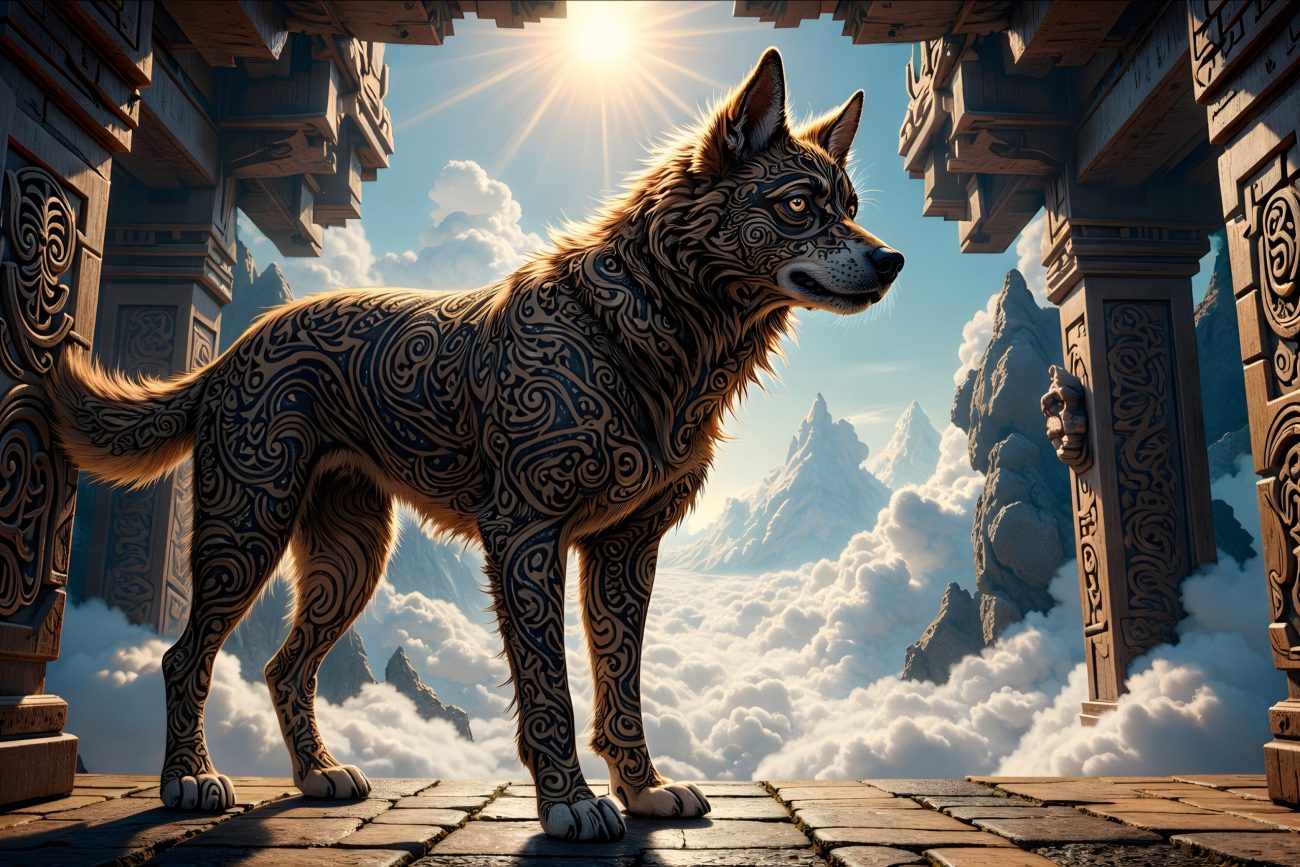
In the ancient stories of the Māori, Irawaru is remembered as the origin of the dog.
He was the husband of Hinauri, who was the sister of the trickster hero Māui. One day Māui and Irawaru went out together, and during their time together Māui became angered with his brother-in-law. Some say Māui envied Irawaru’s success in fishing. Others say he was offended by Irawaru’s greed, or angered when Irawaru refused him a cloak. Whatever the cause, Māui resolved to punish him.
When they returned home, Māui seized Irawaru and stretched out his body. He pulled his limbs until they changed shape, lengthening and bending them. In this way he transformed the man into the first dog.
Afterward, Hinauri searched for her husband and asked Māui where he had gone. Māui told her to stand and call out, “Moi! Moi!”
When she called, a dog came running toward her. Only then did she realize the truth — that the animal was her husband, changed by Māui’s hand.
Overcome with grief, Hinauri left the world of people. She cast herself into the sea, into the domain of Tangaroa, and was not seen again.
Other traditions tell that long after these events, when the voyager Kupe reached Aotearoa, three sacred dogs came with him from Hawaiki. These were not ordinary animals but spirit guardians. They were sent to the far northern headland to watch over the path of souls, guiding the dead as they departed for the afterlife. The people who settled there later became known as Ngāti Kurī, the people of the dogs.
From these stories it is remembered that dogs were not merely animals but sacred companions. They guarded homes, warned of danger, and stood watch against unseen spirits, bound to humankind since the first transformation of Irawaru.
Sources
Wikipedia contributors. (n.d.). Irawaru. In Wikipedia, from https://en.wikipedia.org/wiki/Irawaru
Tradition / Region: Māori mythology (Aotearoa / New Zealand) Alternate Names: Pakehakeha; Tūrehu (in some traditions) Category: Forest dweller, Mountain dweller
The Myth
In the deep forests and mist-covered mountains of Aotearoa dwell the patupaiarehe, a hidden people of pale skin and fair or reddish hair. They are of human stature, yet unlike humans they bear no moko upon their skin. They live in great communities in the hills and ranges, in places wrapped in fog and shadow. Their houses and villages cannot be seen by human eyes.
The patupaiarehe are creatures of the mist. They draw it about themselves like a cloak, and they walk most freely in darkness or on foggy days. The full light of the sun is deadly to them, and so they retreat before dawn. They eat raw food and shun steam and fire; when ovens are opened and clouds of steam rise, they hide themselves away.
At times their presence is revealed by music drifting through the forest—the sweet notes of kōauau and pūtōrino flutes, and their haunting waiata carried on the mist. Their music is said to be more beautiful than any played by mortals. Though they can be hostile to those who trespass upon their sacred mountains, it is also told that they may speak with humans, and sometimes even fall in love with them.
On Mount Moehau and in the Coromandel ranges they once dwelled in strength. Some say they were there before the ancestors of the Māori arrived, and that they were driven from their most sacred peaks. In anger they punished those who offended them. Hunters who stole from their lands found their game turned to skin and bone. Men who intruded upon their treasures were dragged away into the night.
Yet there are gentler tales. Kahukura once came upon them at night as they hauled in their fishing nets. He joined them in their labor, and though they fled at dawn when they discovered he was mortal, he had learned their methods and brought that knowledge back to his people.
There is also the story of Hinerehia, a patupaiarehe woman of Moehau, who fell in love with a mortal man while gathering shellfish in the mist. She lived with him and bore children, weaving beautiful garments—but only at night. When the villagers tricked her into weaving past dawn so they could learn her craft, the first light revealed their deception. Heartbroken, she rose within a cloud and returned to the mountains, leaving her husband and children behind.
In the mountains of Ngongotahā they were said to number in the thousands, their skin pale or ruddy, their hair glinting red or gold. They fetched water in gourds from sacred burial cliffs, avoiding the steam of cooking fires. Some among them desired human husbands or wives, yet unions between the two worlds rarely endured.
In the south, on the misty peaks of Tākitimu, a hunter once encountered Kaiheraki, a woman of the mountain. She shone with coppery hair and fair skin, claiming no people but the mountain itself as her mother. The hunter, knowing her nature, tried to bind her to the human world through fire. But when flame touched her skin and blood flowed, she fled back into the high places, vanishing forever among the ridges and cloud.
Thus the patupaiarehe remain—guardians of misty summits and shadowed forests, beautiful and perilous, glimpsed only in song, in fog, or in the edge of human memory.
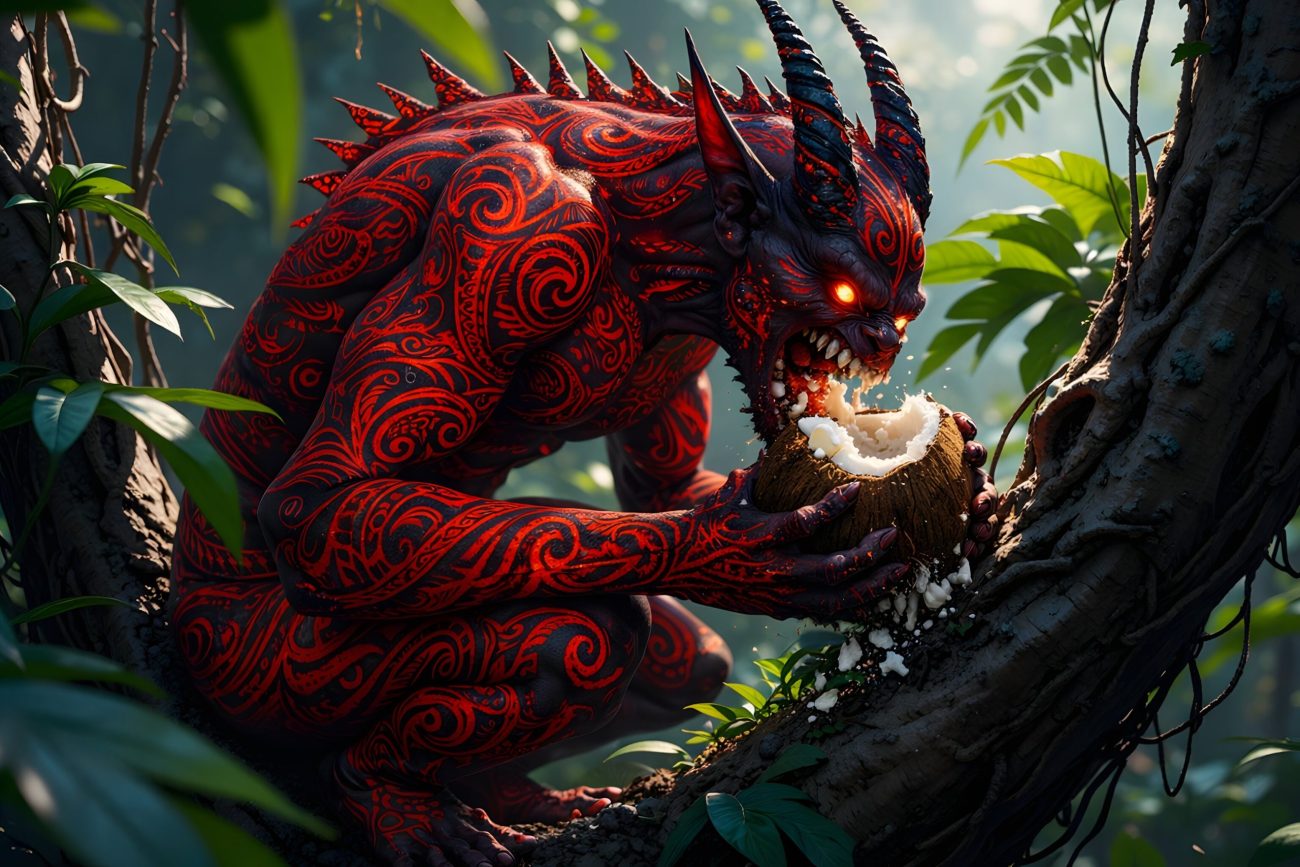
Atua are supernatural beings known in the traditional beliefs of the Polynesian world. Among Hawaiians, Māori, and other Polynesian peoples, atua are regarded as powerful entities that exist beyond the human realm.
They are described as deities or demons, feared and revered alike, whose presence influences the natural world and human life. Atua may dwell in specific places, manifest through natural forces, or act invisibly, shaping events according to their will.
Through tradition, atua are remembered as ever-present supernatural beings, forming a vital part of Polynesian cosmology and belief.