Peryton

Tradition: Gibraltar Mythology, Spanish Mythology
Alternative Names: Peryton, Perytons
Category: Deer, Bird


The Myth

The Peryton is a strange and tragic creature said to have originally inhabited Atlantis. After the seismic catastrophes that destroyed their homeland, the Perytons settled on the border of the Ocean, in the region of the Pillars of Hercules.

According to the legend, the Perytons were haunted by the deaths of their fellow creatures. In memory of the millions who perished at sea, including the inhabitants of Atlantis, they became living cenotaphs, carrying the restless souls of those who had died far from home. They were associated with fishermen, sailors, travelers, and wanderers. Each Peryton possessed a human shadow, which appeared upon the ground while the creature itself flew through the sky.

The delicate nature of the Peryton could not withstand the trauma of forced migration. Something within the creatures eventually broke, transforming them into monsters. Their heads became those of gentle deer, while their bodies were those of birds. They possessed enormous horns and sharp claws, with some accounts describing bodies hardened like tempered adamant and others giving them the clawed feet of eagles.

Once the Perytons had taken to the sky, they could no longer return to the earth. They became predators and developed a thirst for human flesh. The only way for a Peryton to free itself from this terrible fate was to taste the blood of a slain human being and consume human flesh.

The Perytons became a source of terror to those who encountered them. Their attacks could affect travelers, sailors, merchant ships, and even armies. Yet the widows of fishermen were said not to fear them.

When a Peryton saw the broken outline of a human shadow on the ground, it would approach the person whose shadow it recognized. If the Peryton heard the name of its former human self, however, it would suddenly stop its attack and fall toward the ground, weeping like a man awakening from a deep sleep. For a brief moment, the widow could see in the transformed monster the person she had once known.

One of the great stories concerning the Perytons was connected with the Punic Wars. It was said that the army of Scipio, later known as Africanus, was crossing the waters of Gibraltar on its way to fight Carthage when the soldiers were attacked by countless Perytons.

The creatures were difficult to defeat. Their teeth, claws, and horns caused enormous casualties, while their skins were so tough that weapons could scarcely pierce them. Hundreds of Roman soldiers were killed during the attack.

The attack was associated with a prophecy of the Erythraean Sibyl that Rome would eventually be destroyed by the Perytons. Yet after the creatures had killed hundreds of Roman soldiers, they were finally freed from the curse that had transformed them and abandoned the Pillars of Hercules.

The Peryton therefore remained a creature of tragic transformation: originally associated with the dead and with the memories of those lost far from home, it became a predatory monster whose own human shadow constantly reminded it of what it had once been.


Sources

“Peritii.” New Bestiary (Bestiary.us). Accessed September 5, 2026. https://www.bestiary.us/peritii
Lomie

Tradition: Czech Mythology
Alternative Names: Lomie, Los, Lossie
Category: Deer


The Myth

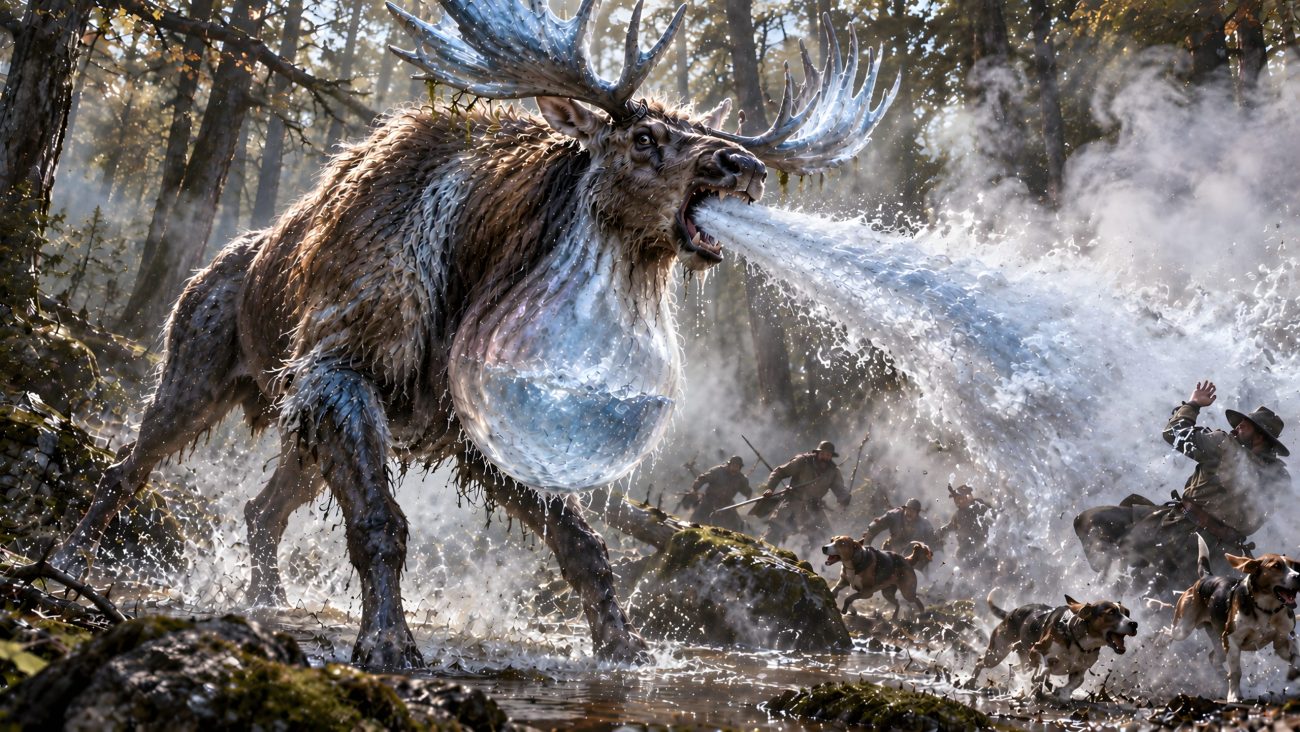
The Lomie is a strange beast said to inhabit the forests of Bohemia. It possesses a large, sac-like bladder beneath its neck, which it uses as a weapon against hunters.

When pursued by hunters, the Lomie runs to a nearby body of water and stops to drink. It fills the bladder beneath its neck with water before continuing its escape.

As it runs, the water inside the bladder becomes heated until it is boiling hot. When the hunters and their dogs eventually corner the creature, the Lomie vomits the boiling water over them. The scalding water burns the hunters and dogs, allowing the beast to escape.

Heylyn merely describes the water as boiling hot, but the Book of Marvels gives a more horrific account. According to this version, the water is extremely poisonous as well as boiling, producing incurable wounds and causing the skin and flesh of its victims to slough away.

The name Lomie appears to derive from the Polish łossie, the plural form of łoś, meaning moose or elk. The name was probably the result of a typographical error by Heylyn. Topsell lists Los and Lossie as names for the elk or moose and likewise attributes the strange ability to regurgitate scalding water to the animal.


Sources

Countess Sica. “Lomie.” A Book of Creatures. October 30, 2020. https://abookofcreatures.com/2020/10/30/lomie/


Lepel Tsmok

Tradition: Belarusian Mythology
Alternative Names: Lepel Tsmok, Lepel Dragon, Poozersky Tsmok
Category: Dragon, Deer


The Myth

The Lepel Tsmok is one of the most famous Belarusian tsmoks, a type of aquatic dragon associated with the Poozerie region. It is said to inhabit Lake Lepel and the surrounding waterways of northern Belarus.

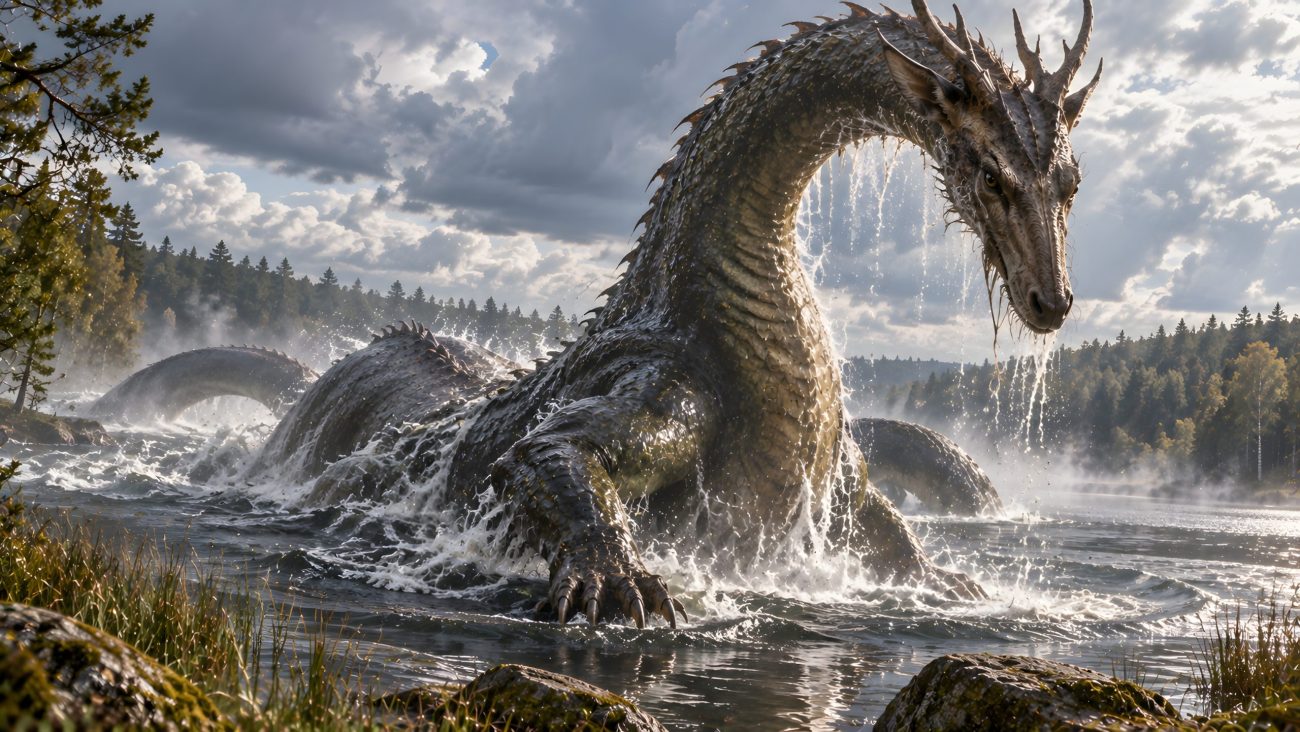
Descriptions of the creature vary, but it is generally imagined as a gigantic serpent-like or dragon-like animal. One description compares it to a large snake with a long neck and a head resembling that of a deer, with a mouth full of sharp teeth. Another describes a creature resembling a gigantic fish, with a head like a horse or a deer. Accounts also give it enormous size and strength, with some saying that its body could stretch for great distances through the water.

The Lepel Tsmok was traditionally feared as a powerful creature of the lakes and rivers. Stories tell of it appearing in the water, frightening people, and occasionally attacking or interfering with boats. Its appearance was often associated with mysterious disturbances in the lakes of the Lepel region.

According to local tradition, the great lake dragons appeared in the Belarusian lakes hundreds of years ago. One tradition connects their disappearance with the legend of Saint Ambrose of Kuteyn. When the saint encountered the dragons and their supernatural presence, he is said to have cursed them and driven them away from the lakes.

Another tradition tells of the disappearance of the Lepel Tsmok through the actions of the villagers themselves. The creature was said to have lived in the lake and surrounding waterways, while people avoided disturbing it. Stories nevertheless persisted of enormous creatures moving beneath the surface and occasionally appearing near the shore.

The Lepel region also preserved ritual traditions connected with the tsmok. In one account, people went to the lakes and rivers to make offerings and pray for protection. The local people regarded the waters as inhabited by powerful supernatural beings, and certain days were considered especially dangerous for entering them.

Stories of the Lepel Tsmok continued into modern times. People claimed to have seen a huge serpent-like creature swimming in the rivers and lakes of the region. Witnesses described an enormous body moving through the water, sometimes with only the head and part of the back visible above the surface.

The creature also became connected with Belarusian literary culture. Vladimir Korotkevich used the traditions surrounding the Lepel Tsmok and the ancient lake dragons in his writings, helping preserve the creature as one of the best-known legendary monsters of Belarus.


Sources

“Лепельский Цмок (Lepelskiy Tsmok).” New Bestiary (Bestiary.us). Accessed September 5, 2026. https://www.bestiary.us/lepelskij-cmok


Seven Roe Deer

Tradition: Austrian Mythology
Alternative Names: Die sieben Rehe
Category: Deer


The Myth

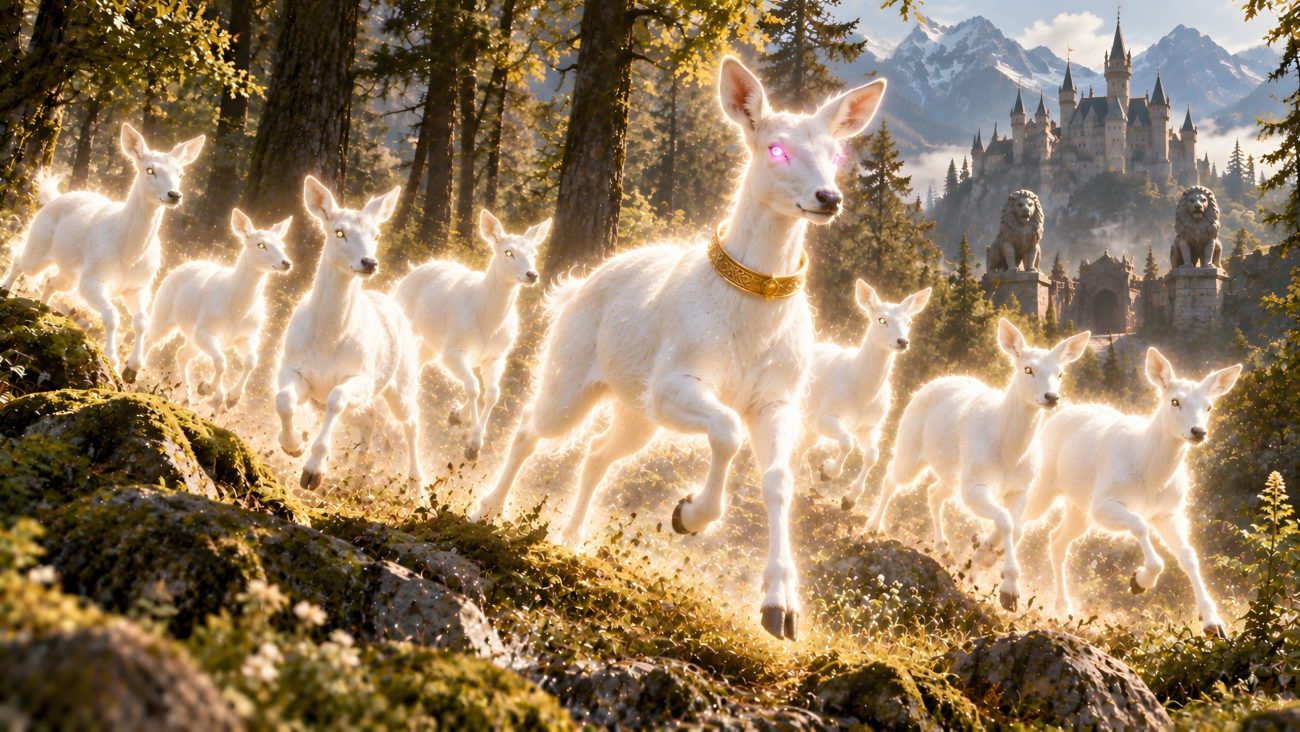
The Seven Roe Deer are seven white roe deer that appear in an old tale from the Austrian Alps. Six of them are ordinary in appearance, while the seventh is slightly larger and wears a golden ring around its neck.

Once there was a count who possessed many forests and a large household of servants. He was very devout and had already won many victories. During times of peace, his greatest pleasure was hunting wild animals, often riding far into the forest with his retinue.

One day, while hunting near the end of May, the count saw a white roe deer running across a meadow in the distance. He immediately rode after it on horseback and pursued it deep into the forest. None of his servants followed him, as he was riding too quickly and soon disappeared from their sight.

The count eventually realized that he had become deeply lost in the forest. Although he repeatedly sounded his hunting horn, which could be heard from far away, nobody came. Nevertheless, he continued following the roe deer.

The animal eventually led him to a large and beautiful meadow. To his astonishment, six other white roe deer were there. One of them was somewhat larger than the others and wore a golden ring around its neck. The count tried several times to shoot it, but every shot missed.

The seven roe deer continued onward, and the count followed them. They led him alternately through dense forests, across beautiful meadows, and over mountains until they finally arrived before a great castle that appeared to be completely uninhabited. On either side of the gate stood two enormous lions guarding the entrance.

When the roe deer reached the gate, it opened. The deer and the count passed through, after which the gate closed by itself. The count found himself inside a large square courtyard with no other exit. He had been trapped within the castle walls.

He explored the upper floors and discovered rooms and halls decorated with extraordinary wealth. The walls were golden, the beds were golden, and golden tables stood throughout the chambers. In a smaller room he found a mirror hanging in a broad golden frame, with a parchment hidden behind it.

The count took out the parchment and read its message:

“Whoever frees the imprisoned princess shall possess an entire kingdom. But he must overcome a terrible monster that comes every night at twelve o’clock beneath a terrifying rattling of chains and devours everything that is on the golden tables.”

The count was filled with horror when he read this, but he decided to face the monster because he was well armed. He ate some food and prepared himself for the night. He lay down in one of the golden beds, placing his sword and two loaded pistols on a nearby table so that they would be immediately within reach.

He had not been asleep for long when he heard the terrifying rattling of chains coming up the staircase. Soon a black man appeared. He had a single enormous eye in the middle of his forehead, shining so brightly that it illuminated the entire room. His body was covered with hair, and chains were wound around his back.

As soon as the count saw him, he leapt toward the monster and fought him with his sword. After a fierce struggle, he managed to cut off the monster’s head. The monster then asked the count to give the golden necklace from the deer to him. The count refused.

After the battle, the count returned to bed and slept peacefully for the remainder of the night.

The following morning, when he entered the courtyard, he saw the same seven roe deer that had led him to the castle. He approached them and kissed the largest deer. The seven white deer then transformed before him into seven beautifully dressed maidens.

The largest deer, the one that had worn the golden ring around its neck, revealed that she was the princess of the kingdom. She and her companions had been transformed into deer by the terrible monster. She explained that she had already led many people to the castle, but none had been fortunate enough to defeat the monster.

The princess then married the count who had freed her, and the two lived happily together. The tale concludes that, if they have not died, they are still living happily to this day.


Sources

Vernaleken, Theodor. “Die sieben Rehe.” In Kinder- und Hausmärchen in den Alpenländern. Vienna, 1863. Reproduced by SAGEN.at. https://www.sagen.at/texte/maerchen/maerchen_oesterreich/allgemein/vernaleken/sieben_rehe.html


Elen

Tradition: Bulgarian Mythology
Alternative Names: Deer
Category: Deer


The Myth

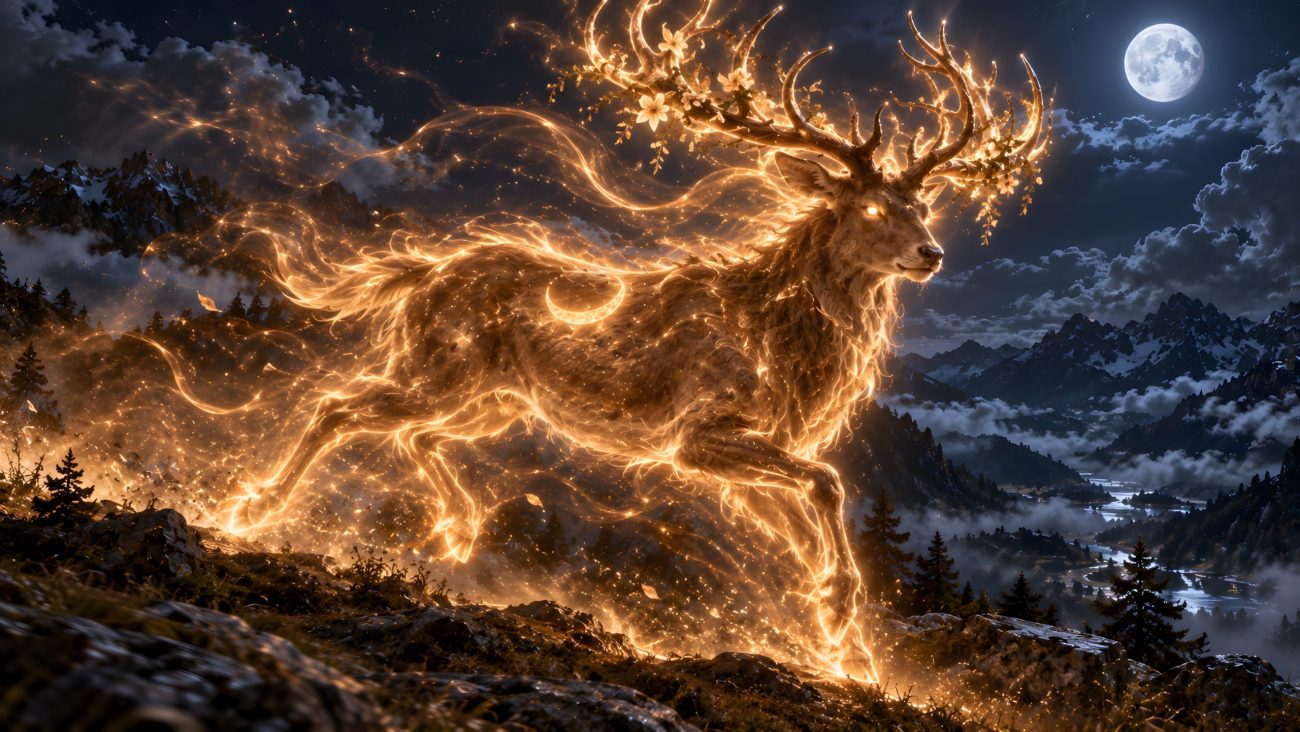
In Bulgarian beliefs, the deer was a companion of the wood nymphs. Its natural abode was in the high mountains, where it was believed to be able to fly over the clouds and the moon. Wood nymphs girded with arrows were said to use the deer as a mount.

Killing a deer was forbidden. The milk of does and the antlers of the deer were believed to possess curative powers, while the antlers could ward off evil spirits and diseases.

When God wished to communicate something to people, he could send a saint or an angel in the guise of a deer. Such a deer was therefore understood to be something extraordinary, carrying a divine message.

The deer was also preserved in Bulgarian folk song as a solar symbol, connected with both heaven and earth. One poetic image describes a bright sun shining on its brow, bright stars upon its chest, and a bright moon upon its back.


Sources

Georgieva, Ivanichka. Bulgarian Mythology. Sofia: Svyat Publishers, 1985. https://archive.org/details/bulgarianmytholo0000unse


Kalir

Tradition: Evenki Mythology, Russian Mythology
Alternative Names: Kalir
Category: Deer


The Myth

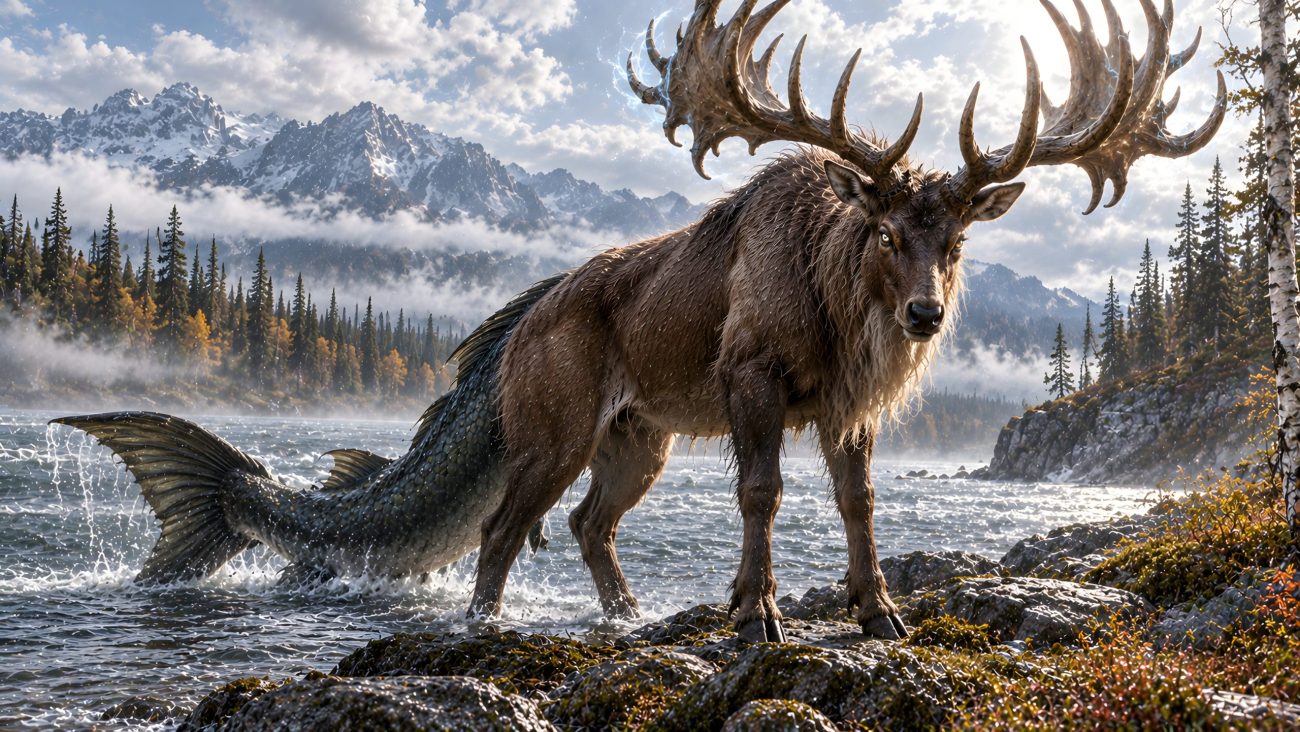
Kalir is a mythical creature from Evenki folklore with the body of a gigantic male wild deer. It has elk antlers on its head and a fish’s tail.

Kalir acts as a spirit assistant to the shaman, serving as a supernatural helper within Evenki shamanic tradition.


Sources

“Калир (Kalir).” New Bestiary (Bestiary.us). Accessed September 5, 2026. https://www.bestiary.us/kalir


Kasunga

Tradition: Japanese Mythology
Alternative Names: Kasunga, Kasuga
Category: Deer, Deity


The Myth

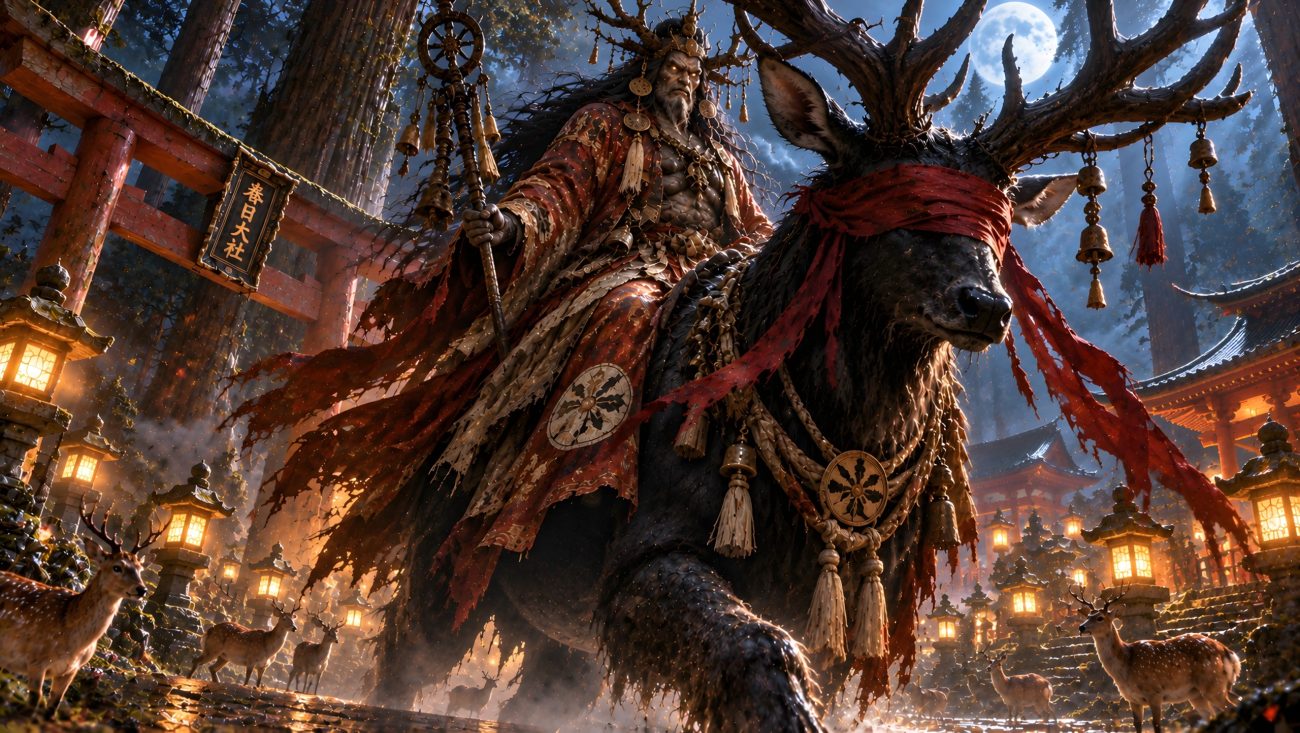
Kasunga refers to the deity associated with Kasuga Grand Shrine in Nara, whose sacred deer were regarded as messengers of the gods. The deer were allowed to roam freely through the streets of Nara and were treated with great reverence.

In 1565, the Jesuit missionary Luis Frois wrote a letter to a colleague in Goa describing Nara as a place subordinate to a shrine of the “devil” named Kasunga. He reported that Nara contained many deer, which he interpreted as idols of the devil. According to his account, the deer wandered through the streets as freely as dogs in Spain, and nobody was permitted to touch them. Anyone who attempted to strike one would supposedly be severely punished, while killing a deer could result in execution and confiscation of all possessions.

Frois therefore understood the worship of Kasunga and the reverence shown toward the deer as a form of devil worship. His description reflects the perspective of a Christian missionary who interpreted Japanese religious practices through the framework of Christianity and regarded non-Christian gods as demonic beings.

Other missionaries who visited Nara during the same period gave different descriptions. In 1565, Almeida described the deity as Kakunga and wrote that the god was believed to grant worldly honor, wealth, longevity, and other things people desired, explaining that these promises made the deity greatly worshipped. He did not specifically characterize the god as a demon.

Gaspar Vilela similarly described the worship at Kasuga Shrine, comparing what he witnessed to the worship of Baal, his priests, and their temples among the ancient Phoenicians. Vilela also recorded a rumor from Miyajima that a demon took the form of a deer in order to be worshipped.

Thus, the accounts of Kasunga preserve an early European interpretation of the sacred deer and religious traditions of Nara. The deer themselves were not originally understood by the Japanese as demons, but as sacred messengers connected with the gods of Kasuga.


Sources

Takahashi, Toshihiro. “カスンガ (Kasunga).” 新版TYZ 妖怪図鑑 (New TYZ Yokai Encyclopedia). December 31, 2019. https://tyz-yokai.blog.jp/archives/1076296181.html


Tarand

Tradition: Scythian Mythology, Russian Mythology, Ukranian Mythology
Alternative Names: Tarandos, Tarandus, Parandrus, Parandros, Aeternae, Analopos, Antalope, Antholops, Aptaleon, Aptolos, Pantolops
Category: Deer


The Myth

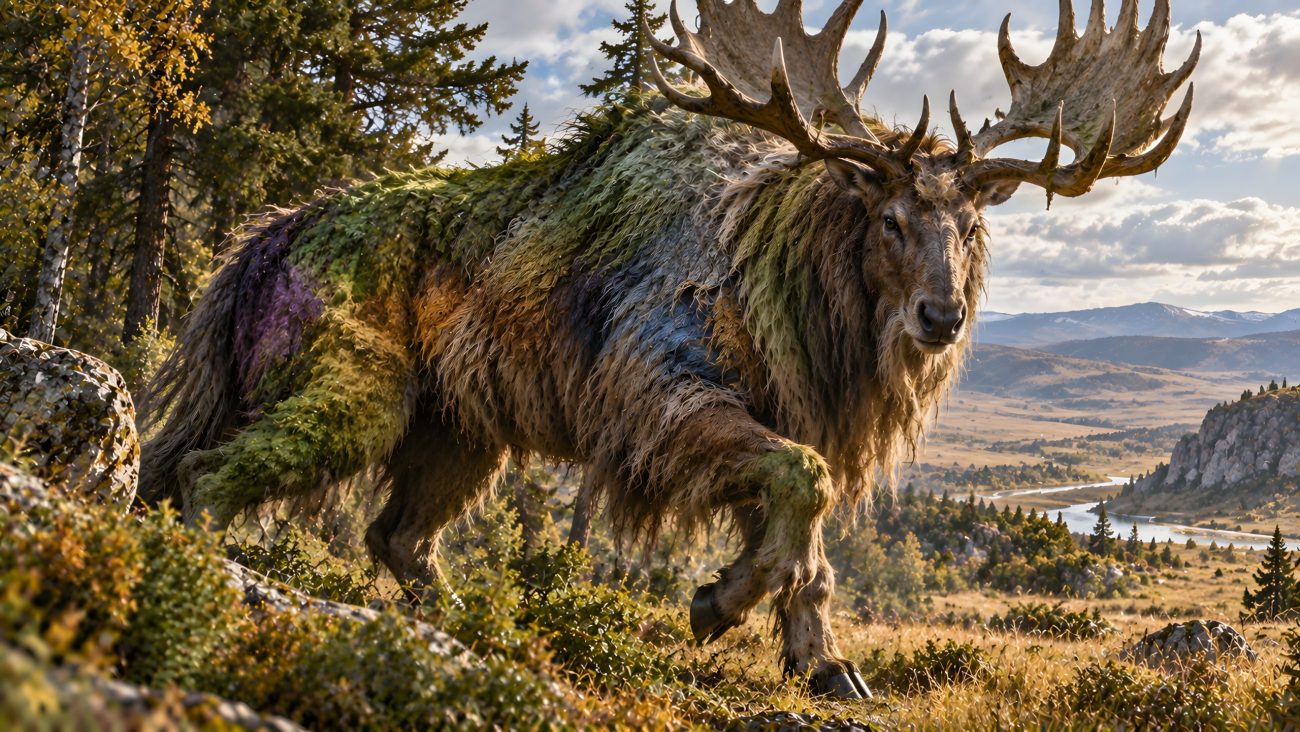
The Tarand is a rare and extraordinary beast said to resemble a large deer or moose. It is described as being about the size of an ox, with a head resembling that of a deer and large, branched antlers. It has cloven hooves, long hair like that of a bear, and an exceptionally tough hide that was said to be strong enough to make shields and breastplates.

Its most remarkable ability is its power to change the color of both its skin and hair. The Tarand can take on the color of whatever surrounds it, becoming the same color as trees, shrubs, plants, flowers, grass, rocks, or the ground. This ability makes it extremely difficult to detect and capture.

The creature was said to inhabit Scythia, particularly among the Scythians called the Geloni. When frightened, it would retreat into its surroundings and take on their colors. When it returned to its natural coloration, it was said to resemble an ass.

Aristotle described the Tarand as an exceptionally rare animal whose hair changed color according to the place in which it stood. He compared its ability to the color-changing skin of the chameleon and polypus, but considered the Tarand remarkable because the transformation affected its hair as well. He described it as being as large as an ox, with the head of a deer.

Pliny the Elder gave a more detailed account. He described the Tarand as an ox-sized creature with a large stag-like head and branched horns, cloven hooves, and deep hair like that of a bear. Its hide was so tough that the Scythians supposedly used it to make protective armor. When the animal hid, its body and hair could imitate the colors of the surrounding trees, plants, flowers, and landscape.

Aelian likewise described the Tarand as a creature from Scythia whose back and size resembled those of a bull. The animal could transform itself completely, hair included, into an astonishing variety of colors. The Scythians were said to cover their shields with its hide and consider it an effective protection against spears.

The Tarand later entered medieval bestiary tradition under forms such as Parandrus. It continued to be described as an animal capable of changing its entire appearance according to its surroundings.

The creature also appeared in later European literature. In François Rabelais’s Pantagruel, the Tarand is described as a bull-sized animal with a stag’s head, branched horns, cloven feet, long bear-like hair, and skin almost as hard as steel armor. Rabelais emphasized that not only the creature’s skin but also its hair could change color according to the objects around it. He even described it changing colors voluntarily according to its fear and emotions.

The Tarand was also said to be unusually tractable when domesticated, despite its rarity and strange abilities. Through these ancient and medieval accounts, it became one of the most remarkable legendary animals associated with the far north and the mysterious natural world beyond the Mediterranean.


Sources

“Tarand (animal).” Wikipedia: The Free Encyclopedia. Wikimedia Foundation. Accessed September 5, 2026. https://en.wikipedia.org/wiki/Tarand_(animal)


Fu Zhu

Tradition: Chinese Mythology
Alternative Names: 夫诸
Category: Deer


The Myth

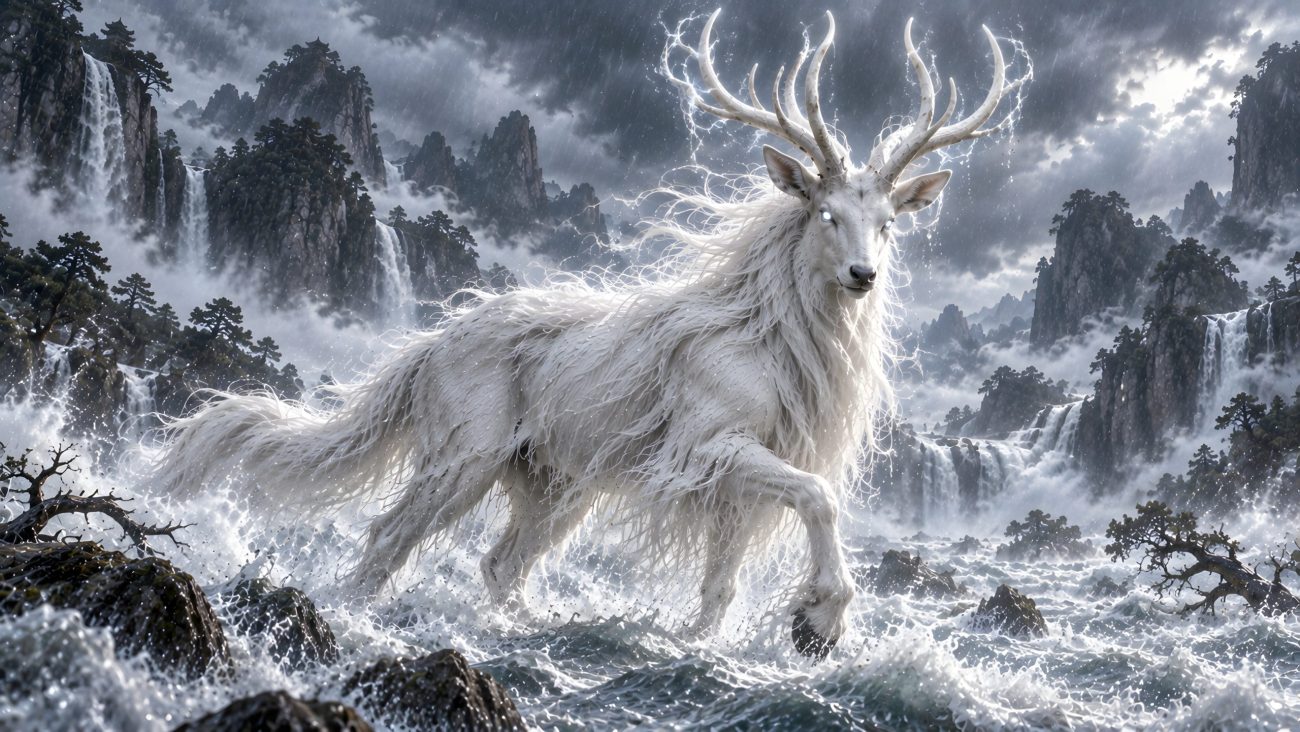
Fu Zhu is a strange white deer with four horns. It is described as resembling an ordinary white deer, except for its four antlers. The creature is associated with water and is regarded as an omen of great floods.

The earliest records of Fu Zhu appear in the Classic of Mountains and Seas. In the Central Mountains Classic, a strange beast is described as having the appearance of a white deer with four horns. It is associated with water and is called Fu Zhu.

The Classic of Mountains and Seas records that Fu Zhu appeared on a mountain in the Central Mountains region. When the creature appeared, it was regarded as a warning that a great flood would soon occur.

According to the tradition, the appearance of a Fu Zhu was therefore not a favorable sign. When one was seen, the settlement in its vicinity could expect a great inundation.


Sources

“夫諸 (Fūzhū).” Chinese Wikipedia. Wikimedia Foundation. Accessed September 5, 2026. https://zh.wikipedia.org/wiki/%E5%A4%AB%E8%AB%B8


Umishika

Tradition: Japanese Mythology
Alternative Names: Umishika
Category: Deer


The Myth

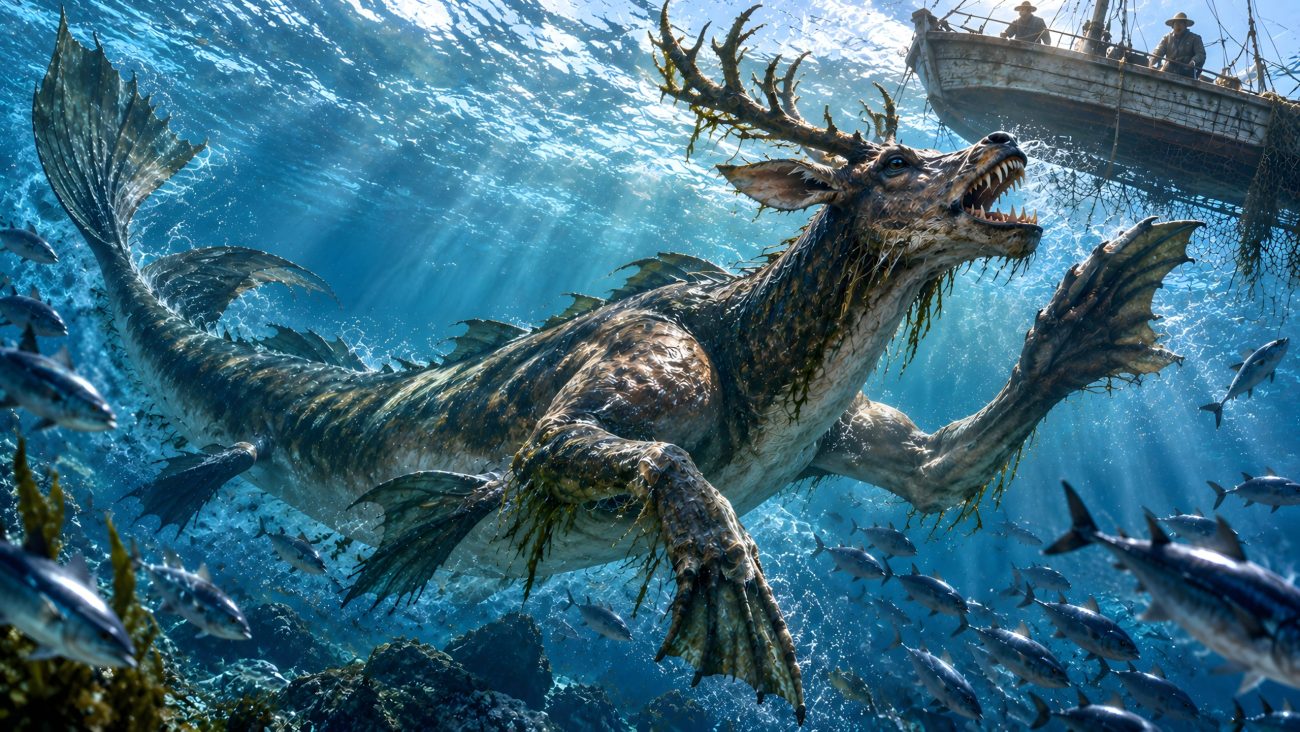
Umishika, meaning “sea deer,” are dangerous sea monsters said to inhabit the open waters south of Japan, particularly around the island of Yakushima and off the southern coast of Kyūshū. Because they live deep beneath the sea, little is known about their appearance. Fishermen who encounter them describe seeing dark, shadowy forms lurking beneath the waves. They are greatly feared by the island’s fishermen.

Umishika are carnivorous and prey on medium-sized fish such as skipjack tuna. They are also aggressive toward humans and will attack fishing boats that enter their feeding grounds.

According to a legend from Yakushima, the umishika are responsible for the taboo against fishing on the sixteenth day of the fifth month of the old lunar calendar.

Long ago, the sixteenth day of the fifth month was considered a holy day belonging to the mountain gods. On that day, all the gods and spirits of the mountains gathered together for a great banquet, and villagers were forbidden from entering the mountains.

One year, however, a fishing boat from the village of Issō went out onto the open sea northwest of Yakushima to catch skipjack tuna. A huge number of fish were swimming close to the surface, and the fishermen were certain that a large shoal was nearby.

When they reached the spot, the fishermen were delighted by how easily they could catch fish. They pulled one tuna after another from the water.

Suddenly, a huge dark shape appeared beneath the surface. One of the elder fishermen recognized the danger and cried out, “It’s an umishika!”

The fishermen immediately pulled in their lines, raised the sails, and prepared to flee toward shore. But the umishika had already noticed them.

The monster pursued the boat, diving beneath the waves and appearing again between the swells. The wind made it difficult for the fishermen to escape, while they rowed with all their strength. They attempted to slow the creature by throwing all of the tuna they had caught into the water behind the boat, hoping it would stop to feed on them.

The tactic failed. Before long, the umishika had caught up with them.

As the monster prepared to climb aboard the boat, one of the fishermen seized an oar and thrust it with all his strength into the creature’s open mouth. The umishika recoiled and fell back into the sea, abandoning its pursuit.

The fishermen rowed continuously toward shore, exhausted by their struggle but grateful to have survived.

Afterwards, the villagers decided that the prohibition on the sixteenth day of the fifth month should apply not only to the mountains but also to the sea. From then on, hunters and fishermen remained at home on that day, making offerings and holding festivals for the gods of the mountains and the sea.


Sources

“Umishika.” Yokai.com: The Japanese Yokai Encyclopedia. Accessed September 5, 2026. https://yokai.com/umishika/