Kasunga

Tradition: Japanese Mythology
Alternative Names: Kasunga, Kasuga
Category: Deer, Deity


The Myth

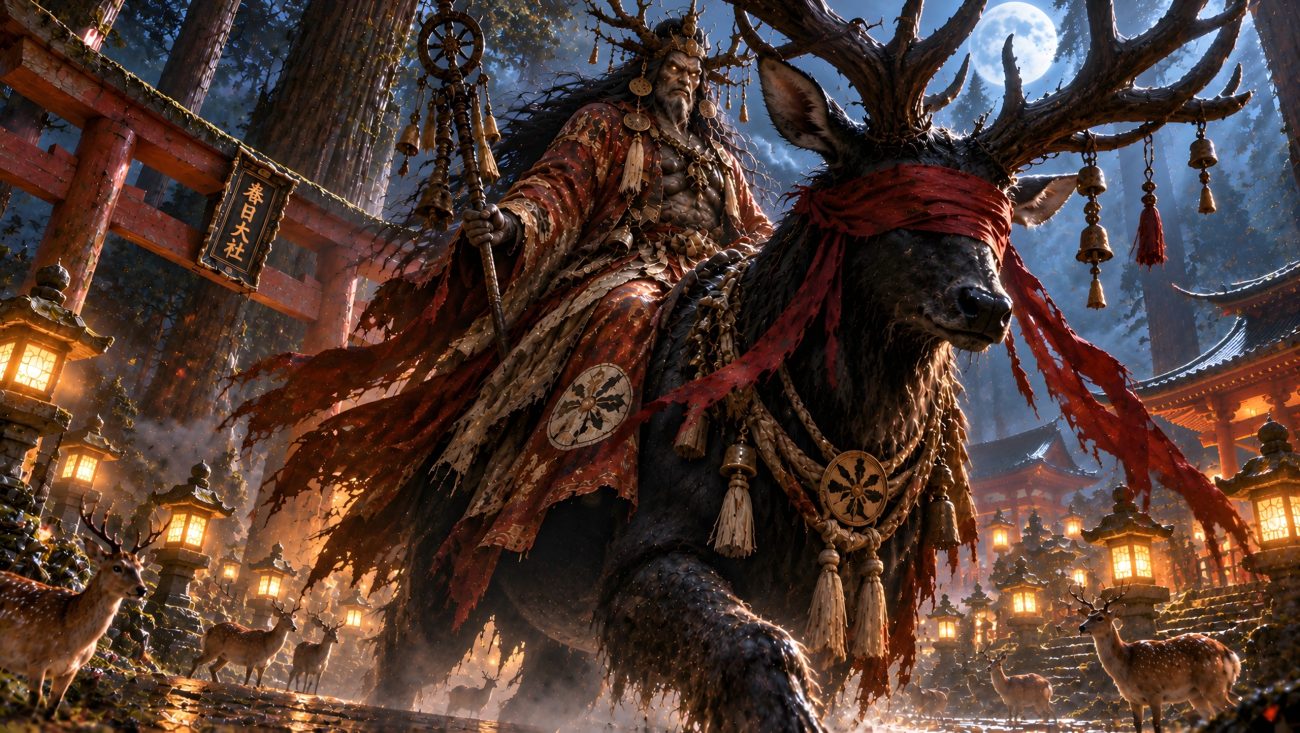
Kasunga refers to the deity associated with Kasuga Grand Shrine in Nara, whose sacred deer were regarded as messengers of the gods. The deer were allowed to roam freely through the streets of Nara and were treated with great reverence.

In 1565, the Jesuit missionary Luis Frois wrote a letter to a colleague in Goa describing Nara as a place subordinate to a shrine of the “devil” named Kasunga. He reported that Nara contained many deer, which he interpreted as idols of the devil. According to his account, the deer wandered through the streets as freely as dogs in Spain, and nobody was permitted to touch them. Anyone who attempted to strike one would supposedly be severely punished, while killing a deer could result in execution and confiscation of all possessions.

Frois therefore understood the worship of Kasunga and the reverence shown toward the deer as a form of devil worship. His description reflects the perspective of a Christian missionary who interpreted Japanese religious practices through the framework of Christianity and regarded non-Christian gods as demonic beings.

Other missionaries who visited Nara during the same period gave different descriptions. In 1565, Almeida described the deity as Kakunga and wrote that the god was believed to grant worldly honor, wealth, longevity, and other things people desired, explaining that these promises made the deity greatly worshipped. He did not specifically characterize the god as a demon.

Gaspar Vilela similarly described the worship at Kasuga Shrine, comparing what he witnessed to the worship of Baal, his priests, and their temples among the ancient Phoenicians. Vilela also recorded a rumor from Miyajima that a demon took the form of a deer in order to be worshipped.

Thus, the accounts of Kasunga preserve an early European interpretation of the sacred deer and religious traditions of Nara. The deer themselves were not originally understood by the Japanese as demons, but as sacred messengers connected with the gods of Kasuga.


Sources

Takahashi, Toshihiro. “カスンガ (Kasunga).” 新版TYZ 妖怪図鑑 (New TYZ Yokai Encyclopedia). December 31, 2019. https://tyz-yokai.blog.jp/archives/1076296181.html


Umishika

Tradition: Japanese Mythology
Alternative Names: Umishika
Category: Deer


The Myth

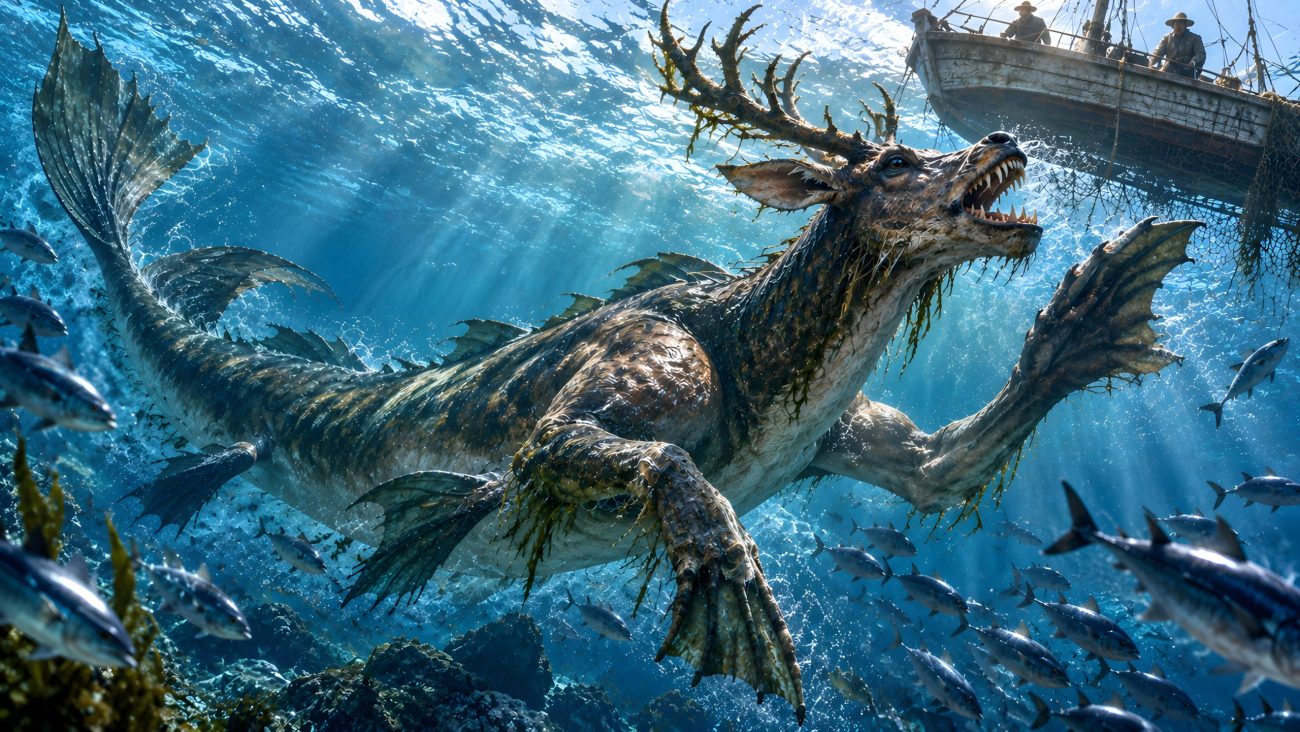
Umishika, meaning “sea deer,” are dangerous sea monsters said to inhabit the open waters south of Japan, particularly around the island of Yakushima and off the southern coast of Kyūshū. Because they live deep beneath the sea, little is known about their appearance. Fishermen who encounter them describe seeing dark, shadowy forms lurking beneath the waves. They are greatly feared by the island’s fishermen.

Umishika are carnivorous and prey on medium-sized fish such as skipjack tuna. They are also aggressive toward humans and will attack fishing boats that enter their feeding grounds.

According to a legend from Yakushima, the umishika are responsible for the taboo against fishing on the sixteenth day of the fifth month of the old lunar calendar.

Long ago, the sixteenth day of the fifth month was considered a holy day belonging to the mountain gods. On that day, all the gods and spirits of the mountains gathered together for a great banquet, and villagers were forbidden from entering the mountains.

One year, however, a fishing boat from the village of Issō went out onto the open sea northwest of Yakushima to catch skipjack tuna. A huge number of fish were swimming close to the surface, and the fishermen were certain that a large shoal was nearby.

When they reached the spot, the fishermen were delighted by how easily they could catch fish. They pulled one tuna after another from the water.

Suddenly, a huge dark shape appeared beneath the surface. One of the elder fishermen recognized the danger and cried out, “It’s an umishika!”

The fishermen immediately pulled in their lines, raised the sails, and prepared to flee toward shore. But the umishika had already noticed them.

The monster pursued the boat, diving beneath the waves and appearing again between the swells. The wind made it difficult for the fishermen to escape, while they rowed with all their strength. They attempted to slow the creature by throwing all of the tuna they had caught into the water behind the boat, hoping it would stop to feed on them.

The tactic failed. Before long, the umishika had caught up with them.

As the monster prepared to climb aboard the boat, one of the fishermen seized an oar and thrust it with all his strength into the creature’s open mouth. The umishika recoiled and fell back into the sea, abandoning its pursuit.

The fishermen rowed continuously toward shore, exhausted by their struggle but grateful to have survived.

Afterwards, the villagers decided that the prohibition on the sixteenth day of the fifth month should apply not only to the mountains but also to the sea. From then on, hunters and fishermen remained at home on that day, making offerings and holding festivals for the gods of the mountains and the sea.


Sources

“Umishika.” Yokai.com: The Japanese Yokai Encyclopedia. Accessed September 5, 2026. https://yokai.com/umishika/


Konjiki-shika

Tradition: Japanese Mythology
Alternative Names: Golden Deer
Category: Deer


The Myth

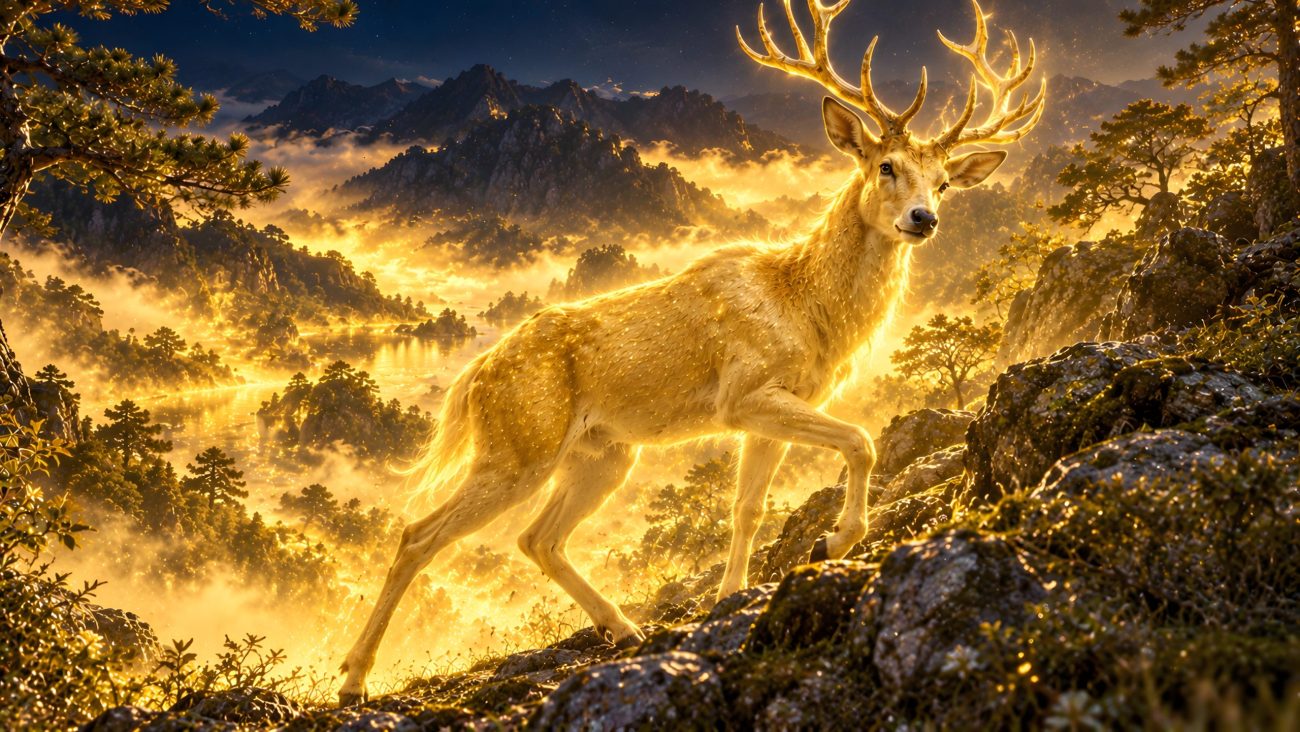
The Golden Deer is a supernatural deer described in a tale from Kai Province, Japan. Its body shone with a brilliant golden light, illuminating the surrounding valley as brightly as daylight.

The story comes from Urami Kanwa, a collection of observations and experiences from Kai Province compiled by Noda Narikata, who served as a Kofu official from 1724 to 1753.

In Tsukahara Village in Yamanashi County, there lived a fisherman named Takebei. One night toward the end of the rainy season in May, Takebei climbed to the top of Hachioji Mountain and looked in every direction, searching for birds and animals to hunt. That night, however, he encountered nothing.

Then he happened to look down into the valley. To his surprise, the entire valley was filled with a golden light as bright as daytime.

Wondering what could be causing such a strange sight, Takebei looked more closely. Within the golden light he saw a deer quietly walking through the valley, attempting to climb the mountain. Its body appeared golden and was surrounded by the brilliant light.

Takebei rejoiced, believing that the extraordinary animal had been sent to him as a gift from Heaven. He raised his gun and took aim at the Golden Deer.

At that moment, however, someone suddenly seized Takebei by his topknot and pulled him violently to the ground onto his back. His gun went off, but the bullet merely cut through the air.

Takebei was left stunned by what had happened. It was thought that the mysterious force that stopped him from killing the Golden Deer may have been the work of the spirit of the mountain god.


Sources

Takahashi, Toshihiro. “金色の鹿 [こんじき‐しか] (Konjiki-shika).” 新版TYZ 妖怪図鑑 (New TYZ Yokai Encyclopedia). April 14, 2019.
https://tyz-yokai.blog.jp/archives/1074336998.html


Kushikiroku

Tradition: Japanese Mythology
Alternative Names: Nine-Colored Deer,
Category: Deer


The Myth

The Nine-Colored Deer is a remarkable deer with nine-colored fur and antlers as white as snow. It lived hidden from humans in a mountain in India, where it was rarely seen. A crow also lived near the river at the foot of the mountain and had a deep bond with the deer.

One day, a man was swept away by the river and was close to drowning. Clinging desperately to a branch, he cried out to the mountain god, tree god, heavenly beings, and dragon god, asking why none of them would save him.

Hearing his cries, the Nine-Colored Deer came to the riverbank. It told the man not to be afraid and instructed him to climb onto its back and hold onto its antlers. The deer then carried him safely to land.

The man wept with gratitude and asked how he could ever repay the deer. The deer asked for only one thing: that the man never reveal that it lived on the mountain.

The deer explained that its nine-colored body and snow-white antlers were unlike anything else in the world. If people discovered it, they would surely kill it for its beautiful fur and antlers. Because of this, it had hidden itself deep within the mountains. Yet when it heard the man’s cries, pity overcame its fear and it came to rescue him.

The man promised never to reveal the deer’s whereabouts and returned home.

Some time later, the queen of the country dreamed of a deer with nine-colored fur and snow-white antlers. She became captivated by the creature and developed such a strong desire to possess its fur and antlers that she fell ill and was confined to her bed. She begged the king to find the deer, convinced that such a creature truly existed.

The king announced a great reward of gold, silver, and other treasures for anyone who could capture the Nine-Colored Deer.

The man who had been rescued knew exactly where the deer lived. At first, he kept the secret. But when he heard of the king’s reward, greed overcame his gratitude. He revealed the deer’s hiding place to the king, forgetting that the creature had saved his life.

The king immediately gathered many soldiers and took the man with him as their guide. They surrounded the valley where the deer lived.

The crow saw what was happening and flew to the cave where the Nine-Colored Deer was sleeping. It cried out a warning, telling the deer that the king had come with an army seeking its rare fur and that the valley had been surrounded.

The deer awoke and came out of its cave, but by then the king and his soldiers were already directly before it. There was nowhere left to escape.

Rather than flee, the deer walked fearlessly toward the king’s palanquin. The soldiers prepared to shoot it with arrows, but the king was moved by the creature’s fearless approach and ordered them to stop.

The deer knelt before the king and asked how he had discovered its hiding place. The king answered that the man standing beside him had led him there.

The deer looked at the man. A bruise had appeared on his face, perhaps as punishment for breaking his promise.

The deer then reminded him of what had happened. It had risked its own life to rescue him from the river, and he had promised never to reveal its existence. Yet he had forgotten the kindness shown to him and had betrayed the deer in exchange for a reward.

The man was unable to answer.

Seeing this, the king understood the man’s ingratitude. He issued a decree forbidding the killing of deer anywhere in his kingdom. Anyone who violated the decree would be executed, and their family would also be destroyed. The king then withdrew his soldiers and returned to his palace.

The Nine-Colored Deer had escaped death. It returned joyfully to its mountain, and afterwards the country prospered. Moderate rains fell, there were no destructive winds or epidemics, the harvests were abundant, and nobody lived in poverty.

The story concludes by contrasting human ingratitude with the kindness of animals: forgetting kindness is found among humans, while helping humans is found among animals. Such things, the story says, have happened both in the past and in the present.

The Nine-Colored Deer is also identified with the Buddha in one of his previous lives. The crow is identified with Ananda, the queen with Sundari, and the ungrateful drowned man with Devadatta. The Nine-Colored Deer Sutra additionally tells that the king scolded the man after learning the truth, and that thousands of deer gathered around the departing Nine-Colored Deer and followed it.


Sources

Takahashi, Toshihiro. “九色鹿 [くしきろく] (Kushikiroku).” 新版TYZ 妖怪図鑑 (New TYZ Yokai Encyclopedia). December 31, 2019. https://tyz-yokai.blog.jp/archives/1076296180.html