Puer

Tradition: Chinese Mythology
Alternative Names: Puer (疟鬼)
Category: Demon


The Myth

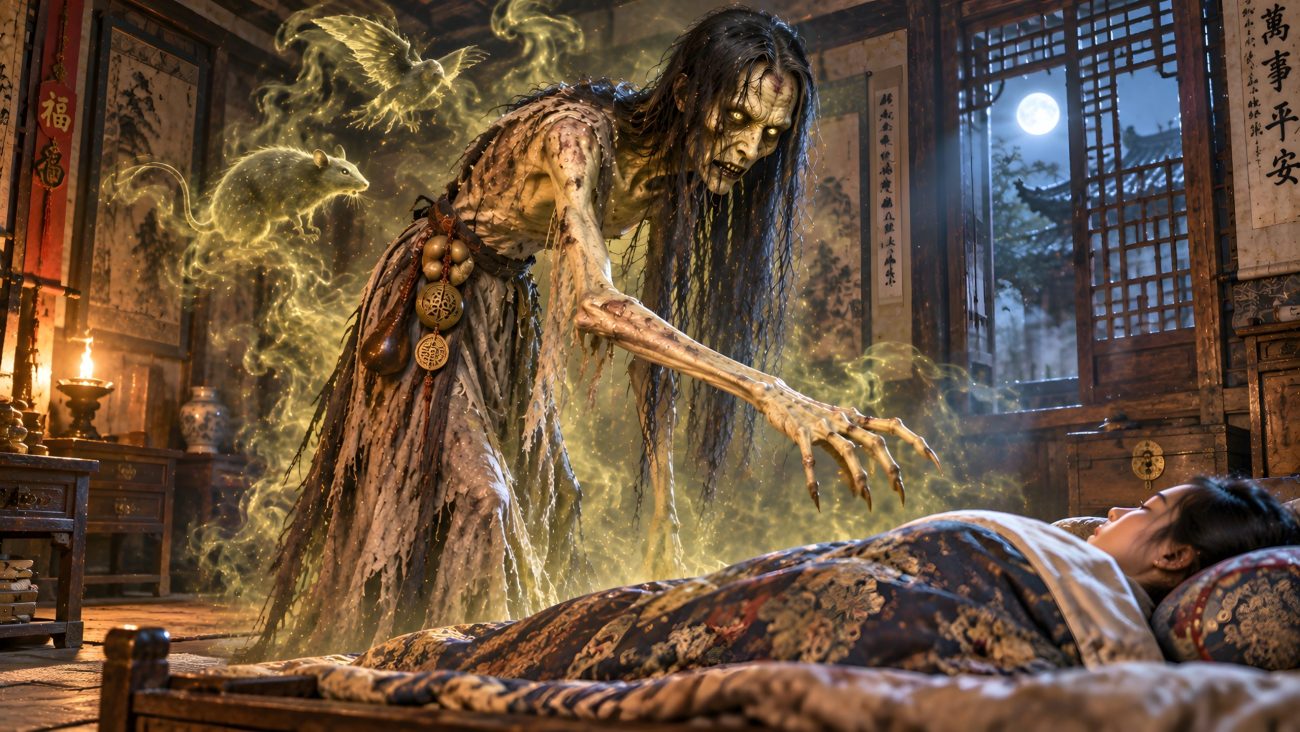
Puer is a Chinese supernatural being associated with malaria and other fevers. It was believed to be a demon responsible for causing illness.

In ancient Chinese accounts, Puer could appear before sleeping people in the form of a small animal, a bird, or a human. It would then approach the person’s body and cause them to fall ill. If the victim tried to drive the creature away, it would gradually grow larger.

Because Puer was associated with disease, people developed various customs intended to prevent it from entering their homes. A common practice was to seek refuge in temples or in other people’s houses before the illness was believed to strike, thereby avoiding the demon.

The Taiping Guangji records a story concerning a person from Jiangxi who was suffering from malaria. He encountered two people who told him that they had been sent to treat his illness.

In Anhui, there was also a custom connected with Puer. Before the local disease season, people would make a paste from soybeans, flour, and water, believing that this mixture could suppress the disease demons and prevent them from spreading illness.

Ancient Chinese medical and literary works likewise associated Puer with recurring fevers and disease. Its appearance and influence were understood through the supernatural framework of illness, with the demon serving as an explanation for the sudden onset of fever and other symptoms.


Sources

“疟鬼 (Nüèguǐ; Malaria Ghost).” Chinese Wikipedia. Wikimedia Foundation. Accessed September 6, 2026. https://zh.wikipedia.org/wiki/%E7%96%9F%E9%AC%BC


Ao Andon

Tradition: Japanese mythology
Alternative Names: Ao Andō, 青行燈
Category: Demon


The Myth

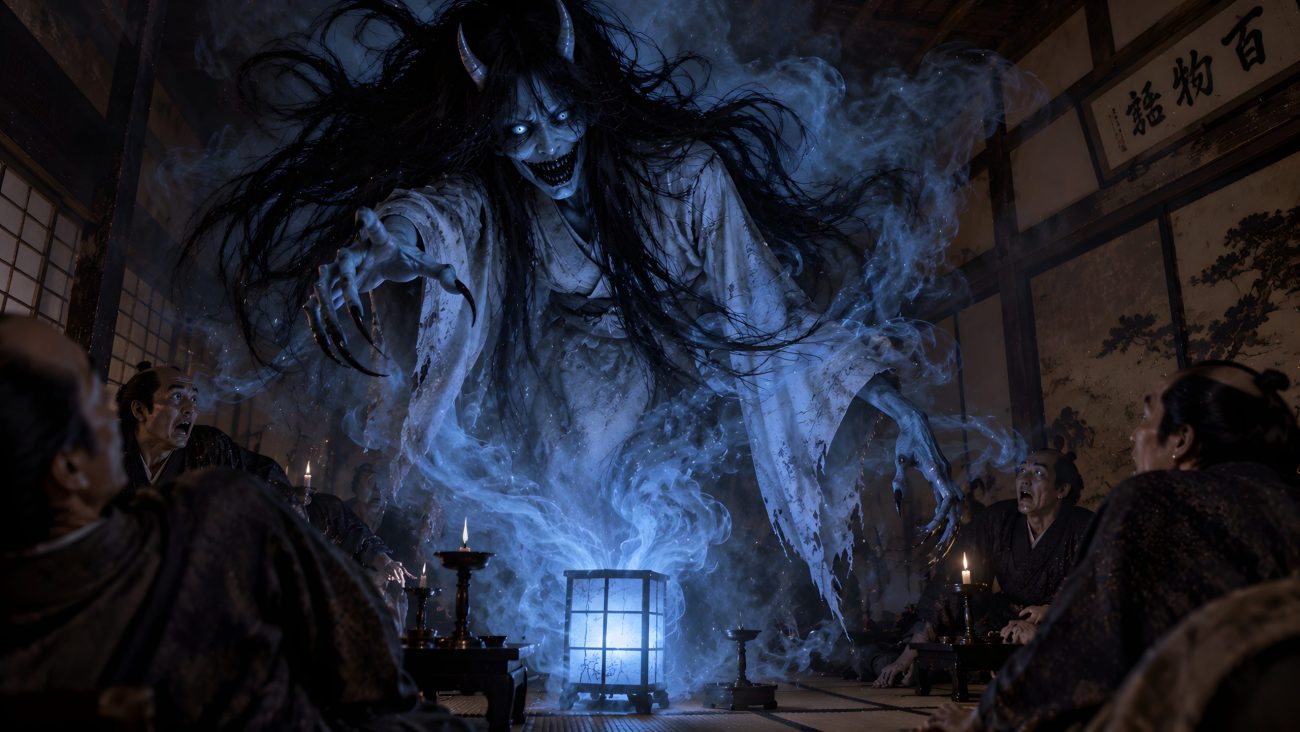
The Ao Andon, meaning “blue lantern,” is a supernatural spirit associated with the Japanese tradition of hyakumonogatari kaidankai, gatherings in which people told one hundred ghost stories. It appears as a demonic woman with long black hair, blue skin, blackened teeth, sharp claws, and horns. She wears a white or blue kimono and emits an eerie blue light.

During the Edo period, hyakumonogatari kaidankai became a popular summertime activity, particularly among the aristocratic classes. Groups gathered together to tell frightening stories in the hope that the fear would provide relief from the intense summer heat.

One hundred candles were placed inside blue paper lanterns called andon. The guests took turns telling increasingly frightening stories about yokai, demons, ghosts, and other supernatural beings. After each story, one candle was extinguished. As the night continued, the room gradually became darker until only the hundredth candle remained, its dim blue light casting long and unsettling shadows.

According to superstition, something terrible would happen when the final candle was extinguished. The accumulated fear of the participants would cause an actual spirit to materialize from the darkness. This spirit was called the Ao Andon.

The Ao Andon was said to emerge from the smoke of the final candle and attack the storytellers. Exactly what happened during this attack was never established. It might slaughter the participants in a horrific finale resembling the stories they had told, or it might simply appear suddenly and give them one final fright before disappearing.

In practice, however, the final story was traditionally never reached. By the time ninety-nine ghost stories had been told, the participants were supposedly too frightened to tell the hundredth. The gatherings therefore ended before the last candle was extinguished and the Ao Andon could appear.

The belief behind the Ao Andon was essentially that speaking about supernatural beings could cause them to appear. By gathering together, telling stories about ghosts and demons, and concentrating their fear upon them, the participants risked bringing the very spirits they discussed into the room.


Sources

“aoandon.” Yokai.com: The Japanese Yokai Encyclopedia. Accessed September 6, 2026. https://yokai.com/aoandon/


Amuku Pey

Tradition: Tamil folklore, Sri Lanka Mythology
Alternative Names: Amuku Pey
Category: Demon


The Myth

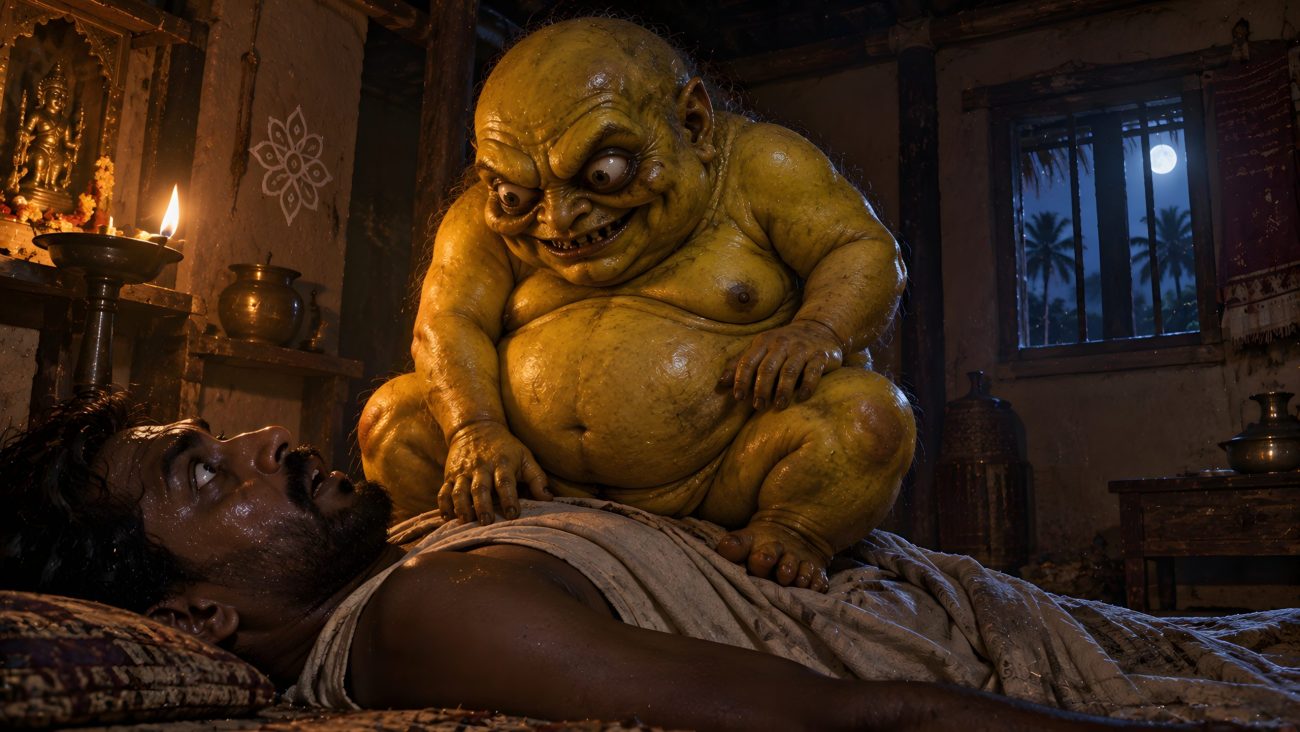
Amuku Pey is an evil spirit in Tamil folklore, particularly among the Tamil people of Sri Lanka. It is associated with sleep and is said to press down upon the chests of sleeping people.

The Amuku Pey is a personification of sleep paralysis, appearing at night while a person is asleep and creating the terrifying sensation of pressure upon the chest.


Sources

“Амуку-пей (Amuku Pey).” New Bestiary (Bestiary.us). Accessed September 6, 2026. https://www.bestiary.us/amuku-pei/en


Al Basty

Tradition: Sumerian Mythology, Armenian Mythology
Alternative Names: Al Basty, Al Kardai, Al Karısı, Albastı, Alvasti, Albasdı, Албасты
Category: Demon


The Myth

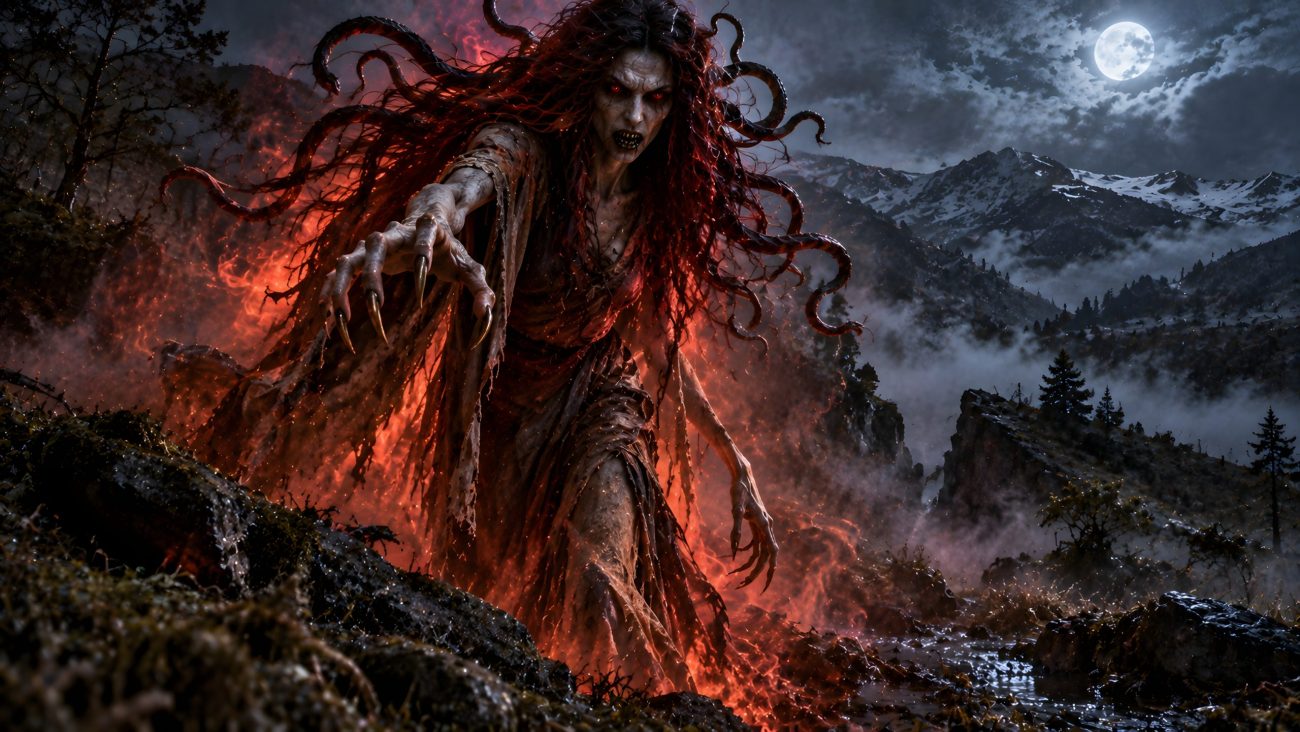
Al Basty is an ancient female spirit found in folklore across the Caucasus and Turkic-speaking regions. She is associated with guilt and is particularly connected with people whose families have committed bloody crimes that have gone unpunished.

The name is commonly associated with the Turkic words al, meaning “red,” and bastı, meaning “pressure” or “pressing.” The spirit is known under many different names across the region, including Al Karısı in Turkic folklore and Al Basty or Alvasti in various Turkic languages.

In some traditions, Al Basty has been associated with the ancient figure of Lilith. Later traditions connected with Lilith have also been attributed to Al Basty, although the stories vary according to the region.

In Turkic folklore, Al Basty has sometimes been confused with the Mare, the Succubus, and other female spirits said to visit people in their dreams. Unlike these spirits, however, Al Basty is not primarily described as a sexual being. Instead, she is said to visit people with guilty souls, particularly those descended from families responsible for violent crimes that were never punished.

Al Basty is especially feared by women during the period after childbirth. She is believed to haunt women during this vulnerable period and cause severe psychological distress. Traditional postpartum practices lasting forty days were consequently observed as a form of protection and care.

Those visited by Al Basty are said to awaken in an intense fever after suffering her torments. She is also associated with horses, which she is believed to steal during the night. Horses tormented by her are found the following morning sweating and exhausted and unable to work normally for the rest of the day. Because of this association, she is also known as the “red mother.”

In Armenian folklore, a related spirit called Āl appears as a demon of childbirth. She is said to blind unborn children and cause miscarriages and stillbirths to women who have committed crimes that have gone unpunished.

The Armenian Āl appears as a spirit of flame with snake-like hair, brass fingernails, and iron teeth. She hides in damp places and attacks women during childbirth. Similar traditions have also been recorded in Afghanistan.

Thus, the Al Basty tradition encompasses several related forms of a dangerous female spirit, particularly associated with guilt, childbirth, illness, and the consequences of violence left unpunished.


Sources

“Al Basty.” Wikipedia: The Free Encyclopedia. Wikimedia Foundation. Accessed September 6, 2026. https://en.wikipedia.org/wiki/Al_Basty


Nuribotoke

Tradition: Japanese mythology
Alternative Names: Nuribotoke
Category: Demon


The Myth

Nuribotoke is a yokai depicted in Japanese picture scrolls and illustrated collections of supernatural creatures, including Hyakkai Zukan and Toriyama Sekien’s Gazu Hyakki Yagyō (Illustrated Night Parade of One Hundred Demons).

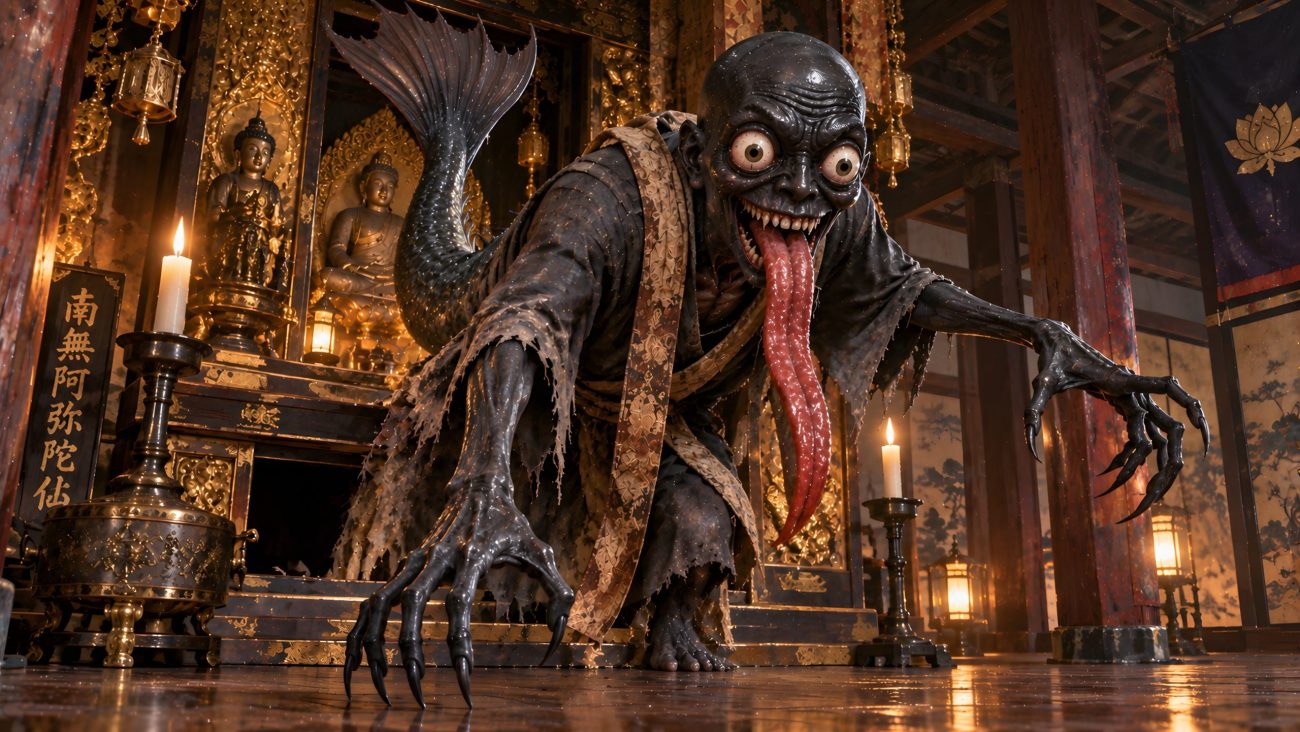
The creature is generally depicted as a completely black Buddhist monk with bulging eyes and a strange appendage resembling a fish’s tail extending from its back.

In Toriyama Sekien’s Gazu Hyakki Yagyō, the Nuribotoke appears emerging from inside a Buddhist altar. Its body is black, but unlike some other depictions, it does not have a tail on its back.

No accompanying text or explanation survives with the traditional illustrations, so there are no specific characteristics, legends, or stories associated with the Nuribotoke in these sources. In later children’s books dealing with yokai, it is sometimes described as suddenly appearing from a Buddhist altar to surprise people.


Sources

Takahashi, Toshihiro. “塗仏 [ぬりぼとけ] (Nuribotoke).” 新版TYZ 妖怪図鑑 (New TYZ Yokai Encyclopedia). October 25, 2009. https://tyz-yokai.blog.jp/archives/1010652662.html


Gofitterrak

Tradition: Sami mythology, Finnish Mythology, Russian Mythology
Alternative Names: Gofitterak, Gofitterak
Category: Deer


The Myth

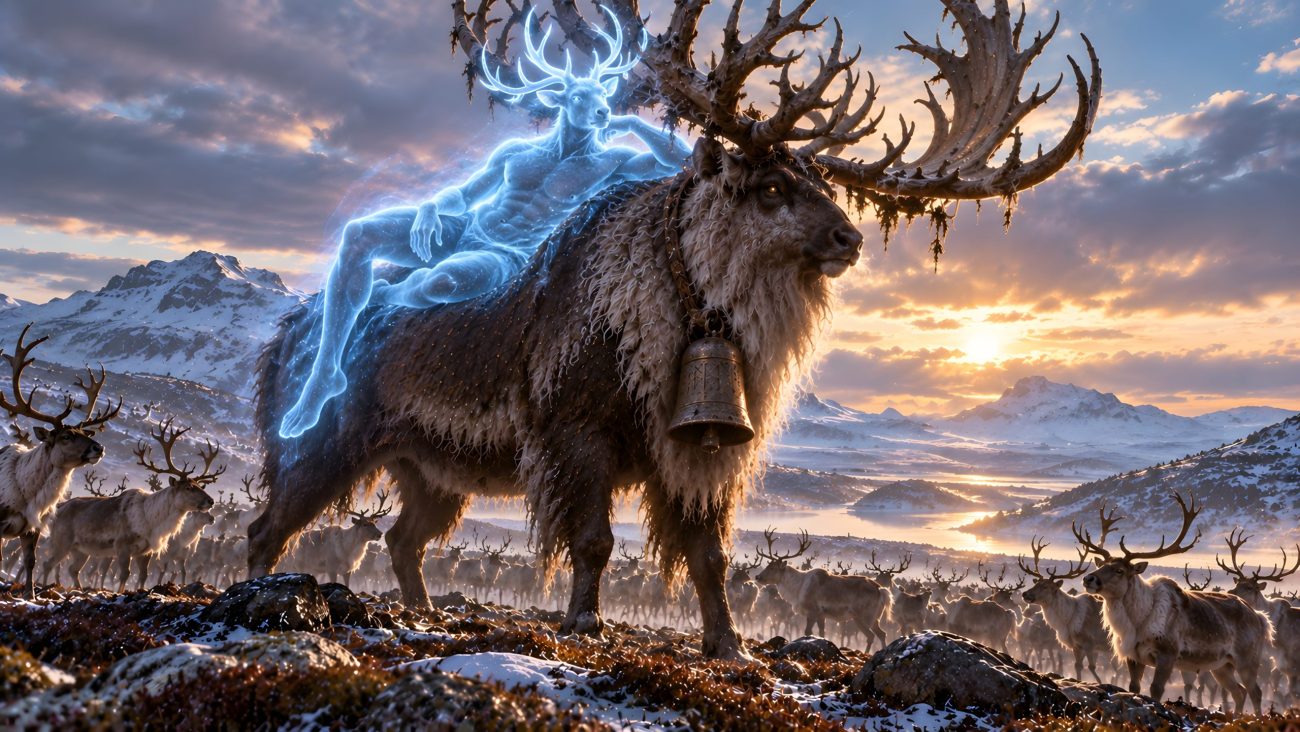
Gofitterrak are wealthy spirits who are masters of wild reindeer herds in Sami mythology. They inhabit the tundra and are associated with the pastures where reindeer graze. They are described as spirits who can be invisible like themselves, yet reveal their presence through the ringing of bells.

Among the mountains, particularly in the kegors—areas covered with lichen where deer graze—and in places covered with grass, the Gofitterrak live with their own herds of deer, cows, and sheep. They sometimes hang bells on their flocks, and by the ringing of these bells the Lapps learn of the spirits’ visible and invisible presence in the pastures.

The herds of the Gofitterrak can be mastered. To do this, a person must have the courage to approach the spirit’s flock while looking only upward and never turning back or looking to either side. The person must then throw a piece of iron into the middle of the flock.

The spirit who tends the herd fears iron and flees when it is thrown. The flock, however, becomes the property of the person who threw the iron away.


Sources

“Гофитэрраки (Gofiterraki).” New Bestiary (Bestiary.us). Accessed September 6, 2026. https://www.bestiary.us/gofiterraki


Teelget

Tradition: Navajo mythology, American Mythology
Alternative Names: Teelget
Category: Deer


The Myth

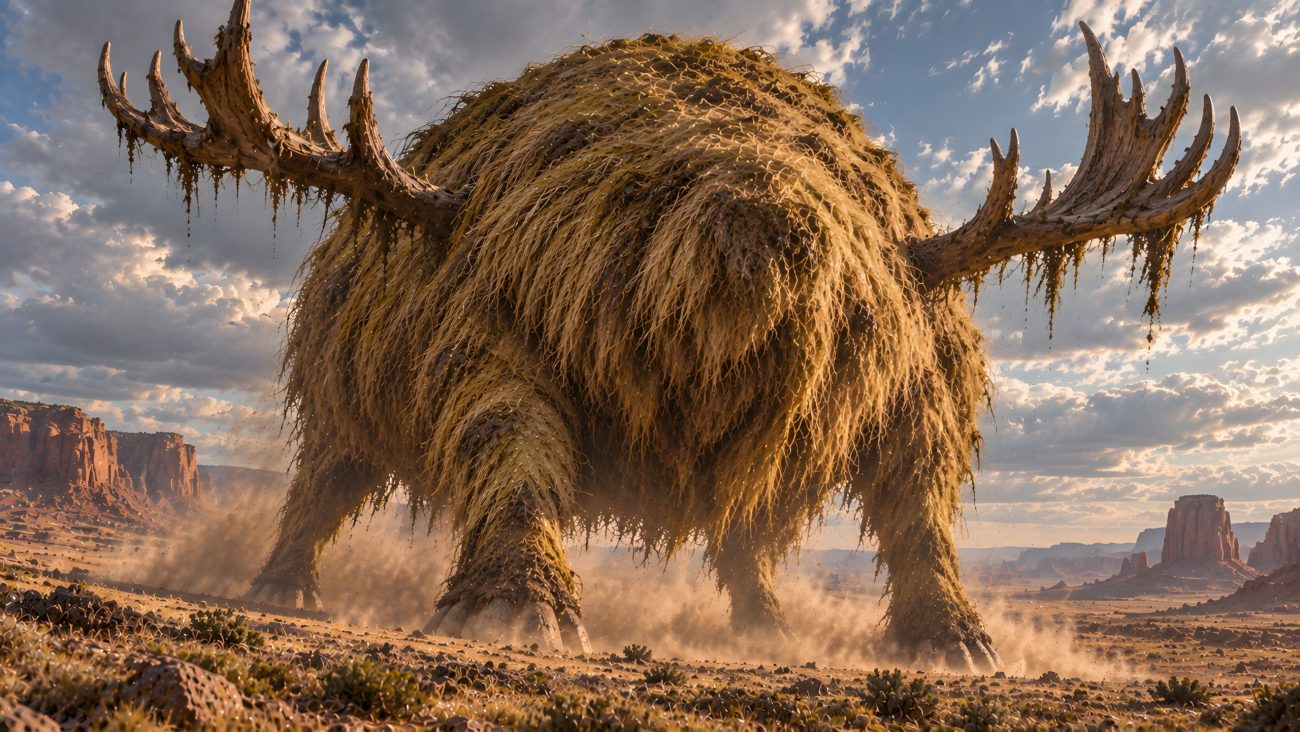
Teelget is one of the Anaye, the “Alien Gods” of Navajo mythology. He was born from a human woman who had resorted to unnatural and evil practices. His supposed father was an antler. The creature born from this union was round, hairy, and headless. Horrified by what she had produced, the woman cast the creature away, and it eventually grew into the monster known as Teelget.

Teelget resembles an enormous, headless elk or antelope. His body is rounded and covered in hair like that of a gopher, while his enormous antlers serve as deadly weapons. The origin of his name is uncertain, although the “tê” is said to refer to his horns.

Teelget became one of the destructive Anaye that laid waste to the land and slaughtered many people. Coyote served as his spy, helping Teelget and the other Anaye in their destruction.

It was Nayenezgani, the “Slayer of Alien Gods,” who finally set out to destroy Teelget. Armed with his lightning arrows, Nayenezgani tracked the monster to a wide open plain where Teelget was resting.

The plain offered no cover, and Nayenezgani realized that Teelget would notice him if he attempted to approach openly. While he considered how to reach the monster, Gopher appeared and asked why he had come. Gopher explained that nobody ventured into the area because everyone feared Teelget.

When Nayenezgani told Gopher that he intended to destroy Teelget, Gopher gladly offered to help. He asked only for Teelget’s hide as payment.

Gopher excavated a tunnel leading directly beneath the sleeping Teelget, reaching the monster’s heart. He then dug four additional tunnels leading north, south, east, and west so that Nayenezgani could hide in them once Teelget awoke.

Gopher also gnawed away the hair around Teelget’s heart, claiming that he needed the hair to line his nest. This left the monster’s heart exposed.

Nayenezgani crawled through the tunnel until he reached the exposed area beneath Teelget’s heart. He fired a chain-lightning arrow directly into the monster’s heart and immediately retreated into the eastern tunnel.

Teelget awoke in agony and fury. He attacked the tunnel with his enormous antlers, gouging open the eastern passage. But Nayenezgani had already escaped into the southern tunnel.

Teelget destroyed the southern tunnel as well, only to find that Nayenezgani had moved into the western passage. He destroyed that tunnel too. Finally, Teelget thrust one of his antlers into the northern tunnel, but before he could reach Nayenezgani, the wound from the lightning arrow overcame him and he collapsed.

Nayenezgani was uncertain whether Teelget was truly dead. Ground Squirrel volunteered to investigate. He explained that Teelget never paid attention to him and that, if the monster were dead, he would dance and sing upon his antlers.

Ground Squirrel approached the fallen Teelget and celebrated upon his antlers, confirming that the monster had been defeated. He then painted his face with Teelget’s blood. It was said that ground squirrels have retained the streaks on their faces ever since that day. In some versions of the story, Chipmunk takes the place of Ground Squirrel and paints stripes down his back instead.

Nayenezgani took a piece of Teelget’s antler and a piece of his liver as trophies. Gopher then immediately began skinning the monster.

Gopher declared that he would wear Teelget’s skin so that, when humans increased once more, they would be reminded of what Teelget had looked like. According to the story, this is why gophers remain rounded and hairy to this day: they still wear the skin that Teelget once wore.


Sources

Countess Sica. “Teelget.” A Book of Creatures. May 8, 2015. https://abookofcreatures.com/2015/05/08/teelget/

Bukavac

Tradition: Serbian Mythology, Croatian Mythology
Alternative Names: Bukavac, Bukalo, Bukovac, Voden Bik, Vodenika
Category: Deer


The Myth

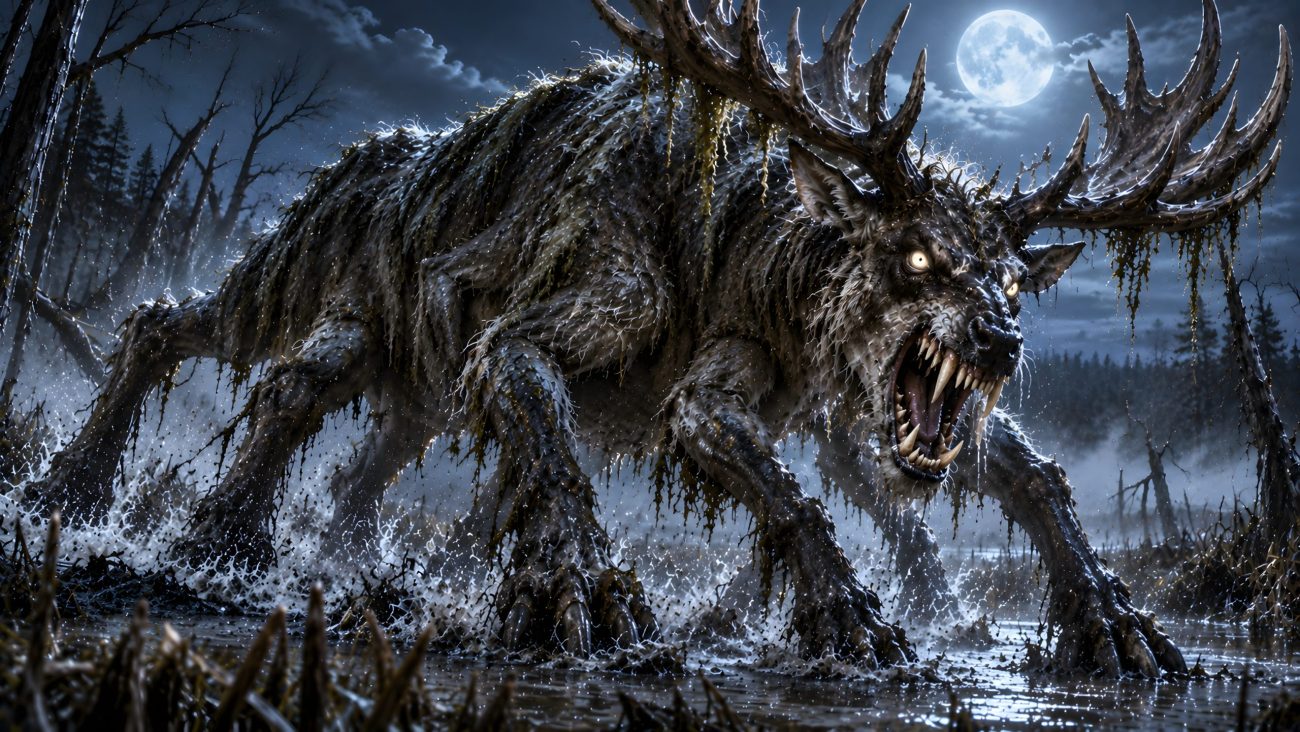
The Bukavac is a demonic creature from Serbian and Croatian folklore, particularly associated with the region of Srem in the Pannonian Plain. It is described as a six-legged monster with deer antlers and a body covered in scales.

The Bukavac is said to live in or near large bodies of water, including lakes and swamps. It emerges from the water at night, making a great deal of noise. The name Bukavac is connected with the Serbian word buka, meaning “noise.”

At night, the Bukavac attacks people and animals that wander near its watery habitat. It leaps upon them and strangles them before disappearing again into the darkness.

The creature is particularly associated with the Srem region around the Danube and Sava rivers, including areas corresponding to present-day Croatia and Serbia. In Serbian tradition, the names Bukavac, Bukalo, and Bukovac can also be used to describe a person who makes a great deal of noise, while the word is related to expressions describing the loud voice of a bull roaring.


Sources

“Sazagan.” New Bestiary (Bestiary.us). Accessed September 6, 2026. https://www.bestiary.us/sazagan


Sazagan

Tradition: Nogai mythology, Russian Mythology, Turkish Mythology
Alternative Names: Sazagan
Category: Deer, Snake, Deity


The Myth

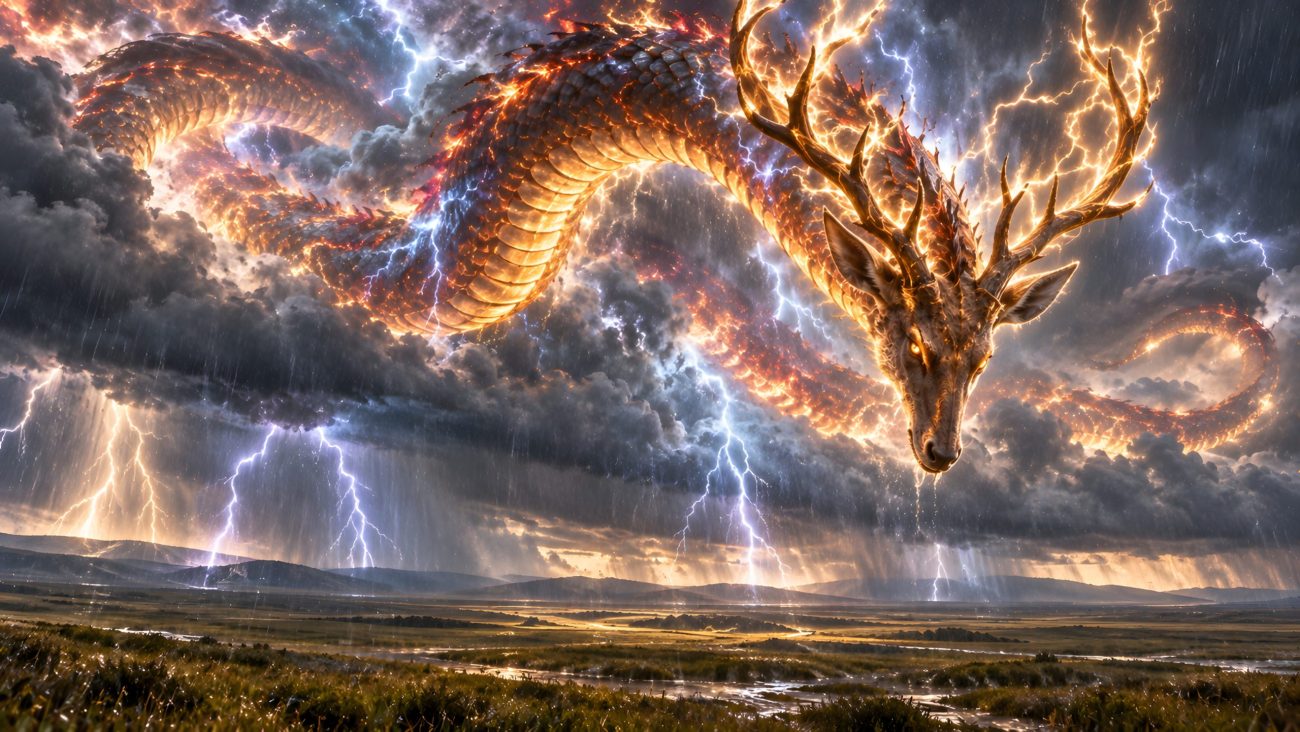
Sazagan is a heavenly being in Nogai mythology, taking the form of a huge fiery serpent with the head of a deer and antlers. Sazagan is associated with lightning, rain, and fertility and is regarded as a powerful being connected with the forces of the sky and weather.

When lightning flashes in the sky, the Nogai traditionally say that “Sazagan is playing, dancing.” Sazagan is regarded as an embodiment of fertility, associated with the generative power of heavenly water: rain, downpours, and lightning. The being has a dual nature, however, bringing both benefit and destruction. Rain fertilizes the earth and provides a source of natural disasters such as floods and hurricanes.

When Sazagan rages in the sky, he is said to shake an uproot trees and blow off roofs. Anyone who witnesses Sazagan dancing during thunderstorms may become infected with causeless laughter.

According to the beliefs of the Kuban Nogai, Sazagan is a personified creature that appears in spring and brings a harvest to the land. Among the Karanogai, it was believed that Sazagan could emerge from the mouth of the giant Topekoz. When this happened, the Karanogai would slaughter a black sheep, wash their faces with the animal’s blood, and light a fire using branches on the freshly flayed hide. They would then wash their hands with milk, pray, and recite words asking Sazagan and Tengri to bring an end to the storm.

When rain continued for too long and thunder rumbled through the sky, people also appealed to Sazagan to stop the storm and prevent the world from being flooded.

The origin of the name Sazagan is uncertain. The first part, “saz,” is associated with melody or music. According to an ancient Nogai myth, Sazagan created viscous clay, saz-balshyk (“singing clay”), with a lightning strike, from which humanity was created. Another legend says that Sazagan playfully created the human form, while Tengri breathed into it and gave it a flying soul.

The second part of the name, “agan,” may derive from the words “yagan” or “yagady,” meaning “it is igniting.” The name Sazagan has therefore been interpreted as meaning something like “igniting the earth” or “igniting melody.”

The name also survived in a popular expression: when teasing someone about their skill or temperament in lovemaking, people may say “sazagandy oynaty,” meaning that someone has “danced Sazagan.”


Sources

“Sazagan.” New Bestiary (Bestiary.us). Accessed September 6, 2026. https://www.bestiary.us/sazagan


Luot-hozik

Tradition: Sami mythology, Russian Mythology
Alternative Names: Luot-hozik
Category: Deer


The Myth

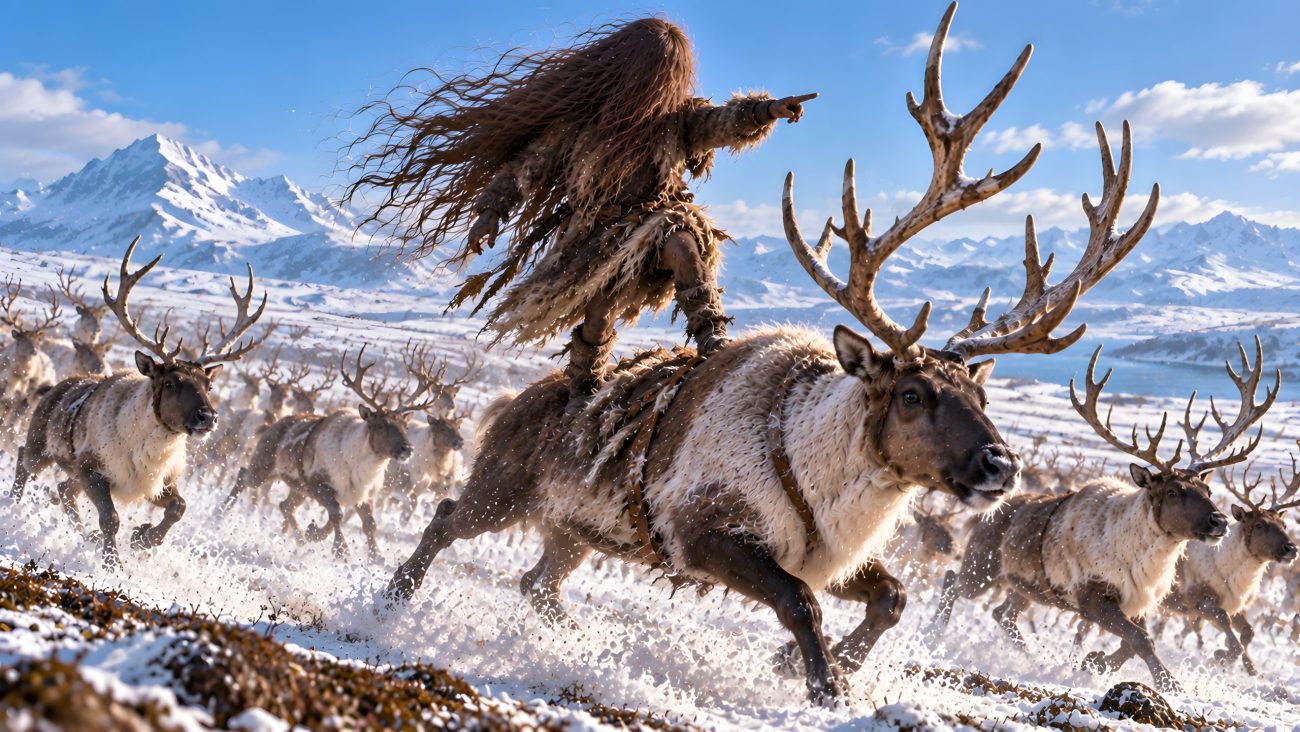
Luot-hozik is a female spirit and patron of reindeer herds who appears in the form of a hairy woman living in the tundra. She protects reindeer and watches over the herds that live in the northern wilderness.

According to Sami mythology, numerous spirits inhabited the land, water, and underworld. Among them were spirits considered masters of wild reindeer herds, while the Mistresses of the Reindeer, Luot-hozik, stood among the protectors of domesticated reindeer. Luot-hozik was believed to live in the tundra, walking on long legs like a human and sometimes appearing as a hairy woman.

The Sami believed that Luot-hozik protected their reindeer and prayed to her for their well-being. She was especially concerned with the herds belonging to the Lapps, or Sami people. She could be particularly displeased when reindeer were released into the wild during the summer, because this exposed them to wolves and other dangers. The Lapps therefore believed that she would protect their animals if they treated her with respect.

When reindeer were driven into the wild, prayers were offered to Luot-hozik. One such prayer asked her to take care of the reindeer and protect them from wolves and other dangers. If the reindeer had been found by autumn, the people thanked her for taking care of their herd.

Luot-hozik was also believed to protect the reindeer from people who tried to steal them. Reindeer were highly valuable possessions among the Sami, and her protection therefore extended not only to the animals themselves but also to the herds belonging to their human owners.

Besides Luot-hozik, other female spirits were believed to protect reindeer from wolves. However, Luot-hozik could not protect the animals from evil people.


Sources

“Луот-кожик (Luot-Khozhik).” New Bestiary (Bestiary.us). Accessed September 5, 2026. https://www.bestiary.us/luot-khozik