Udug

Tradition: Sumerian mythology, Iraqi Mythology
Alternative Names: Udug, Udug Hul, Utukku
Category: Demon


The Myth

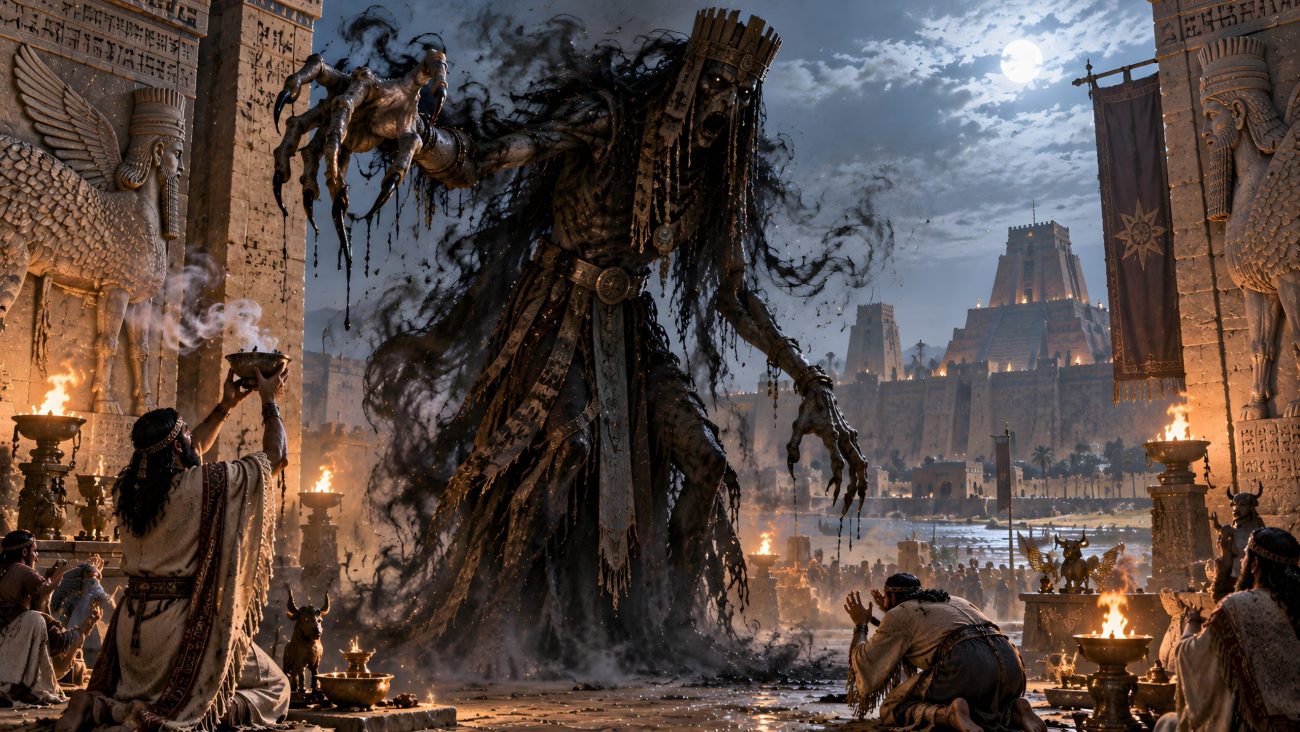
The Udug is an ambiguous class of demons in ancient Mesopotamian mythology, found in the traditions of Sumer, Akkad, Assyria, and Babylonia. The beings were associated with the underworld, Kur, and were distinct from the dingir, the divine beings of Mesopotamian religion.

The appearance of the Udug is deliberately difficult to define. No certain visual representation has been identified, and ancient descriptions emphasize that the demon is essentially nameless and formless. An Old Babylonian incantation describes the Udug as one who, from the beginning, was never given a name and never appeared in a definite form.

Descriptions of the evil Udug instead focus on its terrifying supernatural characteristics. It is described as having a towering stature, a malignant appearance, a dark or pitch-black shadow, and no light within its body. It hides rather than standing openly, its claws drip with bile, and it leaves poison behind it. Its arms enclose its victim, while its terrifying battle cry is so powerful that it cannot be restrained.

The Udug could attack and afflict human beings, particularly through disease and supernatural possession. Its presence could bring painful illness into the body, while curses, poison, evil forces, and other forms of supernatural harm were attributed to its influence.

The Udug is especially prominent in the Udug Hul incantations, ancient Mesopotamian texts concerned with the exorcism of evil Udug. These texts describe the demon as a source of illness and suffering and place the exorcist in the role of removing the supernatural affliction and restoring the victim.

The word Udug was not always restricted to one precise type of demon. It could be used more broadly for demons as a whole, making the identity of an individual Udug difficult to distinguish from the wider world of Mesopotamian supernatural beings.

The Udug was also associated with other demons, including the Gallû and Lilu. Some traditions additionally connect the name with Hanbi, a mysterious figure described as the father of Pazuzu and associated with evil forces, although little is known about Hanbi himself.

The essential nature of the evil Udug was therefore not a particular physical form but its supernatural presence: darkness, poison, terrifying sound, possession, disease, and the unseen forces that afflicted human beings.


Sources

“Udug.” Wikipedia: The Free Encyclopedia. Wikimedia Foundation. Accessed September 7, 2026. https://en.wikipedia.org/wiki/Udug


Al Basty

Tradition: Sumerian Mythology, Armenian Mythology
Alternative Names: Al Basty, Al Kardai, Al Karısı, Albastı, Alvasti, Albasdı, Албасты
Category: Demon


The Myth

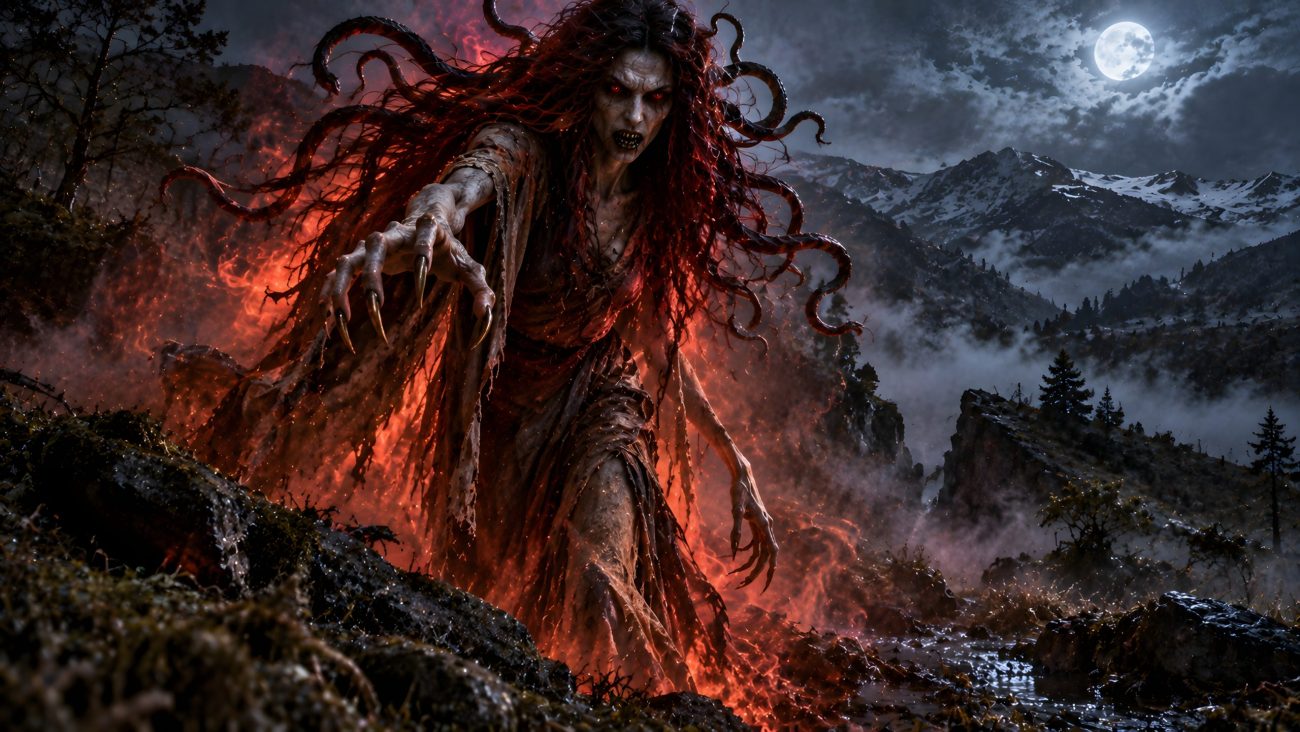
Al Basty is an ancient female spirit found in folklore across the Caucasus and Turkic-speaking regions. She is associated with guilt and is particularly connected with people whose families have committed bloody crimes that have gone unpunished.

The name is commonly associated with the Turkic words al, meaning “red,” and bastı, meaning “pressure” or “pressing.” The spirit is known under many different names across the region, including Al Karısı in Turkic folklore and Al Basty or Alvasti in various Turkic languages.

In some traditions, Al Basty has been associated with the ancient figure of Lilith. Later traditions connected with Lilith have also been attributed to Al Basty, although the stories vary according to the region.

In Turkic folklore, Al Basty has sometimes been confused with the Mare, the Succubus, and other female spirits said to visit people in their dreams. Unlike these spirits, however, Al Basty is not primarily described as a sexual being. Instead, she is said to visit people with guilty souls, particularly those descended from families responsible for violent crimes that were never punished.

Al Basty is especially feared by women during the period after childbirth. She is believed to haunt women during this vulnerable period and cause severe psychological distress. Traditional postpartum practices lasting forty days were consequently observed as a form of protection and care.

Those visited by Al Basty are said to awaken in an intense fever after suffering her torments. She is also associated with horses, which she is believed to steal during the night. Horses tormented by her are found the following morning sweating and exhausted and unable to work normally for the rest of the day. Because of this association, she is also known as the “red mother.”

In Armenian folklore, a related spirit called Āl appears as a demon of childbirth. She is said to blind unborn children and cause miscarriages and stillbirths to women who have committed crimes that have gone unpunished.

The Armenian Āl appears as a spirit of flame with snake-like hair, brass fingernails, and iron teeth. She hides in damp places and attacks women during childbirth. Similar traditions have also been recorded in Afghanistan.

Thus, the Al Basty tradition encompasses several related forms of a dangerous female spirit, particularly associated with guilt, childbirth, illness, and the consequences of violence left unpunished.


Sources

“Al Basty.” Wikipedia: The Free Encyclopedia. Wikimedia Foundation. Accessed September 6, 2026. https://en.wikipedia.org/wiki/Al_Basty


Palm Tree King

Tradition / Region: Iraqi Mythology, Mesopotamian Mythology, Sumerian Mythology
Alternative Name: –
Category: Demon


The Myth

The Palm Tree King was one of the strange and monstrous beings known as the Slain Heroes in ancient Sumerian mythology. These creatures appear in the epic Lugale, which tells the story of the warrior god Ninurta battling monstrous enemies to recover the stolen Tablets of Destiny.

The Slain Heroes served the monstrous being Imdugud, also known later as Anzu, who had stolen the divine Tablets of Destiny from the god Enlil, ruler of wind, storms, and the heavens. Ninurta set out to defeat these creatures and reclaim the tablets.

Very little survives about the Palm Tree King compared to the other monsters in the epic. Ancient texts mention him among the creatures allied with Imdugud, but few details describe his appearance or powers. His unusual name suggests a connection to sacred trees, fertility, or the wilderness of southern Mesopotamia.

Unlike many of the other Slain Heroes defeated by Ninurta during his campaign, the Palm Tree King may have escaped destruction. Some interpretations of the surviving myths describe him as the only monstrous servant of Imdugud not clearly slain in battle.


Sources

Wikipedia contributors. (n.d.). Palm Tree King. In Wikipedia. Retrieved May 10, 2026, from https://en.wikipedia.org/wiki/Palm_Tree_King


Lahama

Tradition / Region: Sumerian Mythology, Mesopotamian mythology
Alternate Names: Associated with Lahmu, Lahamu; linked with Oannes and Kululu
Category: Mermaid


The Myth

In the earliest age of the world, when only the deep fresh waters of the Abzu existed beneath the earth, the god Enki, lord of wisdom and the waters, created beings to dwell within his domain. These beings were called the Lahama, and they belonged to the sacred depths from which life and order would rise.

They were many—fifty in number—and they moved through the watery abyss as servants of Enki. They were shaped like beings of the deep, often imagined with forms that joined man and fish, creatures suited to the hidden waters below the world.

Later tales spoke of ancient ancestors of these beings. From the first primordial waters came the twins Lahmu and Lahamu, monstrous children of the earliest oceanic forces. From them came further generations of gods, and through them the world took form. Thus the spirits of the waters stood close to the beginning of creation itself.

Among the companions of Enki were powerful beings who sometimes rose from the sea to meet humankind. One of these was Kululu, a fish-formed servant of the god who moved between the divine world and the human one.

But the most famous of the sea-beings was Oannes.

In ancient days, near the shores of Babylonia, a strange creature rose from the Persian Gulf. His body was that of a fish, yet beneath the fish’s head was the face of a man, and beside the tail were human legs. Though his form was uncanny, his voice was gentle and human.

By day he walked among people. He taught them writing, numbers, and the arts. He showed them how to build cities and temples, how to establish laws, how to measure the land, and how to plant grain and gather food. Everything needed for civilized life he revealed to them.

He took no food while he stayed among humans. At sunset he returned to the sea and vanished beneath the waves, for he belonged both to water and to land.

Thus the beings of the deep waters—the Lahama and those who rose from them—were remembered as ancient spirits of the abyss, close to the birth of the world, and as teachers who once emerged from the sea to guide humankind.


Gallery


Sources

Bestiary.us contributors. (n.d.). Lahama. In Bestiary.us, from https://www.bestiary.us/lahama/


Interpretive Lenses

Religious Readings
  • Christian Ascetic Deep Dive
Philosophical Readings
  • Nietzschean Deep Dive
Psychological Readings
  • Jungian Deep Dive
Esoteric Deep Dive
  • Hermetic Deep Dive
Political / Social Readings
  • Marxist Deep Dive
Other
  • How to Invite The Lahama