Tradition: Sumerian mythology, Iraqi Mythology
Alternative Names: Udug, Udug Hul, Utukku
Category: Demon
The Myth
The Udug is an ambiguous class of demons in ancient Mesopotamian mythology, found in the traditions of Sumer, Akkad, Assyria, and Babylonia. The beings were associated with the underworld, Kur, and were distinct from the dingir, the divine beings of Mesopotamian religion.
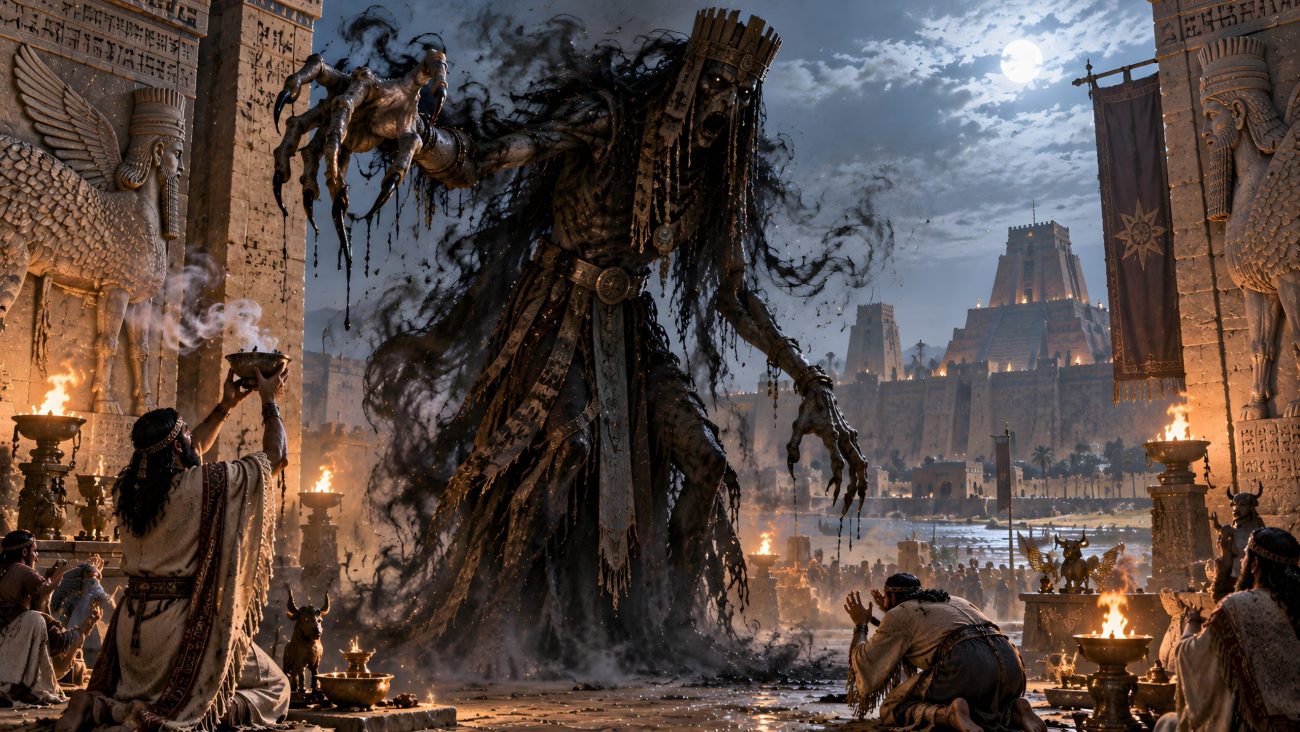
The appearance of the Udug is deliberately difficult to define. No certain visual representation has been identified, and ancient descriptions emphasize that the demon is essentially nameless and formless. An Old Babylonian incantation describes the Udug as one who, from the beginning, was never given a name and never appeared in a definite form.
Descriptions of the evil Udug instead focus on its terrifying supernatural characteristics. It is described as having a towering stature, a malignant appearance, a dark or pitch-black shadow, and no light within its body. It hides rather than standing openly, its claws drip with bile, and it leaves poison behind it. Its arms enclose its victim, while its terrifying battle cry is so powerful that it cannot be restrained.
The Udug could attack and afflict human beings, particularly through disease and supernatural possession. Its presence could bring painful illness into the body, while curses, poison, evil forces, and other forms of supernatural harm were attributed to its influence.
The Udug is especially prominent in the Udug Hul incantations, ancient Mesopotamian texts concerned with the exorcism of evil Udug. These texts describe the demon as a source of illness and suffering and place the exorcist in the role of removing the supernatural affliction and restoring the victim.
The word Udug was not always restricted to one precise type of demon. It could be used more broadly for demons as a whole, making the identity of an individual Udug difficult to distinguish from the wider world of Mesopotamian supernatural beings.
The Udug was also associated with other demons, including the Gallû and Lilu. Some traditions additionally connect the name with Hanbi, a mysterious figure described as the father of Pazuzu and associated with evil forces, although little is known about Hanbi himself.
The essential nature of the evil Udug was therefore not a particular physical form but its supernatural presence: darkness, poison, terrifying sound, possession, disease, and the unseen forces that afflicted human beings.
Sources
“Udug.” Wikipedia: The Free Encyclopedia. Wikimedia Foundation. Accessed September 7, 2026. https://en.wikipedia.org/wiki/Udug
