Enryū

Tradition: Japanese mythology, Chinese mythology
Alternative Names: Yanlong, Salt Dragon, Shio Ryū
Category: Dragon


The Myth

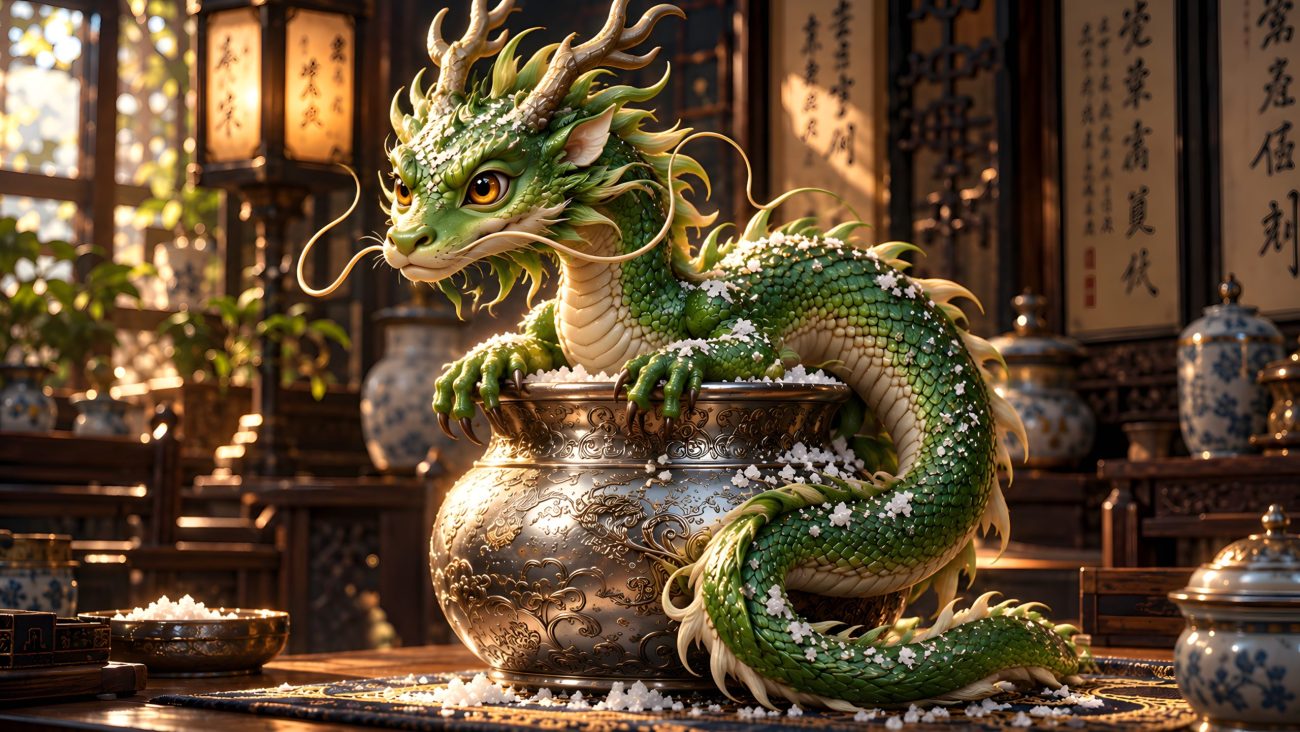
Enryū, the Salt Dragon, was a strange little dragon believed to produce a valuable substance used in tonics. Unlike the enormous dragons of storms and rivers, the Salt Dragon was described as a creature only about one foot long. Its body was covered in scales from which salt could mysteriously emerge.

According to the Compendium of Materia Medica, quoting the Records of Spring Shore, the creature was obtained during the Northern Song dynasty in the reign of Emperor Huizong. Xiao Zhu encountered a Salt Dragon while defeating the Nanman and brought the strange creature into his possession.

The dragon was kept in a silver tub with a jade bowl inside. It was fed salt taken from seawater, and after consuming the salt, more salt would seep from between its scales. The substance produced by the living dragon was regarded as medicinal. Taken together with warm wine, it was believed to increase yang energy and strengthen vitality.

Cai Jing, also called Cai Yuandu in the Records of Spring Shore, was said to have possessed one of these dragons. His Salt Dragon eventually died, however, in a rather peculiar manner. Cai attempted to obtain salt directly by licking the creature’s body. The dragon’s carcass was subsequently preserved by salting it. Even in death it retained value, since a tonic could still be extracted from the preserved body, although its effectiveness was believed to gradually diminish.

The Japanese commentary Bencao Gangmu Keimō repeated the account of the Salt Dragon but admitted that its nature was “not detailed,” offering little additional information about the creature.

The Salt Dragon later appeared in Japanese writings as well. Yanagi Rikyo’s Hitori Ne retold the story of Cai Yuanqing and his Salt Dragon from the Harunogi Kibun. The author remarked that such creatures were rarely discussed because the country in which they were supposedly found was no longer frequently visited, and therefore recorded the strange story for posterity. The same account was subsequently quoted in Keisai Eisen’s Makura Bunko.

The creature also became a subject for Japanese artists. The Illustrated Compendium of Chinese Characters depicts a Salt Dragon peering from a silver jar while reaching toward salt offered to it on a spoon by a boy. Uoya Hokkei created another well-known image of the creature, showing a Salt Dragon receiving salt from a woman. The accompanying humorous poem compares the salt caught between the dragon’s scales to light snow resting upon the swaying branches of a willow.

Thus the Salt Dragon was imagined as a peculiar living source of salt: a tiny dragon that consumed seawater salt, produced more through its scales, and could itself become an ingredient in mysterious medicines even after death.


Sources

Takahashi, Toshihiro. “延竜 [えんりゅう] (Enryū).” 新版TYZ 妖怪図鑑 (New TYZ Yokai Encyclopedia). October 21, 2024. https://tyz-yokai.blog.jp/archives/1083002104.html
Velue

Tradition: French Mythology
Alternative Names: Velue, Peluda, “The Shaggy One,” “The Hairy One”
Category: Dragon, Turtle


The Myth

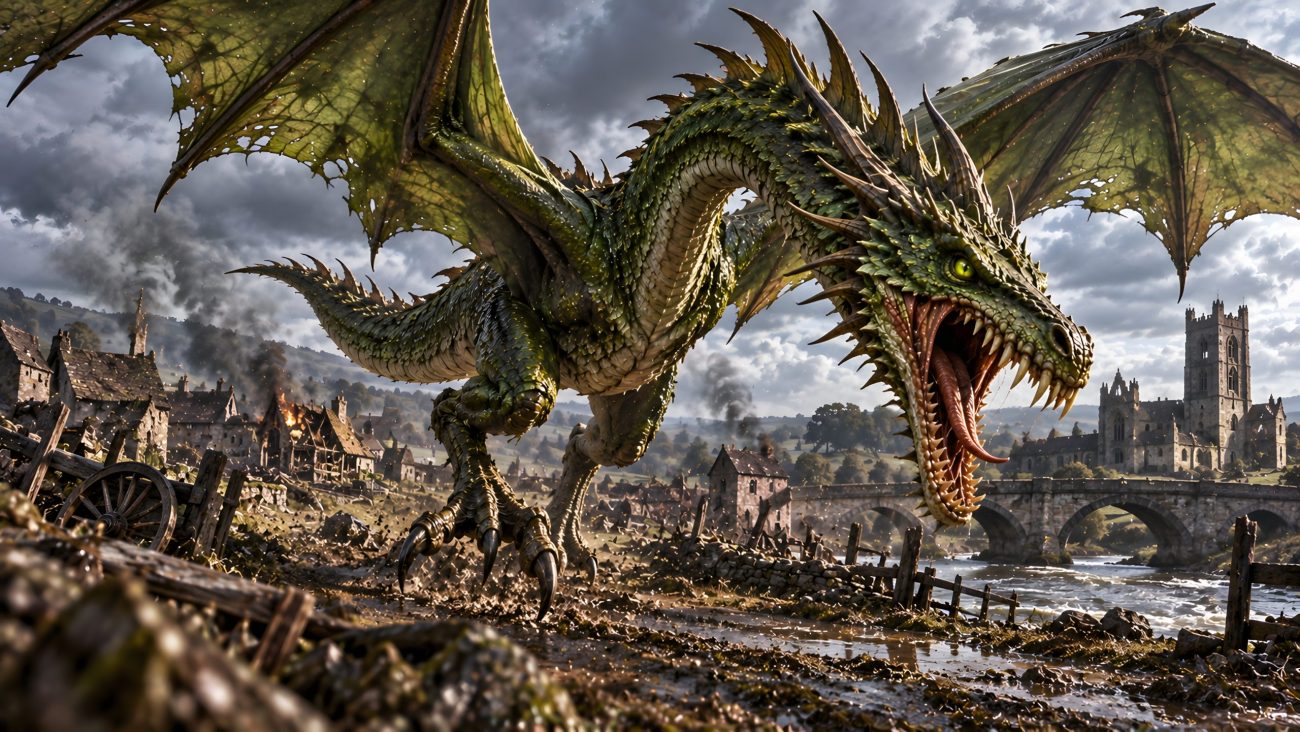
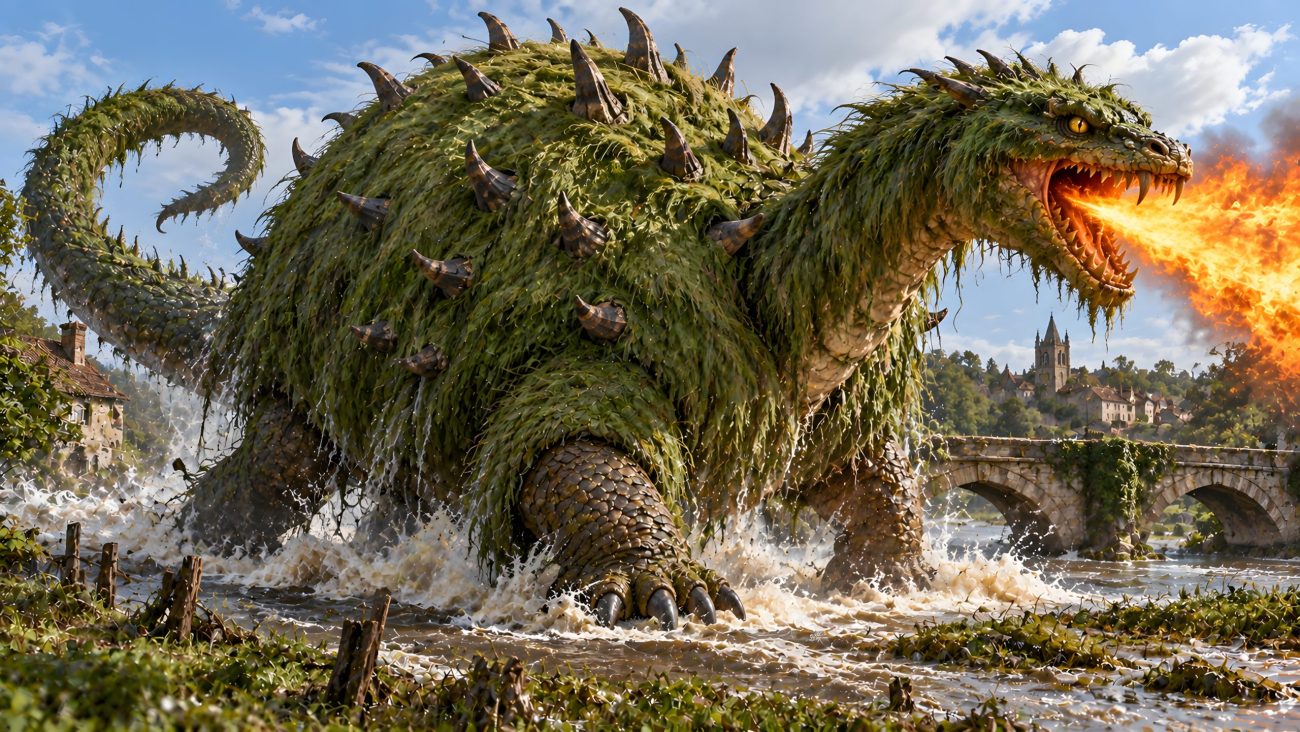
The Velue, whose name means “the shaggy one” or “the hairy one,” was a monstrous dragon said to haunt the Huisne River near La Ferté-Bernard in the Sarthe. Its body was enormous and egg-shaped, roughly the size of a large ox, and covered entirely in shaggy green fur. Sharp spikes protruded from its hairy hide, while its head resembled that of a terrifying serpent. Its immense legs were compared to those of a tortoise, and behind it dragged a powerful serpentine tail capable of killing a man or beast with a single sweep.

The Velue was said to have survived the biblical Flood after being overlooked by Noah. Having escaped the destruction of the world, the creature supposedly carried a grudge against creation and devoted the rest of its existence to destruction and spite.

It breathed fire and laid waste to farms, fields, and crops around the Huisne. Flocks of sheep disappeared down its enormous jaws, with their shepherds sometimes following them as the dragon’s dessert. Walls and moats offered little protection. The Velue was bold enough to enter the streets of the old city itself, terrifying the inhabitants and spreading destruction wherever it went.

Whenever people tried to drive it away, the monster retreated into the Huisne. Its gigantic body displaced so much water that the river overflowed its banks, flooding the surrounding countryside and ruining the fields. The dragon could therefore destroy the land whether it was upon the riverbank or beneath the water.

Women and children were said to be among the Velue’s favorite prey, and it possessed a particular appetite for agnelles, the “she-lambs” of the land—the beautiful and virtuous young women of La Ferté-Bernard. This taste eventually brought about its downfall.

After the Velue seized a young maiden and devoured her, her fiancé set out in pursuit of the monster. He followed its trail to its lair beneath an ivy-covered bridge over the Huisne. There he confronted the beast and struck at its vulnerable tail with his weapon. The blow killed the Velue instantly, bringing an end to the creature that had terrorized the countryside. Its death was celebrated throughout the region.

The story belongs to the tradition of French local dragons such as the Tarasque. Its surviving form is relatively recent: its foundations appear to reach back to the fifteenth century, while the tale was revived and considerably expanded during the nineteenth century. It never developed the major festivals or fixed iconographic traditions associated with some better-known French dragons, although a terracotta fountain sculpture dating from the seventeenth or eighteenth century, discovered in a ditch along the road to La Chapelle-Saint-Rémy, is considered the oldest surviving depiction associated with the Velue.

The association between the Velue and the word agnelles may itself preserve an older local joke. During the sixteenth century, La Ferté-Bernard sided with the Catholic League during the wars of Henri IV. Its governor, Dragues de Comnène, claimed descent from eastern kings and was known for his cunning. During a siege commanded by René de Bouillé, he sent soldiers out of the city disguised as women. The deception nearly succeeded when some of the besiegers approached the apparent damsels gallantly, only to discover that they were walking into an ambush. René de Bouillé’s forces eventually drove the disguised soldiers away, and the incident delighted Henri IV. It gave rise to jokes about the “agnelles de la Ferté“—the “she-lambs of La Ferté”—of whom, as the saying went, only two were needed to strangle a wolf.

The creature is sometimes called Peluda, but this name is a later Spanish rendering of the French Velue. Its popularity as a name for the monster owes much to Jorge Luis Borges, and it is not an original Occitan name for the dragon.


Sources

“Velue.” A Book of Creatures. January 18, 2019. https://abookofcreatures.com/2019/01/18/velue/


Sybaris

Tradition: Greek mythology
Alternative Names: Sybaris, Lamia
Category: Dragon


The Myth

Sybaris, also called Lamia, was a gigantic and monstrous beast that lived in a vast cave on Mount Cirphis near Krisa in Greece. Although the surviving myth gives no precise description of her body, later interpretations have imagined the creature as a dragon or an anguiped, a monstrous being combining human and serpent-like features.

Every day Sybaris emerged from her mountain cave and descended upon the surrounding country, devouring both livestock and human beings. Her constant attacks became such a terror that the people of the region eventually sought help from the Oracle of Delphi, asking how they might put an end to the monster’s depredations.

Apollo’s oracle gave them a terrible answer: a young man had to be offered to the beast. The sacrifice chosen was Alcyoneus, a handsome young man, the son of Diomos and Meganeira.

As Alcyoneus was being prepared for the sacrifice, the young hero Eurybatus happened to pass through the region. Eurybatus was the son of Euphemos and a descendant of the river god Axios. Through divine inspiration he was overcome with love for Alcyoneus and could not allow the young man to be given to the monster.

Eurybatus therefore took Alcyoneus’ place as the victim and confronted Sybaris himself. Instead of allowing the beast to devour him, he seized the monster and hurled her from the mountainside. Sybaris crashed against the rocks below and was killed.

Where the monster struck the earth, a spring suddenly burst forth from the ground. The people of the region named the spring Sybaris in memory of the slain beast, and the name was eventually connected with the city of Sybaris in southern Italy, which was founded by the Locrians.

Thus the monstrous Sybaris, whose daily hunger had terrorized the people of Mount Cirphis, ultimately gave her name to a spring and, through it, to a distant city.


Sources

“Sybaris (mythology).” Wikipedia: The Free Encyclopedia. Wikimedia Foundation. Accessed October 3, 2026. https://en.wikipedia.org/wiki/Sybaris_(mythology)


Sugaar

Tradition: Basque mythology, Spanish Mythology
Alternative Names: Sugar, Sugoi, Suarra, Maju
Category: Dragon, Deity


The Myth

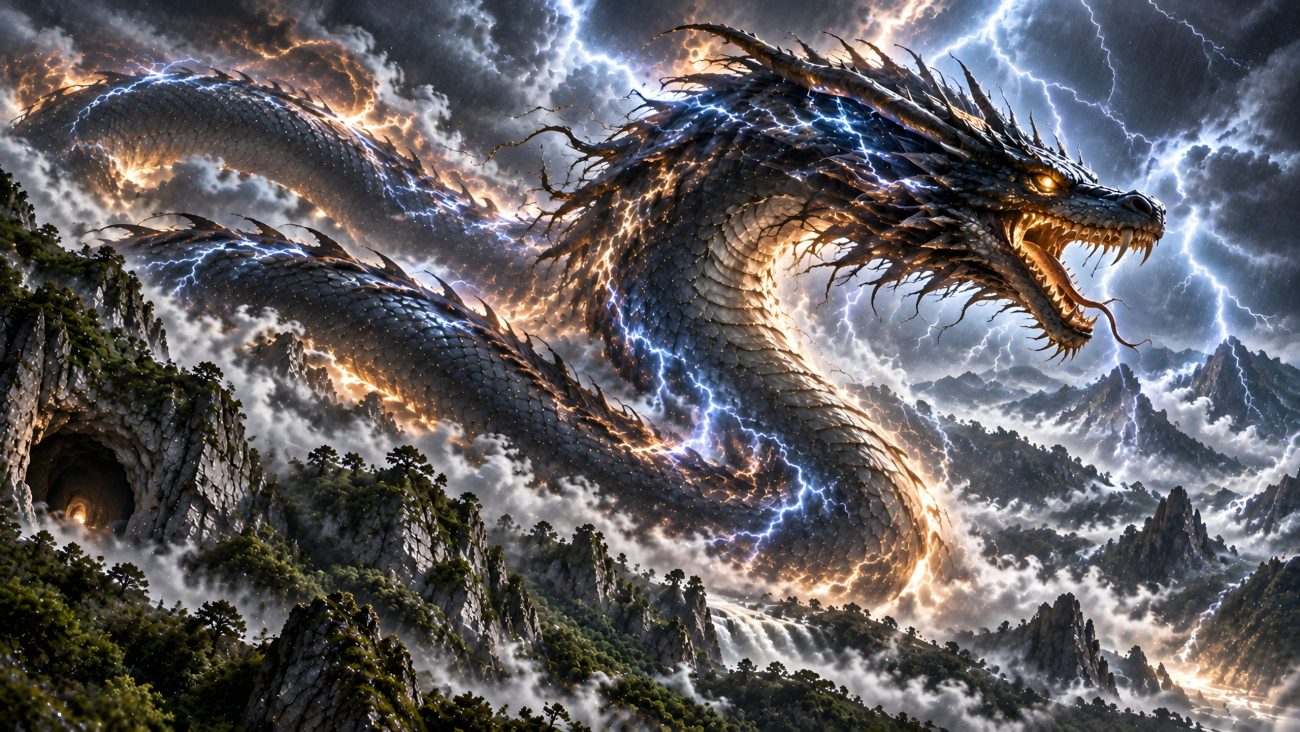
Sugaar is a powerful male serpent or dragon deity of Basque mythology, associated with storms, thunder, rain, and lightning. He may appear as pure fire or lightning, but his usual form is that of a great serpent or dragon. He is the male counterpart of the goddess Mari and is considered an ancient pre-Christian figure, with traditions surrounding him predating those concerning Herensuge.

Sugaar lives among mountains and caves, with one of his homes said to lie in the Aralar mountain range. His most famous dwelling is the cave of Baltzola, where he appears in a tale concerning two brothers from Dima.

Sugaar is Mari’s consort and is said to visit her at Mount Anboto every Friday. Their meetings are understood in different ways: Sugaar may be imagined tending Mari’s hair, while other traditions describe the two joining together and producing the great thunderstorms that sweep across the land. Their union also carries a deeper natural meaning, with Sugaar representing the rain that fertilizes the earth associated with Mari.

Yet Sugaar is not always a divine and benevolent figure. In Betelu he is regarded as an evil spirit, while in Ataun he serves as a frightening bogeyman figure. His nature therefore moves between that of an ancient storm deity and a dangerous supernatural being feared by ordinary people.

One of the most striking stories about Sugaar begins when two young brothers from Dima discover him inside the cave of Baltzola. The younger brother attacks the strange creature, cutting its tail with a stone. His elder brother disapproves of the violence, and the two leave the cave.

Years pass before the elder brother encounters a mysterious man who leads him back to the same cave at Baltzola. There the stranger gives him a box filled with gold and a red belt, instructing him to take the belt to his younger brother.

When the brothers are reunited, the younger brother refuses to wear the belt. Instead, he ties it around a chestnut tree. The moment the belt touches the tree, the tree bursts violently into flames.

The brothers suddenly understand who the mysterious stranger must have been. The man who had given them the gold and the red belt was Sugaar himself, returning years after the brothers had wounded him in his cave.


Sources

“Sugaar.” Wikipedia: The Free Encyclopedia. Wikimedia Foundation. Accessed October 3, 2026. https://en.wikipedia.org/wiki/Sugaar


Sockburn Worm

Tradition: English Mythology
Alternative Names: Sockburn Dragon, Fiery Flying Serpent
Category: Dragon


The Myth

The Sockburn Worm was a ferocious wyvern that terrorized the village of Sockburn in Durham, laying waste to the settlement and destroying its people. The creature was described in the tradition surrounding its defeat as a worm, dragon, or fiery flying serpent, a monstrous beast capable of bringing death and destruction to the inhabitants of the region.

The creature’s reign of terror eventually came to an end when Sir John Conyers confronted it and slew the Worm with his falchion. The victory became so important to local tradition that the reigning king is said to have granted Conyers the manor of Sockburn, with a remarkable condition attached to the grant.

The sword believed to have killed the Worm became known as the Conyers Falchion. For generations it was kept as a physical reminder of the legendary battle. Whenever a newly appointed Bishop of Durham entered the bishopric for the first time at Croft-on-Tees, near the southern edge of the diocese, the Lord of Sockburn traditionally presented the bishop with the weapon.

The presentation was accompanied by a formal declaration recalling the ancient deed: the falchion was presented as the weapon with which the champion Conyers had slain the worm, dragon, or fiery flying serpent that had destroyed men, women, and children. The bishop would take the sword and immediately return it, wishing its holder health and continued enjoyment of the manor.

The memory of the monster survives beyond the sword and ceremony. The Sockburn Worm, shown with the falchion embedded in its body, appears on the district badge of the local Darlington & District Scout Association.


Sources

“Sockburn Worm.” Wikipedia: The Free Encyclopedia. Wikimedia Foundation. Accessed October 3, 2026. https://en.wikipedia.org/wiki/Sockburn_Worm


Seiryū

Tradition: Japanese mythology
Alternative Names: Seiryū, Seiryō, Shōryū, Sōryū, Azure Dragon
Category: Dragon


The Myth

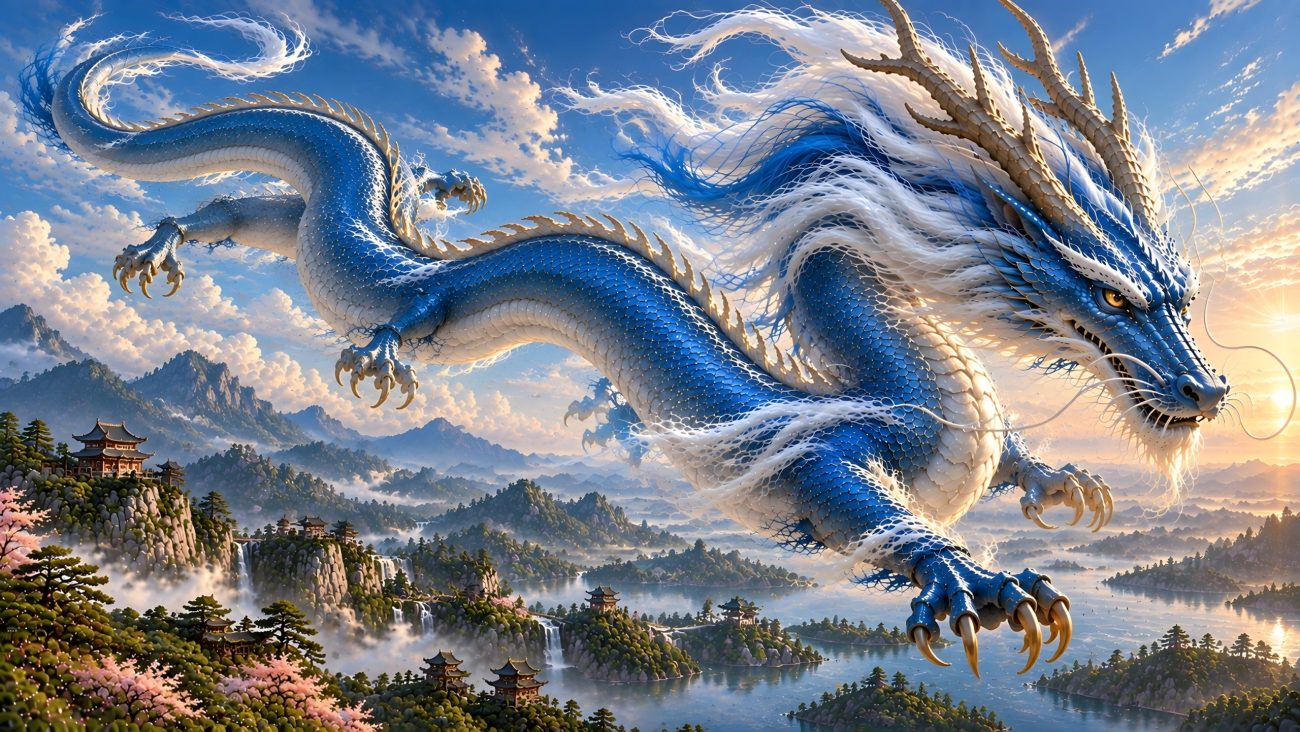
Seiryū, the Azure Dragon, is a great blue dragon who guards the eastern direction of the heavens. He is one of the Four Symbols, four mythical beasts associated with the four directions and the cosmic order. Seiryū represents the east and is connected with the element of wood, spring, and the planet Jupiter.

The tradition of the Four Symbols originated and became established in China during the Han dynasty through ideas concerning Yin and Yang and the Five Elements. Each direction was associated with a particular celestial beast, and these beings became important not only in cosmology but also in ritual practices and the planning of cities.

The Azure Dragon appears alongside the Vermilion Bird, Black Tortoise, and White Tiger as part of this cosmic arrangement. The Book of Rites describes military banners bearing the Four Symbols: the Vermilion Bird was placed at the front, the Black Tortoise at the rear, the Azure Dragon on the left, and the White Tiger on the right. These sacred beasts therefore accompanied armies as symbols representing the ordered directions of the heavens.

The Huainanzi further associates the east with wood, Taihao and Jumang with the governance of spring, Jupiter with the corresponding celestial body, and the Azure Dragon with the beast of the eastern direction.

The image of Seiryū later became deeply established in Japan. One of the most important surviving representations can be found in the murals of the Takamatsuzuka and Kitora Tumuli in Asuka, Nara Prefecture. The tombs were constructed around the seventh and eighth centuries, and their chambers contain representations of the Four Symbols. The artistic tradition was transmitted from the continent through China and Korea, with comparable representations appearing in Chinese tombs from the Han through the Six Dynasties and in the tombs of Goguryeo, Baekje, and Goryeo.

The Four Symbols also became part of Japanese court ritual. The Shoku Nihongi records that during the New Year’s ceremony held in the Daigokuden in 701, seven banners decorated with the Four Symbols together with crows, the sun, and the moon were erected and displayed. This ceremonial arrangement was modeled on the culture of Tang China.

Thus Seiryū is not simply a dragon of the eastern sky, but one of the four great beings through which the heavens, directions, seasons, elements, and earthly ritual were understood as part of a single cosmic order.


Sources

Takahashi, Toshihiro. “青竜 [せいりゅう] (Seiryū).” 新版TYZ 妖怪図鑑 (New TYZ Yokai Encyclopedia). October 21, 2024. https://tyz-yokai.blog.jp/archives/1082920496.html


Santōryū

Tradition: Japanese mythology
Alternative Names: Three-Headed Dragon, Three-Headed Dragon Mummy
Category: Dragon


The Myth

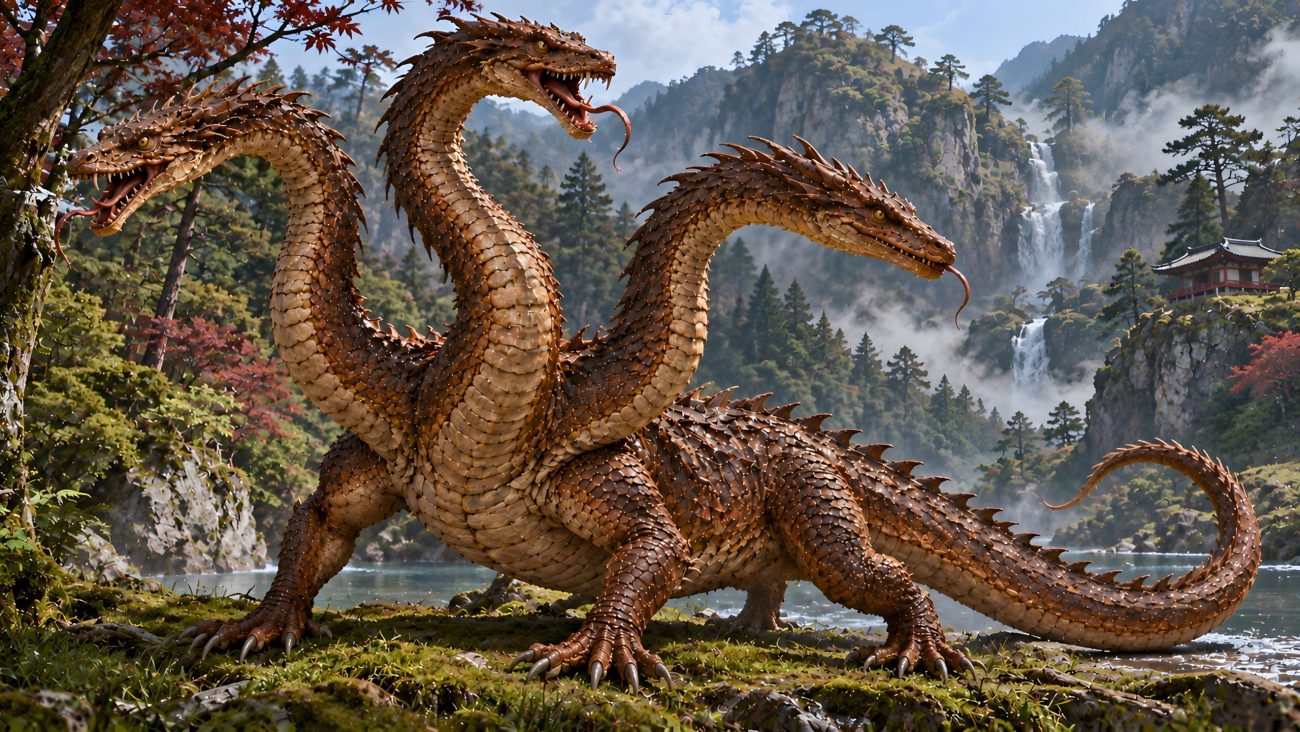
Santōryū is described as a strange three-headed dragon with a reptilian body and three long, slender necks extending from it, each ending in a head. The creature’s appearance resembles an artificial specimen made by combining the body of a small crocodile with three snakes.

Two objects described as “Three-Headed Dragon Mummies” are preserved among the yokai materials at the Japan Yokai Museum in Miyoshi, Hiroshima Prefecture. They were reportedly displayed as sideshow curiosities during the Shōwa period and later exhibited at various yokai exhibitions.

A sideshow flyer known as the “Great Yokai Exhibition” describes the creature as a “Gunma Prefecture Specialty Three-Headed Dragon,” presenting it alongside other supposed regional curiosities such as the “Tochigi Prefecture Specialty Cat Mermaid” and the “Ibaraki Prefecture Specialty Fox-Raccoon Dog.”

The true nature of the Santōryū, however, remains uncertain. There are no other documents or testimonies that objectively establish whether the sideshow described by the flyer actually took place, or whether the mummy and its associated materials were genuinely produced during the Shōwa period. The history of the Three-Headed Dragon therefore remains open to further investigation.


Sources

Takahashi, Toshihiro. “三頭竜 [さんとうりゅう] (Santōryū).” 新版TYZ 妖怪図鑑 (New TYZ Yokai Encyclopedia). October 21, 2024. https://tyz-yokai.blog.jp/archives/1082925945.html


Sekiryū

Tradition: Japanese mythology
Alternative Names: Red Dragon
Category: Dragon


The Myth

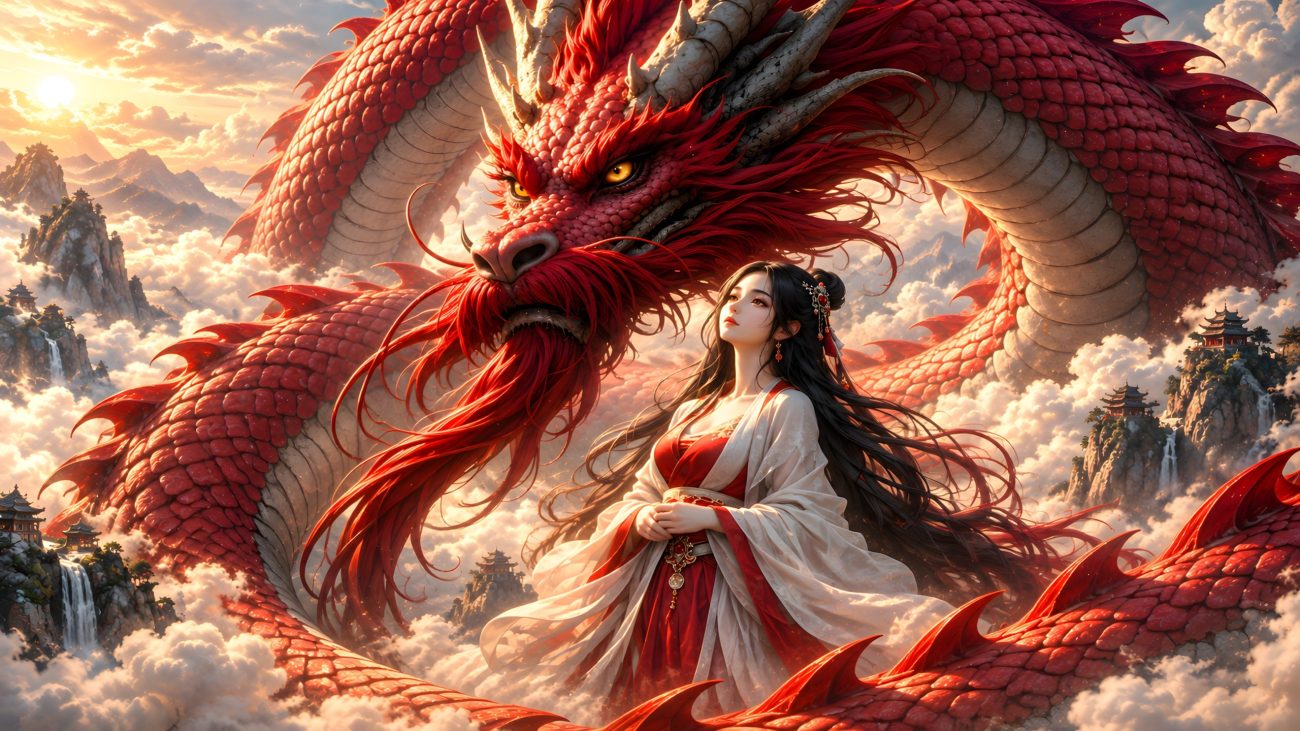
Sekiryū is a dragon with a brilliant red body, appearing in Japanese legends and tales as a supernatural being associated with extraordinary births and immense martial power.

In the Zen Taiheiki, the Red Dragon is said to have played a part in the birth of Sakata Kintoki, better known as Kintarō, who later became one of Minamoto no Yorimitsu’s Four Heavenly Kings. In the fourth year of Ten’en, 976, Yorimitsu visited Mount Ashigara. As he approached the red clouds hanging over the mountain, he encountered an old woman of about sixty and a young man of about twenty who was still dressed like a child. Despite the rugged rocks and steep terrain, the pair moved across the mountain as effortlessly as though they were walking on level ground.

The old woman was the young man’s mother. She described her son as one who had been “conceived between heaven and earth” and had received the command of Heaven. He had neither a surname nor a known father. She then revealed the strange circumstances surrounding his birth.

Before becoming pregnant, the woman had been sleeping upon the mountaintop when she dreamed that she united with a Red Dragon. She awoke to the sound of violent thunder. From this mysterious encounter the extraordinary child was conceived.

As the boy grew, his supernatural nature became increasingly apparent. He could cross mountains with ease, moving over the wild terrain as though it were nothing, and possessed immense strength. He was even capable of lifting enormous rocky cliffs with his bare hands.

When Yorimitsu learned of the young man’s remarkable martial abilities, he recognized his extraordinary potential. The two exchanged cups of sake in a formal bond between lord and retainer, and Yorimitsu bestowed upon him the name Sakata Kintoki. Thus the Red Dragon became the supernatural father of a warrior whose immense strength and martial prowess would make him one of Yorimitsu’s legendary Four Heavenly Kings.

The tale also recalls an older Chinese tradition concerning Liu Bang, the founder and first emperor of the Former Han Dynasty. According to the Records of the Grand Historian, Liu Bang’s mother once dreamed that she had mated with a dragon before becoming pregnant with him. The dragon was identified as a red dragon. The connection between the two stories was recognized within the Japanese tradition, and the Chronicles of Great Peace has Yorimitsu invoke the example when recognizing Kintoki’s extraordinary martial ability.

The strange birth of Kintoki was not universally accepted as a literal encounter with a dragon. The Commentary on the Mountains offers a much more skeptical interpretation, suggesting that the mountain woman may have had relations with several men and, not knowing the true father of her child, claimed that she had conceived him through a dream involving the Red Dragon in order to avoid accusations. The text compares this explanation with stories such as that of Yang Guozhong’s wife in the Tianbao Yishi, where women are said to have concealed questionable pregnancies by claiming that they had conceived through the influence of the sun, moon, or a supernatural dream.

Sekiryū therefore stands at the boundary between divine dragon mythology and the legendary origins of extraordinary heroes: a red dragon appearing in a dream, accompanied by thunder, becomes the mysterious father of a child whose superhuman strength marks him as destined for greatness.


Sources

Takahashi, Toshihiro. “赤竜 [せきりゅう] (Sekiryū).” 新版TYZ 妖怪図鑑 (New TYZ Yokai Encyclopedia). October 21, 2024. https://tyz-yokai.blog.jp/archives/1082924042.html


Rô Beast

Tradition: French Mythology
Alternative Names: Rô, Beast of Rô
Category: Dragon


The Myth

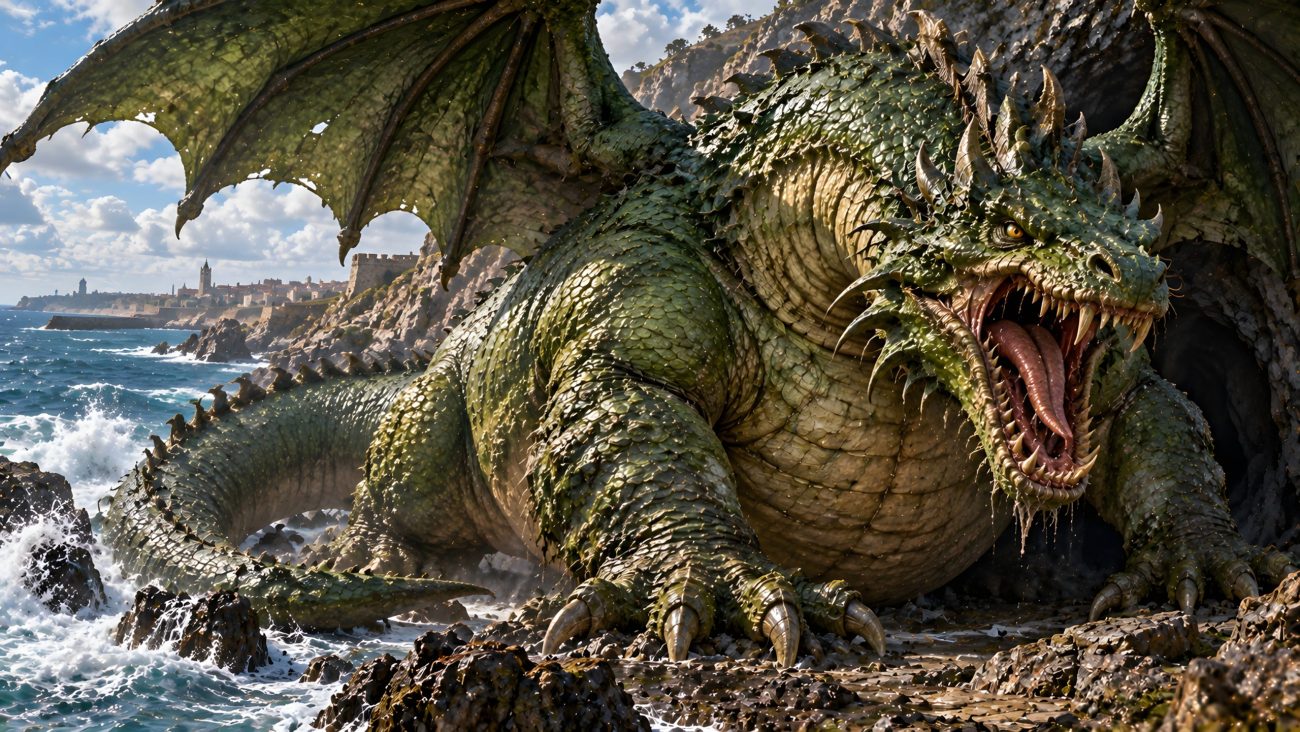
The Rô Beast was a hideous dragon with a winged body and a long, scaly tail. It possessed a malign intelligence almost like that of a human, using its cunning to set traps for people and devour them. The creature lived in a cavern at the Pointe de Roux near Aytré, off La Rochelle, and its terror spread throughout the surrounding coastline. No one was able to stand against it.

The reign of the Rô Beast finally ended when seven pagan heroes arrived by boat on the rising tide. They had come specifically to judge the monster. When Rô saw them approaching, it panicked and retreated toward the Pont de la Pierre, keeping its eyes fixed upon the seven figures who pursued it.

There the heroes attacked. They loosed seven arrows at the dragon, each one intended to seal away a part of its terrible senses. Two arrows struck and closed its eyes, two pierced and blocked its ears, two sealed its nostrils, and the final arrow pinned its monstrous mouth shut.

Rô roared and thrashed in agony, but the heroes cast the helpless beast into a deep pit. There it was condemned to remain until the end of time. The seven heroes then took their places around the pit, becoming eternal guardians who watched over the imprisoned dragon.

Yet Rô was never truly silent. The beast still lives within its prison, screaming and howling with rage. Its cries are said to stir the surrounding sea. When Rô howls toward the north, the Gulf of Chevarache in the Breton Pertuis becomes agitated with waves. When it turns its fury toward the south, the waters of Maumusson begin to stir. The old people feared what might happen if the imprisoned beast ever turned its voice toward the west, for then, they said, the islands themselves would be reduced to dust.

The landscape around the legend became bound to the story. The Pont de la Pierre was once associated with a ruined cromlech, while seven granite stones surrounding a deep pit were regarded as the seats of the seven heroes who had judged Rô. An image resembling the beast was also recognized in the arch of the principal portal of the Church of Talmont, although the figure may instead represent the lion of Ezekiel.

The seven mysterious heroes remain an equally ancient part of the legend. Their arrival from the sea evokes warriors such as Vikings, while the tale may preserve the memory of an older Gaulish tradition in which divine or heroic figures came from across the sea. The name Rô itself has likewise been interpreted as possibly preserving the corrupted name of an older pagan deity.


Sources

“Ro.” A Book of Creatures. May 14, 2021. https://abookofcreatures.com/2021/05/14/ro/


Python

Tradition: Greek mythology
Alternative Names: Pythōn, Delphynē, Drakaina Delphynē
Category: Dragon


The Myth

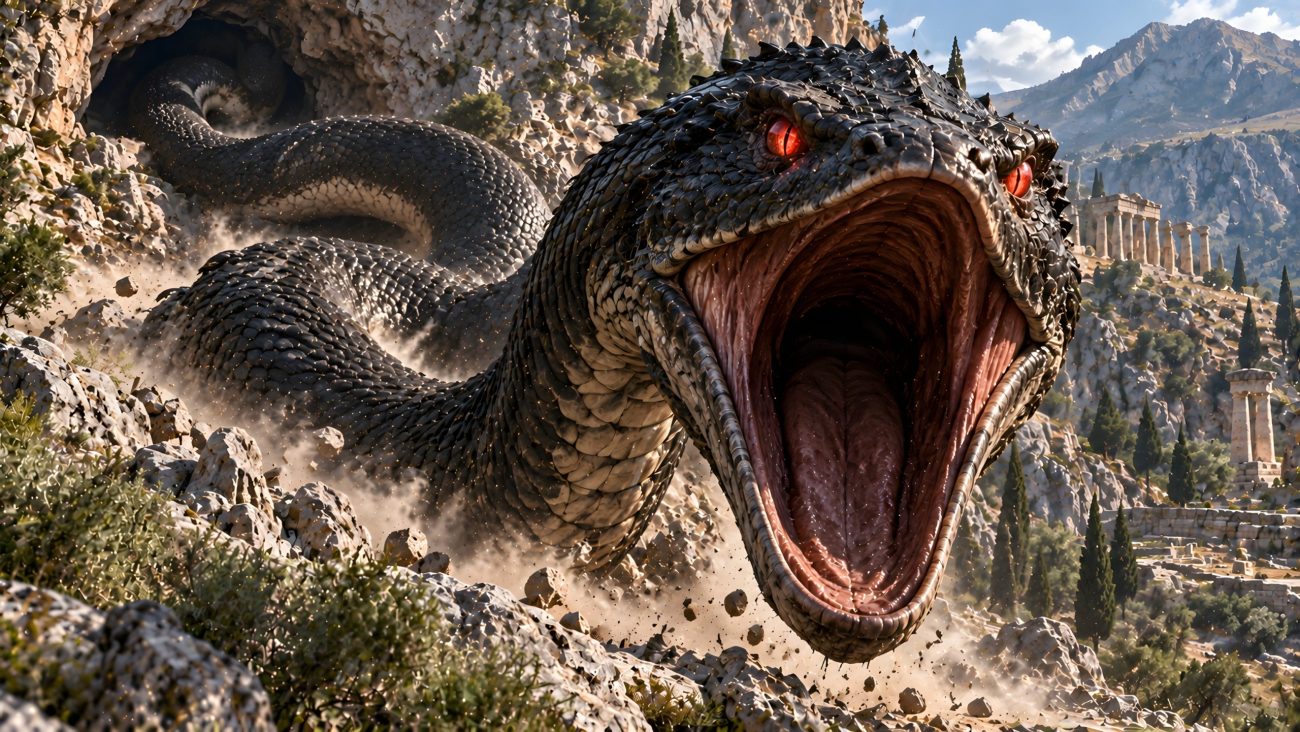
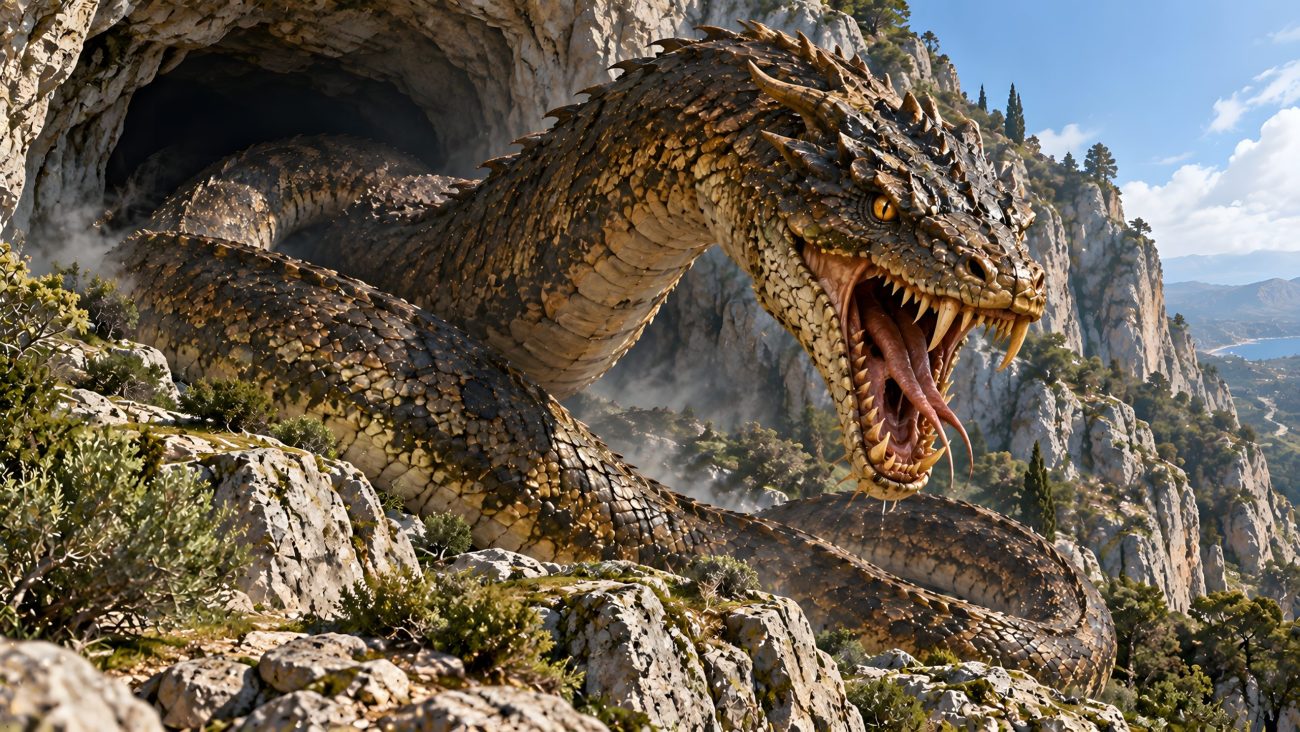
Python was a gigantic dragon-serpent that lived among the caves and slopes of Mount Parnassus near Delphi. The monster was a fearsome and bloody creature, with enormous jaws and a body that could coil around the mountain. In some traditions Python was male, while others described the creature as a female Drakaina, a monstrous serpent with the form of a woman from the waist upward.

Python was set by Gaia, the Earth, to guard the sacred oracle at Delphi. The creature dwelt near the prophetic sanctuary and prevented others from approaching the oracle. The monster was also said to have received and raised Typhoeus, the terrible offspring associated with Hera, and to have been a deadly plague upon humans and their animals.

When Apollo came to Delphi and sought to claim the oracle, Python moved to stop him from reaching the sacred opening. Apollo attacked the dragon with his bow. In the tradition preserved by Simonides, he struck Python with a hundred arrows, while other accounts simply describe Apollo shooting the monster with his deadly arrows.

The battle ended with Python dying beneath Apollo’s attack. The dragon writhed in agony, gasping for breath as its blood spilled onto the earth. Apollo then proclaimed that the monster would rot there and no longer prey upon those who lived from the fruits of the earth. The ancient name Pytho was connected with the word for rotting, referring to the decay of Python’s corpse beneath the power of the sun.

After Python’s death, Apollo took possession of the oracle at Delphi. The sanctuary and its games became associated with the slain dragon, giving rise to the names Pytho, Pythian, and the Pythian Games. The contest between Apollo and Python was remembered in music and ritual, including the Pythian musical tradition that celebrated the god’s victory and the dragon’s final death.

Some traditions give the story an additional motive: Python had relentlessly pursued Apollo’s mother, Leto, while she was pregnant with him. Apollo’s killing of the dragon could therefore be understood as both the conquest of the oracle and vengeance for the suffering inflicted upon his mother.

The ancient traditions also preserve a different interpretation in which Python was not a supernatural dragon at all, but a violent and lawless man who attacked the sanctuary and robbed the wealthy. Apollo killed this Python with his arrows, and the story of the dragon could be understood as the mythical form given to this ancient enemy of Delphi.

After the dragon’s death, Apollo’s victory became one of the defining legends of Delphi. Python’s corpse remained at the heart of the story, giving the sanctuary its ancient name and transforming the place where the monstrous guardian had once ruled into the sacred seat of Apollo’s oracle.


Sources

Atsma, Aaron J. “Drakaina Python (Python).” Theoi Greek Mythology. Accessed October 3, 2026.
https://www.theoi.com/Ther/DrakainaPython.html