Tradition: Japanese mythology
Alternative Names: Red Dragon
Category: Dragon
The Myth
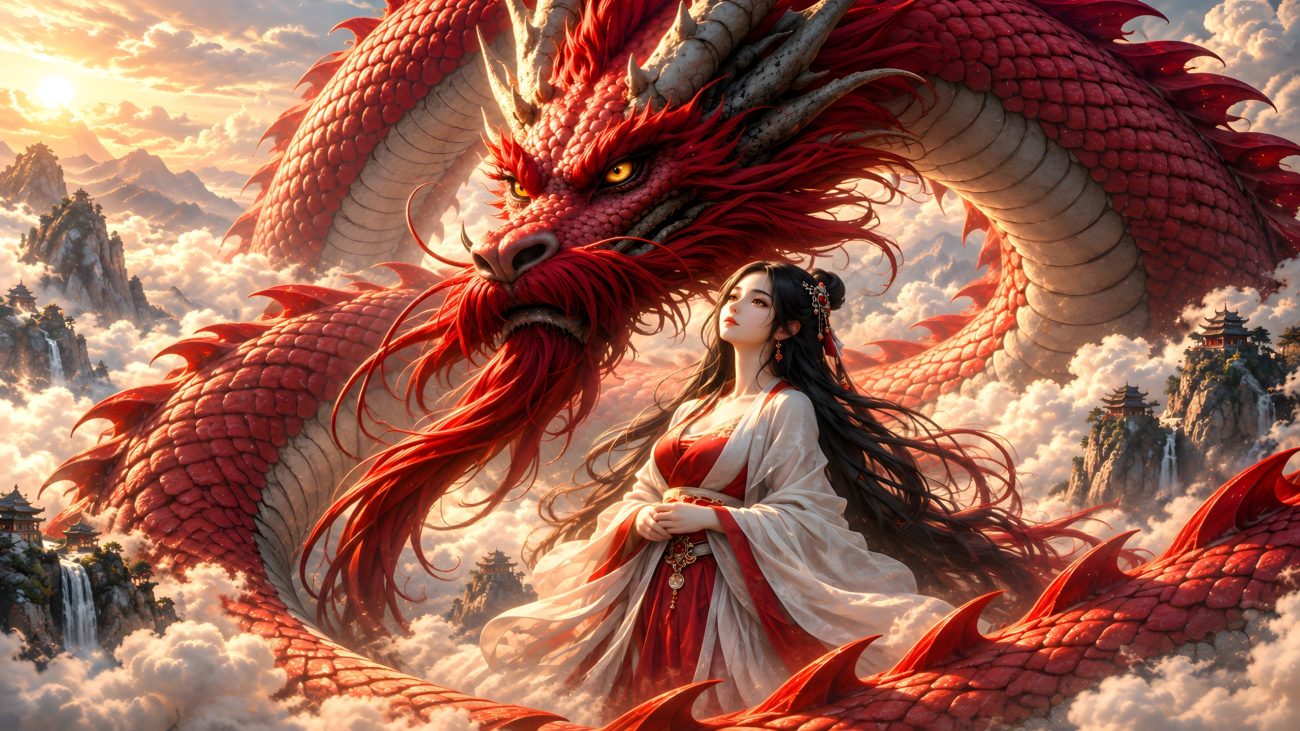
Sekiryū is a dragon with a brilliant red body, appearing in Japanese legends and tales as a supernatural being associated with extraordinary births and immense martial power.
In the Zen Taiheiki, the Red Dragon is said to have played a part in the birth of Sakata Kintoki, better known as Kintarō, who later became one of Minamoto no Yorimitsu’s Four Heavenly Kings. In the fourth year of Ten’en, 976, Yorimitsu visited Mount Ashigara. As he approached the red clouds hanging over the mountain, he encountered an old woman of about sixty and a young man of about twenty who was still dressed like a child. Despite the rugged rocks and steep terrain, the pair moved across the mountain as effortlessly as though they were walking on level ground.
The old woman was the young man’s mother. She described her son as one who had been “conceived between heaven and earth” and had received the command of Heaven. He had neither a surname nor a known father. She then revealed the strange circumstances surrounding his birth.
Before becoming pregnant, the woman had been sleeping upon the mountaintop when she dreamed that she united with a Red Dragon. She awoke to the sound of violent thunder. From this mysterious encounter the extraordinary child was conceived.
As the boy grew, his supernatural nature became increasingly apparent. He could cross mountains with ease, moving over the wild terrain as though it were nothing, and possessed immense strength. He was even capable of lifting enormous rocky cliffs with his bare hands.
When Yorimitsu learned of the young man’s remarkable martial abilities, he recognized his extraordinary potential. The two exchanged cups of sake in a formal bond between lord and retainer, and Yorimitsu bestowed upon him the name Sakata Kintoki. Thus the Red Dragon became the supernatural father of a warrior whose immense strength and martial prowess would make him one of Yorimitsu’s legendary Four Heavenly Kings.
The tale also recalls an older Chinese tradition concerning Liu Bang, the founder and first emperor of the Former Han Dynasty. According to the Records of the Grand Historian, Liu Bang’s mother once dreamed that she had mated with a dragon before becoming pregnant with him. The dragon was identified as a red dragon. The connection between the two stories was recognized within the Japanese tradition, and the Chronicles of Great Peace has Yorimitsu invoke the example when recognizing Kintoki’s extraordinary martial ability.
The strange birth of Kintoki was not universally accepted as a literal encounter with a dragon. The Commentary on the Mountains offers a much more skeptical interpretation, suggesting that the mountain woman may have had relations with several men and, not knowing the true father of her child, claimed that she had conceived him through a dream involving the Red Dragon in order to avoid accusations. The text compares this explanation with stories such as that of Yang Guozhong’s wife in the Tianbao Yishi, where women are said to have concealed questionable pregnancies by claiming that they had conceived through the influence of the sun, moon, or a supernatural dream.
Sekiryū therefore stands at the boundary between divine dragon mythology and the legendary origins of extraordinary heroes: a red dragon appearing in a dream, accompanied by thunder, becomes the mysterious father of a child whose superhuman strength marks him as destined for greatness.
Sources
Takahashi, Toshihiro. “赤竜 [せきりゅう] (Sekiryū).” 新版TYZ 妖怪図鑑 (New TYZ Yokai Encyclopedia). October 21, 2024. https://tyz-yokai.blog.jp/archives/1082924042.html