Tradition: Greek mythology
Alternative Names: Pythōn, Delphynē, Drakaina Delphynē
Category: Dragon
The Myth
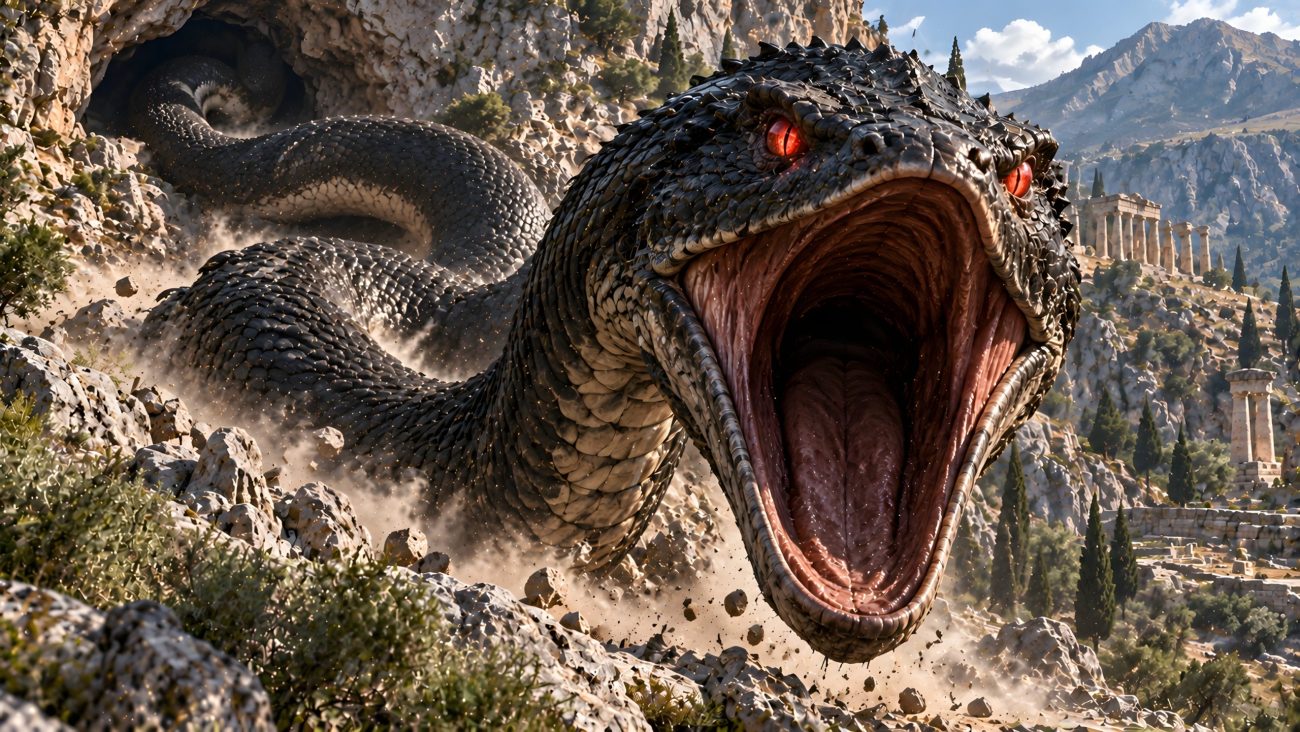
Python was a gigantic dragon-serpent that lived among the caves and slopes of Mount Parnassus near Delphi. The monster was a fearsome and bloody creature, with enormous jaws and a body that could coil around the mountain. In some traditions Python was male, while others described the creature as a female Drakaina, a monstrous serpent with the form of a woman from the waist upward.
Python was set by Gaia, the Earth, to guard the sacred oracle at Delphi. The creature dwelt near the prophetic sanctuary and prevented others from approaching the oracle. The monster was also said to have received and raised Typhoeus, the terrible offspring associated with Hera, and to have been a deadly plague upon humans and their animals.
When Apollo came to Delphi and sought to claim the oracle, Python moved to stop him from reaching the sacred opening. Apollo attacked the dragon with his bow. In the tradition preserved by Simonides, he struck Python with a hundred arrows, while other accounts simply describe Apollo shooting the monster with his deadly arrows.
The battle ended with Python dying beneath Apollo’s attack. The dragon writhed in agony, gasping for breath as its blood spilled onto the earth. Apollo then proclaimed that the monster would rot there and no longer prey upon those who lived from the fruits of the earth. The ancient name Pytho was connected with the word for rotting, referring to the decay of Python’s corpse beneath the power of the sun.
After Python’s death, Apollo took possession of the oracle at Delphi. The sanctuary and its games became associated with the slain dragon, giving rise to the names Pytho, Pythian, and the Pythian Games. The contest between Apollo and Python was remembered in music and ritual, including the Pythian musical tradition that celebrated the god’s victory and the dragon’s final death.
Some traditions give the story an additional motive: Python had relentlessly pursued Apollo’s mother, Leto, while she was pregnant with him. Apollo’s killing of the dragon could therefore be understood as both the conquest of the oracle and vengeance for the suffering inflicted upon his mother.
The ancient traditions also preserve a different interpretation in which Python was not a supernatural dragon at all, but a violent and lawless man who attacked the sanctuary and robbed the wealthy. Apollo killed this Python with his arrows, and the story of the dragon could be understood as the mythical form given to this ancient enemy of Delphi.
After the dragon’s death, Apollo’s victory became one of the defining legends of Delphi. Python’s corpse remained at the heart of the story, giving the sanctuary its ancient name and transforming the place where the monstrous guardian had once ruled into the sacred seat of Apollo’s oracle.
Sources
Atsma, Aaron J. “Drakaina Python (Python).” Theoi Greek Mythology. Accessed October 3, 2026.
https://www.theoi.com/Ther/DrakainaPython.html