Oto Akuka

Tradition / Region: Japanese Mythology
Alternate Names:
Category: Demon, Cow, Pig


The Myth

Oto Akuka is a demon recorded only once, in a single old Japanese scroll. Beyond this appearance, nothing more is known. There are no surviving stories, no extended legends, and no later mentions of the creature.

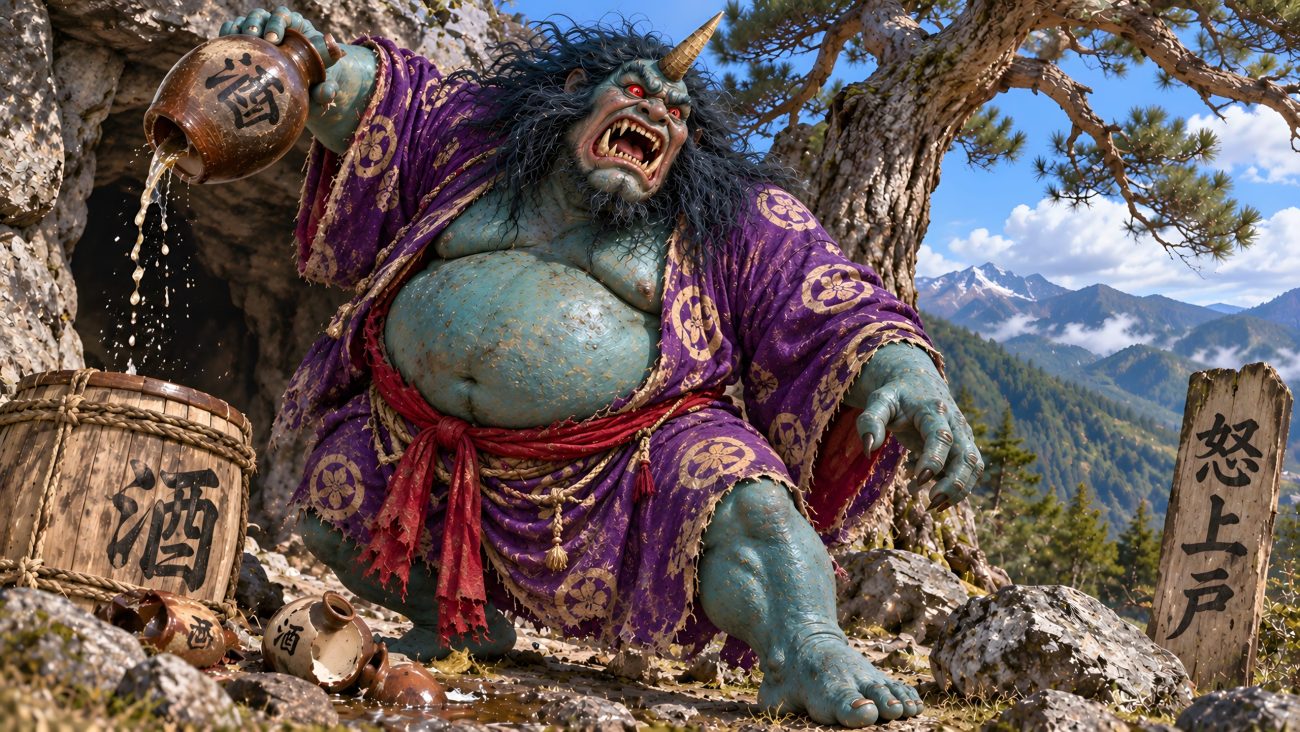
In the scroll, Oto Akuka is shown with blue skin and a beast-like face. Its head is bald and crowned with two horns, and its nose appears crushed, giving it the resemblance of a cow or a pig. The demon is depicted kneeling on the ground. One hand is pressed firmly against the floor, while the other supports its body as it vomits.

The image presents Oto Akuka not as a being that attacks others, but as one overcome by what rises within itself. The demon is shown in the moment of release, brought low and humiliated by its own condition. Its punishment is not delivered by an external force, but unfolds openly through its own body, in full view.

Oto Akuka remains an isolated figure in Japanese folklore—a single, unsettling image preserved in a scroll, offering no tale of origin or aftermath, only the enduring vision of a demon brought to shame.


Gallery


Sources


Youkai Gazou Database. (2007).
鬼;オニ,嘔吐;オウトInternational Research Center for Japanese Studies (Nichibunken). Retrieved from https://www.nichibun.ac.jp/cgi-bin/YoukaiGazou/card.cgi?identifier=U426_nichibunken_0080_0008_0005

Also mentioned in my book Legendary and Mythical Cows

Interpretive Lenses

Religious Readings
  • Christian Ascetic Deep Dive
Philosophical Readings
  • Nietzschean Deep Dive
Psychological Readings
  • Jungian Deep Dive
Esoteric Deep Dive
  • Hermetic Deep Dive
Political / Social Readings
  • Marxist Deep Dive
Other
  • How to Invite The Oto Akuka

Shiro (Shirodawashi)

Tradition / Region: Japanese Mythology
Alternate Names: Shirodashi, Shirodawashi (White Scrubber)
Category: Yōkai / Mountain Dweller / Cave Dweller


The Myth

Shiro, also called Shirodawashi, was a yōkai known for his beast-like face, hooves, and a kimono patterned with scrubbing brushes. He lived in a cave near a remote mountain settlement and first appeared as a friendly and helpful figure.

A pair of monsters, Mōryō and his wife Ochiyobon, fled from Ushū to the mountains beyond Hakone and settled in a ruined house. Shiro assisted them in establishing their new home, but his friendliness soon revealed another nature. He was a heavy drinker and a troublemaker who repeatedly visited their house, demanding food, drink, and money.

Shiro became infatuated with Ochiyobon and schemed to take her for himself. One day, he borrowed a padded robe from Mōryō and never returned it. When Ochiyobon came to demand its return, Shiro claimed he had pawned it and left to retrieve it. Instead, he went to Mōryō’s shack armed with a blade and declared that Ochiyobon was now his wife. Intimidated and afraid, Mōryō surrendered, giving Shiro all his possessions, including clothing, bedding, and cosmetics.

When Ochiyobon learned what had happened, she was devastated. Shiro responded brutally, declaring that since she was now his wife, she must submit. Other monsters gathered, and even Momojii, the master of the cave dwellings, appeared. Momojii attempted to restore Ochiyobon to her husband, but Mōryō, fearing public shame, refused reconciliation and announced plans to remarry.

Abandoned, Ochiyobon grew close to Momojii, who treated her with kindness. Enraged, Shiro attacked Momojii with an oak log, but Momojii overpowered him with a massive axe and drove him away. To settle the conflict, Momojii arranged for Shiro to marry a beautiful female ghost.

Despite her beauty, the ghost suffered under Shiro’s relentless desire. Unable to endure him, she abandoned her lingering grudge against the living and wished to return to the underworld. When demons arrived to claim her, Shiro fought them fiercely. During the chaos, the ghost passed on peacefully, leaving the demons with no soul to seize. They attempted to drag Shiro to hell instead, but along the way a mysterious boy appeared and gave Shiro demon-slaying sake. The boy revealed himself to be the tanuki Kakubei, who slew the demons.

Grateful, Kakubei asked Shiro to help abduct the daughter of a fox whose marriage proposal had been rejected. Shiro eagerly agreed and joined the tanuki in attacking the wedding procession, successfully capturing the bride’s palanquin. However, he soon encountered Mikoshi Nyūdō, who defeated him and took him prisoner. Impressed by Shiro’s boldness, Mikoshi Nyūdō eventually released him, predicting he might serve a greater purpose someday.

Later, tanuki thieves stole the White Fox Jewel and entrusted it to Shiro. When monsters and foxes came to retrieve it, they heard a woman’s voice from within Shiro’s cave. Ochiyobon emerged, holding a bloodstained knife and the jewel. Having been disgraced and betrayed, she took revenge by killing Shiro and returning the treasure to its rightful owners.

Thus ended Shirodawashi, remembered as a violent, cunning, and lust-driven yōkai whose ambition and cruelty ultimately led to his downfall.


Interpretive Lenses

Religious Readings
Philosophical Readings
  • Nietzschean Deep Dive
Psychological Readings
  • Jungian Deep Dive
Esoteric Deep Dive
  • Hermetic Deep Dive
Political / Social Readings
  • Marxist Deep Dive
Other
  • How to Invite The Spirit

Zarazarazattara

Tradition / Region: Japanese Folklore (Haibara County, Shizuoka Prefecture)
Alternate Names:
Category: Yōkai / Mountain Dweller


The Myth

In Haibara County, it is told that a man once spent the night alone in a mountain hut, sitting by the hearth to keep warm. As the fire burned low, the hut lay silent except for the crackle of embers.

At one point, the man lifted the straw mat that covered the entrance. Suddenly, a round object—shaped much like a pumpkin—rolled inside the hut and came to rest beside the hearth. Startled, the man stared at it, thinking how unsettling the thing looked.

Before he could act, the round object spoke, saying, “It’s nothing. I am Zarazarazattara.”

The man felt an even deeper unease and thought to himself that he wished he had left the hut earlier. Immediately, the creature replied, “Never mind. I’ll be right there.” Realizing that the being responded to his very thoughts, the man became terrified, knowing that even thinking in silence was no protection.

Trying to act without revealing his thoughts, the man decided to tend the fire. He picked up a piece of firewood and snapped it to add fuel to the hearth. By chance, a fragment of the broken wood flew off and struck the creature where its face seemed to be.

At this, Zarazarazattara cried out, “I never thought of that,” and fled the hut at once, disappearing back into the night.

Afterward, the man was left alone by the fire, shaken but unharmed, and the strange yōkai was never seen there again.


Interpretive Lenses

Religious Readings
Philosophical Readings
  • Nietzschean Deep Dive
Psychological Readings
  • Jungian Deep Dive
Esoteric Deep Dive
  • Hermetic Deep Dive
Political / Social Readings
  • Marxist Deep Dive
Other

Azuki Arai

Tradition / Region: Japanese Mythology (mountain regions throughout Japan)
Alternate Names: Azukitogi, Azuki Togi
Category: Yōkai / Mountain Dweller / River Dweller


The Myth

Deep in the mountains of Japan, near forest streams and quiet rivers, there is said to live a yōkai known as Azuki Arai, the Bean Washer. It dwells far from villages, choosing remote riverbanks where the sound of flowing water masks its presence. Travelers rarely see it, but many have heard it.

Azuki Arai spends its time crouched beside the water, washing red azuki beans in a basket. As it works, it sings a strange song, its voice mingling with the sound of beans being rinsed:

“Azuki araou ka?
Hito totte kuou ka?”

“Shall I wash my beans,
or shall I catch a human to eat?”

Between the lines of the song comes the sound shoki shoki, the rhythmic noise of beans being washed. The voice carries through the valley, echoing along the stream.

Those who hear the song are often startled or unsettled. It is said that people drawn too close to the sound lose their footing and slip into the water. The splash frightens Azuki Arai, and it immediately flees into the forest, vanishing without a trace.

Azuki Arai is known to be extremely shy and avoids being seen. It mimics the sounds of nature—rustling leaves, flowing water, birds, and insects—to conceal itself. Because of this, most encounters are only auditory, and sightings are rare. Those who do catch a glimpse describe a small, squat figure resembling a monk or peasant, with a large head, wide eyes, and an unsettling grin, seated by the river as it washes beans.

Despite its eerie song, Azuki Arai is not considered truly dangerous. It does not pursue humans, and it disappears at the slightest disturbance. In some regions, seeing it is considered a sign of good fortune, as few are ever able to do so.

Thus, when the sound of beans being washed rises from a mountain stream, people say Azuki Arai is near—quietly working by the water, singing its strange song, and slipping away unseen the moment it is discovered.


Interpretive Lenses

Religious Readings
  • Christian Ascetic Deep Dive
Philosophical Readings
  • Nietzschean Deep Dive
Psychological Readings
  • Jungian Deep Dive
Esoteric Deep Dive
Political / Social Readings
  • Marxist Deep Dive
Other
  • How to Invite The Spirit

Moku Musume

Tradition / Region: Japanese Mythology (Gunma–Nagano, Usui Pass)
Alternate Names: Shumoku Musume
Category: Yōkai / Mountain Dweller / Shark


The Myth

Moku Musume, also known as Shumoku Musume, is a yōkai known from monster paintings and traditional karuta cards. Her appearance is immediately recognizable and unlike that of any ordinary being. Her head is shaped like a shumoku, a T-shaped Buddhist mallet used to strike bells in temples. On each end of this T-shaped head are eyes, giving her vision to both sides, and her face resembles that of a hammerhead shark.

She is depicted as a female figure whose body is otherwise human, with the strange hammer-shaped head defining her supernatural nature. Because of this form, she is sometimes associated visually with Buddhist ritual objects, though her exact behavior is not described in surviving sources.

One karuta card explicitly names her as the “Shumoku Musume of Usui Pass,” suggesting that she was believed to appear at Usui Pass, the mountainous route connecting present-day Gunma and Nagano Prefectures. Travelers passing through the pass would have regarded the area as dangerous and uncanny, and the presence of Moku Musume was tied to this liminal mountain road.

Beyond her appearance and place-name association, little is recorded of her actions. She endures primarily as a visual yōkai, preserved through paintings and cards, her strange hammer-shaped head marking her as a being that belongs neither fully to the human world nor to the ordinary realm of spirits.


Interpretive Lenses

Religious Readings
  • Christian Ascetic Deep Dive
Philosophical Readings
  • Nietzschean Deep Dive
Psychological Readings
  • Jungian Deep Dive
Esoteric Deep Dive
  • Hermetic Deep Dive
Political / Social Readings
  • Marxist Deep Dive
Other
  • How to Invite The Spirit

Chairo-kaze

Tradition / Region: Japan
Alternate Names: Brown Wind
Category: Spirit wind / atmospheric yōkai


The Myth

Chairo-kaze, or “Brown Wind,” is a mysterious spirit wind described by Shigeru Mizuki based on an experience from his childhood. He wrote about it in a school composition titled Brown Wind, later recalling it in his personal writings.

As a child, Mizuki would occasionally encounter a strange wind that made him feel uneasy and different from ordinary gusts of air. The experience always occurred at night, so he could never actually see the wind’s color. Despite this, he instinctively named it the “Brown Wind,” sensing that it carried an uncanny and mysterious presence.

This phenomenon is later mentioned in books about yōkai and supernatural phenomena, including sections devoted to so-called “spirit winds,” where Chairo-kaze is treated as an example of an unseen but perceptible supernatural force felt rather than seen.


Interpretive Lenses

Religious Readings
  • Christian Ascetic Deep Dive
Philosophical Readings
Psychological Readings
Esoteric Deep Dive
  • Hermetic Deep Dive
Political / Social Readings
Other

Kodama

Tradition / Region: Japanese folklore (mountain regions, Honshu, Izu Islands, Okinawa)
Alternate Names: Kidama-sama, Kodama-sama, Kiinushii
Category: Tree spirit / forest guardian


The Myth

Deep in the mountainous forests of Japan, ancient trees are believed to be inhabited by spirits known as Kodama. These spirits dwell within very old trees, and their lives are inseparably bound to their host. If the tree dies, the kodama perishes with it; if the kodama is destroyed, the tree cannot survive.

Kodama are rarely seen, but their presence is often heard. In forests and mountain valleys, sounds sometimes echo longer than they should, returning with an unnatural delay. This phenomenon, known as yamabiko, is traditionally attributed to kodama responding to human voices. When they do appear visually, kodama may manifest as faint, distant orbs of light, or as small, oddly shaped, vaguely humanoid figures moving through the forest.

Although their bodies may leave the tree temporarily, kodama remain guardians of their groves, tending to the balance of nature. Trees inhabited by kodama are considered sacred. Villagers traditionally mark such trees with shimenawa, sacred ropes, to signal their divine status and warn against harm. Cutting down a tree that houses a kodama is believed to bring a powerful curse, capable of plunging an entire community into ruin. In some traditions, when an ancient tree is cut and blood appears to flow from the wood, it is taken as proof that a kodama lived within it.

The belief in tree spirits is ancient. In early Japanese texts, kodama are closely associated with gods and yōkai alike. The tree deity Kukunochi no Kami, recorded in the Kojiki (712 CE), is sometimes interpreted as a kodama. In the Heian-period dictionary Wamyō Ruijushō, tree gods are listed under the name “kodama.” Classical literature such as The Tale of Genji refers to kodama alongside oni, fox spirits, and gods, indicating their liminal nature between kami and yōkai.

Kodama are said to take many forms. Some appear as ghostly lights, others as animals or humans. One story tells of a kodama that fell in love with a human and left its tree, assuming human form in order to meet them. According to medieval Shinto texts such as the Reikiki, kodama may dwell in groups deep within the mountains and are sometimes heard speaking, particularly at moments of death.

Regional traditions preserve related beliefs. On Aogashima and Hachijō-jima in the Izu Islands, shrines are built at the base of great cryptomeria trees and worshipped under the names kidama-sama or kodama-sama, and festivals are held whenever such trees are cut. On Okinawa, tree spirits are called kiinushii, and prayers are made before felling any tree. Nighttime sounds resembling falling trees are believed to be the cries of kiinushii, followed by the tree withering days later. The Okinawan yōkai kijimuna is sometimes said to be a manifestation of these spirits.

In the Gazu Hyakki Yagyō by Toriyama Sekien, kodama are depicted as elderly men and women standing among trees, with the explanation that when a tree reaches a hundred years of age, a divine spirit comes to dwell within it. Through these traditions, kodama remain enduring symbols of the living soul of the forest and the sacred bond between trees and spirit.


Interpretive Lenses

Religious Readings
Philosophical Readings
Psychological Readings
Esoteric Deep Dive
  • Hermetic Deep Dive
Political / Social Readings
Other

Me-te

Tradition / Region: Japan
Alternate Names: Te no Me (“Eye of the Hand”)
Category: Yōkai


The Myth

Me-te is a yōkai known from writings attributed to Sato Arifumi. It is described as a blind creature that wanders through open fields, moving as though it cannot see the world around it.

Despite its blindness, Me-te is extremely dangerous. People are warned never to mock or make light of it. Those who laugh at Me-te or assume it is helpless are said to be punished, for the yōkai will suddenly attack and suck out their eyeballs.

Me-te is also known by the name Te no Me, meaning “Eye of the Hand,” a name that reflects its strange and unsettling nature. In illustrations, it appears in a form similar to figures shown in Gazu Hyakki Yagyō, though it is depicted without wrinkles on the face, and its empty eye sockets are shown through deep shading.

Though little is recorded about its origin or fate, Me-te is remembered as a wandering field yōkai whose apparent weakness conceals a brutal and sudden threat.


Interpretive Lenses

Religious Readings
Philosophical Readings
Psychological Readings
Esoteric Deep Dive
Political / Social Readings
Other

Jatai

Tradition / Region: Japan (Ehime Prefecture and other regions)
Alternate Names:
Category: Object/ yōkai


The Myth

The Jatai is said to appear at night as a living obi, a kimono sash that moves on its own like a great snake. By day it is nothing more than a length of cloth, but after night falls it slithers from its resting place, coiling and gliding through rooms in search of victims.

According to old folk belief, if a person lays an obi near their pillow while sleeping, they may dream of snakes. From this belief grew the story that the obi itself can transform. Because the word for a snake’s body sounds the same as the word for a wicked heart, the sash was believed to awaken as a murderous being. In this form it becomes the Jatai, a dangerous tsukumogami born from jealousy and malice.

The Jatai is especially associated with an obi once worn by a jealous woman. After long use, the resentment bound into the garment gives it life. When it hunts, it wraps itself around sleeping men and strangles them in their beds.

The creature is described as a poisonous snake, long enough to coil itself around a person seven times. This detail is remembered as part of its fearsome nature and its unnatural length. Once the Jatai has tightened its coils, escape is said to be impossible.

The Jatai is depicted in Toriyama Sekien’s Konjaku Hyakki Shūi, where it appears as a living sash transformed into a deadly serpent. Through these tales, the Jatai is remembered as a reminder that strong emotions can linger in objects, waiting for the moment when they take on a life of their own.


Interpretive Lenses

Religious Readings
Philosophical Readings
Psychological Readings
Esoteric Deep Dive
Political / Social Readings
Other

Nurikabe

Tradition / Region: Japan (Edo-period yōkai scrolls)
Alternate Names:
Category: Yōkai / Lion / Dog


The Myth

In illustrated yōkai scrolls from Japan, a creature known as the Nurikabe appears in a form unlike the better-known invisible wall of later folklore. This Nurikabe is a tangible beast with four legs and a powerful body. Its most striking feature is its enormous face, which bears three eyes that shine with an unnatural blue light. It has large, drooping ears like those of an elephant and two black tusks that curve outward. Its body is painted white, giving it a ghostly and imposing appearance. Some describe it as resembling a dog or a lion, though it does not fully match any known animal.

In the scrolls where it appears, the Nurikabe is shown near crashing waves. Behind it emerge figures such as Umi-otoko, a human seaman, and Umi-bōzu, a fearsome sea spirit. This setting places the Nurikabe at the boundary between land and sea, standing where the human world meets the supernatural. It does not act directly against the figures shown, but its presence dominates the scene, suggesting a powerful being that guards or obstructs passage.

The scroll depicting this Nurikabe is dated to the early nineteenth century. No clear written legend accompanies it, and its precise origin is unknown. It is uncertain whether this beast represents a specific local tradition or whether it was created by the artist as a yōkai form inspired by existing beliefs. Its connection to the later Nurikabe known for blocking travelers’ paths is not clearly stated in the original material.

As it appears in the scroll, the Nurikabe remains an enigmatic creature: a massive, watchful being standing firm amid waves and spirits, neither clearly hostile nor welcoming, marking a place where movement forward is uncertain and dangerous.


Interpretive Lenses

Religious Readings
Philosophical Readings
Psychological Readings
Esoteric Deep Dive
Political / Social Readings
Other