Tradition / Region: Japanese Mythology
Alternate Names: Abumiguchi
Category: Object, Yokai
The Myth
On old battlefields where grass grows over rusted iron and forgotten bones, an Abumi-guchi is said to wait.
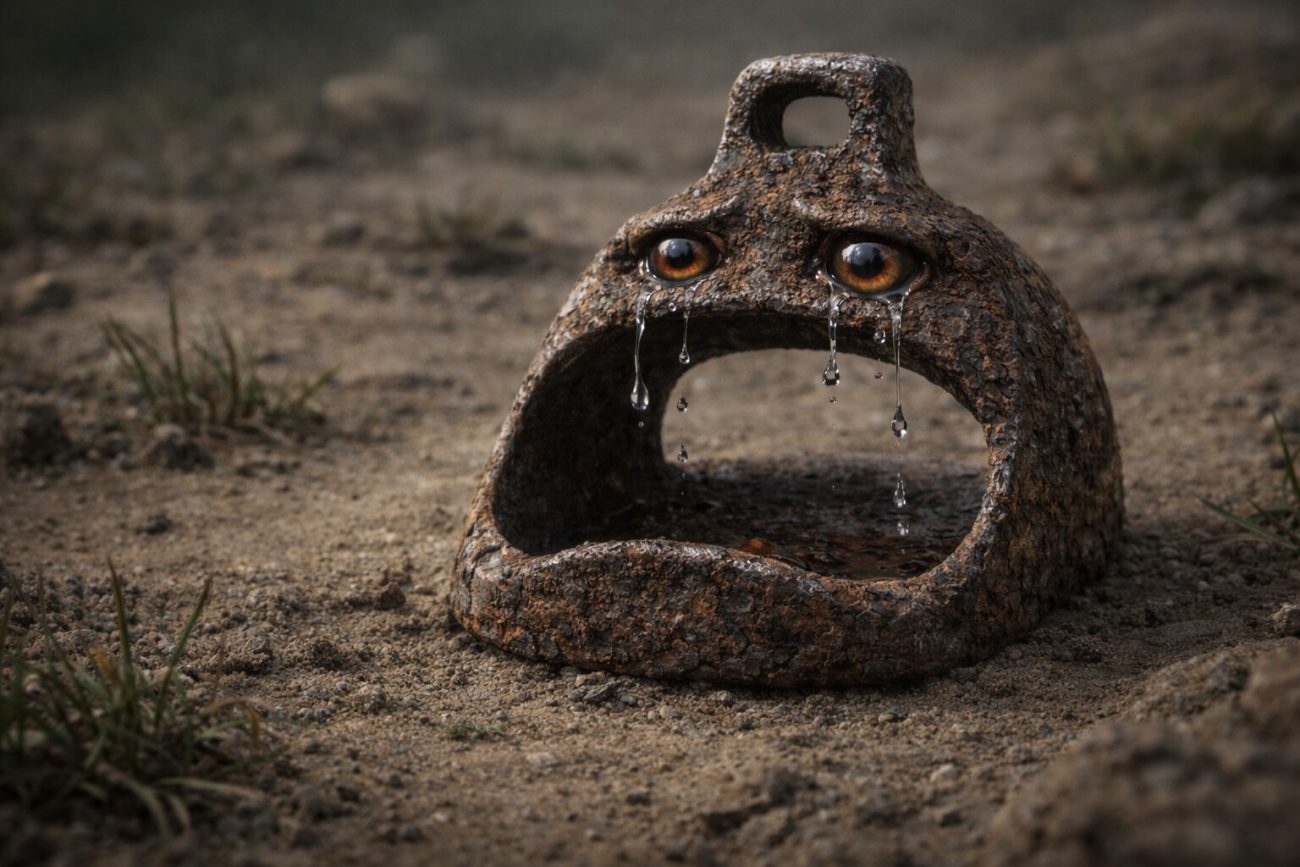
Long ago, it was nothing more than a stirrup—one of a matched pair belonging to a warrior who rode into battle and never returned. When the fighting ended, the dead were buried or burned, the living went home, and the stirrup was left behind in the dirt, still shaped to bear a foot that would never again step into it.
As years passed, the abandoned object awakened.
The iron frame sprouted coarse fur, and where the foot once rested, a mouth formed—wide, soft, and wordless. Thus the Abumi-guchi was born, a tsukumogami shaped not by malice, but by longing.
Unlike many yōkai, the Abumi-guchi does not roam. It does not hunt, trick, or frighten travelers. It remains where it fell, half-buried in grass or mud, facing the direction from which its master once rode. It waits patiently, endlessly, believing that the warrior will return to claim it.
Those who encounter an Abumi-guchi describe it as gentle and sorrowful. It does not attack. It does not speak. If approached, it merely watches with its hollow mouth, as though expecting a familiar presence. Some say it shifts slightly when footsteps approach, mistaking strangers for its long-dead owner.
The Abumi-guchi is said to endure until it finally decays completely, or until time itself erases the memory of the battle. Until then, it remains a symbol of loyalty without reward—an object bound to a purpose that can never again be fulfilled.
In Japanese folklore, the Abumi-guchi stands as a quiet reminder that even tools can grieve, and that devotion, when left behind, may linger far longer than the lives that once gave it meaning.
Sources
Yokai.com contributors. (n.d.). Abumi-guchi. In Yokai.com — The Japanese Mythology Database, from https://yokai.com/abumiguchi/
Wikipedia contributors. (n.d.). Abumi-guchi. In Wikipedia, The Free Encyclopedia, from https://en.wikipedia.org/wiki/Abumi-guchi