Bysen

Tradition / Region: Swedish Mythology
Alternate Names:
Category: Gnome, Spirit


The Myth

In the forests of Gotland, people once feared a strange little being known as the Bysen. He was not born a spirit, but was believed to have once been human. Because of a grave crime committed in life, he was cursed after death and denied all rest. Instead of lying peacefully in the ground, he was condemned to wander the woods forever, half-man and half-spirit, bound to the land he had wronged.

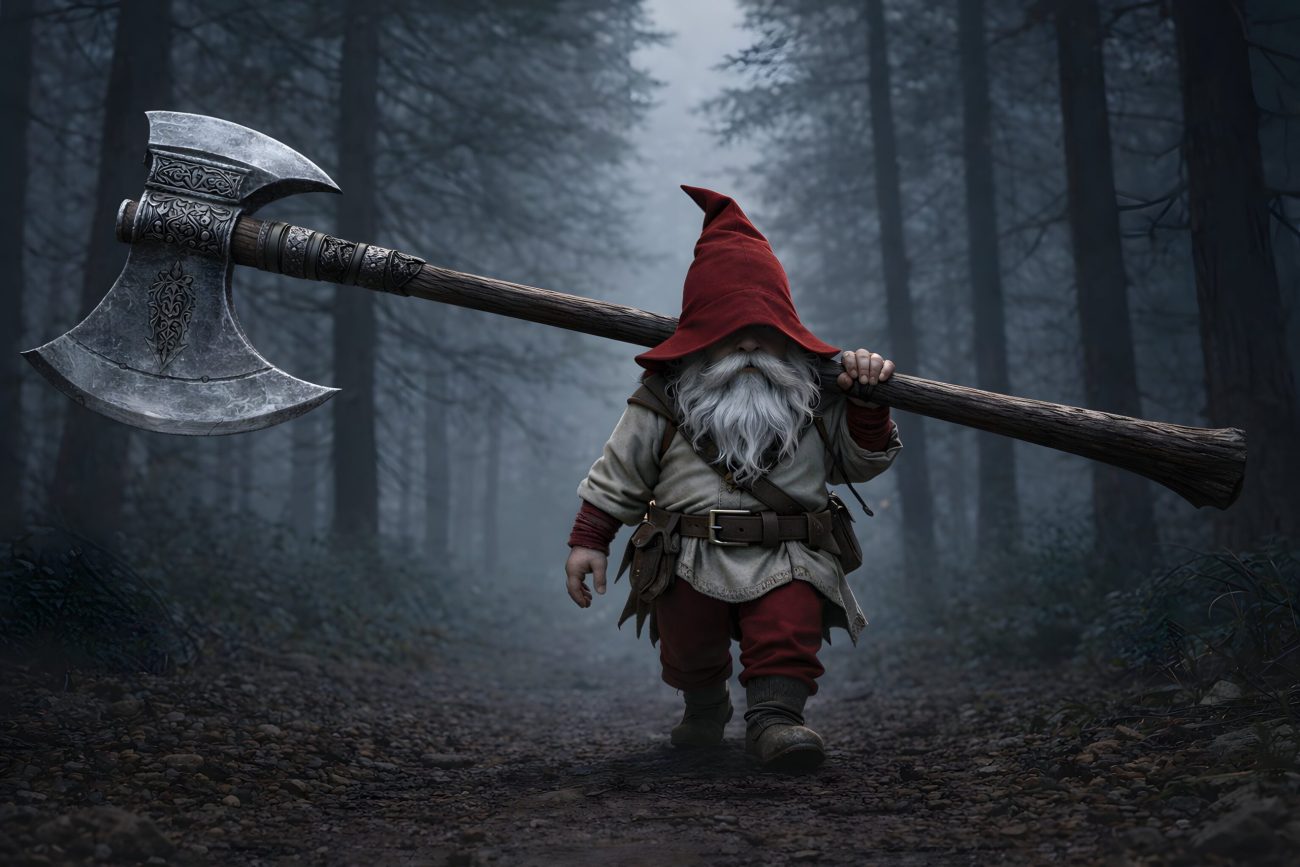
Bysen usually appeared as something easy to overlook: a grey stump, a twisted root, or a small, dull-looking man no taller than a child. Sometimes he wore a red woven cap and carried an axe. This axe was not for honest labor. It marked his role as a reluctant servant of the forest, slowly cutting down Gotland’s trees — so slowly that some said he felled only one tree in a hundred years. In this way, he became both a destroyer and a guardian of nature, bound to it as punishment.

He delighted in confusing people. Foresters hauling timber would suddenly see their loads tip over for no reason. Travelers found themselves wandering in circles, unable to recognize paths they had known all their lives. Those who felt an unseen presence tugging at their senses blamed the Bysen, who was said to lure people off their way and delay their work simply to trouble them.

One of the darkest beliefs about Bysen tied him to land theft. It was said that in life he had moved boundary stones, stealing land from others. As punishment, his spirit was forced to patrol the false borders endlessly. As he walked, he muttered to himself, “This is right… this is wrong,” shifting markers back and forth. If a living person followed him and corrected the stones, restoring the borders to their rightful place, the Bysen could finally be released and find peace.

Seeing Bysen was dangerous. If he noticed you watching him, he could twist your sight so that you would lose him completely and become lost yourself. The only way to break his spell was to turn a piece of clothing inside out or wear it crooked, confusing the spirit and restoring your vision.

Thus, the Bysen lived on in Gotland’s forests as a warning: land stolen brings no rest, nature remembers every wrong, and those who deceive others may wander forever, axe in hand, never finding their way home.


Sources

Wikipedia contributors. (n.d.). Bysen. In Wikipedia, The Free Encyclopedia, from https://en.wikipedia.org/wiki/Bysen


Toornmannetje

Tradition / Region: Dutch Mythology
Alternate Names: Torenmannetjes
Category: Gnome, House dweller


The Myth

In the village of Onstwedde it was once said that small beings lived high in the church tower. These were the Toornmantjes, also called the Torenmannetjes — kabouters who were anything but harmless. From their place in the tower they watched the surrounding land, and when angered, they brought misfortune down upon the fields. Hail would suddenly fall from a clear sky, crops would fail, and farmers would stare helplessly at ruined harvests. Chickens vanished from coops in the night, taken silently, as if by unseen hands.

The Toornmantjes were not creatures of constant malice. Like many spirits of the land, they were deeply sensitive to how humans treated them. If respected, they could be helpful, quietly assisting a household or sparing a farmer from loss. But if insulted, ignored, or disturbed, their anger showed itself swiftly and without mercy.

One farmer learned this the hard way. While working his land, he found a small porcelain figurine and thought it charming. He took it home and placed it on the mantelpiece above the hearth. From that moment on, everything in the house began to go wrong. Illness spread among the family, accidents followed one another, and no effort seemed able to restore peace.

Desperate, the farmer called for the priest. The moment the priest saw the figurine, he understood. It was no harmless ornament — it was a Toornmannetje. By removing it from its place and bringing it into the house, the farmer had offended the tower spirits and drawn their wrath upon himself.

The warning passed down in Onstwedde was clear: these little men are not to be mocked or mishandled. Treat them with care, and they may help you. Cross them, and they will answer with hunger, sickness, and ruin. The Toornmantjes remember every slight — and from their tower, they do not forget.


Sources

Abe de Verteller contributors. (n.d.). Van aardmannetje tot zwarte juffer: Een lijst van Nederlandse en Vlaamse elfen en geesten. In Abe de Verteller, from https://abedeverteller.nl/van-aardmannetje-tot-zwarte-juffer-een


Viy

Tradition / Region: Ukrainian Mythology
Alternate Names:
Category: Gnome, Cave dweller


The Myth

Viy is the master of what lives beneath the earth.

He is said to be the chief of the gnomes and underground beings, an ancient creature so heavy with age and power that his body can scarcely move. His most terrible feature is his eyes. Their eyelids are so vast, thick, and heavy that they drag upon the ground, and Viy himself cannot lift them. When he wishes to see, his servants must raise the lids with iron hooks.

But when his eyes are opened, nothing can hide.

Walls, prayers, circles of protection — all are useless before his gaze. Whatever Viy looks upon is exposed, stripped of concealment, and marked for death. His sight penetrates earth, flesh, and soul alike.

In the tale, Viy is summoned when lesser demons and spirits fail. They call upon him as a final authority, a being whose vision cannot be deceived. When he appears, the ground trembles under his weight. His voice is slow and crushing, and the air grows heavy in his presence.

When Viy’s eyes are lifted and he sees his victim, the victim is doomed. Terror itself seems to answer his gaze, and death follows as a certainty, not as a struggle.

Viy does not chase, does not rage, does not strike. He merely sees.

And that is enough.

He remains a figure of the deep earth and the dark boundary between life and death — a lord not of speed or violence, but of inescapable truth, whose opened eyes end all illusion.


Sources

Wikipedia contributors. (n.d.). Viy (story). In Wikipedia, The Free Encyclopedia, from https://en.wikipedia.org/wiki/Viy_(story)


Acalica

Tradition / Region: Bolivian Mythology
Alternate Names:
Category: Gnome, Cave dweller


The Myth

High in the Bolivian mountains, where clouds cling to stone and storms rise without warning, people speak of the Acalica. They are said to dwell deep within caves hidden in cliffs and ravines, places where thunder echoes long after the sky has cleared. These beings are rarely seen, and most who believe in them know them only through the sudden turning of the weather.

The Acalica are small, wizened men when they choose to appear, bent like ancient roots, their faces lined as though carved by wind and rain. But they do not often show themselves. Instead, their presence is felt when calm skies darken, when hail falls unexpectedly, or when drought ends with sudden rain. Shepherds and travelers say that storms do not come by chance in the mountains — they are sent.

It is believed that the Acalica govern rain, wind, and frost from their rocky shelters. When angered, they unleash violent weather that can ruin crops or make mountain paths deadly. When appeased, they bring gentle rains that nourish the fields. Because of this, people once spoke softly near caves and avoided disturbing stones or entrances in the highlands, fearing they might offend the hidden masters of the sky.

Though few claim to have seen them directly, the Acalica remain part of the living landscape — not creatures of open legend, but of whispered caution — reminders that in the Andes, the weather itself may be listening.


Sources

Wikipedia contributors. (n.d.). Acalica. In Wikipedia, The Free Encyclopedia, from https://en.wikipedia.org/wiki/Acalica


Coblyn

Tradition / Region: Welsh folklore
Alternate Names: Coblynau (plural)
Category: Gnome, Cave dweller


The Myth

Deep beneath the hills of Wales, where pick and hammer rang against stone, miners spoke of the coblyn—a small, ugly little being who lived in mines and quarries. Barely half a yard tall, the coblyn dressed like a miner, carrying tiny tools and scurrying through the dark tunnels alongside human workers.

Coblynau were known not for their strength, but for their sounds. In the silence underground, miners sometimes heard strange knocking and tapping echoing through the rock. Those who understood the signs believed these knocks were not random at all. They were warnings, or guides—signals that rich veins of ore lay close, or that danger was near. To follow a coblyn’s knocking was often to find treasure.

Though they mimicked the labor of miners, the coblyn’s work was more playful than practical. They chipped and tapped with great enthusiasm, imitating human effort without truly shaping the stone. Still, they were considered friendly spirits, far kinder than many other underground beings. A mine blessed by coblynau was thought to be a fortunate one.

Like many spirits of the deep earth, the coblyn thrived in darkness and secrecy. It was rarely seen clearly, and most encounters came only through sound. Yet its presence lingered in miners’ lore as a quiet companion of the underworld—ugly, busy, and strangely benevolent, guiding humans to the hidden wealth of the stone.


Sources

Wikipedia contributors. (n.d.). Coblyn. In Wikipedia, The Free Encyclopedia, from https://en.wikipedia.org/wiki/Coblyn


Kyrië

Tradition / Region: Dutch Mythology
Alternate Names:
Category: Gnome


The Myth

In the Kempen, people once spoke of Kyrië, the king of all kabouters. His name meant “lord,” and he ruled over the little folk from within a kabouterberg hidden in one of the ancient burial mounds on the heath near Hoogeloon. From this mound, Kyrië was said to watch over his people and the land they inhabited, maintaining the quiet balance between humans and the hidden world beneath the earth.

One day, tragedy struck. A hunter, unaware of whom he faced, wounded Kyrië and killed him. Soon after, a mournful cry echoed across the heath, a voice filled with grief calling out: “Kyrië is dood! Kyrië is dood!” The lament was taken up by the kabouters themselves, mourning the loss of their lord.

After Kyrië’s death, the kabouters vanished. It was said that all of them left the Kempen, abandoning their hills and hidden homes forever. From that moment on, the burial mounds grew silent, and the land lost the unseen presence that had once dwelled beneath it. To this day, the story explains why the kabouters no longer walk the Kempen heath—and why the hills feel emptier than they once did.


Gallery


Sources

Abe de Verteller contributors. (n.d.). Van aardmannetje tot zwarte juffer: Een lijst van Nederlandse en Vlaamse elfen en geesten. In Abe de Verteller, from https://abedeverteller.nl/van-aardmannetje-tot-zwarte-juffer-een-lijst-van-nederlandse-en-vlaamse-elfen-en-geesten/


Interpretive Lenses

Religious Readings
  • Christian Ascetic Deep Dive
Philosophical Readings
  • Nietzschean Deep Dive
Psychological Readings
  • Jungian Deep Dive
Esoteric Deep Dive
  • Hermetic Deep Dive
Political / Social Readings
  • Marxist Deep Dive
Other
  • How to Invite The Kyrië

Hangel Gnome

Tradition / Region: Luxembourg Mythology
Alternate Names:
Category: Gnome


The Myth

On the hanging slopes known as the Hangels near Kontern, people once believed that small gnomes lived hidden away in underground grottoes. These little folk were never loud or boastful, but their presence was felt everywhere. Where they lived, the land prospered, work went smoothly, and good fortune seemed to settle like a quiet blessing.

The Hangel gnomes were known above all for their tireless industriousness. Night after night, unseen by human eyes, they labored beneath the earth, tending to their hidden dwellings and quietly influencing the world above. Fields grew better, households flourished, and misfortune kept its distance wherever the gnomes remained undisturbed.

Though no one could say exactly when they vanished, the stories insist that something was lost when they did. The Hangels became silent, and the easy flow of luck faded. Even so, the people of Kontern still remember that their hills were once home to diligent little beings who worked in secret and filled the land with prosperity simply by dwelling beneath it.


Gallery


Sources

SAGEN.at contributors. (n.d.). Wichtlein (Hangels). In SAGEN.at, from https://www.sagen.at/texte/sagen/luxemburg/Wichtlein_Hangels.html


Interpretive Lenses

Religious Readings
  • Christian Ascetic Deep Dive
Philosophical Readings
  • Nietzschean Deep Dive
Psychological Readings
  • Jungian Deep Dive
Esoteric Deep Dive
  • Hermetic Deep Dive
Political / Social Readings
  • Marxist Deep Dive
Other
  • How to Invite The Hangel Gnome

Manchachicoj

Tradition / Region: Argentine Mythology
Alternate Names:
Category: Demon, Gnome


The Myth

Manchachicoj was said to be a small and deformed being, born of an unnatural union between a demon and a terrestrial witch. Though his body was misshapen, he possessed a strange charm: elegant in manner, seductive in speech, and gifted with a romantic soul that did not match his monstrous origins.

He lived in the Salamanca, the legendary place of sorcery and forbidden knowledge, where demons, witches, and spirits gathered beyond the reach of ordinary people. From this shadowed world, Manchachicoj would emerge, drawn again and again toward humanity by an unfulfilled longing.

His fate was tragic. No matter how refined his words or how sincere his devotion, Manchachicoj was doomed to fall in love with young human women who could never truly belong to him. Each love was impossible from the start, divided by nature, destiny, and fear. He could enchant and fascinate, but never remain. His presence carried danger and sorrow, and his romances ended in separation, loss, or despair.

Thus Manchachicoj became a symbol of cursed desire: a being caught between worlds, elegant yet grotesque, condemned to wander in search of a love he could approach but never keep.


Gallery


Sources

Wikipedia contributors. (n.d.). Legendary creatures of the Argentine Northwest region. In Wikipedia, The Free Encyclopedia, from https://en.wikipedia.org/wiki/Legendary_creatures_of_the_Argentine_Northwest_region


Interpretive Lenses

Religious Readings
  • Christian Ascetic Deep Dive
Philosophical Readings
  • Nietzschean Deep Dive
Psychological Readings
  • Jungian Deep Dive
Esoteric Deep Dive
  • Hermetic Deep Dive
Political / Social Readings
  • Marxist Deep Dive
Other
  • How to Invite The Manchachicoj

Mężyk

Tradition / Region: Polish mythology
Alternate Names: Mały mąż, mały człowiek, mały mężczyzna
Category: Demon, Gnome


The Myth

In the old beliefs of the Pomeranian people, Mężyk was a feared male demon who preyed upon the most vulnerable moments of human life. He was especially dangerous to women who had just given birth and to their newborn children, striking during the fragile time of childbirth and early infancy.

Mężyk was described as a small, male figure with a beard so long it reached all the way to the ground. He moved unseen through homes at night, slipping close to cradles. When his moment came, he would seize a child from its crib and hurl it onto the bench near the hearth. If no one intervened in time, he would steal the infant away completely, carrying it down into the underground world from which he came. Some believed the stolen children were never returned, replaced instead with sickly or unnatural beings.

He was considered the male counterpart to dangerous female spirits such as the dziwożony, mamuny, sybiele, and boginki—beings likewise blamed for the disappearance or exchange of infants. Together, these spirits embodied the deep anxieties surrounding childbirth, infant mortality, and unseen forces lurking at the edge of the household.

To protect against Mężyk, families relied on simple but powerful defenses. Iron or steel objects were placed in the cradle—knives, nails, or other metal items—believed to repel the demon and prevent him from approaching the child. Through such measures, people sought to guard newborns from the bearded thief who waited in the shadows, ready to snatch life away before it had fully begun.


Sources

Wikipedia contributors. (n.d.). Mężyk (demon). In Wikipedia, The Free Encyclopedia (Polish), from https://pl.wikipedia.org/wiki/M%C4%99%C5%BCyk_(demon)


Little Peterman

Tradition / Region: German mythology
Alternate Names: Petermännchen
Category: House dweller, Gnome


The Myth

Deep within the halls, vaults, and tunnels of Schwerin Palace lives Little Peterman, a small but vigilant household spirit who has guarded the castle for centuries. He is only a few feet tall and is most often seen carrying a heavy ring of keys, which jangle softly as he wanders through locked doors and hidden passages beneath the palace. Some say he also bears a lantern to light his way, and at times a sword or dagger, marking him as both watchman and protector.

Little Peterman is good-natured toward the honest. He rewards loyalty and upright behavior, and he is especially known for watching over the castle’s guards. Soldiers who fell asleep during night watch were sometimes shaken awake by an unseen hand or startled by sudden noises—saving them from severe punishment or disgrace. In this way, Peterman acted not as an enforcer of discipline, but as a quiet guardian of those who tried to do their duty.

Thieves and intruders, however, receive no such kindness. To them, Little Peterman becomes a tormentor. He bangs on doors, crashes through corridors, rattles chains, and plays relentless pranks until the unwelcome guest flees the castle in terror. His noises echo through the night, reminding all that the palace is never truly unguarded.

One old legend says that when Christianity came to the region, the pagan god once worshipped on the site of Schwerin Castle fled, taking his servants with him. Only one remained behind: Little Peterman, who refused to abandon his post. Another tale claims he once worked as a blacksmith in the underground tunnels, forging tools or weapons long forgotten, and that his spirit remained after death to protect the place he knew best.

Little Peterman does not have a single fixed appearance. Some have seen him as a small old man with a long white beard flowing to his waist. Others describe him as a jaunty cavalier with a feathered hat, curled moustache, waistcoat, and riding boots with spurs. Whatever his form, he is always unmistakably at home in the castle.

To this day, Little Peterman is remembered as the faithful spirit of Schwerin Palace: loyal, watchful, playful, and stern by turns—a reminder that even stone walls and locked doors may have a living memory that refuses to leave.


Sources

Wikipedia contributors. (n.d.). Petermännchen. In Wikipedia, The Free Encyclopedia, from https://en.wikipedia.org/wiki/Peterm%C3%A4nnchen