Whirlwind Ghost

Tradition: Pawnee Mythology, American Mythology
Alternative Names: Ghost-Man, Whirlwind Spirit
Category: Ghost


The Myth

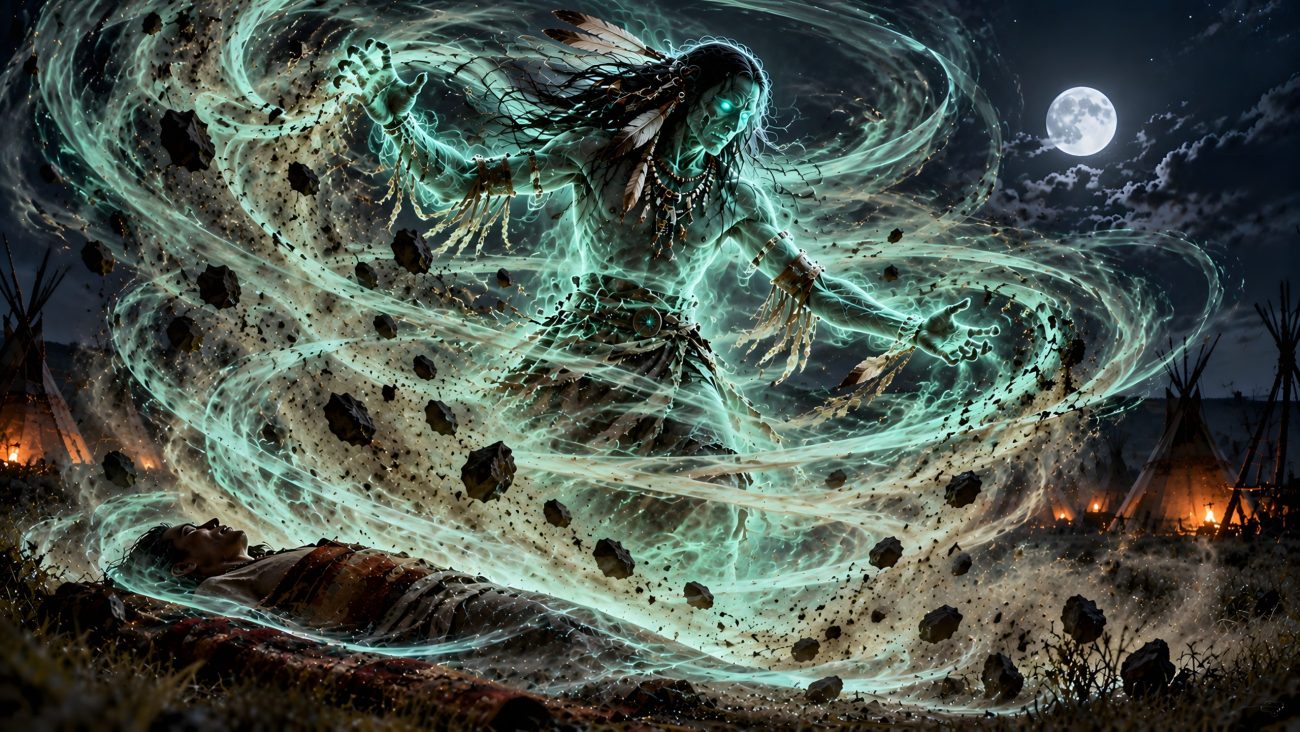
Ghost-Man was a mysterious man who lived among graveyards and rarely stayed at home. Whenever he entered a village, whirlwinds appeared around him, rising beside him before suddenly disappearing. People suspected that he was a ghost because of his strange connection to these swirling winds. Despite his frightening nature, Ghost-Man possessed the power to heal those whose spirits were threatened by supernatural forces.

When a man became gravely ill because a ghost or whirlwind was trying to steal his spirit, Ghost-Man offered to help. Sitting beside the sick man, he gathered dust and threw it into the air, creating a whirlwind that enveloped the patient. The sick man recovered, and Ghost-Man returned home without demanding any payment. He continued healing others who suffered from the same mysterious illness. On another occasion, he was summoned to treat a man who had fallen ill after dreaming of the dead.

This time, Ghost-Man did not throw dust into the air. Instead, he spun around and transformed his own body into a whirlwind that surrounded the sick man and restored his health. However, Ghost-Man made a terrible mistake: he failed to transform himself back into human form. When the whirlwind subsided, only a skeleton remained on the ground. Terrified, the people fled from the lodge, but the recovered man stayed behind, gathered the bones, and buried them. From this strange event came the belief that whirlwinds are ghosts or spirits, and the story serves as a warning about the mysterious and dangerous powers of those who practise spiritual healing.


Sources

Dorsey, George A. The Pawnee: Mythology (Part I). Collected under the auspices of the Carnegie Institution of Washington. Washington, D.C.: Carnegie Institution of Washington, 1906.
Santa Compaña

Tradition: Spanish Mythology
Alternative Names: Güestia, Estadea, Estantiga, Estantigua, Rolda, As da Noite, Pantalla, Avisóns, Pantaruxada
Category: Ghost


The Myth

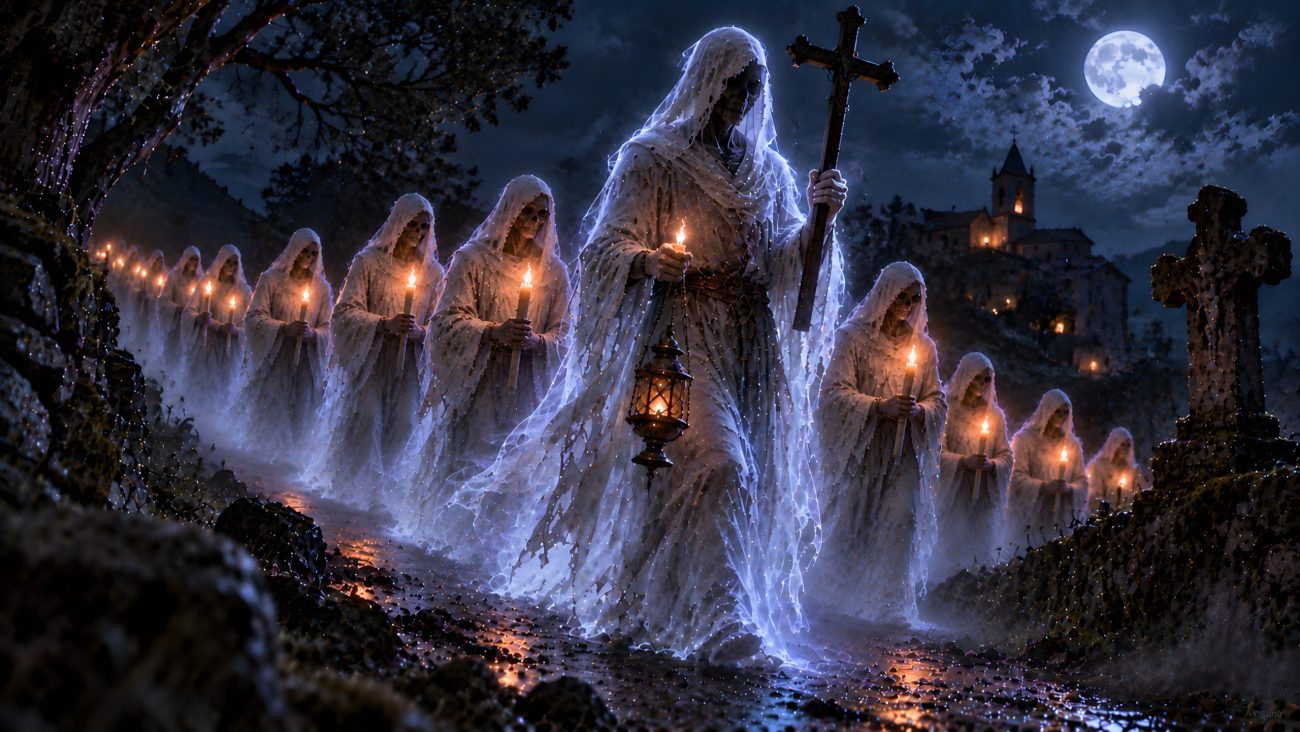
The Santa Compaña is a terrifying procession of the dead that wanders along lonely village paths, through forests, and around parishes in northwestern Iberia. Its members are the souls of the deceased, sometimes described as spirits suffering in torment, who appear at midnight wearing white, hooded cloaks. They carry lit candles as they move silently through the darkness. Even when the spirits themselves remain invisible, their presence may be sensed through a sudden shiver, an overwhelming feeling of danger, or the faint smell of melted candle wax drifting through the air. Some people see only the floating lights of their candles, which resemble will-o’-the-wisps moving along deserted paths.

At the head of the procession walks a living person, carrying a cross, a vessel of holy water, or both. This unfortunate individual has been placed under a supernatural curse that forces them to lead the dead through the night. At midnight, the cursed person falls into a trance and leaves their bed without conscious awareness of what they are doing. They lead the procession through villages and forests until it ends before daybreak, then return home with no memory of the night’s events. Despite having slept, they awaken exhausted and increasingly weakened. If the curse remains unbroken for weeks, the leader may become pale, thin, and sickly, eventually dying and unknowingly passing the burden to another parishioner.

The only way for the living leader to escape this fate is to find another person during the procession and transfer the cross or vessel of holy water to them, passing the curse along. The Santa Compaña’s principal purpose is to announce an approaching death, and the procession is believed to visit the homes of those whose deaths are near. A person who encounters it must take care not to become its next leader. One traditional method of protection is to draw Solomon’s Circle on the ground, placing a six-pointed star and its protective symbol inside, and remain within it until the procession passes. Other methods include lying face-down or making protective gestures with the hands. Those capable of seeing the procession are sometimes believed to have been mistakenly anointed with the holy oil used for the sick during baptism, while others are thought to possess a special sensitivity that allows them to perceive the hidden world of the dead.

The person leading the procession may be either a man or a woman, depending on whether the parish’s patron saint is male or female. Although the dead follow the living leader, the procession itself is an ominous presence that moves through the night, bringing fear and forewarning tragedy. In Galician tradition it is known as the Santa Compaña, while in Asturias it is especially associated with the name Güestia. Under these names, the procession embodies the dreadful belief that the boundary between the living and the dead can open in the darkness, allowing restless souls to pass through the world of the living and announce that someone’s final hour is approaching.


Sources

“Santa Compaña.” Wikipedia: The Free Encyclopedia. Wikimedia Foundation. Accessed October 15, 2026. https://en.wikipedia.org/wiki/Santa_Compa%C3%B1a


O-Chiyobon’s Ghost

Tradition: Japanese Mythology
Alternative Names: O-Chiyobon’s Ghost
Category: Ghost


The Myth

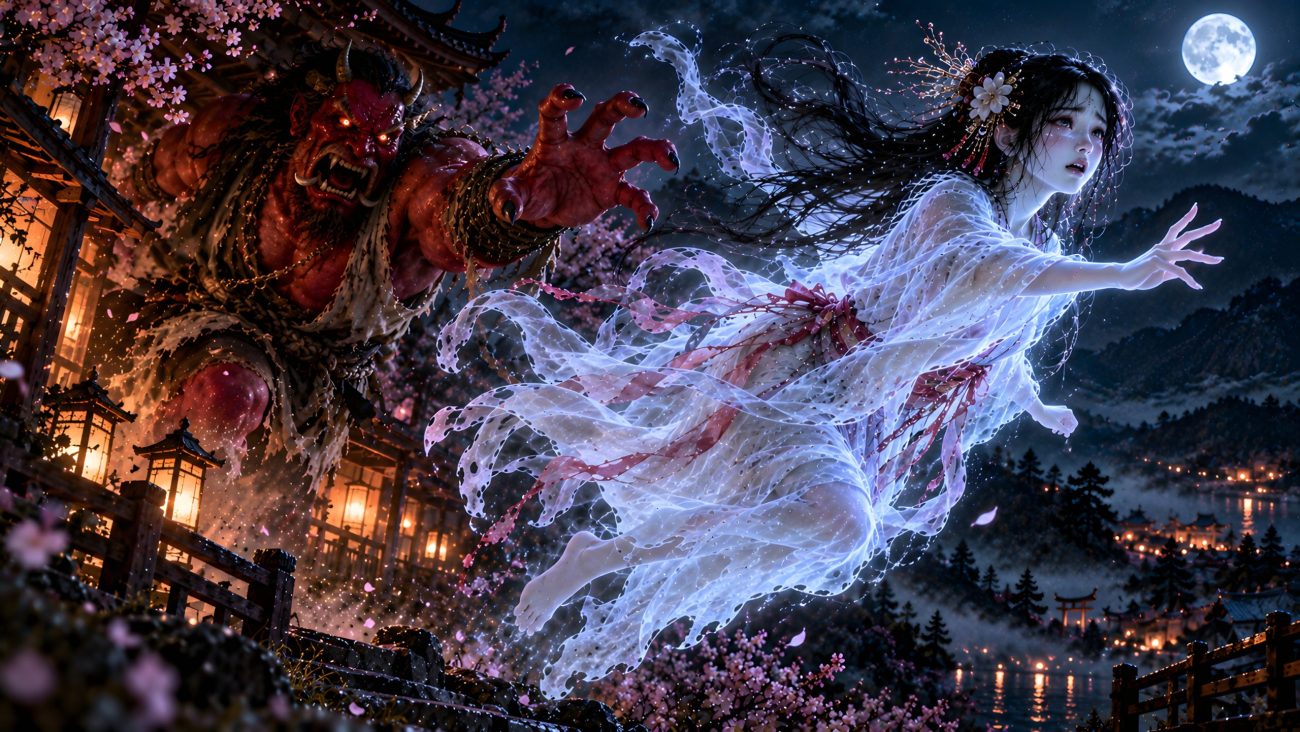
O-Chiyobon’s ghost is a female spirit who appears in the supernatural world of Kegawa Daiko-den, a tale by Jippensha Ikku. After leaving Hell and returning to the world of the living, the ghost becomes lost on a mountain path. She discovers the illuminated home of Momonjii, a kindly monster who rents out underground holes to other supernatural creatures, and asks him for shelter and a cup of tea. Momonjii welcomes her inside and learns that she has returned to the living world to haunt a man against whom she holds a grudge. However, the man has moved to the foot of the mountain, and while searching for him, she lost her way. Momonjii offers to let her stay at his home and use it as a base for her nightly visits. The ghost happily accepts, asking him to find a strong companion who can help frighten her enemy, since she is too weak and timid to terrify him alone.

Meanwhile, Momonjii has been sheltering O-Chiyobon, a strange-looking woman whom he rescued from the drunken and violent monster Shiradawashi. After Momonjii and O-Chiyobon become lovers, Shiradawashi storms into the house carrying a huge log, furious that his woman has been taken from him. Momonjii retaliates with an axe, and the other monsters living in his rented holes intervene to settle the fight. After Shiradawashi is thoroughly beaten, Momonjii decides that he must compensate for his mistreatment of O-Chiyobon. He therefore gives the visiting ghost to Shiradawashi as his wife, forgiving his overdue rent and promising that he will never have to pay rent again. Although Shiradawashi complains that his new wife is too beautiful for a monster, he accepts the arrangement because of the financial benefits. He soon becomes unable to resist her charms and spends every night with her.

The ghost, however, finds life with Shiradawashi unbearable. Although she dislikes having a monster for a husband, she endures his advances because she still hopes to use his strength to take revenge on the man she hates. Eventually, her suffering becomes so great that she wishes she could return to Hell, but she no longer knows the way. Unable to escape, she abandons her desire for revenge and begins devoutly chanting the name of Amida Buddha, hoping to reach the Pure Land and find peace. In Hell, Enma, the King of the Underworld, grows furious that the ghost has failed to return and sends a troop of demons to bring her back. When they arrive to seize her, Shiradawashi fiercely fights the demons, throwing and striking the powerful beings in an attempt to keep his wife.

During the fierce battle, a purple cloud suddenly descends from the sky, and Amida Buddha appears within it. Addressing the ghost with a playful pun involving kinako mochi, he invites her to leave Hell behind and enter the Pure Land. Through the power of her sincere devotion, the ghost achieves salvation and escapes her suffering forever. Shiradawashi is left without a wife, and his story continues until he eventually becomes involved in a conflict between a tanuki and a fox, where he meets his end at the hands of O-Chiyobon.


Sources

“居候幽霊 (Isōrō Yūrei).” 新版TYZ 妖怪図鑑 (New TYZ Yokai Encyclopedia). https://tyz-yokai.blog.jp/archives/1072132463.html


Zwaardman

Tradition: Dutch Mythology, Belgian Mythology
Alternative Names: Zwaardman
Category: Ghost


The Myth

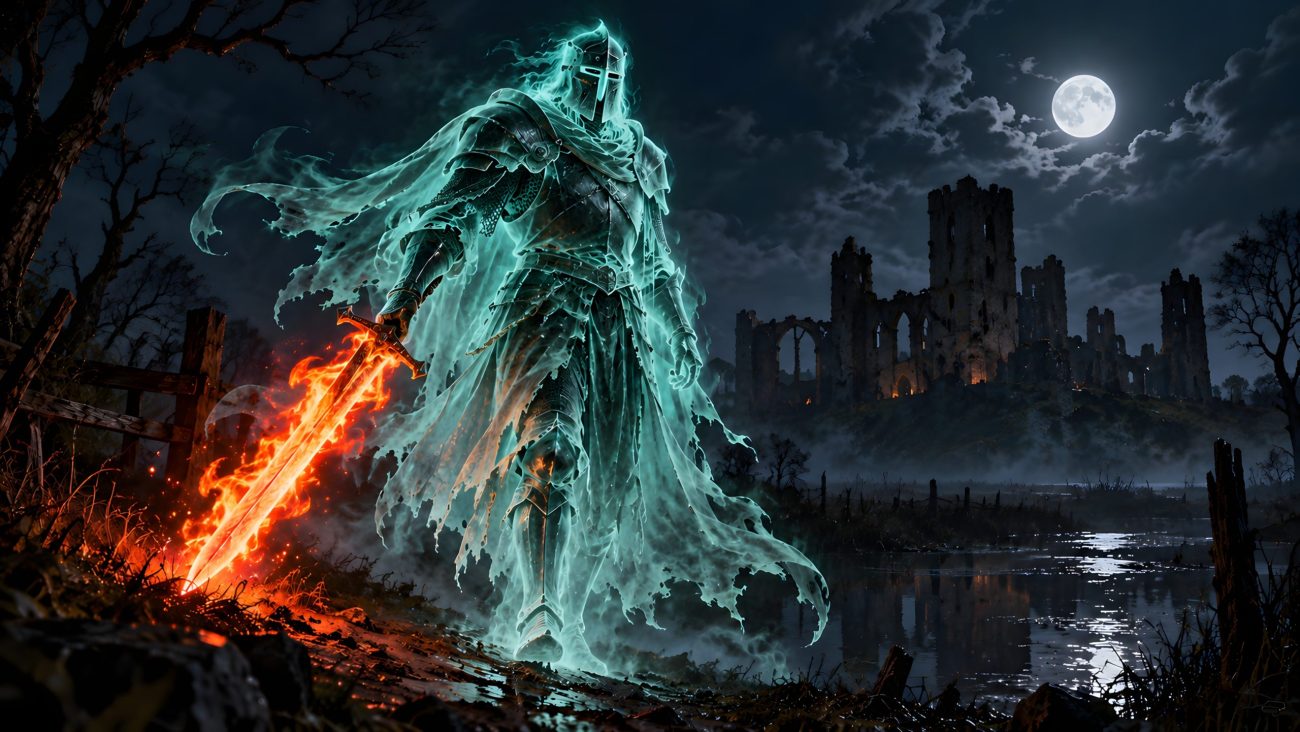
The Zwaardman is the ghost of a knight who wanders the earth carrying a flaming sword. In life, he was a proud and wrathful man whose arrogance led him to commit a terrible crime: he murdered a priest inside a church while the priest was celebrating Mass. For this sacrilege, he received a dreadful punishment that continued beyond death.

As divine punishment for his crime, the knight’s castle sank into the ground, and his spirit was condemned to wander forever. Unable to find rest, the Zwaardman haunts the places associated with his legend, appearing as a ghostly knight wielding a sword engulfed in flames.

Stories of the Zwaardman are told in several places, including Uithuizermeeden, Maaseik, Bergeijk, and Sint-Pieters-Rode near Brussels. His legend warns of the terrible consequences of pride, violence, and the murder of a holy man.


Sources

Van der Veen, Abe. “Van aardmannetje tot zwarte juffer: Een lijst van Nederlandse en Vlaamse elfen en geesten.” Abe de Verteller. https://abedeverteller.nl/van-aardmannetje-tot-zwarte-juffer-een-lijst-van-nederlandse-en-vlaamse-elfen-en-geesten/


Ghost Town Ghost

Tradition: Tlingit Mythology, American Mythology
Alternative Names: Ghost House
Category: Ghost


The Myth

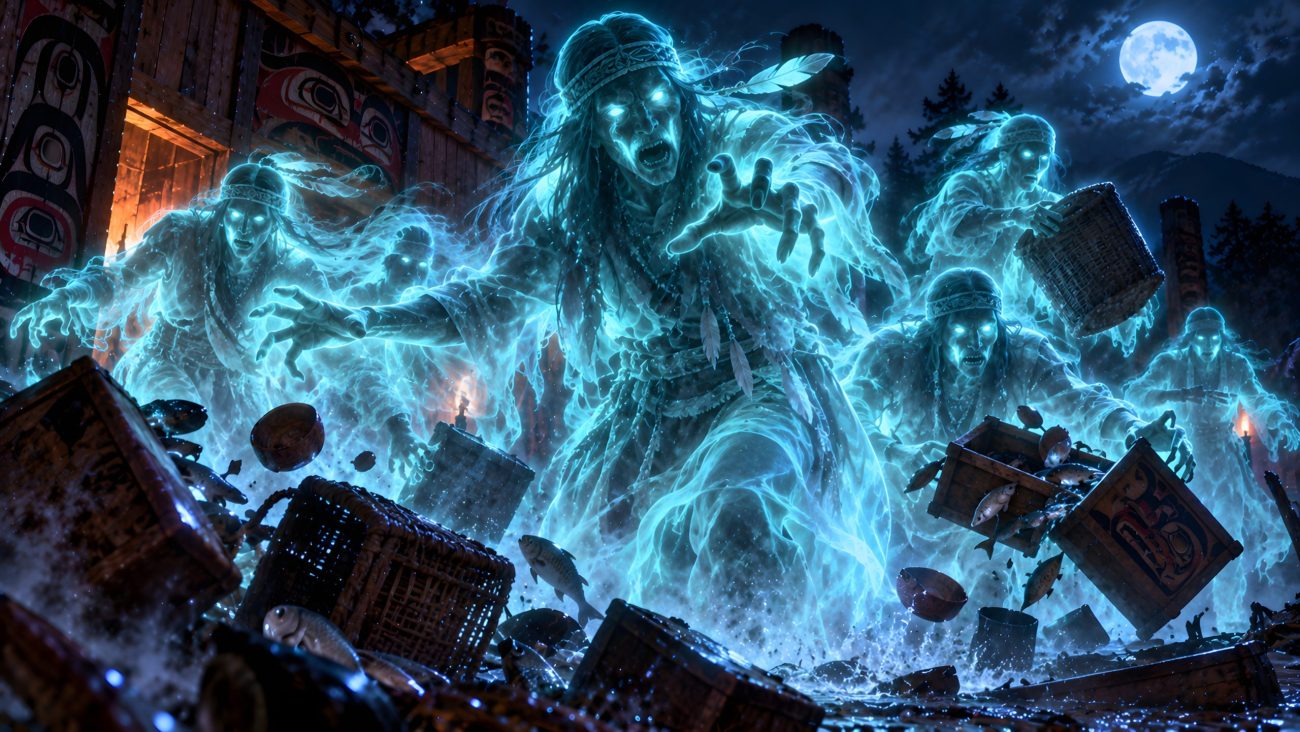
Ghost Town is a deserted settlement inhabited by invisible spirits. When Raven arrives, he finds a large town where everyone appears to have died. He enters the largest house, but an unseen presence continually pushes him away, even though he cannot see anyone inside. Realizing that the house is haunted, Raven discovers that the apparently empty town is not as deserted as it seems.

Raven decides to take provisions from the empty houses, loading them into his canoe before paddling away. However, he does not notice that a long rope connects the stern of his canoe to a tree on the shore. Once he reaches the end of the rope, the canoe is abruptly pulled back to the beach, and all the provisions are returned to the houses. Despite these mysterious actions, Raven cannot see anyone responsible.

The invisible inhabitants then retaliate by dropping a large stone onto Raven’s foot, leaving him badly lame. Although the town appears empty, its ghostly residents can move objects, prevent outsiders from taking their possessions, and inflict physical harm on those who disturb their settlement.


Sources

Judson, Katharine Berry, ed. Myths and Legends of Alaska. Illustrated. Chicago: A. C. McClurg & Co., 1911.


Uryak

Tradition: Tatar Mythology, Bashkir Mythology, Russian Mythology
Alternative Names: Örek, Örak, Эрак
Category: Ghost


The Myth

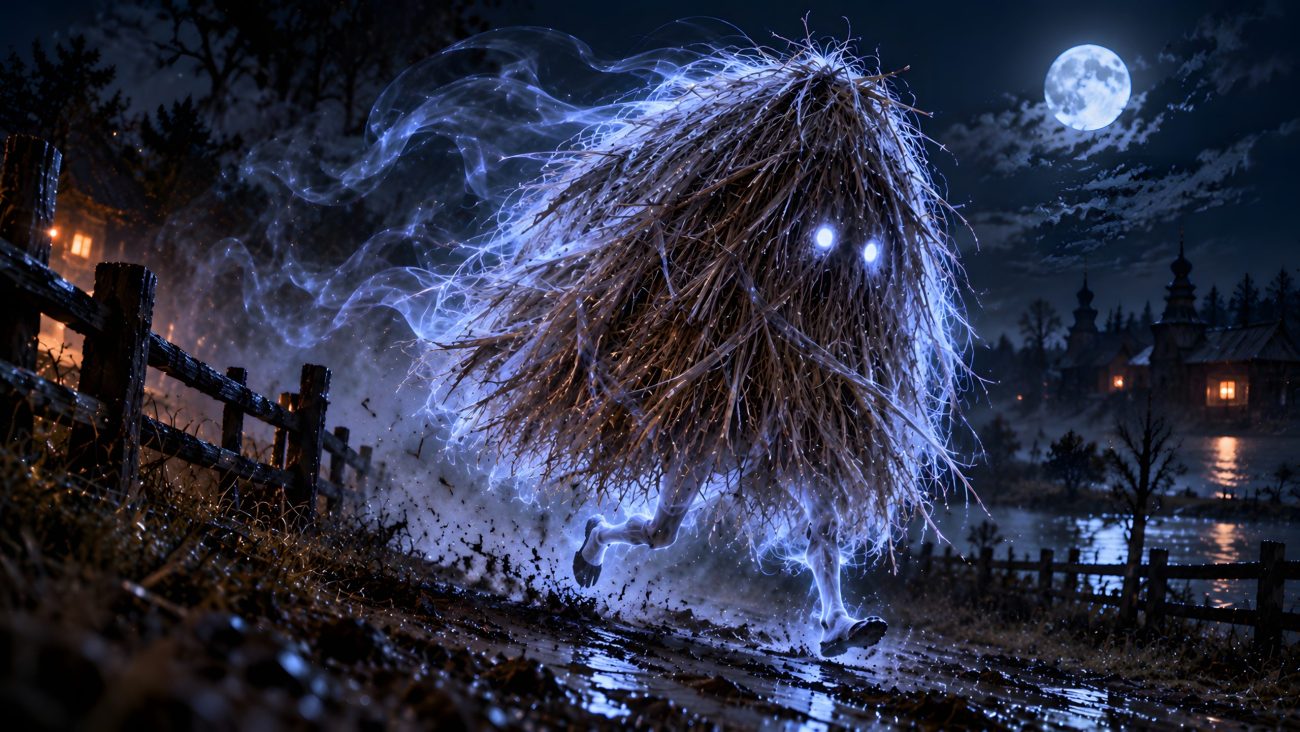
The Uryak is the ghost of a person who died a violent death, appearing in places where blood has been spilled. It may take the form of a human figure or a haystack-like shape, swaying and moving forward as it travels. Some accounts describe it as a strange, indistinct creature that can transform into a cloud. Although it is generally not considered directly harmful to people, its appearance is deeply frightening, particularly when encountered alone at night. The Uryak is associated with the graves of those who died violently and is believed to appear at the very place where a person’s life ended.

The Uryak is said to have a distinctive heart-rending cry that draws attention to its presence. People who encounter it may become terrified, confused, or even lose the use of their limbs. In Tatar tradition, a person who sees the spirit from a distance may hear its mournful cries and attempt to avoid it. If the Uryak approaches someone and refuses to leave them alone, the traditional way to drive it away is to address it with foul language. Bashkir accounts also describe the Örak as a terrifying apparition that may appear as a very tall, thin man in a white robe. It can frighten people into delirium, disability, or madness, and is sometimes said to visit murderers, knock on their doors, and torment them.

The Uryak can also appear in deceptive forms. One Tatar tale tells of a woman riding along a forest path who encounters a man dressed in white standing on a bridge. As she approaches, he transforms into a round ball of fire, rolls toward her cart, and becomes a little girl who climbs aboard. The frightened woman tries prayers and religious invocations to make the strange child leave, but the girl refuses and begins striking her with a stick while shouting obscenities. After a long struggle, the woman abandons the cart and flees, while the girl continues following her. Only when the woman remembers that a horse must be harnessed head-on to a cart does she escape the apparition. The strange girl immediately disappears, and the woman returns safely to her village. Such encounters portray the Uryak as a restless and uncanny spirit whose appearances are linked to violent death, fear, and places marked by bloodshed.


Sources

“Уряк (Uryak).” New Bestiary (Bestiary.us). https://www.bestiary.us/uryak


Bánánach

Tradition: Irish Mythology
Alternative Names: Bánánacha (plural)
Category: Ghost


The Myth

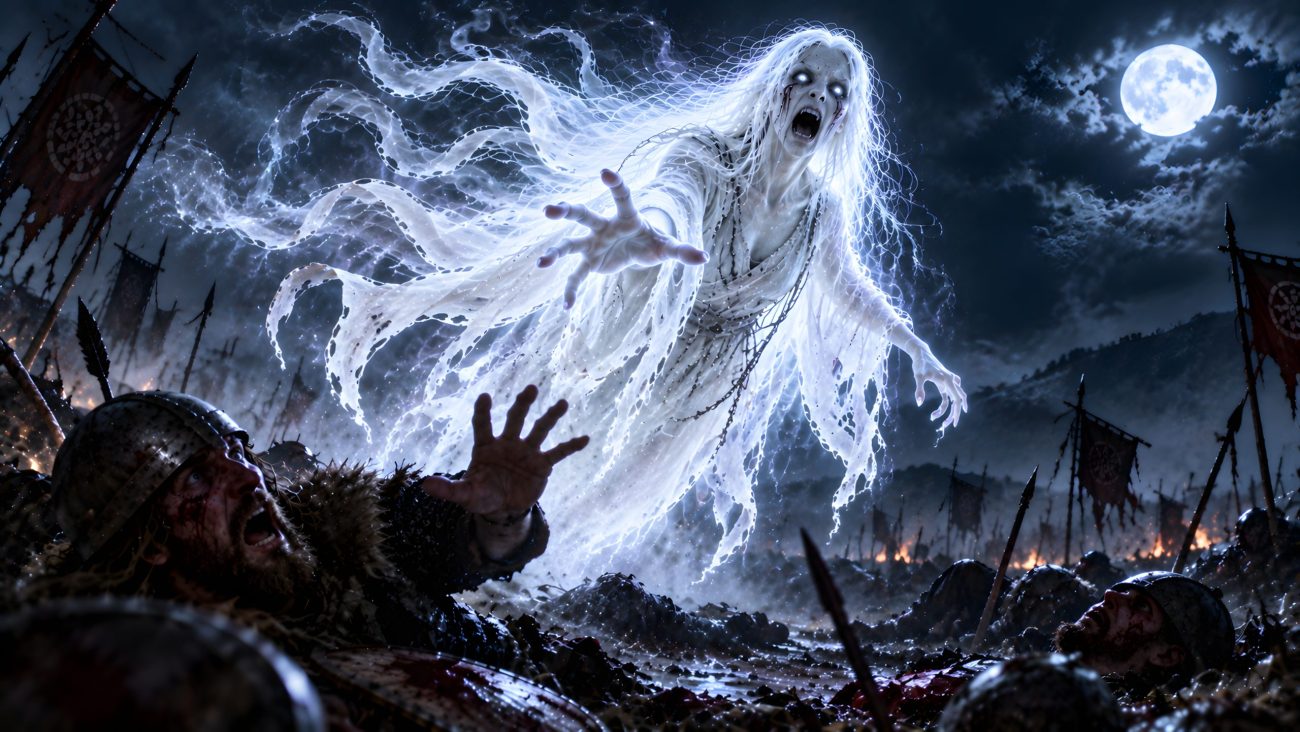
The bánánach are supernatural spectres that haunt battlefields, appearing amid the terror and confusion of war. They are associated with the clash of weapons, the cries of combatants, and the frightening sounds that fill the battlefield. Rather than being described with a fixed physical appearance, they are portrayed as mysterious presences whose arrival intensifies the fear of those caught in battle.

In Irish mythology, the bánánach appear alongside other terrifying battlefield beings, including the bócanach, a goat-like battle spectre, and the geniti glinne, a female battle spectre associated with valleys. These beings are connected with the supernatural forces of warfare and are said to have been sent by the Tuatha Dé Danann to strike fear into the enemies of the hero Cú Chulainn, answering his battle cry. Their presence made the sounds and dangers of combat seem to take on a life of their own.

The bánánach and their companion spectres were so terrifying that even the legendary bull Dond Cúalnge was associated with the power to ward them off. They embody the supernatural terror of the battlefield, where the clash of weapons and the cries of warriors become indistinguishable from the frightening presence of otherworldly beings.


Sources

“Bánánach.” Wikipedia: The Free Encyclopedia. Wikimedia Foundation. Accessed October 15, 2026. https://en.wikipedia.org/wiki/B%C3%A1n%C3%A1nach


Bean-nighe

Tradition: Scottish Mythology
Alternative Names: Washing Woman, Washer at the Ford, Nigheag, Nigheag na h-ath, Nigheag bheag a bhroin
Category: Ghost


The Myth

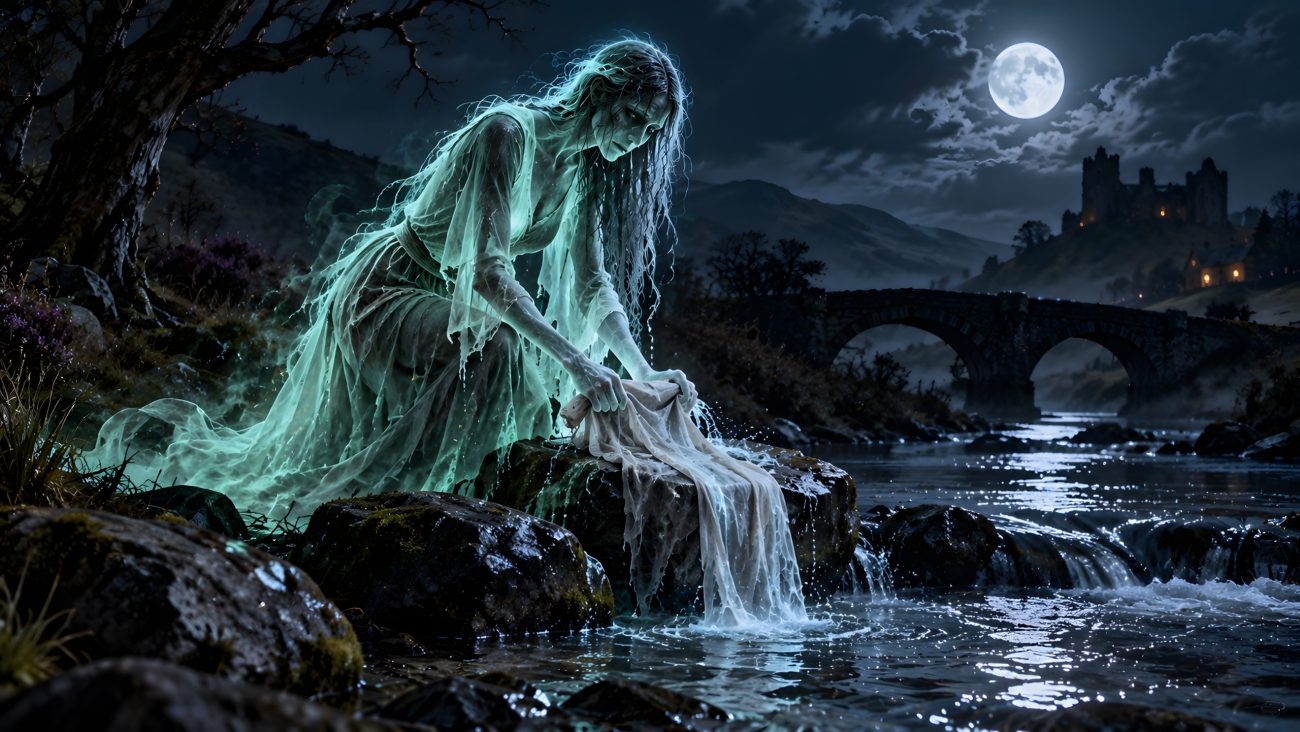
The bean-nighe is a female spirit who appears beside lonely streams, pools, and fords, washing the blood from the clothing and burial shrouds of people who are about to die. She is often heard singing a mournful dirge as she beats the garments against stones, seemingly absorbed in her grim task. Her appearance varies between regions. On the islands of Mull and Tiree, she has unusually long breasts that she throws over her shoulders while washing. On Skye, she resembles a small, pitiful child, while in Perthshire she is described as short, round-bodied, and dressed in green. Other accounts give her a single nostril, a large protruding front tooth, or red, webbed feet.

The bean-nighe is regarded as a messenger from the Otherworld and an omen of approaching death, particularly a sudden or violent one. Some traditions say she is the spirit of a woman who died in childbirth and must wash burial clothes until the day she would naturally have died. Those who encounter her may sometimes discover the fate awaiting them. If approached stealthily and caught, she may answer questions, reveal whose shroud she is washing, or grant three wishes. On Mull and Tiree, a person who wishes to obtain knowledge from her must approach from behind and claim to be her foster-child by taking one of her breasts into his mouth. If the garment belongs to the person himself or to a friend, he may be able to stop her washing and avert the threatened death. On Skye, however, anyone whom she sees first risks losing the use of their limbs.

One Highland tale tells of Gille-cas-fliuch, who encountered the washerwoman of the ford during the night as she washed and lamented beside stepping stones on Benbecula. He seized her and demanded three wishes in exchange for releasing her. The bean-nighe revealed that she was washing the death shroud of Great Clanranald, who would never again cross the ford at Dun-buidhe during his lifetime. Gille-cas-fliuch threw the shroud into the loch on the point of his spear and hurried to warn Clanranald. The chief immediately ordered a small boat to be made and crossed the loch to the mainland, never returning to Dun-buidhe. In another tale, a tall woman was seen washing bloodstained shirts in Loch Slin shortly before the roof of Fearn Abbey collapsed during a service, killing many people. Such stories portray the bean-nighe as a mysterious herald of death whose washing foretells tragedies that may still be avoided if her warning is understood in time.


Sources

“Bean-nighe.” Wikipedia: The Free Encyclopedia. Wikimedia Foundation. Accessed October 15, 2026. https://en.wikipedia.org/wiki/Bean-nighe


Gloeiige

Tradition: Dutch Mythology
Alternative Names: De Glène Kerel, De Gloeiige Man, Gloeiende Gerrit, Gleunigen, Glende Kerels, Sjoufert
Category: Ghost


The Myth

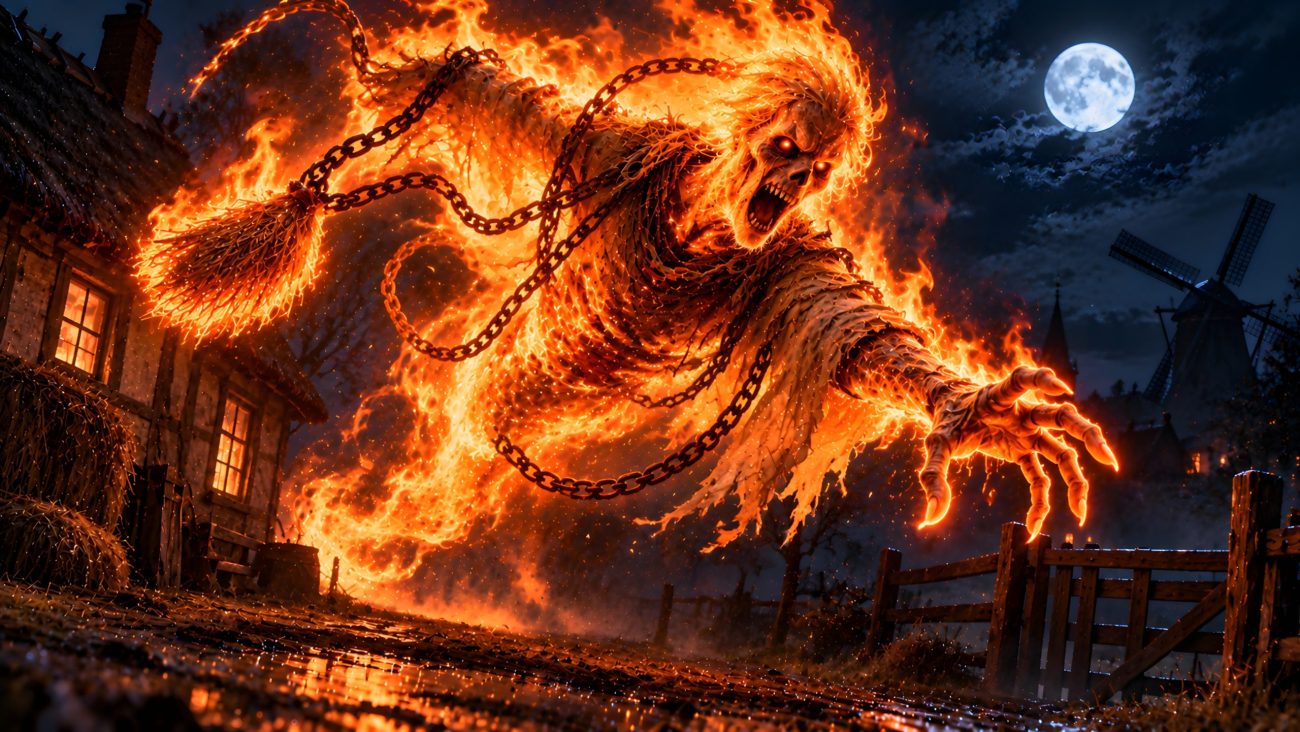
The Gloeiige is a fiery ghostly apparition that appears as a living flame, a fireball, or a blazing projectile. Sometimes it takes the shape of a burning bundle of straw or a flaming thatch of roofing. These spirits are the restless souls of people who brought a curse upon themselves during their lives, particularly unjust land surveyors and arsonists, but also thieves and murderers. Many had sworn false oaths, declaring, “May I burn forever if I lie.” After death, they were condemned to fulfil their own terrible curses, doomed to burn as fiery apparitions.

The Gloeiigen are dangerous spirits that may be summoned by calling or whistling for them. Anyone who calls one and then flees may discover a blackened handprint burned onto their door the following morning. In autumn, the fiery spirits descend from the sky and lash chimneys with their blazing chains. Sometimes they enter houses themselves, striking sinners with their chains and leaving painful brands upon their bodies.

In Venlo, the inhabitants were said to have to provide the Gloeiige with an annual offering consisting of a cartload of sand, a pair of tin shoes, and seven and a half stuivers. These strange demands reflect the spirit’s fearsome place in local tradition, where the souls of those who had sworn false oaths or committed serious wrongs continued to suffer through fire after death.


Sources

Van der Veen, Abe. “Van aardmannetje tot zwarte juffer: Een lijst van Nederlandse en Vlaamse elfen en geesten.” Abe de Verteller. https://abedeverteller.nl/van-aardmannetje-tot-zwarte-juffer-een-lijst-van-nederlandse-en-vlaamse-elfen-en-geesten/


Lange Man

Tradition: Belgian Mythology, Dutch Mythology
Alternative Names: Lange Man
Category: Ghost


The Myth

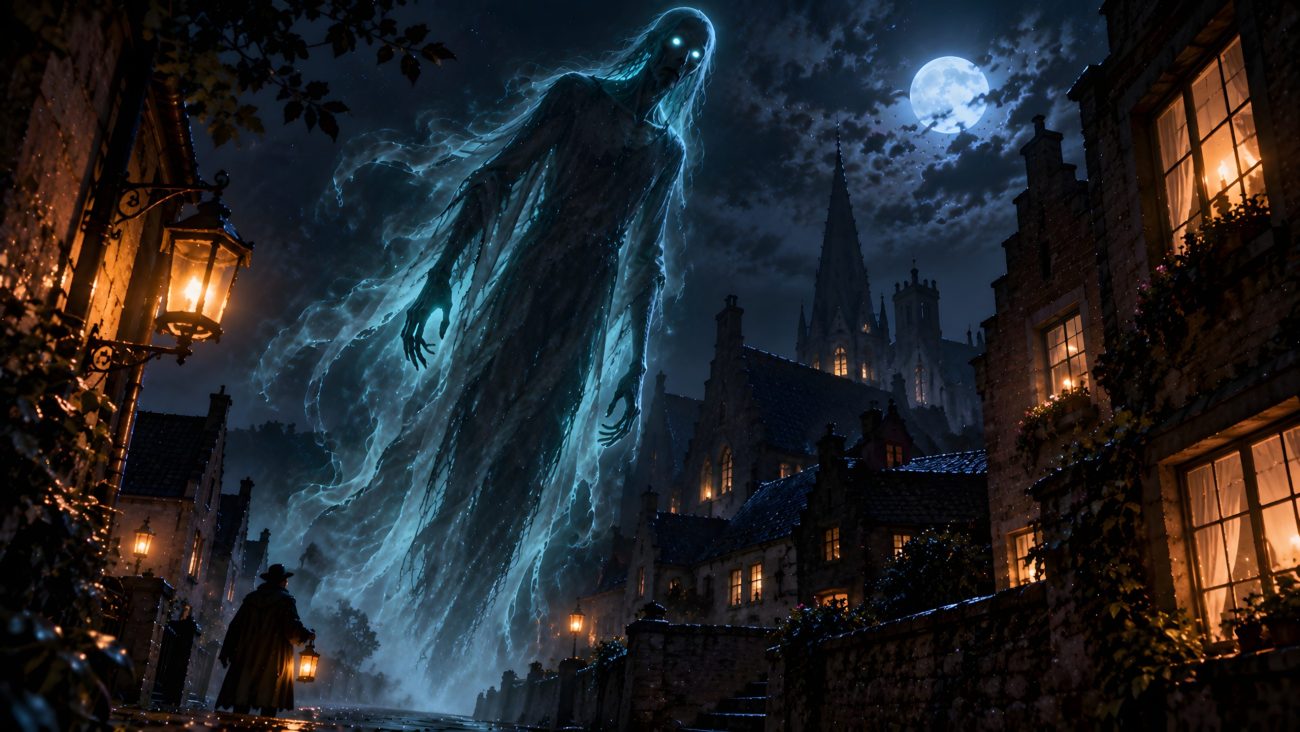
The Lange Man is a tall, black apparition shaped like a human figure. Rather than walking, he glides above the ground with his legs held tightly together, his neck stiff and his arms hanging limply at his sides. Despite his frightening appearance, he is said to protect people who travel late at night.

In Maastricht, the Lange Man is said to emerge from a cellar opening during the night before growing to a height greater than the surrounding houses. He peers through people’s windows and knocks on the highest panes of glass, towering over the buildings as he moves through the darkness. He can also transform himself into an old woman or a large, rolling ball, making his appearance unpredictable and unsettling.

Despite his occasional protective role, the Lange Man is also regarded as a harbinger of disease. His nocturnal appearances and strange transformations are signs that illness may soon come to the people who encounter him.


Sources

Van der Veen, Abe. “Van aardmannetje tot zwarte juffer: Een lijst van Nederlandse en Vlaamse elfen en geesten.” Abe de Verteller. https://abedeverteller.nl/van-aardmannetje-tot-zwarte-juffer-een-lijst-van-nederlandse-en-vlaamse-elfen-en-geesten/