Clíodhna

Tradition: Irish Mythology
Alternative Names: Clídna, Clíodna, Clíona, Cleena, Clíodna of Carrigcleena
Category: Ghost


The Myth

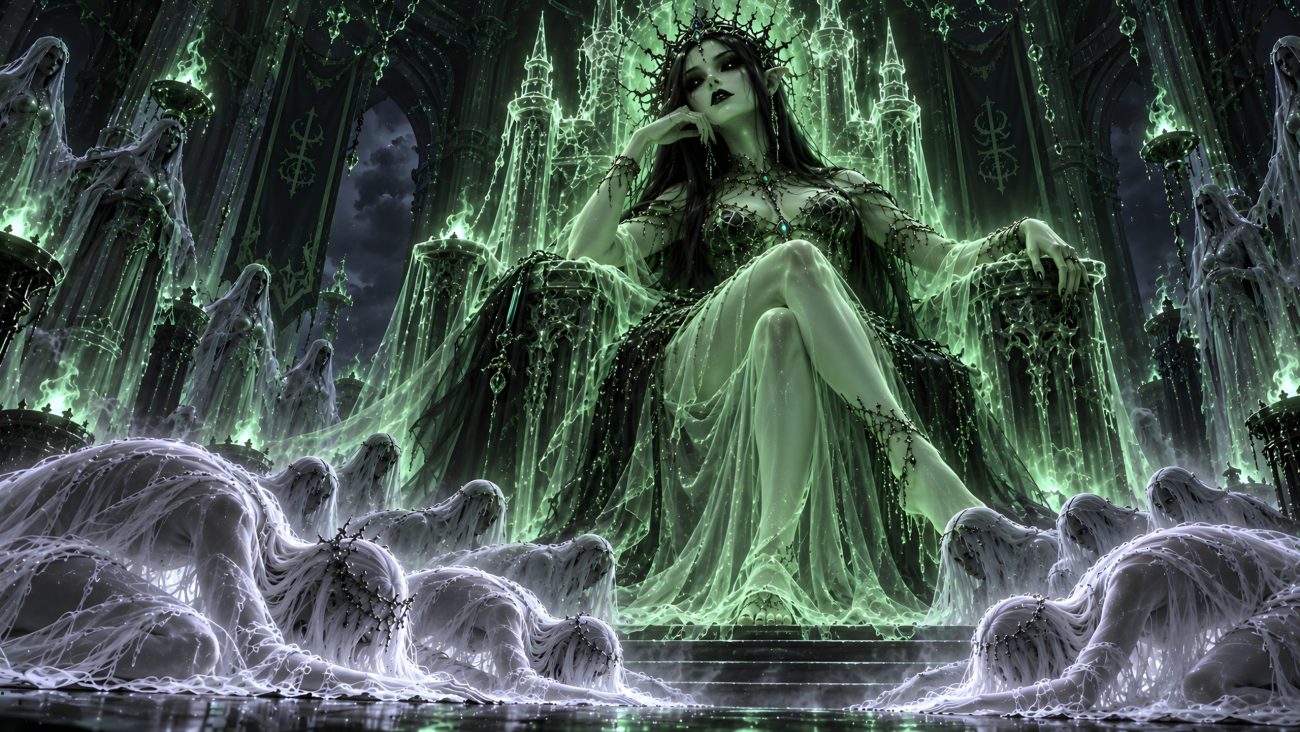
Clíodhna is a powerful supernatural woman in Irish mythology, associated particularly with southern Munster, or Desmond, where she rules as queen over the sióga, the fairies. Known as Clíodna of Carrigcleena, she is regarded in some traditions as a queen of the banshees, while others portray her as a goddess of love and beauty and a benefactor of County Cork. Her palace lies among a great pile of rocks near Mallow, at a place known as Carrig-Cleena. She is closely associated with several old Irish families, including the MacCarthys, O’Keeffes, O’Donovans, and FitzGeralds, and appears in numerous local legends.

One of the best-known stories about Clíodhna concerns her love for Ciabhan of the Curling Hair, recounted in the medieval Irish work Acallam na Senórach, or Colloquy of the Ancients. Clíodhna was the daughter of Gebann, a chief druid in the otherworldly land of Tír Tairngire, ruled by Manannán. When she saw Ciabhan, she fell in love with him and agreed to leave the otherworld with him. They sailed to Ireland and reached Teite’s Strand, where Ciabhan went ashore to hunt, leaving her in their boat. People sent after them from Manannán’s realm played enchanting music that lulled Clíodhna to sleep. A tremendous wave then swept her away. The place became known as Tonn Chlíodhna, or “Clíodhna’s Wave,” near Glandore Harbour. Different versions of the legend disagree about whether she drowned.

Clíodhna is also associated with three brightly coloured birds that feed on apples from an otherworldly tree. Their sweet singing is said to heal sickness. In another tradition preserved in the Book of Lismore, she gives Teigue, the son of Cian, three magical birds to guide his warriors and provide music during their voyage, as well as an emerald cup that transforms water into wine. She warns Teigue that losing the cup will bring about his death. With the birds and cup, Teigue and his warriors eventually return home victorious after rescuing their captured people.

Other legends portray Clíodhna as a powerful enchantress whose jealousy can bring terrible consequences. In one tale, she and her younger sister Aoivil both fall in love with a prince named Caiov. When he chooses Aoivil, Clíodhna curses her sister, causing her to lose her beauty and appear dead. She then secretly carries Aoivil to a cave at Castlecor, transforms her into a white cat, and enchants the cave into a palace filled with treasure. Aoivil remains trapped there, returning to human form for only one week each year at midsummer. Clíodhna eventually marries Caiov, but when the truth is revealed, their relationship is shattered. She retires to her fairy palace at Carrigcleena, where she continues to visit her enchanted sister.

Clíodhna also appears in tales of mortals taken into Fairyland. In one story, she abducts the chieftain Fitz-Gerald, whom she desires, but releases him after his beloved Ellen O’Brien travels to Carrigcleena and pleads for his return in poetry. Another legend concerns the Blarney Stone: when Cormac Laidir MacCarthy faced a lawsuit, Clíodhna advised him to kiss the first stone he found on his way to court. He followed her advice and delivered his case with such eloquence that he won. The stone was later incorporated into Blarney Castle and became associated with the gift of persuasive speech. Across these traditions, Clíodhna appears as a figure of beauty, magic, desire, jealousy, and otherworldly power, capable of helping mortals but also drawing them into dangerous encounters with the fairy realm.


Sources

“Clíodhna.” Wikipedia: The Free Encyclopedia. Wikimedia Foundation. Accessed October 16, 2026. https://en.wikipedia.org/wiki/Cl%C3%ADodhna
Cóiste Bodhar

Tradition: Irish Mythology
Alternative Names: Silent Coach, Death Coach, Cóiste na Marbh
Category: Ghost


The Myth

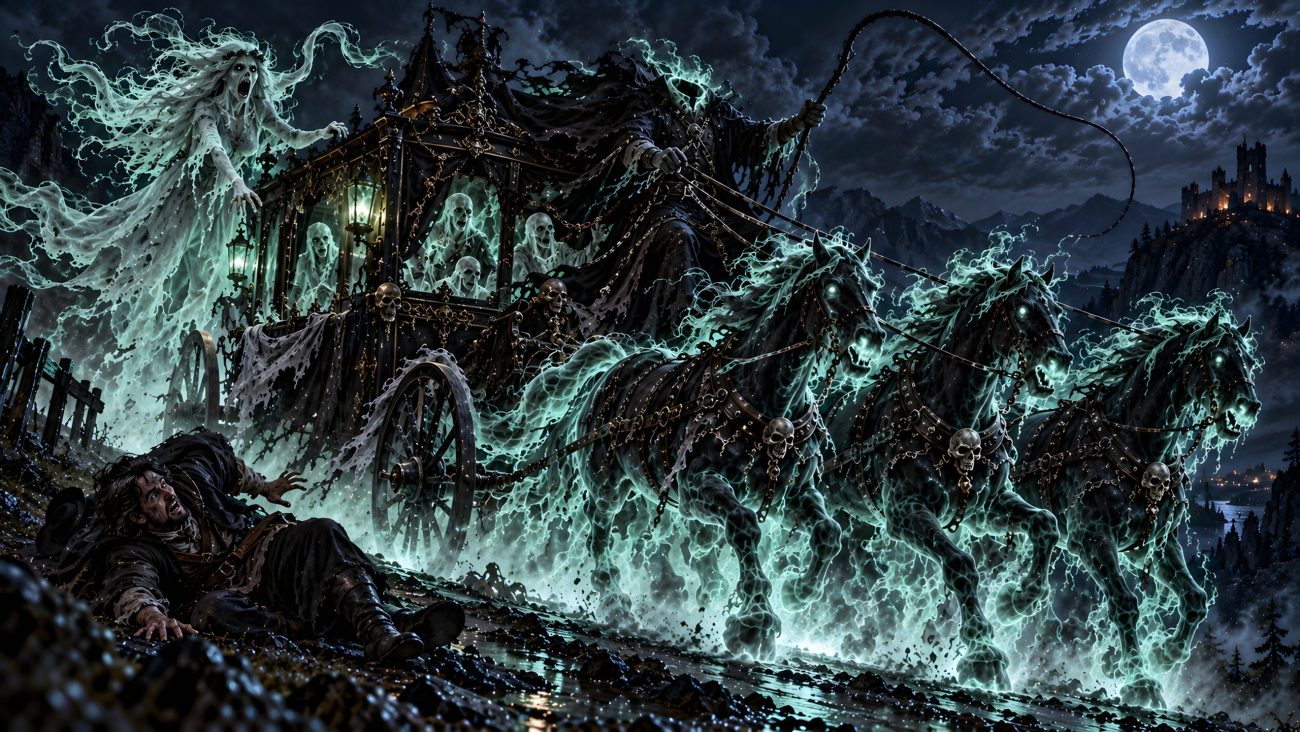
The Cóiste Bodhar is a supernatural death coach from Irish mythology whose appearance or sound foretells an approaching death. Its name is commonly translated as “silent coach,” although it is also known as the death coach. It is usually described as a black carriage driven or led by the Dullahan, a terrifying headless horseman. The banshee, another supernatural herald of death, is also associated with the coach and is sometimes said to accompany it on its journeys.

The sight or sound of the Cóiste Bodhar warns that someone is destined to die soon. The threatened person may be the witness themselves or a close relative. According to Irish belief, once the death coach arrives in the earthly world, it can never return empty. Its appearance therefore signals a death that cannot be prevented by mortal intervention, as the fate of the doomed individual has already been decided by a higher power.

Related traditions occur elsewhere in the British Isles. In Scottish folklore, a death coach is said to appear along Edinburgh’s Royal Mile, where it collects the souls of the dead. Another supernatural vehicle, known as the Hell Wain, is reportedly seen moving through the night sky. Similar stories of phantom coaches and spectral riders also occur in British and American culture, where they serve as ominous reminders of approaching death.


Sources

“Death coach.” Wikipedia: The Free Encyclopedia. Wikimedia Foundation. Accessed October 16, 2026. https://en.wikipedia.org/wiki/Death_coach


Banshee

Tradition: Irish Mythology
Alternative Names: Bean Sí, Bean Sídhe, Fairy Woman, Woman of the Fairy Mound
Category: Ghost


The Myth

The banshee is a female spirit in Irish mythology whose mournful cries foretell the death of a member of a family. Her name derives from the Irish bean sí, meaning “woman of the fairy mound,” connecting her to the ancient burial mounds scattered throughout the Irish countryside. These mounds were regarded as entrances to the supernatural world inhabited by the sí, or fairies. The banshee is most often heard rather than seen, announcing impending death through screaming, shrieking, wailing, or the traditional Irish lament known as keening.

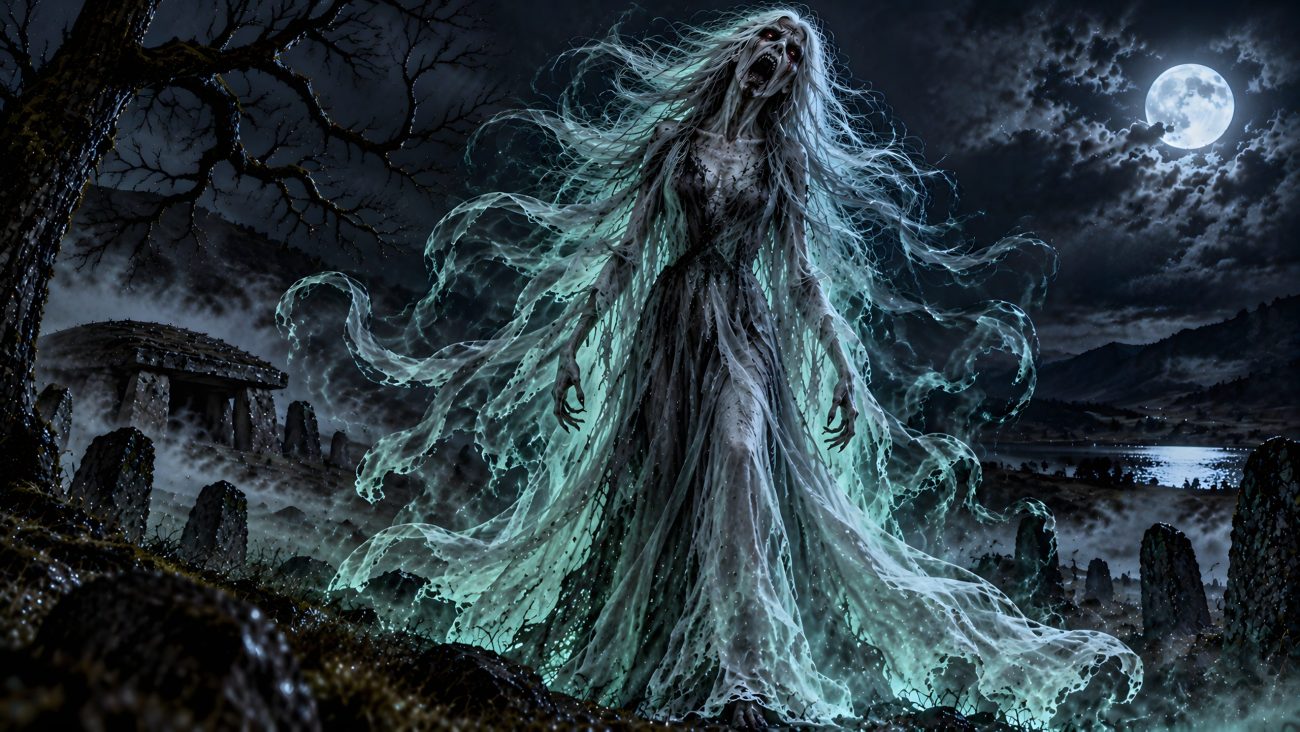
Descriptions of the banshee vary between accounts. She may appear as an old woman with long, streaming hair, which she sometimes combs while lamenting. In some traditions, she wears a grey cloak over a green dress, and her eyes are red from continual weeping. Other descriptions portray her dressed entirely in white, with red hair and a deathly complexion. Her stature also differs between tales: although some accounts describe her as unnaturally tall, many depict her as an exceptionally small, elderly figure, sometimes no more than a few feet in height. She may also appear as a veiled woman crouching beneath trees at night or as a spectral figure flying through the moonlight while crying bitterly.

In some legends, the banshee is the spirit of a young woman who died before her time and was assigned by supernatural powers to warn her mortal relatives of approaching death. She may even appear as a sweet-singing maiden associated with the family she serves. Traditional accounts claim that the banshee’s lament is heard around the home of a family when one of its members suffers from an illness destined to end in death. The belief was particularly associated with ancient and noble families, who were said to possess the privilege of a supernatural mourner. Her cry does not necessarily cause death; rather, it serves as a sorrowful warning that death is near.


Sources

“Banshee.” Wikipedia: The Free Encyclopedia. Wikimedia Foundation. Accessed October 16, 2026. https://en.wikipedia.org/wiki/Banshee


Fear Gorta

Tradition: Irish Mythology
Alternative Names: Fear Gortach, Man of Hunger, Man of Famine
Category: Ghost


The Myth

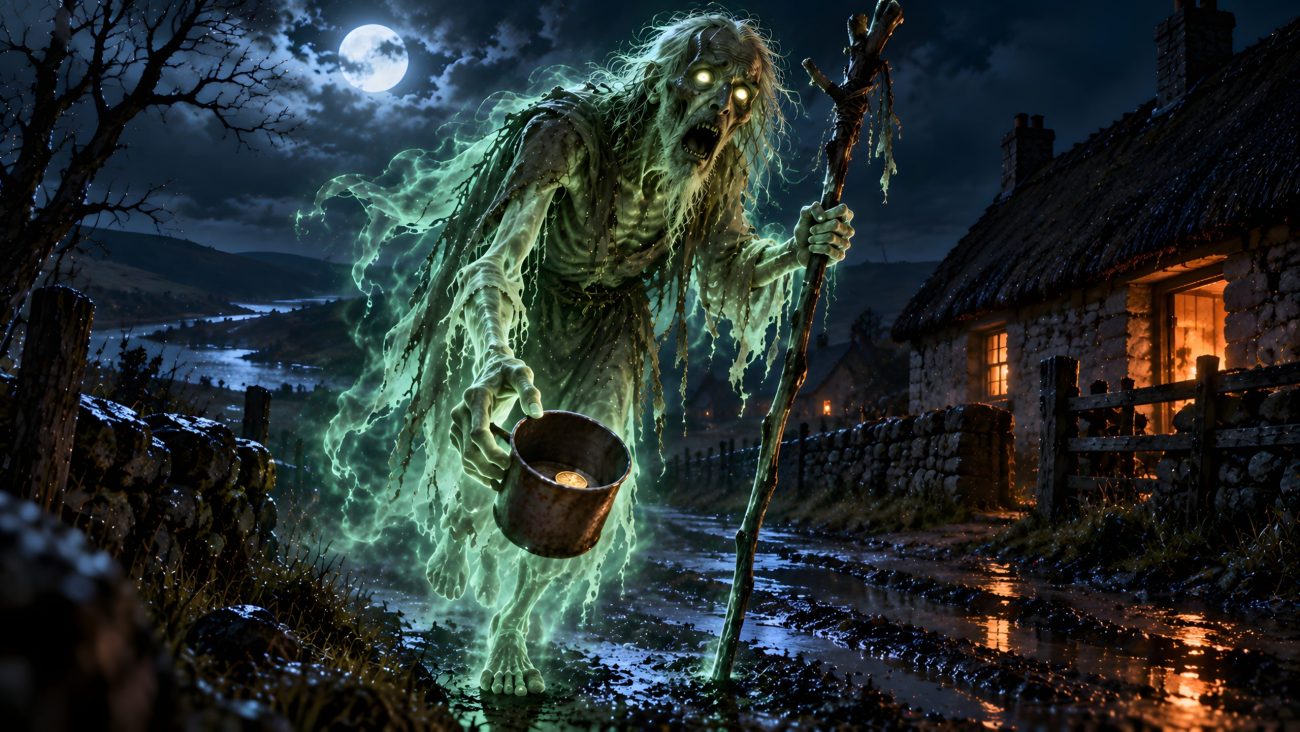
The Fear Gorta, whose name means “Man of Hunger” or “Man of Famine” in Irish, is a phantom that resembles an emaciated human being. He wanders the roads during times of famine, seeking food from those he encounters. His appearance is gaunt and starving, and he carries a long staff and a tin cup containing a single coin. He rattles the coin inside the cup to announce his presence as he approaches travelers and houses, asking for food from anyone who crosses his path.

Those who encounter the Fear Gorta are expected to offer him something to eat. If he approaches a house, its inhabitants should leave a scrap of food on the doorstep. Travelers who meet him on the road must likewise provide an offering. Those who refuse risk misfortune or even death, while those who show generosity receive blessings and good fortune. The phantom thus embodies both the terror of starvation and the moral importance of helping the hungry, making compassion a matter of survival as well as virtue.

One account describes the Fear Gorta as a harbinger of famine who emerges from a patch of hungry grass, known in Irish as Féar Gortach. In the region of Kiltubbrid, the term is also associated with a sudden, overwhelming hunger that can strike people traveling through the mountains. If this hunger is not quickly satisfied, it can prove fatal. The precise origins of the Fear Gorta are uncertain, although the familiar version of the figure is believed to have developed during or shortly after the Great Irish Famine of 1845–1852. The offerings made to him also resemble offerings associated with the Tuatha Dé Danann, suggesting that the figure may preserve elements of older supernatural traditions.


Sources

“Fear Gorta.” Wikipedia: The Free Encyclopedia. Wikimedia Foundation. Accessed October 16, 2026. https://en.wikipedia.org/wiki/Fear_gorta


Bánánach

Tradition: Irish Mythology
Alternative Names: Bánánacha (plural)
Category: Ghost


The Myth

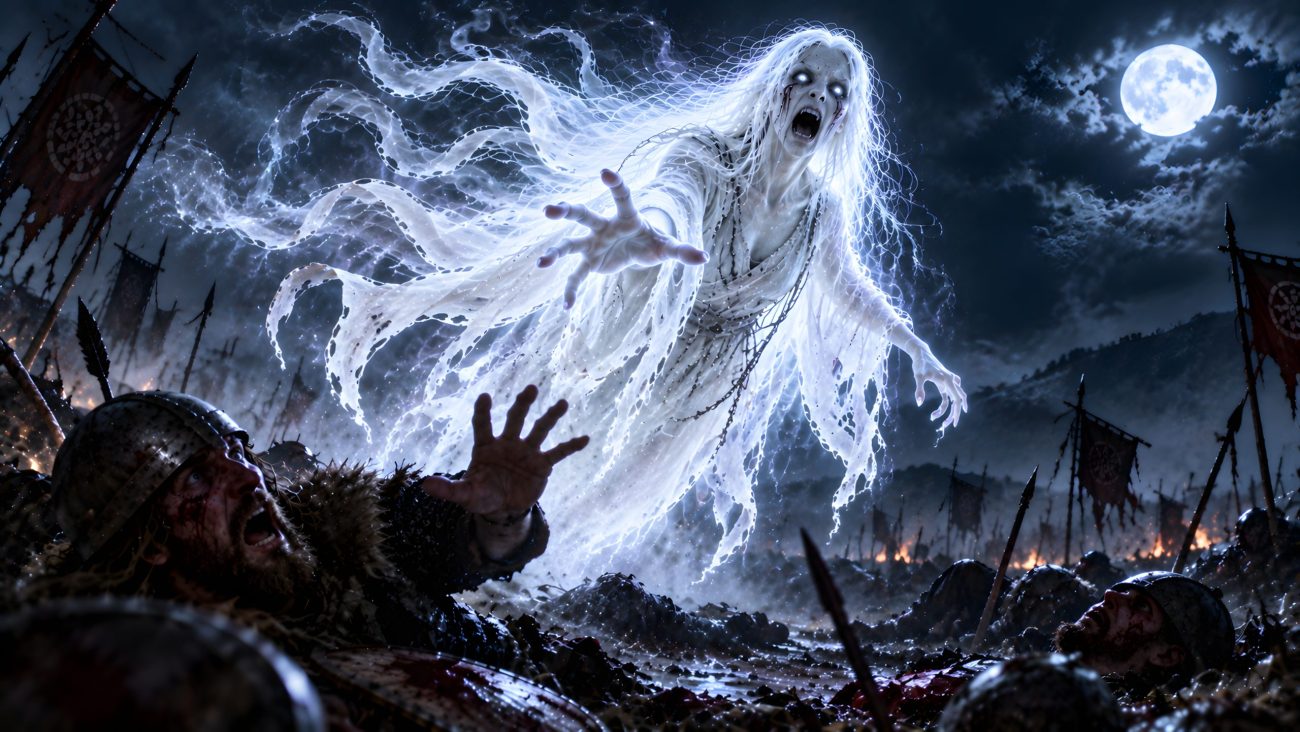
The bánánach are supernatural spectres that haunt battlefields, appearing amid the terror and confusion of war. They are associated with the clash of weapons, the cries of combatants, and the frightening sounds that fill the battlefield. Rather than being described with a fixed physical appearance, they are portrayed as mysterious presences whose arrival intensifies the fear of those caught in battle.

In Irish mythology, the bánánach appear alongside other terrifying battlefield beings, including the bócanach, a goat-like battle spectre, and the geniti glinne, a female battle spectre associated with valleys. These beings are connected with the supernatural forces of warfare and are said to have been sent by the Tuatha Dé Danann to strike fear into the enemies of the hero Cú Chulainn, answering his battle cry. Their presence made the sounds and dangers of combat seem to take on a life of their own.

The bánánach and their companion spectres were so terrifying that even the legendary bull Dond Cúalnge was associated with the power to ward them off. They embody the supernatural terror of the battlefield, where the clash of weapons and the cries of warriors become indistinguishable from the frightening presence of otherworldly beings.


Sources

“Bánánach.” Wikipedia: The Free Encyclopedia. Wikimedia Foundation. Accessed October 15, 2026. https://en.wikipedia.org/wiki/B%C3%A1n%C3%A1nach