Tradition: Irish Mythology
Alternative Names: Clídna, Clíodna, Clíona, Cleena, Clíodna of Carrigcleena
Category: Ghost
The Myth
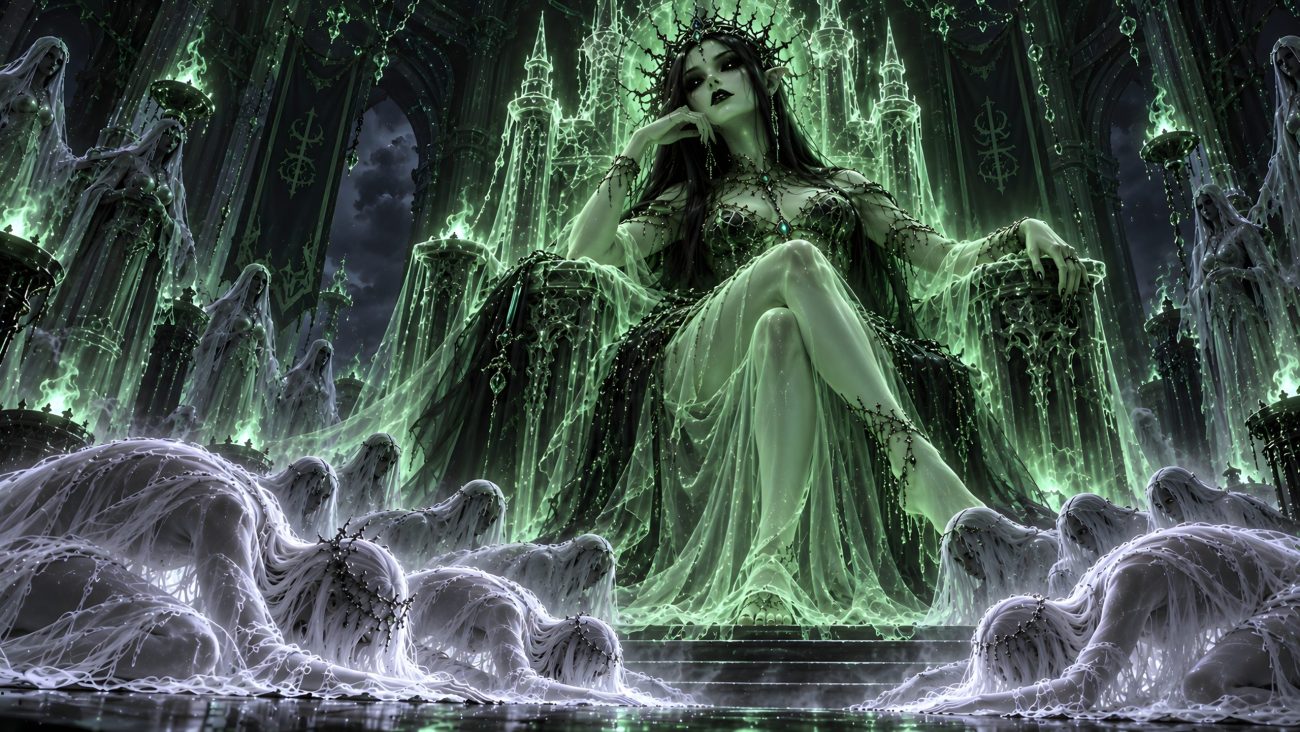
Clíodhna is a powerful supernatural woman in Irish mythology, associated particularly with southern Munster, or Desmond, where she rules as queen over the sióga, the fairies. Known as Clíodna of Carrigcleena, she is regarded in some traditions as a queen of the banshees, while others portray her as a goddess of love and beauty and a benefactor of County Cork. Her palace lies among a great pile of rocks near Mallow, at a place known as Carrig-Cleena. She is closely associated with several old Irish families, including the MacCarthys, O’Keeffes, O’Donovans, and FitzGeralds, and appears in numerous local legends.
One of the best-known stories about Clíodhna concerns her love for Ciabhan of the Curling Hair, recounted in the medieval Irish work Acallam na Senórach, or Colloquy of the Ancients. Clíodhna was the daughter of Gebann, a chief druid in the otherworldly land of Tír Tairngire, ruled by Manannán. When she saw Ciabhan, she fell in love with him and agreed to leave the otherworld with him. They sailed to Ireland and reached Teite’s Strand, where Ciabhan went ashore to hunt, leaving her in their boat. People sent after them from Manannán’s realm played enchanting music that lulled Clíodhna to sleep. A tremendous wave then swept her away. The place became known as Tonn Chlíodhna, or “Clíodhna’s Wave,” near Glandore Harbour. Different versions of the legend disagree about whether she drowned.
Clíodhna is also associated with three brightly coloured birds that feed on apples from an otherworldly tree. Their sweet singing is said to heal sickness. In another tradition preserved in the Book of Lismore, she gives Teigue, the son of Cian, three magical birds to guide his warriors and provide music during their voyage, as well as an emerald cup that transforms water into wine. She warns Teigue that losing the cup will bring about his death. With the birds and cup, Teigue and his warriors eventually return home victorious after rescuing their captured people.
Other legends portray Clíodhna as a powerful enchantress whose jealousy can bring terrible consequences. In one tale, she and her younger sister Aoivil both fall in love with a prince named Caiov. When he chooses Aoivil, Clíodhna curses her sister, causing her to lose her beauty and appear dead. She then secretly carries Aoivil to a cave at Castlecor, transforms her into a white cat, and enchants the cave into a palace filled with treasure. Aoivil remains trapped there, returning to human form for only one week each year at midsummer. Clíodhna eventually marries Caiov, but when the truth is revealed, their relationship is shattered. She retires to her fairy palace at Carrigcleena, where she continues to visit her enchanted sister.
Clíodhna also appears in tales of mortals taken into Fairyland. In one story, she abducts the chieftain Fitz-Gerald, whom she desires, but releases him after his beloved Ellen O’Brien travels to Carrigcleena and pleads for his return in poetry. Another legend concerns the Blarney Stone: when Cormac Laidir MacCarthy faced a lawsuit, Clíodhna advised him to kiss the first stone he found on his way to court. He followed her advice and delivered his case with such eloquence that he won. The stone was later incorporated into Blarney Castle and became associated with the gift of persuasive speech. Across these traditions, Clíodhna appears as a figure of beauty, magic, desire, jealousy, and otherworldly power, capable of helping mortals but also drawing them into dangerous encounters with the fairy realm.
Sources
“Clíodhna.” Wikipedia: The Free Encyclopedia. Wikimedia Foundation. Accessed October 16, 2026. https://en.wikipedia.org/wiki/Cl%C3%ADodhna