Tradition: Spanish Mythology
Alternative Names: Güestia, Estadea, Estantiga, Estantigua, Rolda, As da Noite, Pantalla, Avisóns, Pantaruxada
Category: Ghost
The Myth
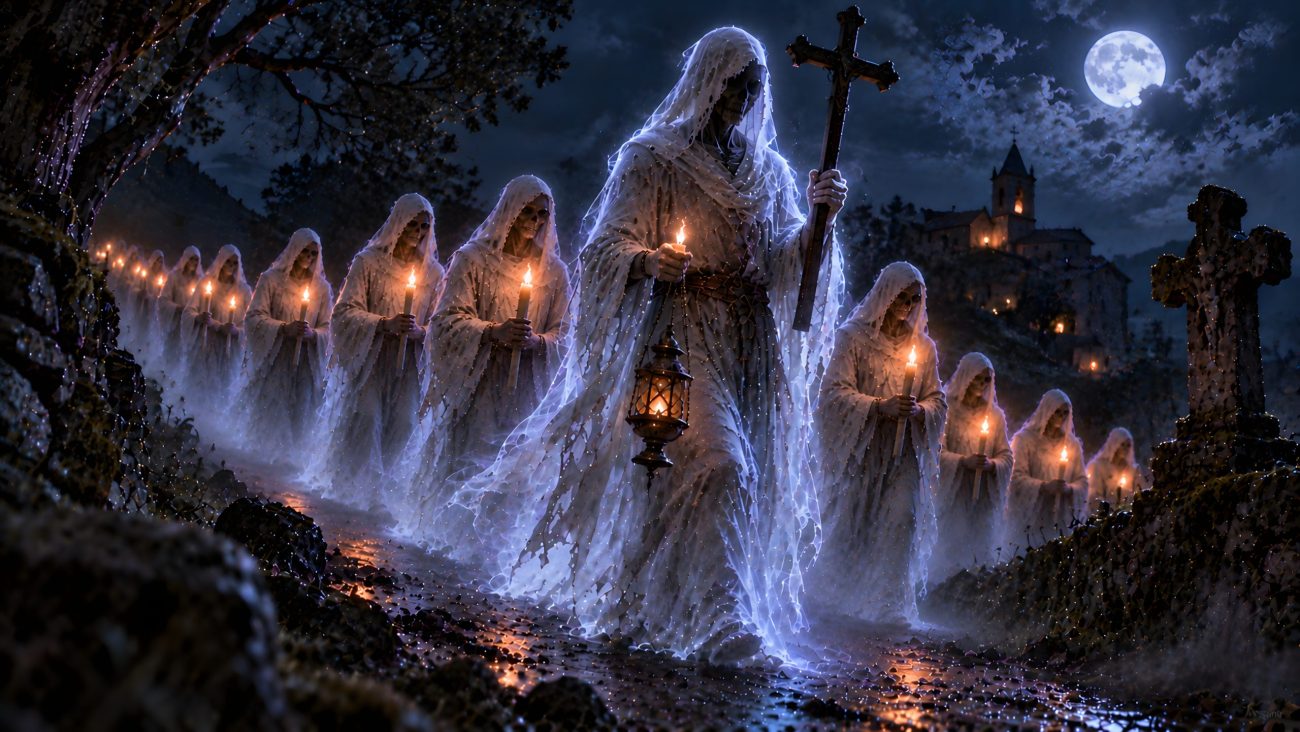
The Santa Compaña is a terrifying procession of the dead that wanders along lonely village paths, through forests, and around parishes in northwestern Iberia. Its members are the souls of the deceased, sometimes described as spirits suffering in torment, who appear at midnight wearing white, hooded cloaks. They carry lit candles as they move silently through the darkness. Even when the spirits themselves remain invisible, their presence may be sensed through a sudden shiver, an overwhelming feeling of danger, or the faint smell of melted candle wax drifting through the air. Some people see only the floating lights of their candles, which resemble will-o’-the-wisps moving along deserted paths.
At the head of the procession walks a living person, carrying a cross, a vessel of holy water, or both. This unfortunate individual has been placed under a supernatural curse that forces them to lead the dead through the night. At midnight, the cursed person falls into a trance and leaves their bed without conscious awareness of what they are doing. They lead the procession through villages and forests until it ends before daybreak, then return home with no memory of the night’s events. Despite having slept, they awaken exhausted and increasingly weakened. If the curse remains unbroken for weeks, the leader may become pale, thin, and sickly, eventually dying and unknowingly passing the burden to another parishioner.
The only way for the living leader to escape this fate is to find another person during the procession and transfer the cross or vessel of holy water to them, passing the curse along. The Santa Compaña’s principal purpose is to announce an approaching death, and the procession is believed to visit the homes of those whose deaths are near. A person who encounters it must take care not to become its next leader. One traditional method of protection is to draw Solomon’s Circle on the ground, placing a six-pointed star and its protective symbol inside, and remain within it until the procession passes. Other methods include lying face-down or making protective gestures with the hands. Those capable of seeing the procession are sometimes believed to have been mistakenly anointed with the holy oil used for the sick during baptism, while others are thought to possess a special sensitivity that allows them to perceive the hidden world of the dead.
The person leading the procession may be either a man or a woman, depending on whether the parish’s patron saint is male or female. Although the dead follow the living leader, the procession itself is an ominous presence that moves through the night, bringing fear and forewarning tragedy. In Galician tradition it is known as the Santa Compaña, while in Asturias it is especially associated with the name Güestia. Under these names, the procession embodies the dreadful belief that the boundary between the living and the dead can open in the darkness, allowing restless souls to pass through the world of the living and announce that someone’s final hour is approaching.
Sources
“Santa Compaña.” Wikipedia: The Free Encyclopedia. Wikimedia Foundation. Accessed October 15, 2026. https://en.wikipedia.org/wiki/Santa_Compa%C3%B1a