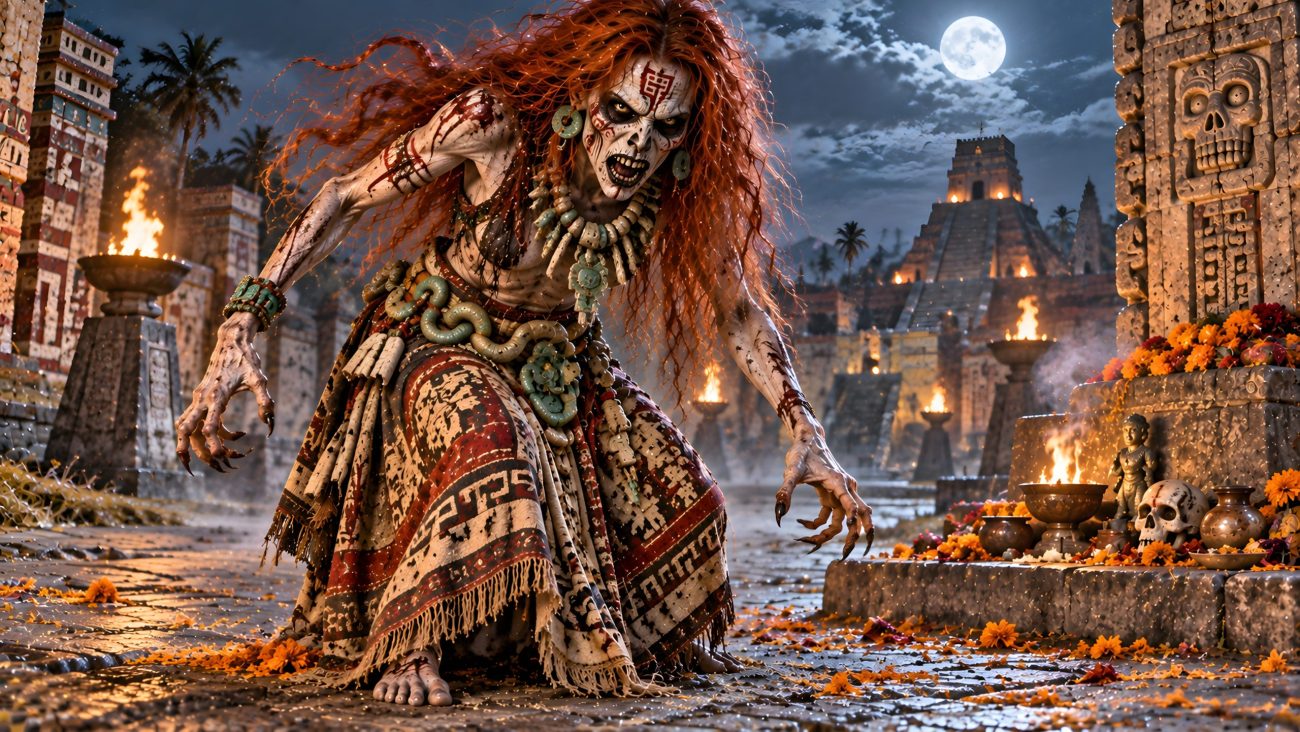
Zheztyrnak

Tradition: Kazakh mythology
Alternative Names: Zheztyrnak, Jeztyrnak, Jez Tumshuk, Chulbus, Shulbus, Mu-shubun
Category: Demon


The Myth

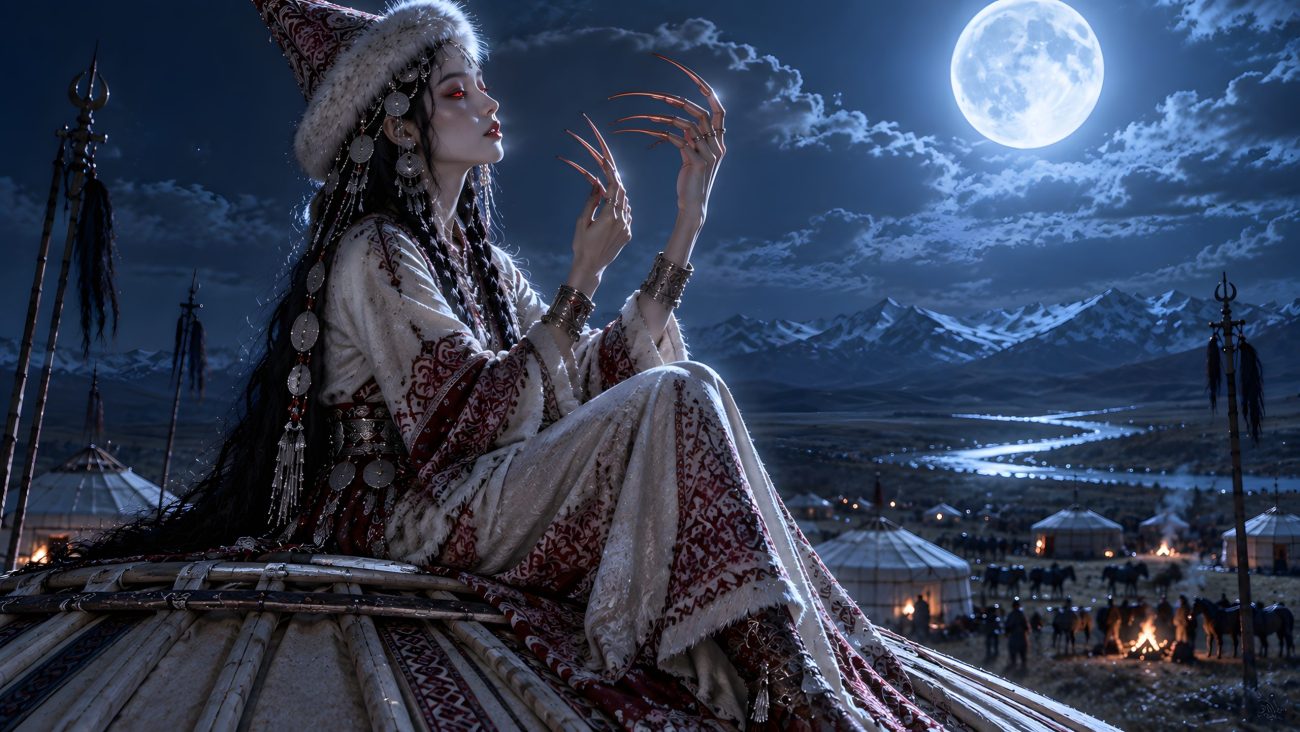
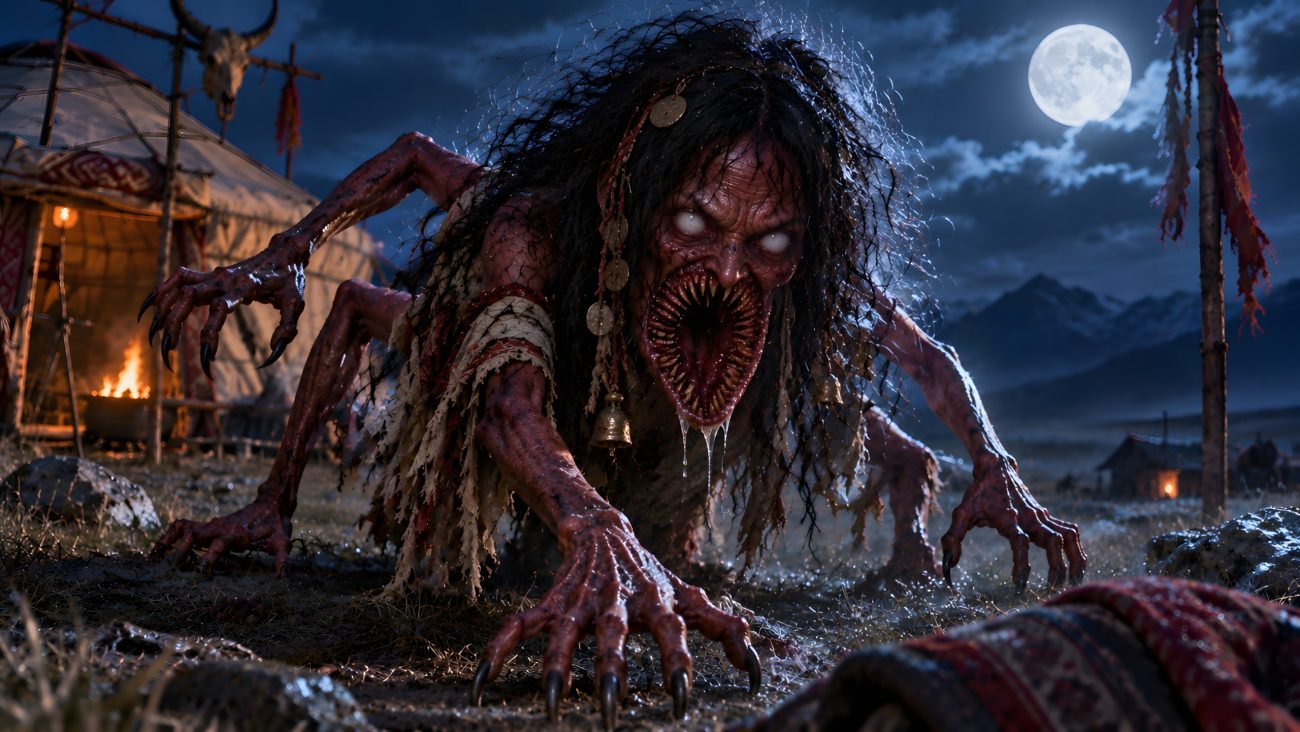
Zheztyrnak is an evil demonic creature that usually appears as a beautiful young woman, although she can sometimes take the form of a terrible old woman. Beneath her attractive appearance she hides monstrous copper claws. Her ten fingers end in sharp, razor-like copper claws, while blue-tinted blades grow along her palms, each sharp enough to cut through stone. She usually hides these claws beneath long sleeves.

Zheztyrnak has tremendous supernatural power and possesses a loud, piercing voice. Her scream is deadly to birds and small animals. She is a frightening forest woman, especially dangerous to anyone who encounters her alone.

Zheztyrnak is sometimes compared to a vampire. She can hypnotize a person with her cold, unblinking gaze. Once her victim falls asleep, she attacks with her claws and sucks out all of their blood.

She is also fiercely vindictive. If a Zheztyrnak is killed, her husband seeks revenge for her death, and after his death, the victim may be pursued by their orphaned children.

One Kazakh tale tells of a hunter who encountered Zheztyrnak late in the evening. A young woman appeared at his hunting fire, and the hunter invited her to share his meal. He noticed that she constantly covered her nose with her sleeve, even while eating, and realized that she was no ordinary woman but a Zheztyrnak.

After she left, the hunter placed a log beside the fire and covered it with his clothes. He then climbed into a tree with his gun and waited. During the night, Zheztyrnak returned and threw herself onto the disguised log, believing the hunter was sleeping there. From his hiding place, the hunter fired and killed the demon with a well-aimed shot.


Sources

“Жезтырнак (Zheztyrnak).” New Bestiary (Bestiary.us). Accessed September 7, 2026. https://www.bestiary.us/zheztyrnak
Meker

Tradition: Kazakh mythology
Alternative Names: Meker, Meker-katyn
Category: Demon


The Myth

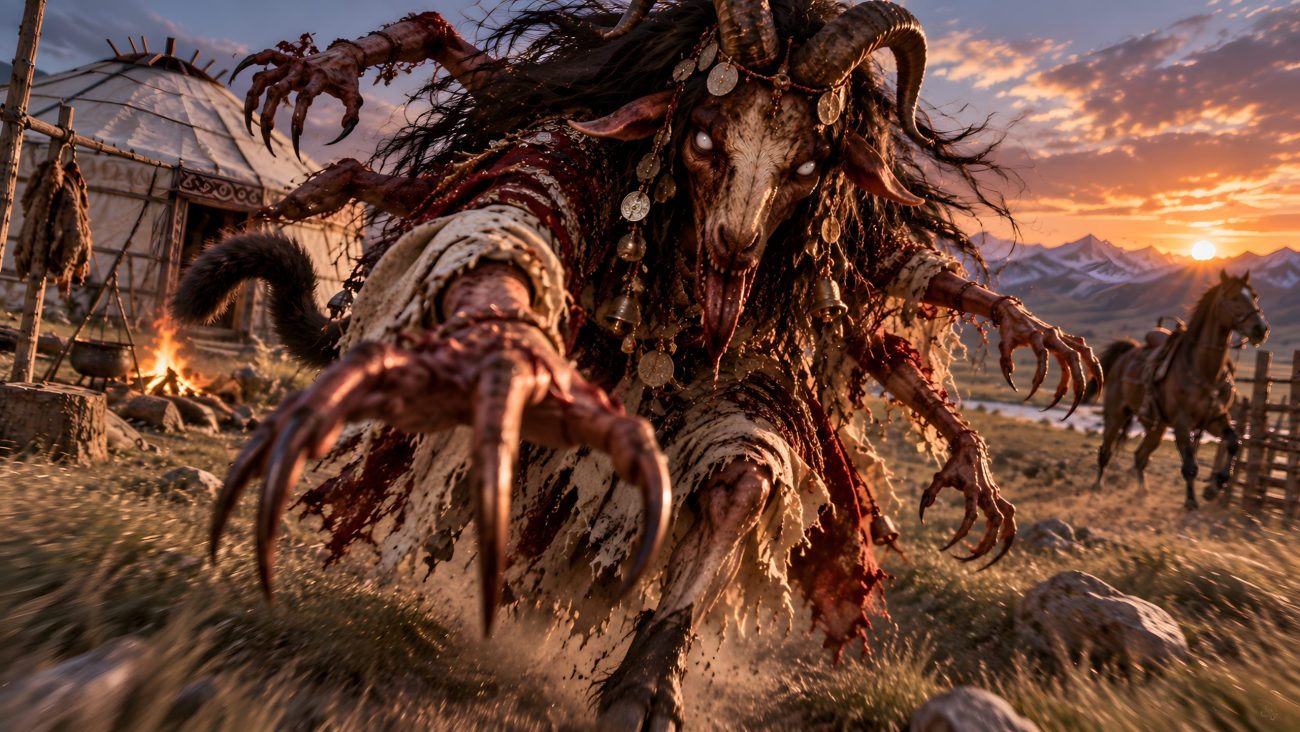
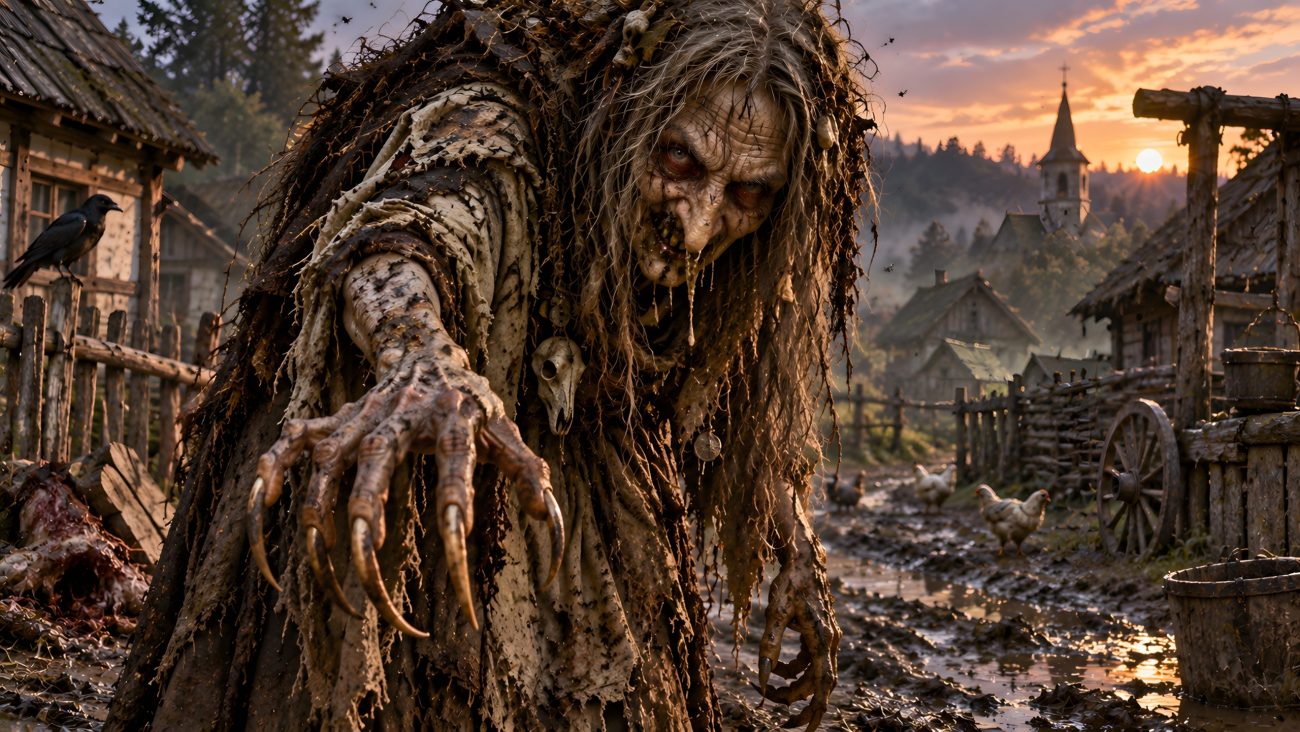
Meker is an evil demon from lower Kazakh mythology that usually takes the form of a woman. However, the Meker can also transform into the form of a dog, cat, or kid goat.

Mekers are among the evil spirits of Kazakh mythology and are sometimes used as another name for the Albasty. In modern Kazakh speech, “meker-katyn” is used as an insult for an evil, constantly quarrelling woman.

No further legends about the Meker are given in the source.


Sources

“Мекер (Meker).” New Bestiary (Bestiary.us). Accessed September 7, 2026. https://www.bestiary.us/Meker


Myrlyava

Tradition: Sorbian Mythology, German Mythology
Alternative Names: Marawa, Myrlata, Myrlawa, Marava, Myrljata
Category: Demon


The Myth

Myrlyava is an evil demoness from Upper Sorbian folklore who appears as a repulsive, ugly, and perpetually dirty woman.

She was rarely seen, and nobody knew where she came from, where she lived, or what she fed on. Her mysterious nature made her a frightening figure in local folklore.

In Müllrose, in northern Upper Lusatia, people had a saying about a woman who had been working for a long time and was constantly busy with her work. They would say:

“She must be an old Myrlyava.”

The name was therefore used to describe a woman who was regarded as particularly unpleasant or unattractive.


Sources

“Мырлява (Myrlawa).” New Bestiary (Bestiary.us). Accessed September 7, 2026. https://www.bestiary.us/Myrlyava


Martu

Tradition: Kazakh mythology
Alternative Names: Martu
Category: Demon


The Myth

Martu is an evil demon from lower Kazakh mythology who takes the form of a woman.

Little is known about her appearance or nature beyond her female form and her identity as an evil demon. The name Martu is also used as an insult in Kazakh speech, but no further legends about the creature are given in the source.


Sources

“Марту (Martu).” New Bestiary (Bestiary.us). Accessed September 7, 2026. https://www.bestiary.us/Martu


Kulyashi

Tradition: Russian Mythology
Alternative Names: Kulyashi, Kuleshata, Kuleshi
Category: Demon


The Myth

Kulyashi are small water demons from the folklore of the Vologda region of Russia. They live in the water and are said to emerge during Epiphany.

People were afraid of accidentally scooping up a Kulyash when drawing water, and a saying recorded in Vladimir Dal’s dictionary warned that the Kulyashi came out of the water at Epiphany. Because of them, people were careful when going onto or drawing from the water during this time.

In the Russian North, these little water beings were also known as Kuleshi or Kuleshata. They appeared during Svyatki, the Christmas festive period, where they caused trouble and mischief for people. When the festive season came to an end, the creatures disappeared again.

Kulyashi were therefore imagined as small, troublesome supernatural beings that appeared for a short period, disturbed people, and then vanished. They were regarded as a kind of water-dwelling counterpart to the better-known Shulikuny.


Sources

“Куляши (Kulyashi).” New Bestiary (Bestiary.us). Accessed September 7, 2026. https://www.bestiary.us/Kulyashi


Imp

Tradition: English Mythology
Alternative Names: Impe
Category: Demon


The Myth

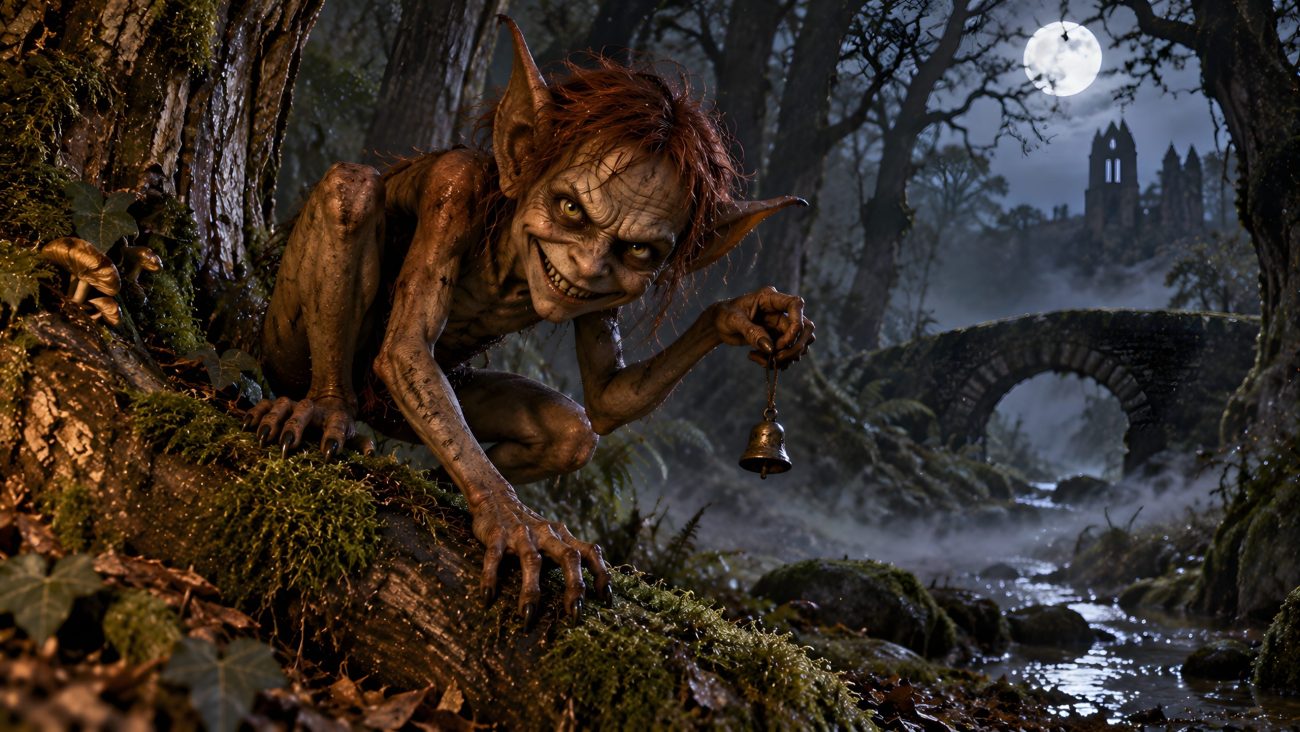
Imps are small supernatural beings, usually described as lively, troublesome, and mischievous. They are often portrayed as lesser beings, sometimes resembling fairies and sometimes described as small demons or attendants of the Devil.

Imps are known for playing tricks on people. Their mischief can be harmless, but they can also mislead travelers, cause trouble, or otherwise disturb people. They were sometimes believed to seek friendship with humans, using jokes and pranks to gain their attention, although their behavior could just as easily drive people away.

In later folklore, imps became associated with witches and warlocks as familiar spirits. They were believed to serve their masters as companions, spies, or informants. Such familiars could take the form of animals such as black cats, lizards, or toads.

One of the best-known legends concerns the Lincoln Imp. According to a legend from Lincolnshire, the Devil came to Lincoln Cathedral accompanied by two imps. The imps began causing havoc inside the cathedral until an angel appeared and ordered them to stop.

One of the imps attempted to throw a stone at the angel. The angel commanded, “O impious imp, be ye turned to stone,” and the creature was immediately petrified. Its companion escaped, while the unfortunate imp remained as a stone figure inside the cathedral.


Sources

“Imp.” Wikipedia: The Free Encyclopedia. Wikimedia Foundation. Accessed September 7, 2026. https://en.wikipedia.org/wiki/Imp


Dodomeki

Tradition: Japanese mythology
Alternative Names: 百々目鬼, どどめき
Category: Demon


The Myth

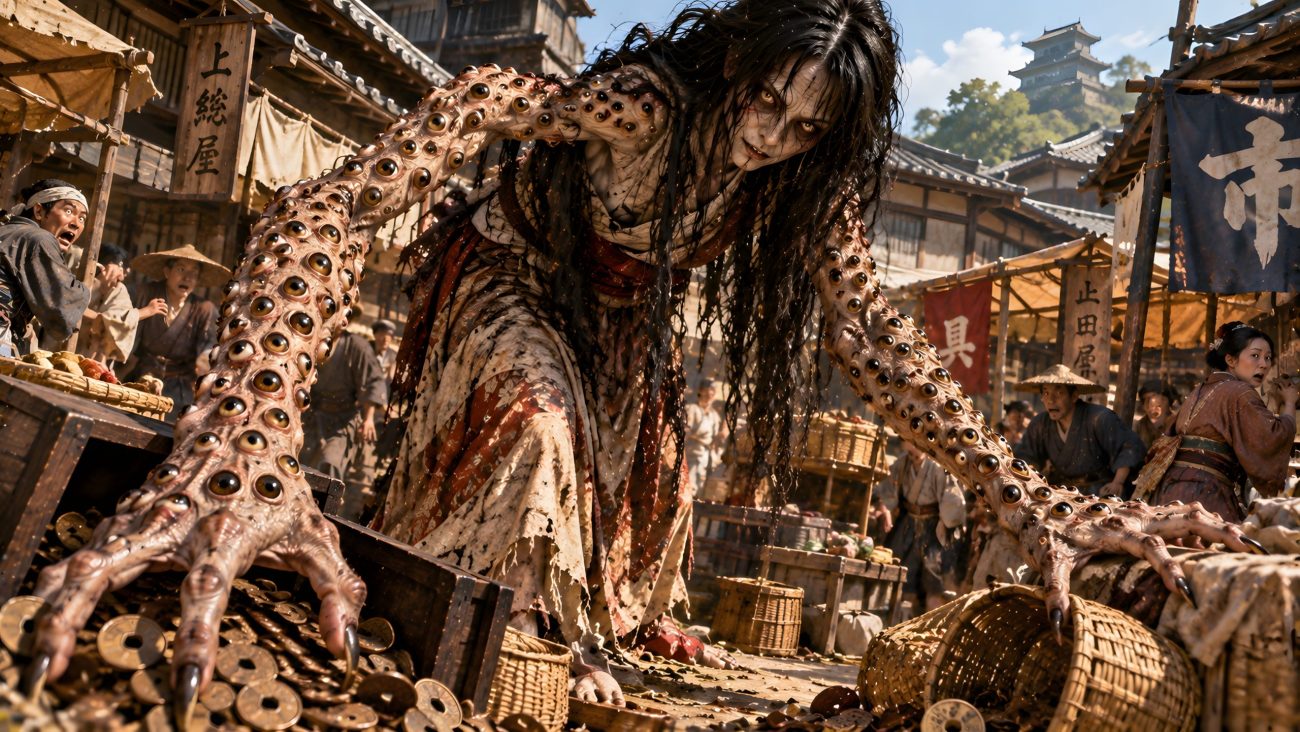
The Dodomeki is a cursed woman with exceptionally long arms covered in hundreds of tiny bird eyes. She was originally a human woman who developed a habit of stealing money. As a consequence of her wicked deeds, hundreds of small bird eyeballs eventually sprout from her arms, transforming her into a monster.

The creature’s appearance is built around a series of Japanese wordplays. Having “long arms” is an expression for someone who has a tendency to steal, so the Dodomeki possesses long arms both figuratively and literally. Copper coins, called dōsen, had holes in their centers and were colloquially called chōmoku, meaning “bird’s eye,” because of their appearance. Thus, a woman who stole copper coins became a monster whose arms were covered in bird eyes.

Money could also be called oashi, literally “feet,” because money comes and goes as though it had feet. The expression ashi ga tsuku means “to catch someone who has committed a crime.” By replacing ashi with chōmoku, which could also refer to money, the expression becomes a pun meaning “covered in bird eyes.” These wordplays were incorporated into Toriyama Sekien’s description of the yokai.

A much older legend tells of Fujiwara no Hidesato, a nobleman who had been granted the position of kokushi of Shimotsuke Province after defeating the rebel Taira no Masakado. While hunting in his newly acquired territory, Hidesato encountered an old man who warned him that an oni had appeared at the horse graveyard at Utsunomiya. Hidesato took his bow and arrows and went to investigate.

He waited at the horse graveyard until nightfall. During the hour of the ox, an enormous demon appeared and began ravenously devouring the carcasses of dead horses. It stood more than ten feet tall, possessed sharp, spiked hair, and had glowing eyes covering its entire body. Hidesato carefully aimed at the brightest eye and fired an arrow directly into it.

The arrow struck the demon, which roared in pain and fled into the woods. Eventually it collapsed at the foot of Mount Myōjin. Yet the wounded demon still possessed tremendous power. Flames erupted from its body, while its mouth split open and released poisonous fumes. The intense heat and toxic air overwhelmed Hidesato, forcing him to abandon the fight and return to his palace.

When Hidesato returned the following day, he found that a large area of ground had been blackened and burned. The demon itself, however, had disappeared.

Four hundred years later, during the Muromachi period, a village had developed on the northern slope of Mount Myōjin. Strange events began occurring there. The head priest of the local temple suffered mysterious injuries, while unexplained fires repeatedly broke out around the temple.

A new head priest, the virtuous Saint Chitoku, was summoned to discover the cause. Chitoku noticed that a young woman frequently visited the temple whenever he preached his sermons. He eventually realized that she was actually the wounded demon from Hidesato’s battle, disguised as a human woman.

After surviving the battle, the demon had retreated into nearby caves to recover. In human form, it repeatedly returned to the place where it had fallen at Mount Myōjin. There it gradually sucked back up the poisonous fumes it had released during the battle and collected the blood it had spilled. Because the village temple had been constructed directly over the old battlefield, the demon began causing fires and attacking the priest in an attempt to drive the people away.

One day, Saint Chitoku confronted the disguised demon. She revealed her true nature as a Dodomeki, but she did not attack him. While repeatedly visiting the temple, she had listened to Chitoku’s powerful sermons, and his teachings had deeply affected her.

The Dodomeki promised that she would never again commit evil. From that time onward, the area around Mount Myōjin became known as Dodomeki.


Sources

“Dodomeki.” Yokai.com: The Japanese Yokai Encyclopedia. Accessed September 7, 2026. https://yokai.com/dodomeki/


Udug

Tradition: Sumerian mythology, Iraqi Mythology
Alternative Names: Udug, Udug Hul, Utukku
Category: Demon


The Myth

The Udug is an ambiguous class of demons in ancient Mesopotamian mythology, found in the traditions of Sumer, Akkad, Assyria, and Babylonia. The beings were associated with the underworld, Kur, and were distinct from the dingir, the divine beings of Mesopotamian religion.

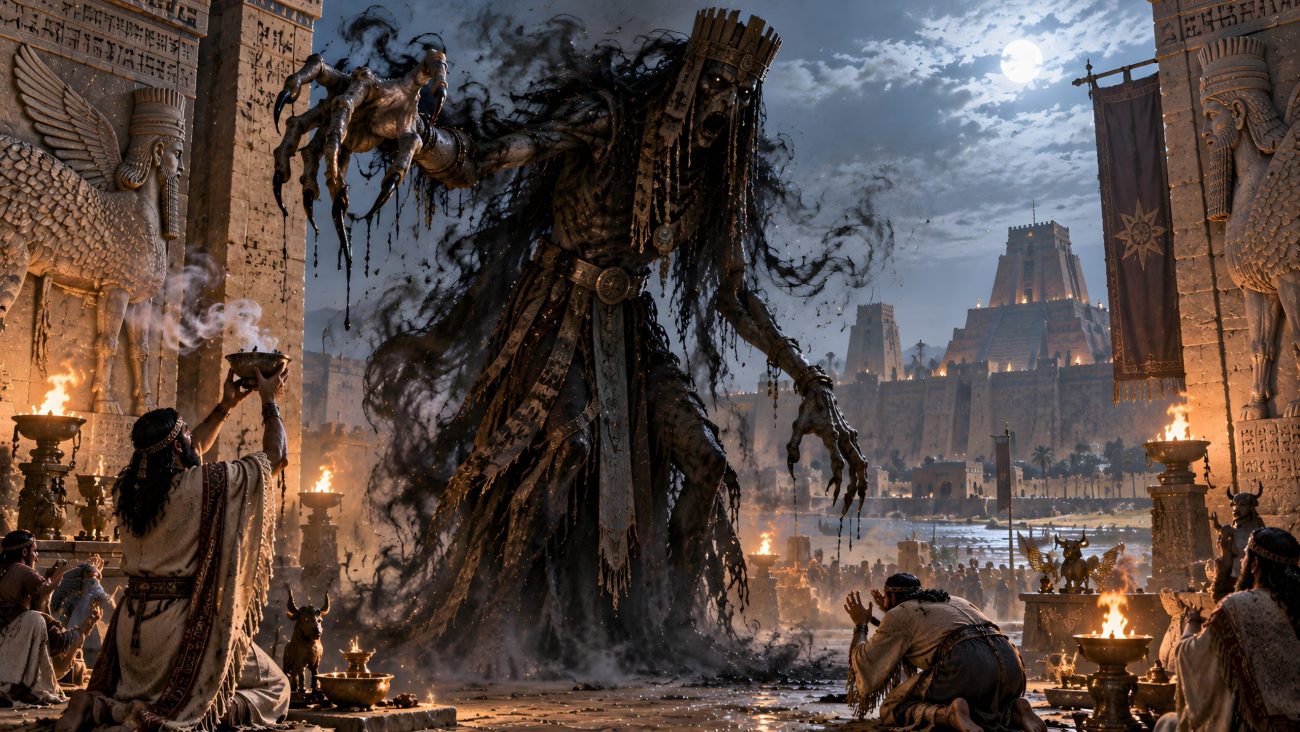
The appearance of the Udug is deliberately difficult to define. No certain visual representation has been identified, and ancient descriptions emphasize that the demon is essentially nameless and formless. An Old Babylonian incantation describes the Udug as one who, from the beginning, was never given a name and never appeared in a definite form.

Descriptions of the evil Udug instead focus on its terrifying supernatural characteristics. It is described as having a towering stature, a malignant appearance, a dark or pitch-black shadow, and no light within its body. It hides rather than standing openly, its claws drip with bile, and it leaves poison behind it. Its arms enclose its victim, while its terrifying battle cry is so powerful that it cannot be restrained.

The Udug could attack and afflict human beings, particularly through disease and supernatural possession. Its presence could bring painful illness into the body, while curses, poison, evil forces, and other forms of supernatural harm were attributed to its influence.

The Udug is especially prominent in the Udug Hul incantations, ancient Mesopotamian texts concerned with the exorcism of evil Udug. These texts describe the demon as a source of illness and suffering and place the exorcist in the role of removing the supernatural affliction and restoring the victim.

The word Udug was not always restricted to one precise type of demon. It could be used more broadly for demons as a whole, making the identity of an individual Udug difficult to distinguish from the wider world of Mesopotamian supernatural beings.

The Udug was also associated with other demons, including the Gallû and Lilu. Some traditions additionally connect the name with Hanbi, a mysterious figure described as the father of Pazuzu and associated with evil forces, although little is known about Hanbi himself.

The essential nature of the evil Udug was therefore not a particular physical form but its supernatural presence: darkness, poison, terrifying sound, possession, disease, and the unseen forces that afflicted human beings.


Sources

“Udug.” Wikipedia: The Free Encyclopedia. Wikimedia Foundation. Accessed September 7, 2026. https://en.wikipedia.org/wiki/Udug


Oni no Nembutsu

Tradition: Japanese mythology
Alternative Names: Oni no Nembutsu, Demon Soliciting Alms
Category: Demon


The Myth

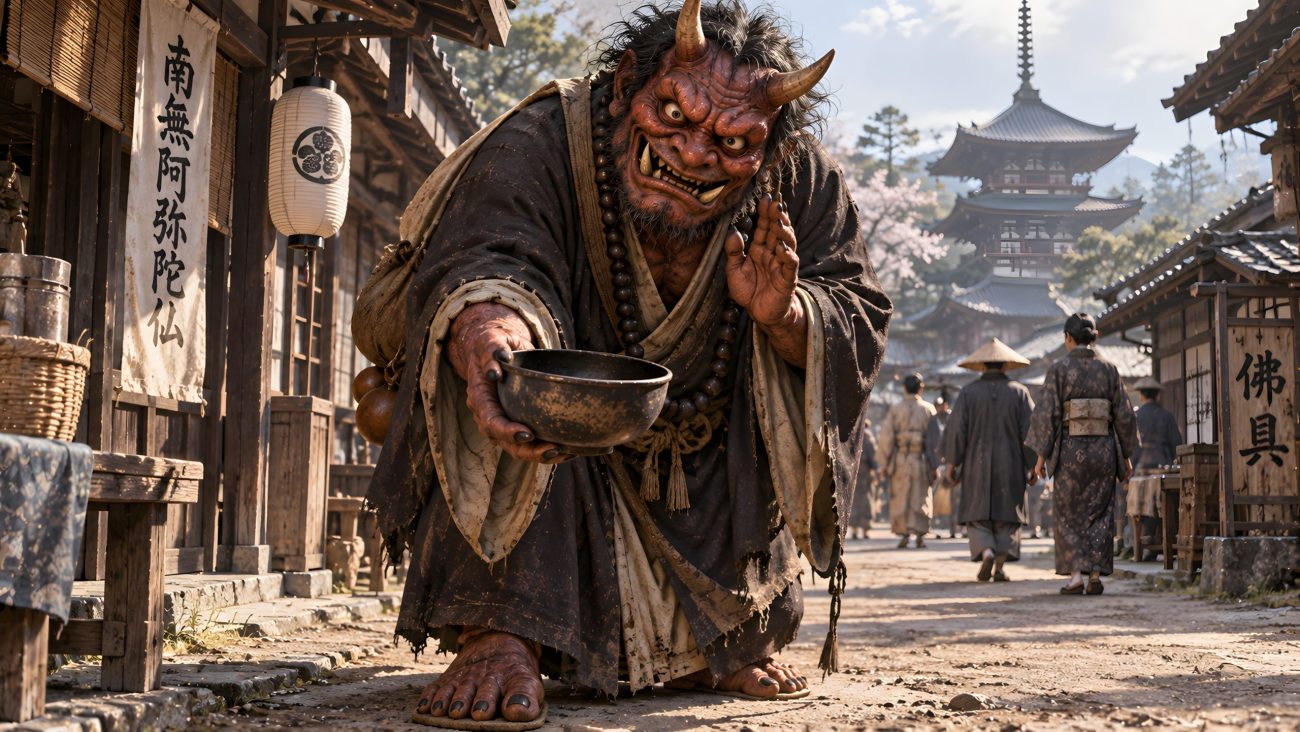
The Oni no Nembutsu is a mischievous demon depicted as an oni dressed in the robes of a Buddhist priest and begging for alms.

The creature belongs to the tradition of the oni, supernatural demons commonly portrayed as frightening but also capable of humorous and mischievous behavior. In the depiction, the demon takes on the appearance and role of a Buddhist religious figure, humorously placing a fearsome supernatural being in the position of a priest who depends upon others for offerings.

The figure was used in the popular tradition of Otsu-e, where mischievous demons could be portrayed in humorous situations and accompanied by moralizing text. The image of the demon dressed as a priest and soliciting alms became one of these humorous supernatural subjects.


Sources

University of Michigan Museum of Art. “Ôtsu-e: Demon Soliciting Alms (Oni no Nembutsu).” University of Michigan Museum of Art. 18th century. Accession no. 1964/2.102. Accessed September 6, 2026. https://umma.umich.edu/objects/otsu-e-demon-soliciting-alms-oni-no-nembutsu-1964-2-102/


Cihuateteo

Tradition: Aztec Mythology, Mexico Mythology
Alternative Names: Cihuateteo, Cihuātēteoh, Cihuātēotl
Category: Demon


The Myth

The Cihuateteo, meaning “Divine Women,” are the spirits of women who died in childbirth. Because childbirth was understood as a struggle equivalent to battle, women who died giving birth were likened to male warriors who had died in violent conflict. A woman in labor was said to capture the spirit of her newborn child in the same way that a warrior captured an enemy in battle.

The Cihuateteo resided in Cihuatlampa, the “place of women,” in the west where the sun sets. Each day, they accompanied the sun toward the west from noon until sunset. Some traditions suggest that they could even carry the sun through the underworld until it rose again. They performed this duty alongside the spirits of male warriors who had died in battle, and this privilege was reserved for these two groups of the dead.

On five particular days of the Aztec calendar—1 Deer, 1 Rain, 1 Monkey, 1 House, and 1 Eagle—the Cihuateteo descended from Cihuatlampa and returned to the earth.

When they appeared on earth, the Cihuateteo were feared as demons of the night. They were particularly associated with crossroads, where roadside shrines were erected to appease them. They were believed to steal children, cause madness and seizures, and tempt men into adultery. Individual Cihuateteo could be associated with the particular calendar day on which they descended.

A woman’s death in childbirth was understood as the result of losing a violent struggle. The gods were believed to have sent the child down to earth, and the woman had to fight and struggle to bring it into the world. If she succeeded, the newborn child was her reward; if she failed, she died and her soul became a Cihuateteotl.

The body of a woman who had died in childbirth was believed to retain extraordinary powers after her soul had departed. Her remains therefore required special protection. An armed group consisting of her widowed husband, his friends, midwives, and elderly women guarded the body against male warriors, who sought parts of it because of their supposed magical power.

The left middle finger and the hair were considered particularly potent. Warriors who obtained these relics could place them on their shields, where they were believed to give them courage and strength while blinding their enemies.

Cihuateteo were depicted as fearsome women with clenched, claw-like fists, bared teeth and gums, and aggressive poses. Their clawed feet could be tucked beneath their skirts, giving them an appearance that was simultaneously seated and ready to attack.

Their bodies often emphasized the physical consequences of childbirth. They were depicted with taut stomachs, exposed breasts, and prominent nipples, emphasizing their unrealized role as mothers who had died before being able to nurse their newborn children.

Their hair was often depicted as long, unkempt, and swirling, sometimes orange in color. Their skirts could be fastened with serpent belts, while some figures from El Zapotal carry staffs bearing heads as trophies and appear covered in flayed skins.

The serpent around the waist may refer to Cihuacoatl, a goddess associated with war, sacrifice, political power, fertility, childbirth, and midwifery. Their unkempt hair was associated with darkness and the earth, while Cihuatlampa itself was a place of darkness. The earth and earth goddesses likewise carried associations with both childbirth and sacrifice, two central aspects of the Cihuateteo.


Sources

“Cihuateteo.” Wikipedia: The Free Encyclopedia. Wikimedia Foundation. Accessed September 6, 2026. https://en.wikipedia.org/wiki/Cihuateteo