Stuhać

Tradition: Serbian mythology, Bosnian Mythology
Alternative Names: Stuhać
Category: Demon


The Myth

Stuhać is a demonic creature that lives in high mountains and barren, desolate areas. Its appearance is not described, but it is known for wearing clutters made from human ligaments around its legs.

The ligament clutters allow Stuhać to keep its footing while moving across dangerous mountain precipices. If one of these clutters breaks, Stuhać pulls ligaments from someone’s legs and uses them to make a new one.


Sources

“Stuhać.” Wikipedia: The Free Encyclopedia. Wikimedia Foundation. Accessed September 9, 2026. https://en.wikipedia.org/wiki/Stuha%C4%87


Rokita

Tradition: Polish Mythology
Alternative Names: Rokita
Category: Demon


The Myth

Rokita is a demon said to inhabit the gateways to the underworld.

He is associated with wild and isolated places, particularly wetlands and forests. Rokita is also said to dwell inside old willow trees, making these trees another place where the demon may be encountered.

His domains therefore lie between the human world and the underworld: the wetlands, forests, and ancient willows that conceal the entrances to the realm of the dead.


Sources

“Rokita (folklore).” Wikipedia: The Free Encyclopedia. Wikimedia Foundation. Accessed September 9, 2026. https://en.wikipedia.org/wiki/Rokita_(folklore)


Poroniec

Tradition: Polish Mythology
Alternative Names: Poroniec
Category: Demon


The Myth

Poroniec is a malicious and hostile demon believed to arise from the soul of a miscarried child or aborted fetus. The same fate could befall a child who was stillborn, died, or was killed by its mother shortly after birth and was not buried according to traditional customs.

Poroniec was considered an especially powerful demon because it possessed the potential of a life that had never been fulfilled.

Beliefs about Poroniec were connected with numerous taboos surrounding pregnant women, mothers, and newborn children. Pregnant women were forbidden from looking into wells or drawing water from them. Women with newborns were forbidden from leaving the house with the child, particularly going out into the fields, and sexual intercourse was also prohibited.

Newborn children were subjected to protective magical practices. One such practice involved wiping the baby with a bunch of straw. The mother was traditionally kept inside for the first six weeks after childbirth. Only after this period was she taken outside, while the child was considered fully human and given a name.

There was also a belief that a miscarried child buried beneath the threshold of a house as a foundation offering could instead become a favorable Kłobuk. In this way, it would not become a Poroniec.


Sources

“Poroniec (demon).” Wikipedia, wolna encyklopedia (Polish Wikipedia). Wikimedia Foundation. Accessed September 9, 2026. https://pl.wikipedia.org/wiki/Poroniec_(demon)


Habernitsa

Tradition: Russian Mythology, Polish Mythology
Alternative Names: Chabernica, Habernitsa, Cornflower Wraith, Lady Cornflower, Cornflower Witch
Category: Demon


The Myth

Habernitsa is a noon demon who appears as a young, slender woman dressed in azure, with cornflowers woven into her hair. She wanders along the boundaries of fields at midday.

She becomes angry with people who trample the grain or work with sharp tools in the fields at noon. Those she considers deserving of punishment are put to sleep by her whisper.

Once they have fallen asleep, Habernitsa causes them terrible pain and injuries. She can inflict headaches, paralysis, and severe pain in the lower back. In some cases, she attacks more violently, breaking the victim’s arms, legs, or neck.

To avoid Habernitsa’s wrath, field workers must stop working and take a break at midday, at the time of the Angelus.


Sources

“Cornflower Wraith (Habernitsa).” Wikipedia: The Free Encyclopedia. Wikimedia Foundation. Accessed September 9, 2026. https://en.wikipedia.org/wiki/Cornflower_Wraith


Marțolea

Tradition: Romanian Mythology
Alternative Names: Marț-sara, Marți Seara
Category: Demon, Sheep


The Myth

Marțolea is a demonic being that lives in the mountains and descends on Tuesday nights. Its gender is uncertain because it can change its form. It usually appears as a goat with a human-like head, horns, and hooves, but it can also take the form of an ugly old woman dressed entirely in white, a soldier, or a handsome young man.

Marțolea comes at night to punish women who work on Tuesday, a day that is considered semi-holy and must be respected. It forbids four particular household tasks: spinning wool, sowing, boiling laundry, and baking bread. It can lure women with its singing before punishing those who have continued working.

Its punishments are terrible. Unmarried women may be killed, with their guts ripped out and hung from nails on the walls or around the dishes. Married women may be killed, or Marțolea may possess their baby or their husband when he is away from home.

Marțolea appears differently depending on whom it encounters. To married women it appears as an old woman, to married men as a virgin, and to unmarried women as a handsome young man.

Those who respect Tuesday and refrain from the forbidden work are rewarded instead. Marțolea may leave eggs on their doorstep or bring them flowers from the highest mountains of Bucovina. On the first night of March, women wearing Mărțișor charms may also receive a silver coin from Marțolea, which they must keep throughout the year.


Sources

“Marțolea.” Wikipedia: The Free Encyclopedia. Wikimedia Foundation. Accessed September 9, 2026. https://en.wikipedia.org/wiki/Mar%C8%9Bolea


Yan-gant-y-tan

Tradition: French Mythology
Alternative Names: Yan-gant-y-tan
Category: Demon


The Myth

Yan-gant-y-tan is a strange demon that wanders through the countryside of Finistère at night. He carries five candles, one burning on each finger of his right hand, and spins them around like a flaming wheel.

Because of the candles, Yan-gant-y-tan cannot turn quickly while walking, since doing so might extinguish their flames. His appearance is sometimes described as that of a wiry old troll or a hairy wild man, but the five burning candles on his hand distinguish him from other creatures of this kind.

Encountering Yan-gant-y-tan is considered an evil omen, particularly for travelers journeying at night. One way of avoiding his bad omen is to leave a small bag of gold or a gold chain around a travelers’ post. Yan-gant-y-tan will take the offering and leave the house alone for another day.

Despite his reputation as a bad omen, Yan-gant-y-tan can also appear to travelers who have no light and give them five candles, allowing them to find their way through the night.


Sources

“Yan-gant-y-tan.” Wikipedia: The Free Encyclopedia. Wikimedia Foundation. Accessed September 9, 2026. https://en.wikipedia.org/wiki/Yan-gant-y-tan


Jiro Saburo Sai

Tradition: Japanese Mythology
Alternative Names: Jiro Saburo’s Wife, Demon Wife
Category: Demon


The Myth

Jiro Saburo’s wife was a cruel and intensely jealous woman who eventually transformed into a terrifying demon after her husband abandoned her. Before her transformation, she was already known for her vicious temper and unbearable jealousy, particularly toward the female servants of her household.

She became furious whenever a female servant even looked at her husband or spoke with him. Her constant abuse eventually drove all of the servants away. As the family’s wealth declined, her behavior became increasingly bitter and violent, and she refused to listen to anyone who tried to correct her.

Jiro Saburo finally warned her that if she did not change, he would leave the household. Enraged, she attacked him and choked him, declaring that even if she could not kill him while alive, she would kill him after her death. She accused him of wanting to leave her for another woman.

Jiro Saburo eventually disappeared. When his wife discovered that he had fled, she became consumed by hatred. She searched everywhere for him, repeatedly swearing that she would never allow him to escape her. During the day she wandered about looking for him, while at night she wept and repeated that she hated him for abandoning her.

After forty or fifty days, she had become almost unrecognizable. Her eyes were bloodshot, her cheekbones protruded, and she had become filthy and disheveled. She refused to wash or eat and behaved so strangely that the villagers became afraid of her.

Then her house suddenly became silent. At midnight, however, the villagers heard her speaking inside as though someone had come to visit her. The following day the house was silent again. Several brave villagers eventually looked through a hole in the wall and saw something horrifying.

Two horns had grown from the woman’s head. Her mouth had split almost to her ears, and fangs had emerged from both sides. Her eyes shone fiercely, making her indistinguishable from a demon. Terrified, the villagers abandoned the neighborhood.

People who knew where Jiro Saburo was hiding hurried to warn him. He remembered his wife’s threat that she would return from the dead to kill him and feared that she would find him.

A traveling monk named Gen’ō was staying nearby. He was the famous monk said to have destroyed the Sesshō-seki, the Killing Stone. Jiro Saburo went to him, explained everything, and begged for help.

Gen’ō told him that his wife’s obsession had transformed her into a demon. She had entered the demonic realm with nothing in her heart except the desire to kill her husband. According to Gen’ō, six days had passed since her death, and that night she would receive permission from the Sixth Heaven to travel through the three thousand worlds in a single night.

Gen’ō instructed Jiro Saburo to return home. There they found the corpse of his wife lying in the ruined house, its face already resembling that of a demon or rakshasa.

The monk stripped Jiro Saburo naked and covered his body with the Nio Hannya Sutra. He then ordered him to climb onto the demoness’s back, wrap his arms around her neck, and never let go.

Jiro Saburo obeyed despite his terror. As night fell, Gen’ō left him alone and told him that his survival depended entirely on holding on. Jiro Saburo remained clinging to the corpse and continuously recited Buddhist names.

In the middle of the night, the demoness’s cold body gradually began to grow warm. Suddenly it rose to its feet. Its eyes shone brightly, flames came from its mouth, and it spoke.

“Oh, how wonderful! Tonight I have been granted permission to kill you. Now, let’s see where you are.”

The demoness ran away, carrying Jiro Saburo on her back. She raced across mountains, rivers, and valleys like a bird flying through the night, searching everywhere for him. Jiro Saburo realized that this was his only chance to survive and held onto her neck with all his strength, determined not to release her even if his arms were torn away.

The demon searched throughout the night but never realized that Jiro Saburo was clinging to her back. When dawn approached, she returned home in frustration.

“I’ve searched so hard, but I can’t find you. I suppose you must have died before me.”

She laughed bitterly, lamenting that she had failed to find him. Immediately afterward, the demoness collapsed to the ground, and Jiro Saburo lost consciousness.

At dawn, Gen’ō returned and woke Jiro Saburo. Seeing that he had followed his instructions and survived the night, the monk told him that he no longer needed to fear his wife. Together they buried the demoness’s corpse and gave her a proper burial.

Not long afterward, Jiro Saburo cut off his topknot and became a disciple of Gen’ō.


Sources

Takahashi, Toshihiro. “次郎三郎妻 [じろうさぶろうさい] (Jirō Saburō Sai).” 新版TYZ 妖怪図鑑 (New TYZ Yokai Encyclopedia). June 16, 2019. https://tyz-yokai.blog.jp/archives/1074775106.html


Hime Oni

Tradition: Japanese Mythology
Alternative Names: Princess Demon
Category: Demon


The Myth

Hime Oni is the daughter of a demon who appears in the Kyōgen play Kubihiki (“Neck Pulling”). She is a young female demon who has never eaten a human before.

While Chinzei Hachirō Tametomo was passing through Inamino in Harima, a terrifying demon suddenly appeared and attacked him, intending to devour him. However, the demon decided that Tametomo would make a suitable first human meal for his daughter. He called his daughter and ordered her to eat him.

The demon princess approached Tametomo, but instead of attacking him, she was struck by his fan. Frightened by the blow, she cried out that it hurt and ran away. Her father became angry when he heard that Tametomo had struck his daughter and confronted him again.

Tametomo explained that he had only accidentally hit her while using his fan. He then proposed that he and the demon princess settle the matter with a contest. If she defeated him, he would allow himself to be eaten, but if he won, she would spare his life.

The first contest was arm wrestling. The princess reluctantly returned and, urged on by her father, accepted the challenge. However, she was far too weak to compete with Tametomo and was defeated almost immediately. She cried out in pain and ran away again, causing her father to become furious with Tametomo.

Tametomo then proposed a shin-pushing contest. Once again, the demon princess was easily defeated and burst into tears, while her father angrily confronted Tametomo.

Finally, Tametomo suggested a neck-pulling contest. In this game, a rope is placed around each person’s neck and the two opponents pull against each other. The princess agreed, and the contest began.

Her father acted as referee, but he became increasingly worried as Tametomo gained the advantage. He stopped the contest and declared that the difference in strength was too great. He then ordered his other demons to help his daughter.

The contest resumed with a large group of demons standing behind the princess. The father took the lead, and all of the demons pulled together on the rope.

Suddenly, Tametomo removed the rope from his own neck. The demons, still pulling with all their strength, were thrown backward by their own momentum and fell scattered across the ground. Tametomo used the confusion to escape, finally getting away from the demons.


Sources

Takahashi, Toshihiro. “姫鬼 [ひめおに] (Hime Oni).” 新版TYZ 妖怪図鑑 (New TYZ Yokai Encyclopedia). May 5, 2018. https://tyz-yokai.blog.jp/archives/1070781396.html


Akanyūdō

Tradition: Japanese mythology
Alternative Names: Aoandon, Blue Lantern
Category: Demon


The Myth

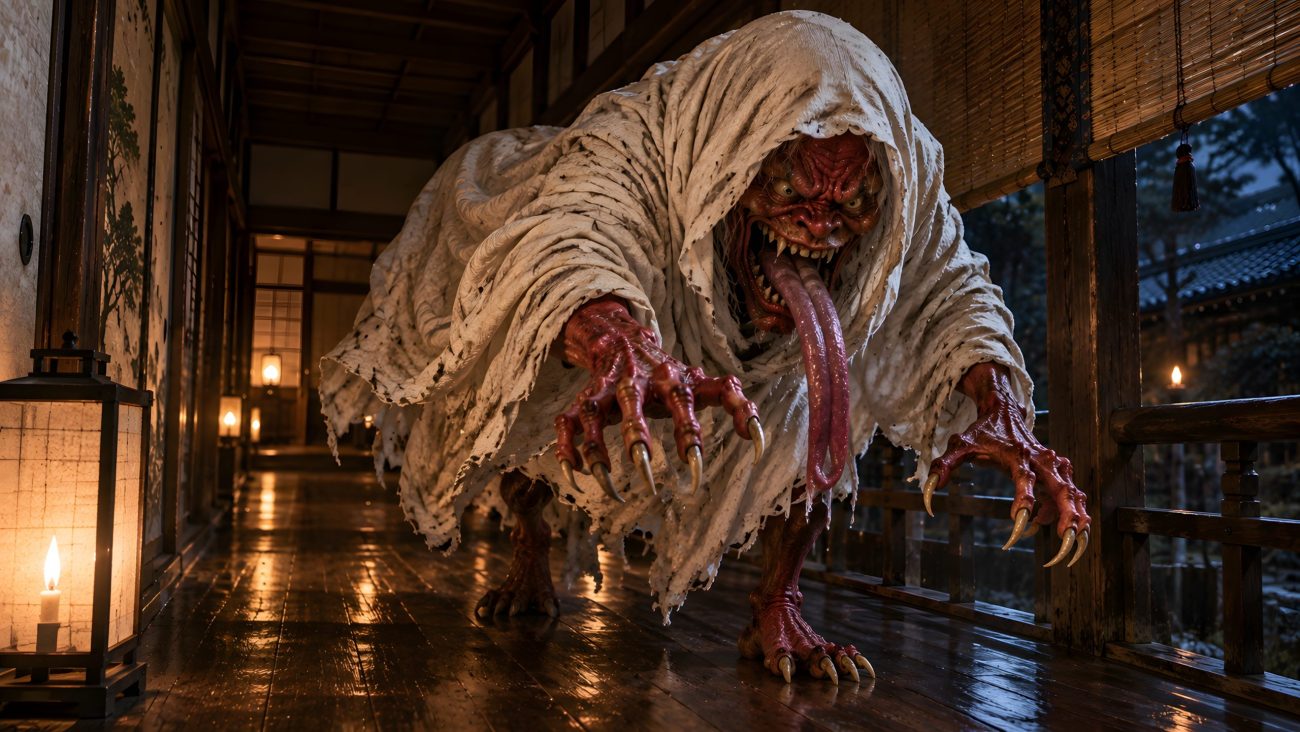
Akanyūdō is a red yōkai wearing a white cloth. It has the appearance of a Buddhist monk or priest, with its body and face covered in a vivid red color.

The creature is depicted in the Hyakki Yagyō Emaki, a Japanese scroll of supernatural creatures. Akanyūdō is shown in the same posture as another yōkai that is identified as Ganjōji (元興寺) in other works. No further legend or behavior is given for Akanyūdō in the source.


Sources

Takahashi, Toshihiro. “赤入道 [あかにゅうどう] (Akanyūdō).” 新版TYZ 妖怪図鑑 (New TYZ Yokai Encyclopedia). August 1, 2015. https://tyz-yokai.blog.jp/archives/1035781303.html


Kowabakarachiki

Tradition: Japanese mythology
Alternative Names: Kowabakarachiki
Category: Demon


The Myth

Kowabakarachiki is a strange monster depicted stomping on a man. Its barking cry is described as “akirence,” while the man being stepped on cries out, “Oya wo ya, whatever.”

The creature appears in the Hyakki Yakō Monogatari, where it is listed as “Bamba Kowabakarachiki.” It does not appear in the Chinese texts associated with Heian and Han traditions, and the source describes it as a later local creation.

Kowabakarachiki was created as a wordplay based on the Yuri language, or Kaku language. Its name is said to play on a phrase meaning roughly “Koha — this is, well, stupid.” The strange cry of the monster and the words shouted by the man are constructed in the same playful manner.

The creature is therefore a yokai built around deliberately strange, foreign-sounding speech, turning unfamiliar language into a source of humor and supernatural absurdity.


Sources

Takahashi, Toshihiro. “コワバカラチキ (Kowabakarachiki).” 新版TYZ 妖怪図鑑 (New TYZ Yokai Encyclopedia). October 19, 2013. https://tyz-yokai.blog.jp/archives/1010654442.html