Tradition: Aztec Mythology, Mexico Mythology
Alternative Names: Cihuateteo, Cihuātēteoh, Cihuātēotl
Category: Demon
The Myth
The Cihuateteo, meaning “Divine Women,” are the spirits of women who died in childbirth. Because childbirth was understood as a struggle equivalent to battle, women who died giving birth were likened to male warriors who had died in violent conflict. A woman in labor was said to capture the spirit of her newborn child in the same way that a warrior captured an enemy in battle.
The Cihuateteo resided in Cihuatlampa, the “place of women,” in the west where the sun sets. Each day, they accompanied the sun toward the west from noon until sunset. Some traditions suggest that they could even carry the sun through the underworld until it rose again. They performed this duty alongside the spirits of male warriors who had died in battle, and this privilege was reserved for these two groups of the dead.
On five particular days of the Aztec calendar—1 Deer, 1 Rain, 1 Monkey, 1 House, and 1 Eagle—the Cihuateteo descended from Cihuatlampa and returned to the earth.
When they appeared on earth, the Cihuateteo were feared as demons of the night. They were particularly associated with crossroads, where roadside shrines were erected to appease them. They were believed to steal children, cause madness and seizures, and tempt men into adultery. Individual Cihuateteo could be associated with the particular calendar day on which they descended.
A woman’s death in childbirth was understood as the result of losing a violent struggle. The gods were believed to have sent the child down to earth, and the woman had to fight and struggle to bring it into the world. If she succeeded, the newborn child was her reward; if she failed, she died and her soul became a Cihuateteotl.
The body of a woman who had died in childbirth was believed to retain extraordinary powers after her soul had departed. Her remains therefore required special protection. An armed group consisting of her widowed husband, his friends, midwives, and elderly women guarded the body against male warriors, who sought parts of it because of their supposed magical power.
The left middle finger and the hair were considered particularly potent. Warriors who obtained these relics could place them on their shields, where they were believed to give them courage and strength while blinding their enemies.
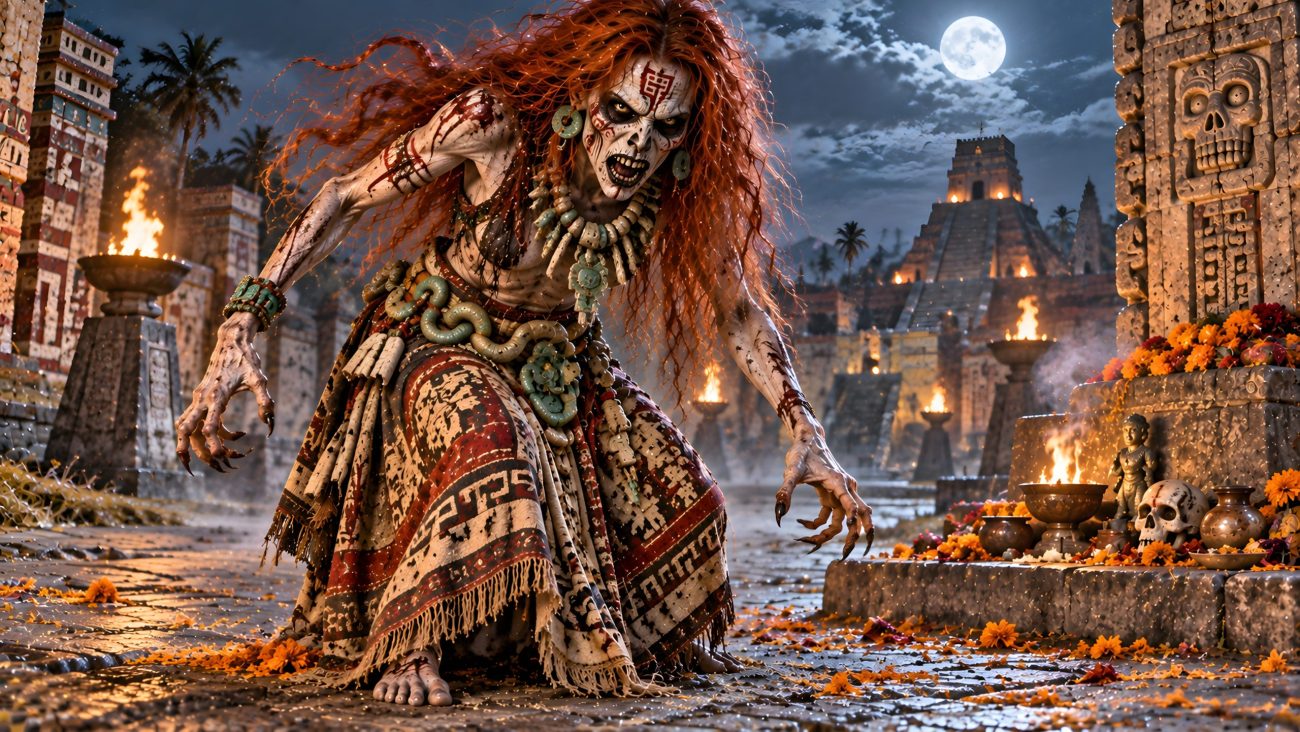
Cihuateteo were depicted as fearsome women with clenched, claw-like fists, bared teeth and gums, and aggressive poses. Their clawed feet could be tucked beneath their skirts, giving them an appearance that was simultaneously seated and ready to attack.
Their bodies often emphasized the physical consequences of childbirth. They were depicted with taut stomachs, exposed breasts, and prominent nipples, emphasizing their unrealized role as mothers who had died before being able to nurse their newborn children.
Their hair was often depicted as long, unkempt, and swirling, sometimes orange in color. Their skirts could be fastened with serpent belts, while some figures from El Zapotal carry staffs bearing heads as trophies and appear covered in flayed skins.
The serpent around the waist may refer to Cihuacoatl, a goddess associated with war, sacrifice, political power, fertility, childbirth, and midwifery. Their unkempt hair was associated with darkness and the earth, while Cihuatlampa itself was a place of darkness. The earth and earth goddesses likewise carried associations with both childbirth and sacrifice, two central aspects of the Cihuateteo.
Sources
“Cihuateteo.” Wikipedia: The Free Encyclopedia. Wikimedia Foundation. Accessed September 6, 2026. https://en.wikipedia.org/wiki/Cihuateteo