Tradition: Japanese mythology
Alternative Names: 百々目鬼, どどめき
Category: Demon
The Myth
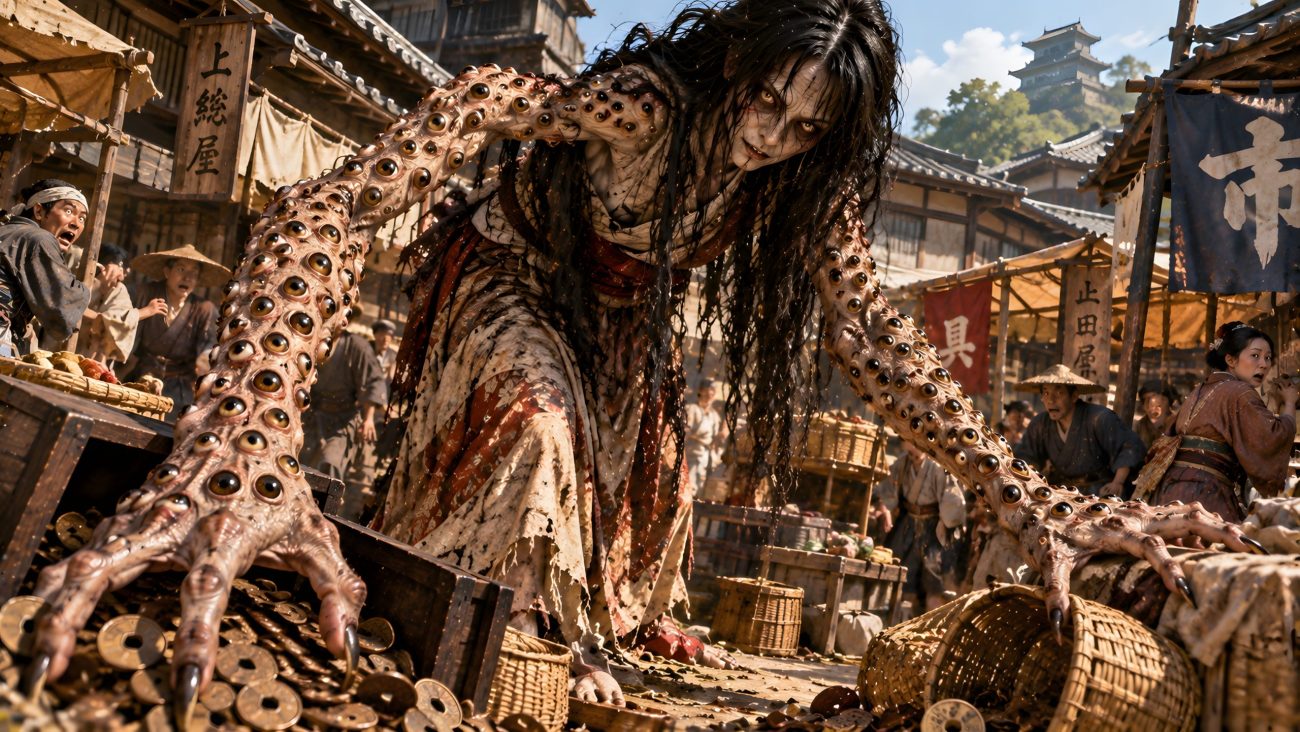
The Dodomeki is a cursed woman with exceptionally long arms covered in hundreds of tiny bird eyes. She was originally a human woman who developed a habit of stealing money. As a consequence of her wicked deeds, hundreds of small bird eyeballs eventually sprout from her arms, transforming her into a monster.
The creature’s appearance is built around a series of Japanese wordplays. Having “long arms” is an expression for someone who has a tendency to steal, so the Dodomeki possesses long arms both figuratively and literally. Copper coins, called dōsen, had holes in their centers and were colloquially called chōmoku, meaning “bird’s eye,” because of their appearance. Thus, a woman who stole copper coins became a monster whose arms were covered in bird eyes.
Money could also be called oashi, literally “feet,” because money comes and goes as though it had feet. The expression ashi ga tsuku means “to catch someone who has committed a crime.” By replacing ashi with chōmoku, which could also refer to money, the expression becomes a pun meaning “covered in bird eyes.” These wordplays were incorporated into Toriyama Sekien’s description of the yokai.
A much older legend tells of Fujiwara no Hidesato, a nobleman who had been granted the position of kokushi of Shimotsuke Province after defeating the rebel Taira no Masakado. While hunting in his newly acquired territory, Hidesato encountered an old man who warned him that an oni had appeared at the horse graveyard at Utsunomiya. Hidesato took his bow and arrows and went to investigate.
He waited at the horse graveyard until nightfall. During the hour of the ox, an enormous demon appeared and began ravenously devouring the carcasses of dead horses. It stood more than ten feet tall, possessed sharp, spiked hair, and had glowing eyes covering its entire body. Hidesato carefully aimed at the brightest eye and fired an arrow directly into it.
The arrow struck the demon, which roared in pain and fled into the woods. Eventually it collapsed at the foot of Mount Myōjin. Yet the wounded demon still possessed tremendous power. Flames erupted from its body, while its mouth split open and released poisonous fumes. The intense heat and toxic air overwhelmed Hidesato, forcing him to abandon the fight and return to his palace.
When Hidesato returned the following day, he found that a large area of ground had been blackened and burned. The demon itself, however, had disappeared.
Four hundred years later, during the Muromachi period, a village had developed on the northern slope of Mount Myōjin. Strange events began occurring there. The head priest of the local temple suffered mysterious injuries, while unexplained fires repeatedly broke out around the temple.
A new head priest, the virtuous Saint Chitoku, was summoned to discover the cause. Chitoku noticed that a young woman frequently visited the temple whenever he preached his sermons. He eventually realized that she was actually the wounded demon from Hidesato’s battle, disguised as a human woman.
After surviving the battle, the demon had retreated into nearby caves to recover. In human form, it repeatedly returned to the place where it had fallen at Mount Myōjin. There it gradually sucked back up the poisonous fumes it had released during the battle and collected the blood it had spilled. Because the village temple had been constructed directly over the old battlefield, the demon began causing fires and attacking the priest in an attempt to drive the people away.
One day, Saint Chitoku confronted the disguised demon. She revealed her true nature as a Dodomeki, but she did not attack him. While repeatedly visiting the temple, she had listened to Chitoku’s powerful sermons, and his teachings had deeply affected her.
The Dodomeki promised that she would never again commit evil. From that time onward, the area around Mount Myōjin became known as Dodomeki.
Sources
“Dodomeki.” Yokai.com: The Japanese Yokai Encyclopedia. Accessed September 7, 2026. https://yokai.com/dodomeki/