Snawfus

Tradition: Ozark folklore, American Mythology
Alternative Names: Snawfus
Category: Deer


The Myth

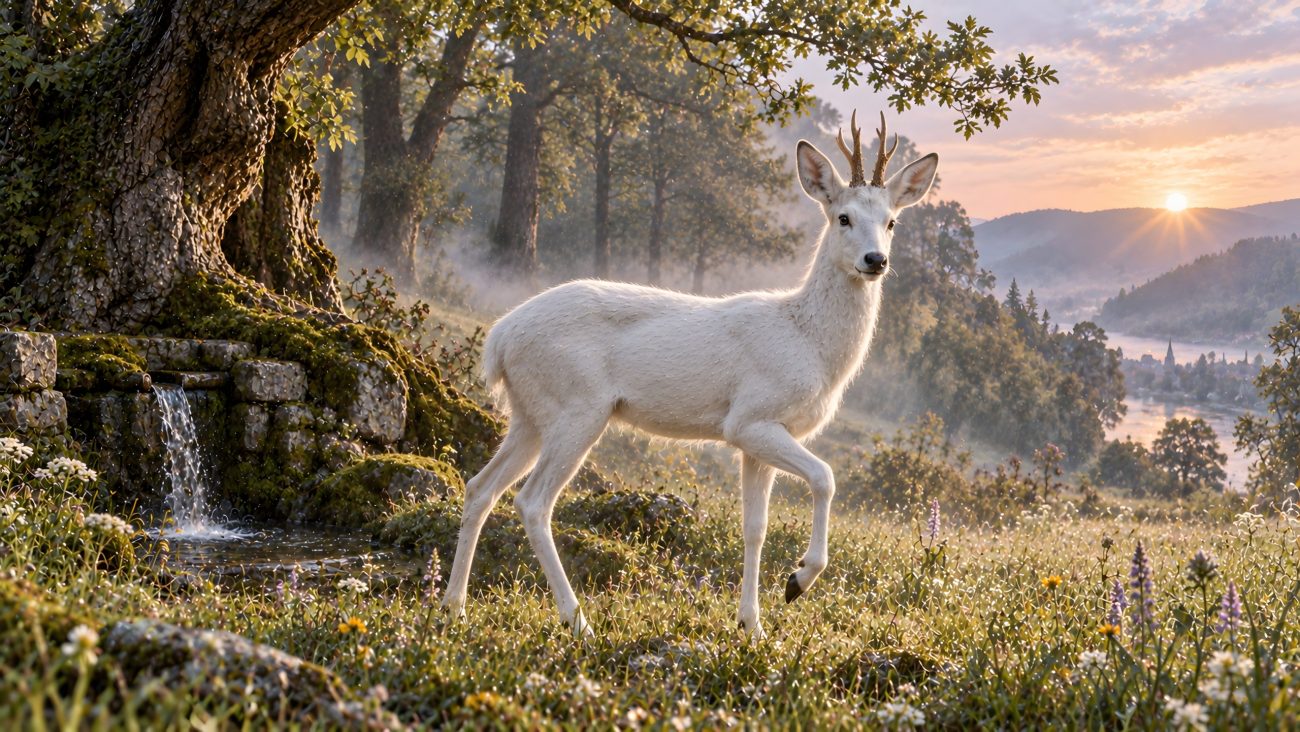
The Snawfus is a supernatural albino deer from the folklore of the Ozarks in Arkansas and Missouri. Although it possesses supernatural powers, it is not considered dangerous.

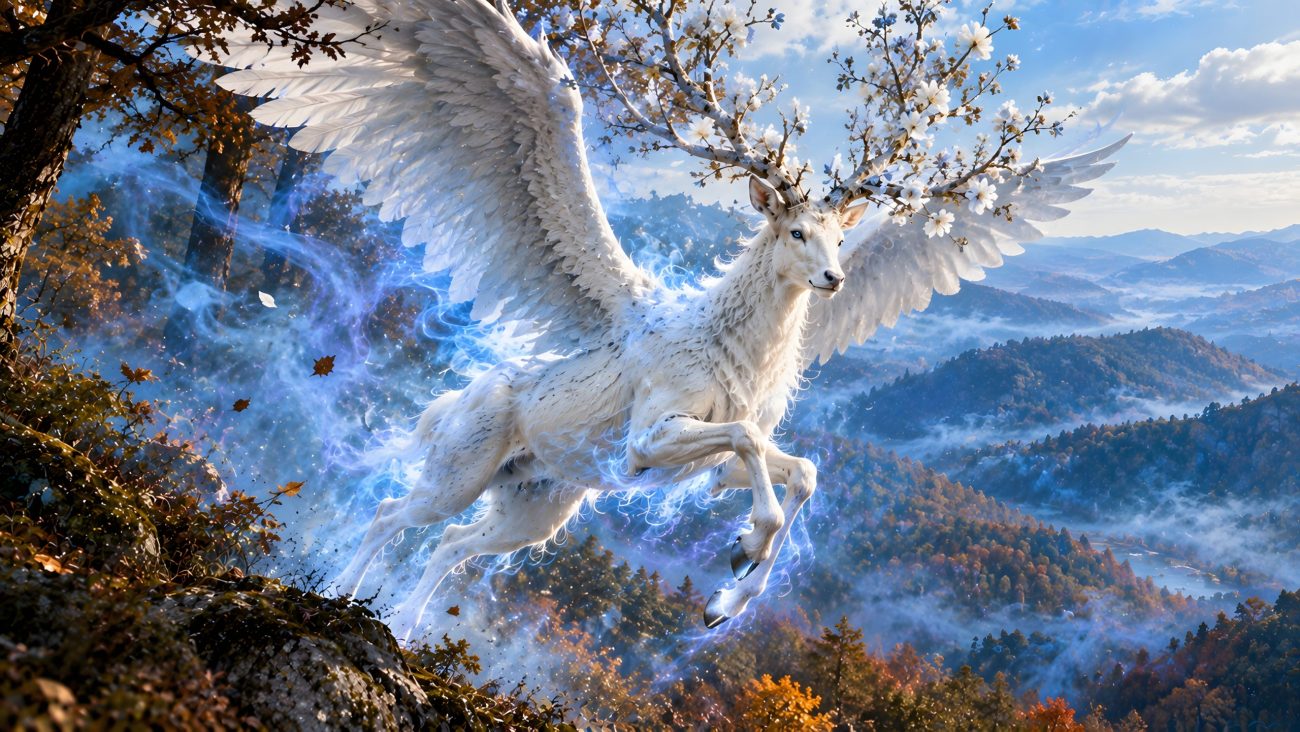
According to some accounts, the Snawfus can leap effortlessly into the treetops. Other accounts describe it as having feathery wings, allowing it to fly silently through the air like an owl. Some traditions also give the creature flowering branches instead of ordinary antlers.

Leila A. Wade of Republic, Missouri, extensively studied the Snawfus and reported that the creature emitted spirals of blue smoke. The smoke drifted away from the deer and spread across the Ozark hills, covering them in a magical blue haze.

According to the tradition, this blue haze can still be seen over the Ozarks during autumn.


Sources

“Snawfus.” A Book of Creatures. July 2, 2021. https://abookofcreatures.com/2021/07/02/snawfus/


Witch as a Roe

Tradition: Austrian Mythology
Alternative Names: Die Hexe als Reh
Category: Deer


The Myth

A hunter once encountered a roe deer on a forest clearing above the “broat’n Rief’n” near Axams. He immediately raised his weapon to shoot it. But the animal suddenly placed its front feet together pleadingly, while tears streamed from its eyes. The hunter noticed that there was something unusual about the creature and could not bring himself to shoot it.

Several months later, the hunter visited the market in Imst and stopped at an inn. To his great surprise, the waitress served him a rich meal and assured him that she herself would pay for everything.

As he prepared to leave, he thanked the waitress and asked whether she knew him. Since the hunter believed that he had never met her before, he was astonished when she told him that she had once been a roe deer in the forest near Axams and that he had been about to shoot her.

She explained that when he had raised his weapon, she had pleaded with him in the form of the deer. Had he shot her then, she said, it would have meant the loss of her soul. From that moment onward, however, she had changed her ways, improved herself, and renounced the Devil.


Sources

Dörler, Adolf Ferdinand, ed. “Die Hexe als Reh.” In Sagen aus Innsbruck’s Umgebung, mit besonderer Berücksichtigung des Zillerthales. Innsbruck, 1895, no. 106. Reproduced by SAGEN.at.
https://www.sagen.at/texte/sagen/oesterreich/tirol/doerler/hexe_reh.html


Calopus

Tradition: Greek Mythology, Italian Mythology, Roman Mythology
Alternative Names: Aeternae, Analopos, Antalope, Antholops, Aptaleon, Aptolos, Pantolops, Jachamur, Jachmur, Jamur, Yamur, Chatloup
Category: Deer


The Myth

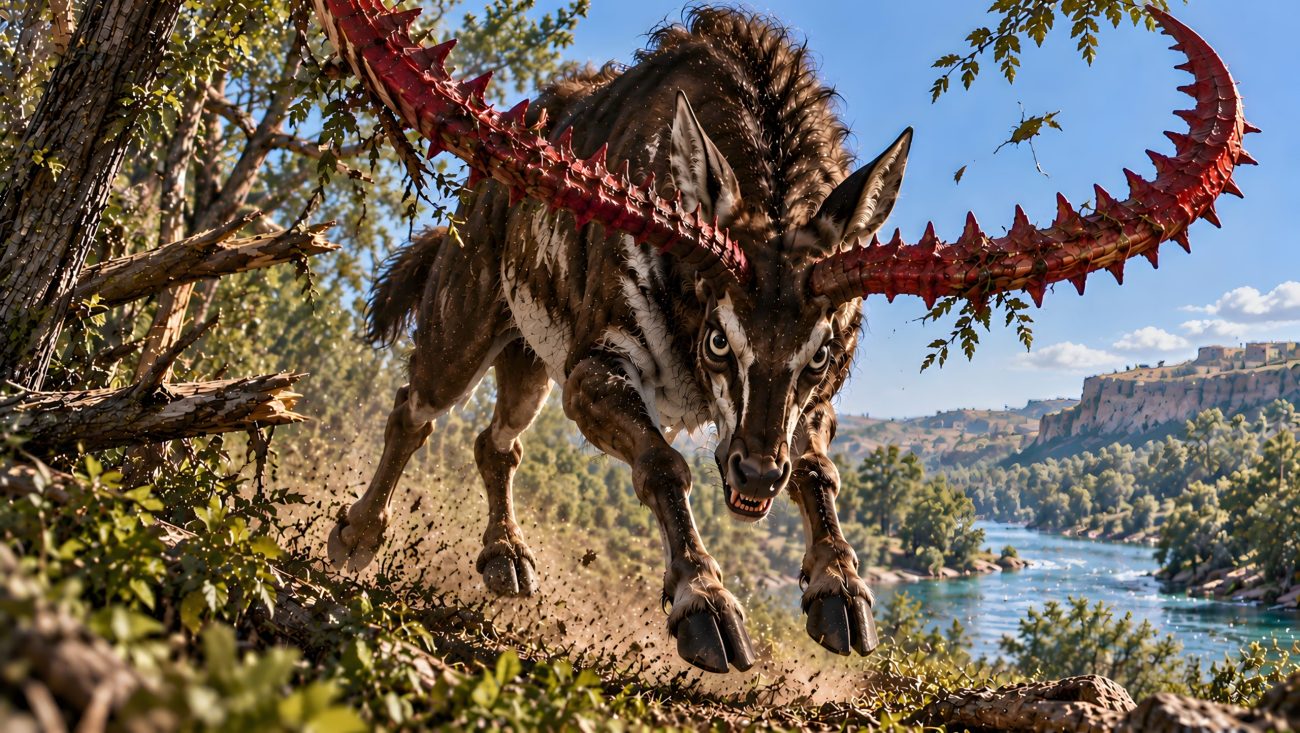
The Calopus is a strange antelope-like creature resembling a roe deer in both appearance and size. Its most remarkable feature is a pair of enormous saw-toothed horns growing from its head. These serrated horns are powerful enough to shred branches and even human limbs, but they also have a dangerous weakness: they can easily become entangled in dense thickets.

When a Calopus becomes trapped by its horns in the branches, it cries out. The sound alerts nearby hunters, who can then find the helpless creature and kill it.

The creature was believed to inhabit India, Syria, and the region around the Euphrates, where it was particularly fond of drinking the cool waters of the Euphrates. The Greeks knew the animal as Analopos and by several related names, while the Romans called it Calopus, meaning “pretty foot.” According to Bochart, these names ultimately derived from the Coptic Pantolops.

Alexander the Great was said to have encountered a number of these antelopes during his campaigns in India. One obscure account calls them “aeternae.” The creatures attacked the Macedonian soldiers and pierced their shields with their enormous horns.

Despite their formidable weapons, the Calopuses were overwhelmed by Alexander’s army. Accounts give wildly different numbers for the slaughter, ranging from 5,400 to 8,550 creatures. According to Topsell, this great slaughter was the reason that hardly any of these animals could be seen afterwards.

Several real animals have been proposed as possible inspirations for the Calopus. It may have been based on one of various antelopes, although the moose has also been suggested. The moose’s habit of stripping or shredding trees may have inspired the creature’s distinctive saw-like horns.

The name “Chatloup,” meaning “cat-wolf,” was later popularized by Barber and Rose, but this appears to be a corruption of the original name Calopus rather than an authentic alternative name for the creature.


Sources

Countess Sica. “Calopus.” A Book of Creatures. September 4, 2016. https://abookofcreatures.com/2016/09/04/calopus/


White Roe

Tradition: German Mythology
Alternative Names: Das weiße Reh
Category: Deer


The Myth

The White Roe is a milky-white deer that appears near a spring at the Hasensprung, a height near Baden in Baden. The spring emerges quietly from old masonry beneath an oak in a somewhat wild rocky woodland. It flows particularly strongly during the full moon and less strongly as the moon wanes.

One morning at first light, a young man came into the woodland and saw a milky-white roe grazing on a meadow filled with flowers. The strange animal greatly fascinated him.

“I must have it!” he thought. He quietly crept toward the White Roe and stretched out his trembling hand, overcome with desire to capture it. But the deer suddenly ran toward the spring. At the edge of the spring lay a maiden with extraordinarily beautiful features, resting her head beside the water.

The young man remained motionless, staring in astonishment at the lovely apparition. He did not know what to do. Fear urged him to flee, yet the beauty of the maiden held him spellbound.

“What am I doing?” he quietly asked himself.

The maiden then waved to him, turning backward as though looking around her. The young man looked again, but there was nothing there. When he turned around once more, both the milky-white roe and the beautiful maiden had disappeared.

Only the quiet spring remained to greet him.


Sources

Gottschalck, Friedrich. “Das weiße Reh.” In Die Sagen und Volksmährchen der Deutschen. Halle, 1814. Originally citing Schreiber, Beschreibung von Baden, Heidelberg, 1811, p. 188. Reproduced by SAGEN.at. https://www.sagen.at/texte/sagen/deutschland/allgemein/gottschalck/dasweissereh.html


Tianlu

Tradition: Chinese Mythology
Alternative Names: 天鹿
Category: Deer


The Myth

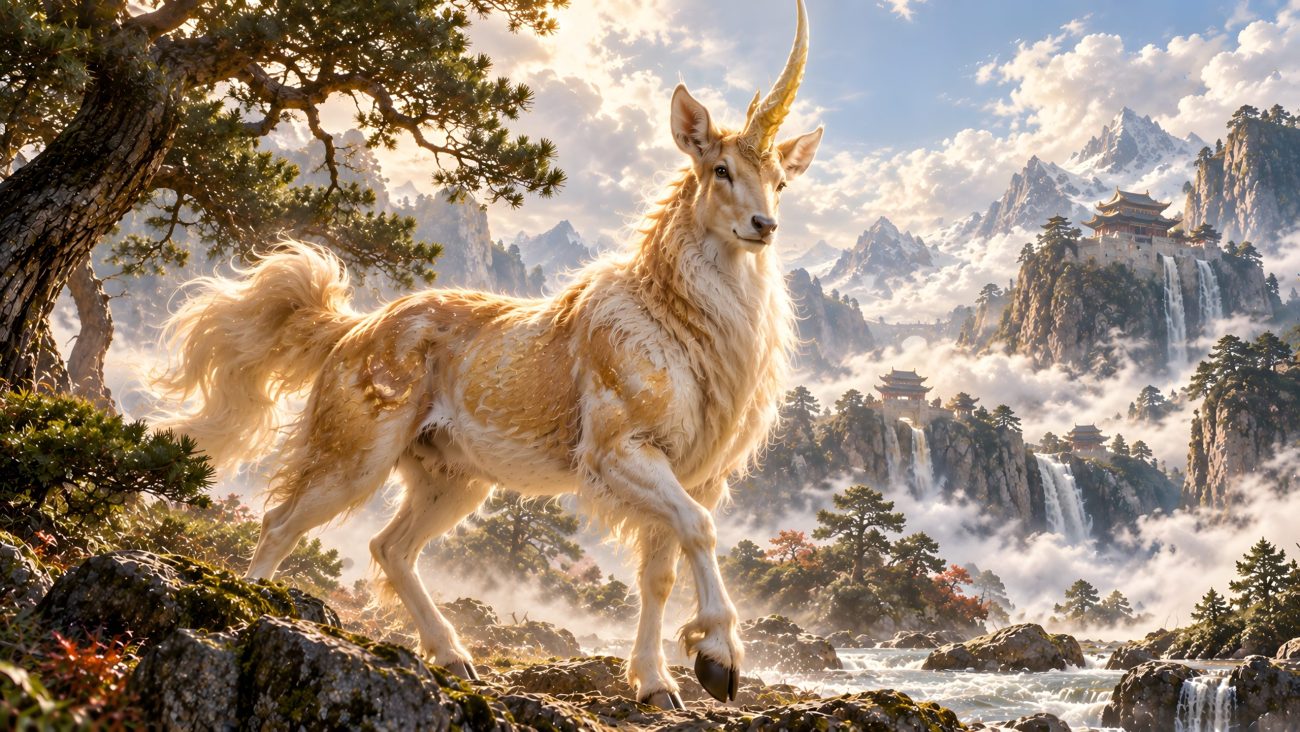
Tianlu is a legendary creature described as a deer with a single horn. In ancient China, it was regarded as an auspicious animal and a favorable omen.

The Book of Song records Tianlu among auspicious creatures, describing it as a beast of good omen whose appearance was associated with the virtue and prosperity of a ruler. Its body was said to possess a brilliant coloration, and its appearance before a king was considered a favorable sign.

The Yiwenzu Lei likewise records Tianlu in its discussion of auspicious phenomena, describing it as a pure and benevolent beast. Its appearance was connected with virtuous rule and the manifestation of heavenly approval.

Because of its extraordinary appearance and association with auspicious signs, Tianlu was regarded as one of the supernatural deer of ancient Chinese tradition. It represented a favorable omen appearing during the reign of a virtuous ruler.


Sources

“天鹿 (Tiānlù; Heavenly Deer).” Chinese Wikipedia. Wikimedia Foundation. Accessed September 5, 2026. https://zh.wikipedia.org/wiki/%E5%A4%A9%E9%B9%BF


White Hart

Tradition: English Mythology
Alternative Names: White Hart
Category: Deer


The Myth

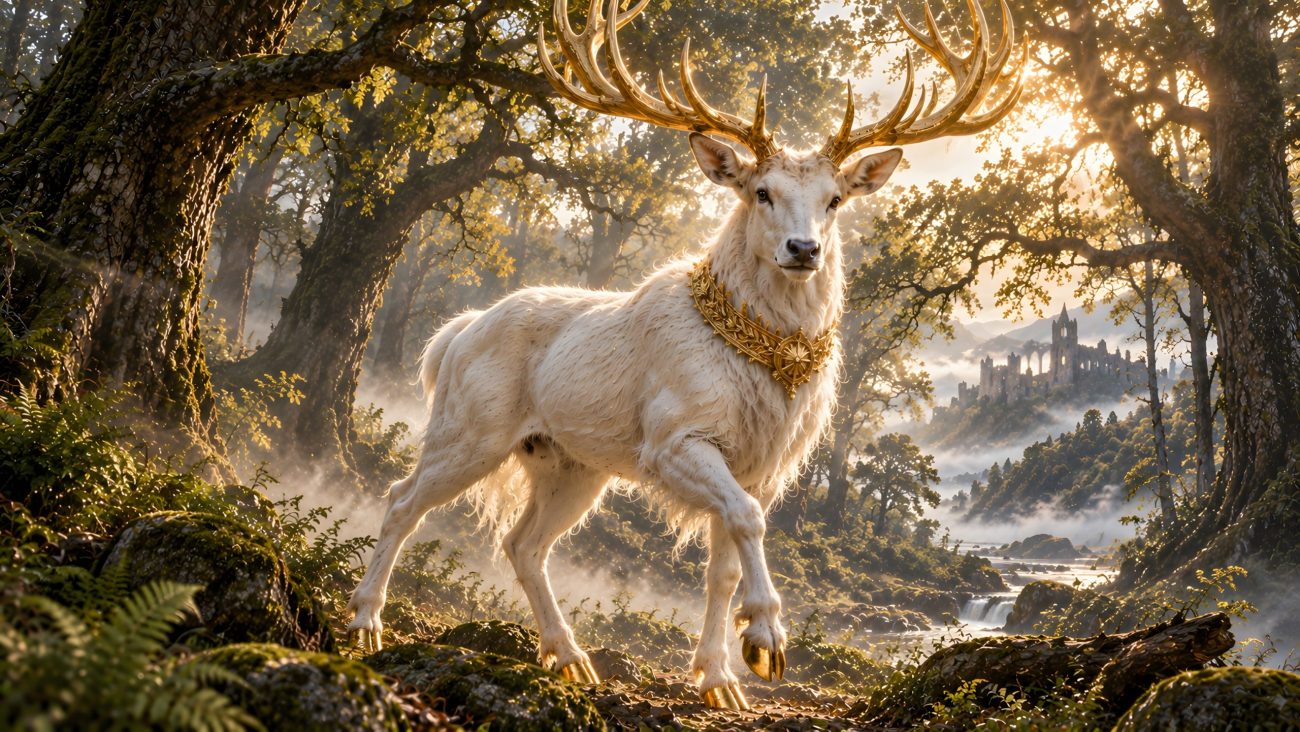
The White Hart is a magnificent white stag, with “hart” being the old English word for a mature male deer. In English tradition, the white hart became associated with royalty, particularly with Richard II, who adopted it as his personal badge.

Richard II probably derived the white hart from the arms of his mother, Joan, the Fair Maid of Kent, who was heiress of Edmund of Woodstock, Earl of Kent. The image may also have served as a pun on Richard’s name, with “Richard” being interpreted as “Rich-hart.”

The White Hart was prominently displayed by Richard II. In the Wilton Diptych, the earliest surviving authentic contemporary portrait of an English king, Richard wears a gold and enamelled white hart jewel. The angels surrounding the Virgin Mary also wear white hart badges, linking the creature closely with Richard’s royal identity.

The White Hart later became a familiar symbol in England. Numerous inns and pubs adopted the name and image of the white stag, making the creature one of the most recognizable traditional signs of English inns.

In English folklore, the White Hart is also associated with Herne the Hunter, a supernatural hunter traditionally connected with Windsor Forest. Through this association, the white stag became linked not only with royalty and heraldry but also with the mysterious supernatural world of the English forest.


Sources

“White Hart.” Wikipedia: The Free Encyclopedia. Wikimedia Foundation. Accessed September 5, 2026. https://en.wikipedia.org/wiki/White_Hart


Akhlis

Tradition: German Mythology
Alternative Names: Achlis, Alces, Ahlkis
Category: Elk, Deer


The Myth

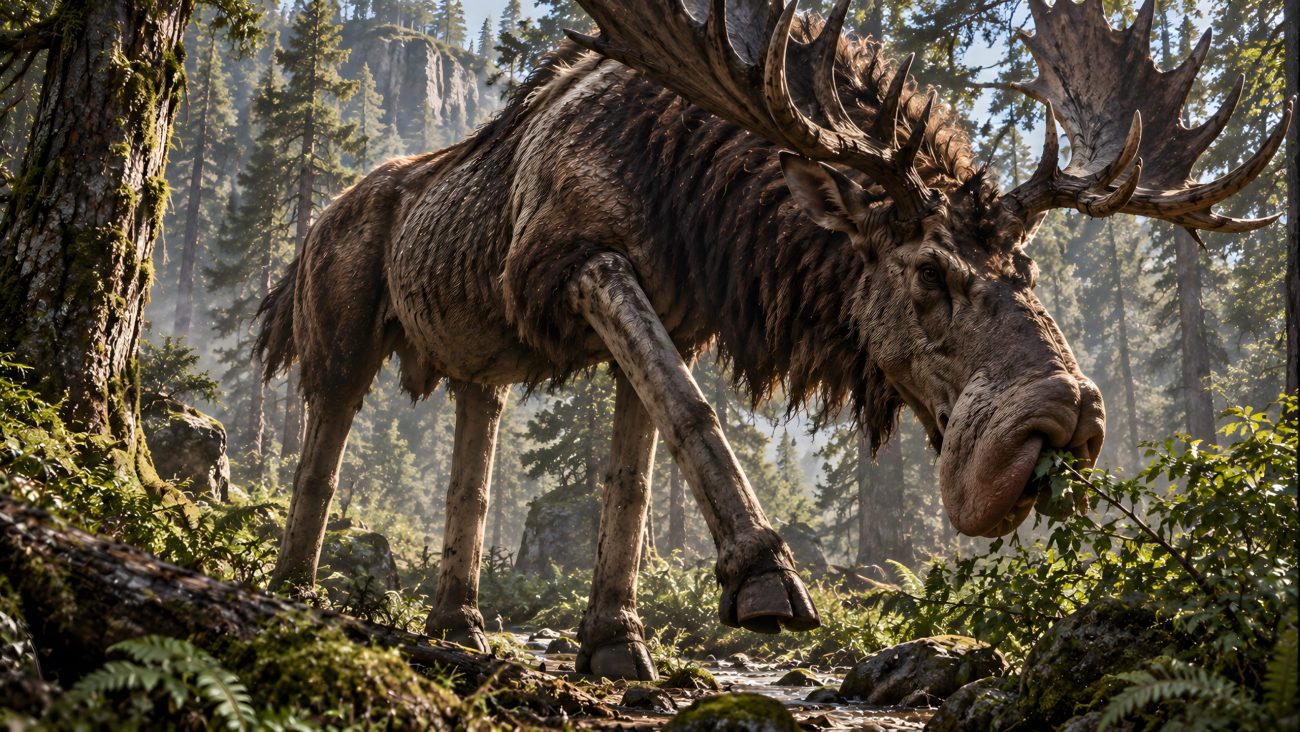
The Akhlis is a strange animal described as resembling an elk, but possessing several unusual features. It has stiff legs without joints or ligaments and a large upper lip that hangs down. Because of the construction of its legs, it is said to be unable to lie down and, if it falls, unable to rise again. Instead, it rests by leaning against trees.

According to Gaius Julius Caesar, the Akhlis was found in the great forests of the north, particularly the Hercynian Forest. He described animals called alces that resembled goats in their build and markings but were considerably larger. They had blunt antlers and legs without joints, preventing them from lying down. When they needed to sleep, they leaned against trees, and hunters could supposedly discover their usual resting places by following their tracks.

The Akhlis was also said to have an unusual way of feeding. According to Pliny the Elder, it resembled an elk and lived on the island of Scandinavia. Its upper lip was so large that it could only graze by walking backwards, preventing it from moving forward while feeding.

Later writers repeated and expanded these descriptions. Solinus described another elk-like animal with a hanging upper lip, saying that it could only graze while walking backwards and that its legs were so straight and stiff that it was difficult to stop once it began running. These accounts closely resemble Caesar’s earlier description of the alces.

The ancient descriptions are therefore unusual because they appear to combine a real northern animal—the elk—with fantastical characteristics. Caesar’s account is generally recognizable as a description of an elk, while the strange details concerning its stiff legs, inability to lie down, and backwards grazing became attached to the creature in later retellings.

The Akhlis was eventually forgotten, surviving mainly in ancient and medieval writings about the animals of the far north. Its name and description were later compared with other legendary elk-like creatures, although the original accounts present it primarily as a mysterious northern animal rather than a supernatural monster.


Sources

Sergey Ksaverov. “Ахлис (Achlis).” New Bestiary (Bestiary.us). Accessed September 5, 2026. https://www.bestiary.us/Akhlis


Bai Lu

Tradition: Chinese Mythology
Alternative Names: White Deer
Category: Deer


The Myth

The White Deer is a white-colored deer regarded in Chinese tradition as an auspicious and extraordinary animal. Since ancient times, it was associated with good omens and supernatural significance. Legends tell of immortals and recluses riding white deer, while white deer also appear as mounts and companions of supernatural beings. The White Deer is notably featured in Journey to the West, where a white deer spirit appears as a supernatural being, and in stories concerning the King of Bhikkhu Kingdom. It is also associated with the North Star, which is said to have the white deer as its mount.

Ancient Chinese writings record appearances of white deer as extraordinary omens. The Guoyu records the appearance of white deer, while the Records of the Grand Historian describes a white deer appearing before the Son of Heaven, with its white hide being treated as something of great value. The Book of Han likewise records a white deer among unusual and auspicious phenomena.

White deer continued to appear in later Chinese literature and historical records. Tang-era poetry also refers to white deer, while Ming-era writings record further sightings of them as remarkable creatures and auspicious signs. In one recorded incident during the Ming dynasty, a white deer was presented to the imperial court as an extraordinary omen.

Because of their rarity and their association with immortals, celestial beings, longevity, and favorable omens, white deer came to occupy a special place in Chinese imagination. They could appear as ordinary animals of unusual color, but in legends and religious stories they could also become supernatural beings, mounts of immortals, or spirits possessing extraordinary powers.


Sources

“白鹿 (Báilù; White Deer).” Chinese Wikipedia. Wikimedia Foundation. Accessed September 5, 2026. https://zh.wikipedia.org/wiki/%E7%99%BD%E9%B9%BF


Kushikiroku

Tradition: Japanese Mythology
Alternative Names: Nine-Colored Deer,
Category: Deer


The Myth

The Nine-Colored Deer is a remarkable deer with nine-colored fur and antlers as white as snow. It lived hidden from humans in a mountain in India, where it was rarely seen. A crow also lived near the river at the foot of the mountain and had a deep bond with the deer.

One day, a man was swept away by the river and was close to drowning. Clinging desperately to a branch, he cried out to the mountain god, tree god, heavenly beings, and dragon god, asking why none of them would save him.

Hearing his cries, the Nine-Colored Deer came to the riverbank. It told the man not to be afraid and instructed him to climb onto its back and hold onto its antlers. The deer then carried him safely to land.

The man wept with gratitude and asked how he could ever repay the deer. The deer asked for only one thing: that the man never reveal that it lived on the mountain.

The deer explained that its nine-colored body and snow-white antlers were unlike anything else in the world. If people discovered it, they would surely kill it for its beautiful fur and antlers. Because of this, it had hidden itself deep within the mountains. Yet when it heard the man’s cries, pity overcame its fear and it came to rescue him.

The man promised never to reveal the deer’s whereabouts and returned home.

Some time later, the queen of the country dreamed of a deer with nine-colored fur and snow-white antlers. She became captivated by the creature and developed such a strong desire to possess its fur and antlers that she fell ill and was confined to her bed. She begged the king to find the deer, convinced that such a creature truly existed.

The king announced a great reward of gold, silver, and other treasures for anyone who could capture the Nine-Colored Deer.

The man who had been rescued knew exactly where the deer lived. At first, he kept the secret. But when he heard of the king’s reward, greed overcame his gratitude. He revealed the deer’s hiding place to the king, forgetting that the creature had saved his life.

The king immediately gathered many soldiers and took the man with him as their guide. They surrounded the valley where the deer lived.

The crow saw what was happening and flew to the cave where the Nine-Colored Deer was sleeping. It cried out a warning, telling the deer that the king had come with an army seeking its rare fur and that the valley had been surrounded.

The deer awoke and came out of its cave, but by then the king and his soldiers were already directly before it. There was nowhere left to escape.

Rather than flee, the deer walked fearlessly toward the king’s palanquin. The soldiers prepared to shoot it with arrows, but the king was moved by the creature’s fearless approach and ordered them to stop.

The deer knelt before the king and asked how he had discovered its hiding place. The king answered that the man standing beside him had led him there.

The deer looked at the man. A bruise had appeared on his face, perhaps as punishment for breaking his promise.

The deer then reminded him of what had happened. It had risked its own life to rescue him from the river, and he had promised never to reveal its existence. Yet he had forgotten the kindness shown to him and had betrayed the deer in exchange for a reward.

The man was unable to answer.

Seeing this, the king understood the man’s ingratitude. He issued a decree forbidding the killing of deer anywhere in his kingdom. Anyone who violated the decree would be executed, and their family would also be destroyed. The king then withdrew his soldiers and returned to his palace.

The Nine-Colored Deer had escaped death. It returned joyfully to its mountain, and afterwards the country prospered. Moderate rains fell, there were no destructive winds or epidemics, the harvests were abundant, and nobody lived in poverty.

The story concludes by contrasting human ingratitude with the kindness of animals: forgetting kindness is found among humans, while helping humans is found among animals. Such things, the story says, have happened both in the past and in the present.

The Nine-Colored Deer is also identified with the Buddha in one of his previous lives. The crow is identified with Ananda, the queen with Sundari, and the ungrateful drowned man with Devadatta. The Nine-Colored Deer Sutra additionally tells that the king scolded the man after learning the truth, and that thousands of deer gathered around the departing Nine-Colored Deer and followed it.


Sources

Takahashi, Toshihiro. “九色鹿 [くしきろく] (Kushikiroku).” 新版TYZ 妖怪図鑑 (New TYZ Yokai Encyclopedia). December 31, 2019. https://tyz-yokai.blog.jp/archives/1076296180.html
Siéhnam

Tradition: Chorote mythology, Argentinian Mythology
Alternative Names: Siéhnam
Category: Deer


The Myth

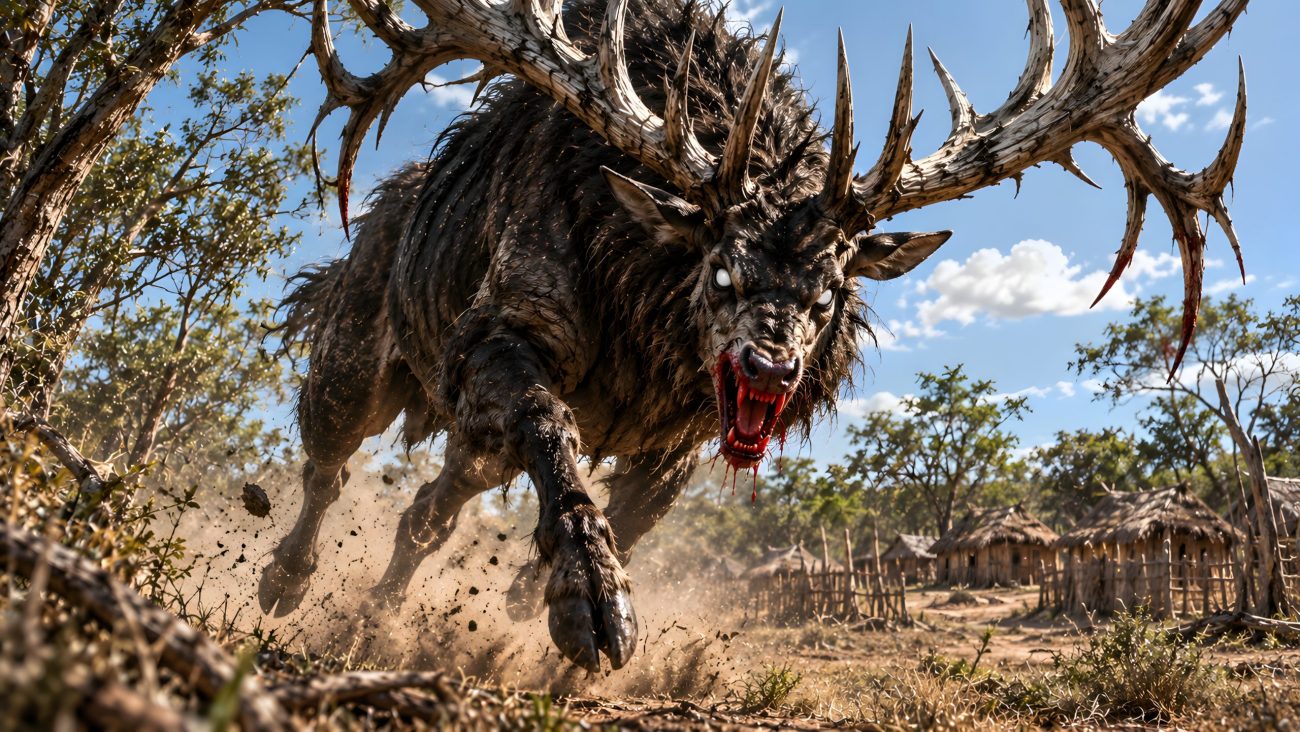
Siéhnam is a terrifying deer that once brought terror to the Chorote people of Argentina. He attacked villages at night, appearing after midnight to hunt people.

Siéhnam killed his victims with his large antlers, stabbing them when he found them. If he discovered someone sleeping on their back, he would bite their throat. He killed four people every night, causing the Chorote to suffer terrible losses.

Eventually, the people became desperate and asked their shaman for help. They asked him, “What is it that comes at night?”

The shaman stayed awake and woke just before midnight. As the hour approached, he heard Siéhnam coming. When the deer appeared, the shaman confronted him: “Now I have caught you! I thought it was someone else, but it was you. You and I will fight!”

The shaman and Siéhnam fought, until eventually the shaman threw the deer to the ground. After this defeat, Siéhnam never returned.

The following day, the shaman brought the good news to the village. He told the people that they could now sleep peacefully, believing that the creature that had been tormenting them would not come back.


Sources

Countess Sica. “Siéhnam.” A Book of Creatures. February 8, 2021. https://abookofcreatures.com/2021/02/08/siehnam/