White Roe

Tradition: German Mythology
Alternative Names: Das weiße Reh
Category: Deer


The Myth

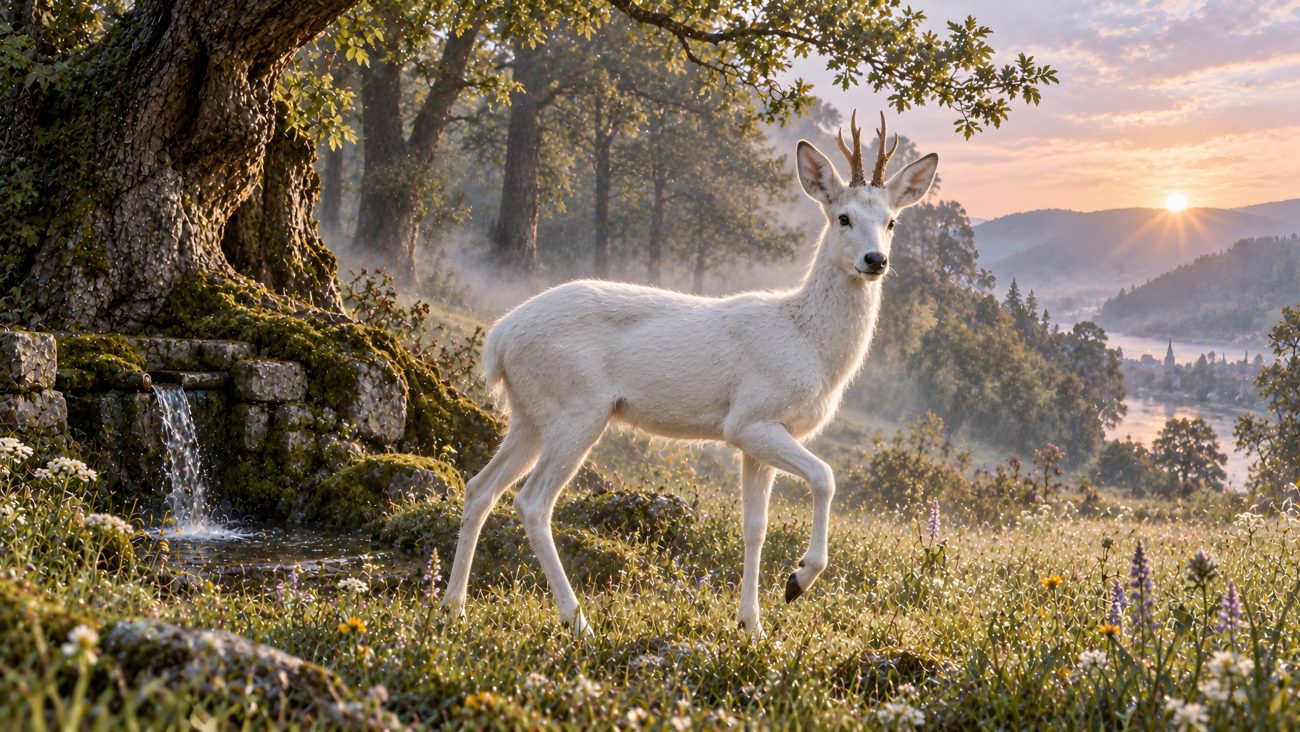
The White Roe is a milky-white deer that appears near a spring at the Hasensprung, a height near Baden in Baden. The spring emerges quietly from old masonry beneath an oak in a somewhat wild rocky woodland. It flows particularly strongly during the full moon and less strongly as the moon wanes.

One morning at first light, a young man came into the woodland and saw a milky-white roe grazing on a meadow filled with flowers. The strange animal greatly fascinated him.

“I must have it!” he thought. He quietly crept toward the White Roe and stretched out his trembling hand, overcome with desire to capture it. But the deer suddenly ran toward the spring. At the edge of the spring lay a maiden with extraordinarily beautiful features, resting her head beside the water.

The young man remained motionless, staring in astonishment at the lovely apparition. He did not know what to do. Fear urged him to flee, yet the beauty of the maiden held him spellbound.

“What am I doing?” he quietly asked himself.

The maiden then waved to him, turning backward as though looking around her. The young man looked again, but there was nothing there. When he turned around once more, both the milky-white roe and the beautiful maiden had disappeared.

Only the quiet spring remained to greet him.


Sources

Gottschalck, Friedrich. “Das weiße Reh.” In Die Sagen und Volksmährchen der Deutschen. Halle, 1814. Originally citing Schreiber, Beschreibung von Baden, Heidelberg, 1811, p. 188. Reproduced by SAGEN.at. https://www.sagen.at/texte/sagen/deutschland/allgemein/gottschalck/dasweissereh.html

Akhlis

Tradition: German Mythology
Alternative Names: Achlis, Alces, Ahlkis
Category: Elk, Deer


The Myth

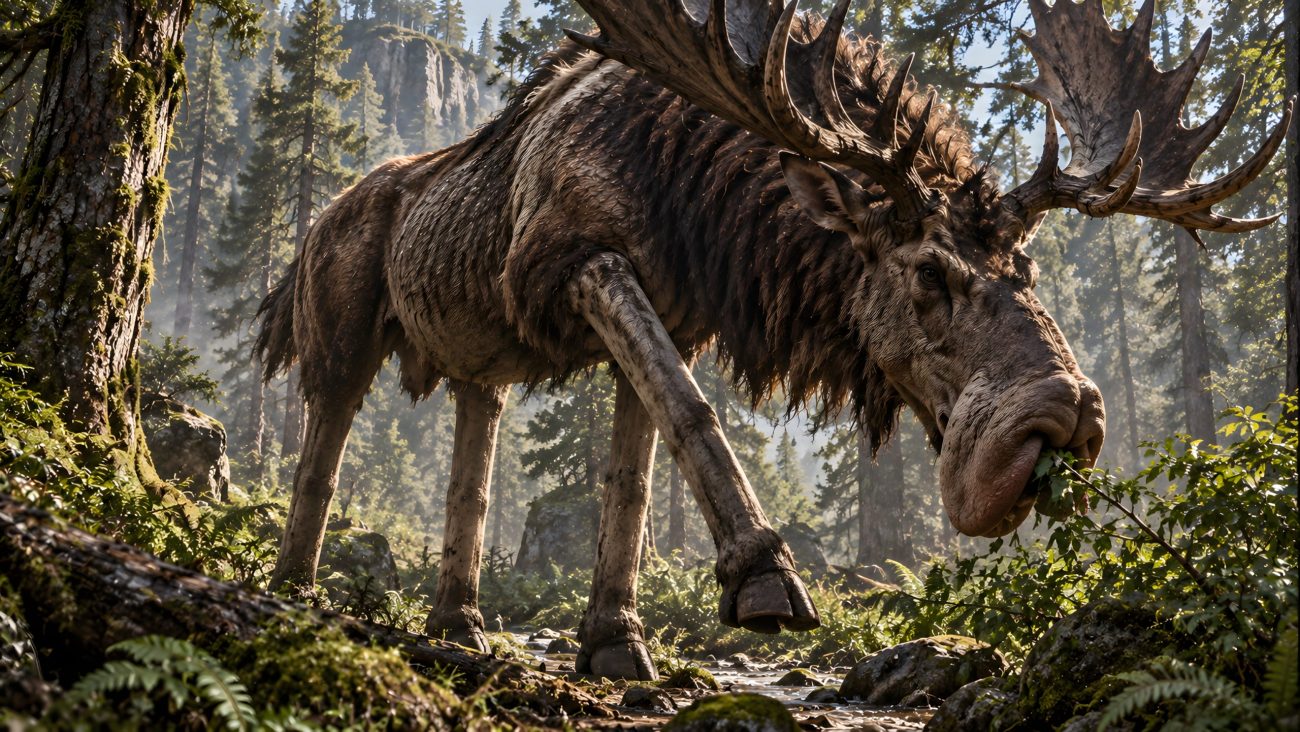
The Akhlis is a strange animal described as resembling an elk, but possessing several unusual features. It has stiff legs without joints or ligaments and a large upper lip that hangs down. Because of the construction of its legs, it is said to be unable to lie down and, if it falls, unable to rise again. Instead, it rests by leaning against trees.

According to Gaius Julius Caesar, the Akhlis was found in the great forests of the north, particularly the Hercynian Forest. He described animals called alces that resembled goats in their build and markings but were considerably larger. They had blunt antlers and legs without joints, preventing them from lying down. When they needed to sleep, they leaned against trees, and hunters could supposedly discover their usual resting places by following their tracks.

The Akhlis was also said to have an unusual way of feeding. According to Pliny the Elder, it resembled an elk and lived on the island of Scandinavia. Its upper lip was so large that it could only graze by walking backwards, preventing it from moving forward while feeding.

Later writers repeated and expanded these descriptions. Solinus described another elk-like animal with a hanging upper lip, saying that it could only graze while walking backwards and that its legs were so straight and stiff that it was difficult to stop once it began running. These accounts closely resemble Caesar’s earlier description of the alces.

The ancient descriptions are therefore unusual because they appear to combine a real northern animal—the elk—with fantastical characteristics. Caesar’s account is generally recognizable as a description of an elk, while the strange details concerning its stiff legs, inability to lie down, and backwards grazing became attached to the creature in later retellings.

The Akhlis was eventually forgotten, surviving mainly in ancient and medieval writings about the animals of the far north. Its name and description were later compared with other legendary elk-like creatures, although the original accounts present it primarily as a mysterious northern animal rather than a supernatural monster.


Sources

Sergey Ksaverov. “Ахлис (Achlis).” New Bestiary (Bestiary.us). Accessed September 5, 2026. https://www.bestiary.us/Akhlis