Tradition: Greek Mythology, Italian Mythology, Roman Mythology
Alternative Names: Aeternae, Analopos, Antalope, Antholops, Aptaleon, Aptolos, Pantolops, Jachamur, Jachmur, Jamur, Yamur, Chatloup
Category: Deer
The Myth
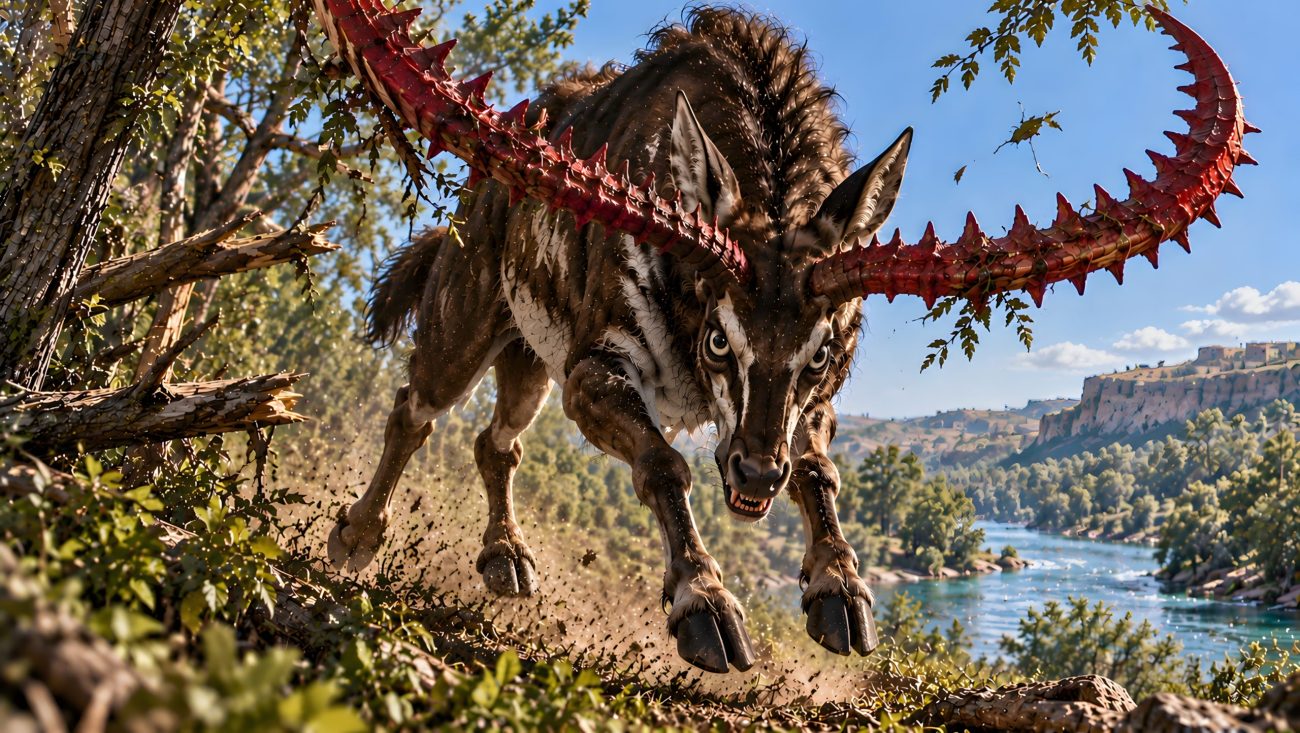
The Calopus is a strange antelope-like creature resembling a roe deer in both appearance and size. Its most remarkable feature is a pair of enormous saw-toothed horns growing from its head. These serrated horns are powerful enough to shred branches and even human limbs, but they also have a dangerous weakness: they can easily become entangled in dense thickets.
When a Calopus becomes trapped by its horns in the branches, it cries out. The sound alerts nearby hunters, who can then find the helpless creature and kill it.
The creature was believed to inhabit India, Syria, and the region around the Euphrates, where it was particularly fond of drinking the cool waters of the Euphrates. The Greeks knew the animal as Analopos and by several related names, while the Romans called it Calopus, meaning “pretty foot.” According to Bochart, these names ultimately derived from the Coptic Pantolops.
Alexander the Great was said to have encountered a number of these antelopes during his campaigns in India. One obscure account calls them “aeternae.” The creatures attacked the Macedonian soldiers and pierced their shields with their enormous horns.
Despite their formidable weapons, the Calopuses were overwhelmed by Alexander’s army. Accounts give wildly different numbers for the slaughter, ranging from 5,400 to 8,550 creatures. According to Topsell, this great slaughter was the reason that hardly any of these animals could be seen afterwards.
Several real animals have been proposed as possible inspirations for the Calopus. It may have been based on one of various antelopes, although the moose has also been suggested. The moose’s habit of stripping or shredding trees may have inspired the creature’s distinctive saw-like horns.
The name “Chatloup,” meaning “cat-wolf,” was later popularized by Barber and Rose, but this appears to be a corruption of the original name Calopus rather than an authentic alternative name for the creature.
Sources
Countess Sica. “Calopus.” A Book of Creatures. September 4, 2016. https://abookofcreatures.com/2016/09/04/calopus/