Cheongwoo

Tradition / Region: Korean Mythology
Alternate Names: The Blue Cow; Blue Ox of Danyang
Category: Cow


The Myth

During the time of the Joseon Dynasty, in the mountainous lands near Danyang, people spoke of a strange and powerful ox that appeared among the hills.

Its body was blue in color, and it stood larger than any ordinary ox. Its head was broad, and its horns spread wide apart, giving it a fearsome and imposing look. Because of its color, it became known as Cheongwoo, the Blue Cow.

Though it seemed wild and strong, the beast was not beyond human control. A man named Yi Ji-beon managed to tame it and made it serve him. Once mastered, Cheongwoo allowed itself to be ridden like a horse, carrying the man across the land.

The creature feared neither cold nor mountain. It moved easily through winter winds and climbed steep slopes without tiring, crossing rocky paths where no common animal could travel. Its strength, endurance, and strange nature made it a wonder among the people.

The tale of Cheongwoo was later written down so that the memory of the blue cow — the mountain beast that bore a man upon its back — would not be forgotten.


Gallery


Sources

Namuwiki contributors. (n.d.). 청우 (한국의 요괴). In Namuwiki. Retrieved from https://namu.wiki/w/%EC%B2%AD%EC%9A%B0(%ED%95%9C%EA%B5%AD%EC%9D%98%20%EC%9A%94%EA%B4%B4)


Interpretive Lenses

Religious Readings
  • Christian Ascetic Deep Dive
Philosophical Readings
  • Nietzschean Deep Dive
Psychological Readings
  • Jungian Deep Dive
Esoteric Deep Dive
  • Hermetic Deep Dive
Political / Social Readings
  • Marxist Deep Dive

Catoblepas

Tradition / Region: Greek Mythology
Alternate Names:
Category: Cow


The Myth

In ancient times, in the distant lands of Africa near the sources of great rivers and marshes, there lived a dreadful creature called the Catoblepas.

It was shaped somewhat like a bull, though more monstrous and misshapen. Its limbs were heavy, and its head was enormous, so large that it could scarcely lift it from the ground. Because of this weight, the beast always walked with its gaze turned downward. This was considered a mercy, for its eyes were said to bring instant death to any who met them.

Its face was grim and terrible. A mane like that of a horse hung over its head, and its eyes were small, red, and bloodshot. It fed only on poisonous plants that grew in the marshes, and the foulness of its food filled its breath with deadly vapor. When angered or disturbed, the creature released a noxious breath that poisoned the air itself, so that animals and men who inhaled it lost their strength, their voice, and their life.

Because of this, all creatures avoided the places where it dwelled, and even hunters feared to approach its marsh.

Stories were told of travelers and soldiers who unknowingly came near it. Some died from its gaze, others from its breath, until at last men armed with long spears managed to kill the monster from a distance. Its hide was said to have been taken as a trophy and placed in a temple dedicated to a mighty hero.

Yet the terror of the Catoblepas lived on in tales, for it was remembered as a beast so foul and dangerous that even its mere presence could bring death, a creature that kept its head forever bowed, as though the world itself could not bear its sight.


Gallery


Sources

George of Pisidia. Hexaemeron, p. 29

Bestiary.us, Katoblepas. Retrieved May 28, 2025, from https://www.bestiary.us/katoblepas

Pliny the Elder. Natural Histories, Book VIII, Chapter 32, p. 209–210.


Interpretive Lenses

Religious Readings
  • Christian Ascetic Deep Dive
Philosophical Readings
  • Nietzschean Deep Dive
Psychological Readings
  • Jungian Deep Dive
Esoteric Deep Dive
  • Hermetic Deep Dive
Political / Social Readings
  • Marxist Deep Dive

Camahueto

Tradition / Region: Chilean Mythology
Alternate Names:
Category: Cow


The Myth

In the southern lands of Chile, especially among the people of Chiloé and Patagonia, there is said to live a mighty beast called the Camahueto.

It is born in lonely freshwater places — marshes, lakes, or rivers — where its life begins in secret. Some say it comes from a horn of another Camahueto, planted in the earth by a sorcerer so that the creature may grow there. Over many years, sometimes twenty or more, the young beast gains enormous strength and speed. As it matures, a horn grows from its forehead, often said to be bright like silver, and even if broken it will grow again.

When its time comes, the Camahueto leaves the inland waters and journeys toward the sea. It chooses stormy nights for this passage. As it moves down rivers and streams, terrible crashing sounds are heard, and people say the beast drags trees, animals, and even parts of the land itself along its path. Rivers rise suddenly and violently when it passes, as though the waters themselves are driven by its strength.

Once it reaches the ocean, the Camahueto becomes a creature of the deep. There it is said to overturn ships, devour fish and men, and shatter coastal rocks with its horn. Many shipwrecks and strange disappearances along the coast are blamed on its presence.

Yet the beast is not beyond control. Sorcerers are said to master it with a lasso made from thick brown sea-kelp. Those who command it may ride the Camahueto across great distances, though such power is dangerous and feared.

Because of its strength and the strange power believed to lie in its horn, the Camahueto is both dreaded and respected, a creature of land, river, and sea whose coming is always marked by noise, destruction, and awe.


Gallery


Sources

Bestiary.us. (n.d.). Kamahujeto, from https://www.bestiary.us/kamahujeto

García Barría, N. (1997). Tesoro mitológico del archipiélago de Chiloé: bosquejo interpretativo. Andrés Bello, p. 75–79.


Interpretive Lenses

Religious Readings
  • Christian Ascetic Deep Dive
Philosophical Readings
  • Nietzschean Deep Dive
Psychological Readings
  • Jungian Deep Dive
Esoteric Deep Dive
  • Hermetic Deep Dive
Political / Social Readings
  • Marxist Deep Dive

The Calf-Bleater of Sufferloh

Tradition / Region: German Mythology
Alternate Names: The Calf Spirit; The Bleating Steward; The Hoofprint Ghost
Category: Cow, Ghost


The Myth

In the free village of Sufferloh, the people once lived under the protection of Tegernsee Abbey. Each year, out of their own goodwill, they brought a calf to the prelate as a sign of respect. The offering was freely given and caused no resentment among the farmers.

But in time a new monastery steward was appointed. When another year passed, he declared that the gift would no longer be voluntary. From then on, he demanded the first-born calf from the farmers as a fixed obligation. The people obeyed, but bitterness settled in their hearts.

After the steward died, strange happenings began in the monastery passage. At night, a loud bleating echoed through the corridors — the unmistakable cry of a calf. The sound returned again and again, filling the monks with dread.

Not long after, a calf’s hoofprint appeared in the stone floor of the passage. No matter what was done, the mark would not vanish. Even when the tiles were removed, the imprint could still be seen beneath them.

The monks finally sealed the passage in hopes of ending the disturbance. Yet the bleating continued night after night, and peace did not return until the monastery itself was dissolved.

People later said the spirit of the unjust steward had been condemned to wander, crying forever like the calf he once demanded without mercy. Some claimed the ghost was driven first to the Ringspitze, and later, by order of the Pope, to roam the Unnütz mountain with other restless spirits, doomed to bleat through the darkness for all time.


Gallery


Sources

SAGEN.at contributors. (n.d.). Kalbplärrer. In SAGEN.at – Traditionelle Sagen aus Deutschland: Bayern–Isarwinkel, from https://www.sagen.at/texte/sagen/deutschland/bayern/isarwinkel/kalbplaerrer.html


Interpretive Lenses

Religious Readings
  • Christian Ascetic Deep Dive
Philosophical Readings
  • Nietzschean Deep Dive
Psychological Readings
  • Jungian Deep Dive
Esoteric Deep Dive
  • Hermetic Deep Dive
Political / Social Readings
  • Marxist Deep Dive

Grünröckel

Tradition / Region: Hungarian Mythology
Alternate Names: The Greencoat; Green Coat Man; Mountain Dwarf of Günser
Category: Mountain dweller


The Myth

In the Günser Mountains, people speak of a small, strange being known as the Grünröckel, the Greencoat. It is said to appear on bright moonlit nights along mountain paths and hollow roads. Though not truly evil, its appearance is feared, for those who meet it often suffer misfortune afterward.

One summer night, three men from the mountains were hauling wood down into town with their oxen, using the cool moonlight to avoid the heat and the swarms of flies. Their teams moved one behind another through a hollow between vineyards while the drivers rested on their wagons.

Suddenly the first pair of oxen stopped and would not go forward.

The driver climbed down and went ahead to see what blocked the way. There, in the middle of the hollow, shining clearly in the full moon, stood a short figure. It wore a pointed hat, a white ruff at the neck, and over its shoulders a bell-shaped green coat that hung down to its thighs. Beneath it were short breeches and tight trousers. The little man stood still, smiling with an eerie grin.

Terrified, the driver leapt back and seized his long-handled axe. He rushed forward and struck with all his strength. But just as the blade came down, the small man sprang lightly up the embankment and vanished at once. Though the slope was thick with vines, the figure passed through without a sound or any sign of resistance, as if it had never been solid at all.

The men continued on their way, shaken. Soon afterward, one of the companions died unexpectedly, and people said the meeting with the Greencoat had brought the ill fortune.

In the mountains it is also said that the Grünröckel is a spirit who delights in startling travelers and teasing wanderers, though he is not wholly hostile. Some claim he is the restless ghost of an executed man who once fled through these hills, while others believe he is an ancient mountain spirit who has always belonged to the land.

But all agree that when the small man in the green coat appears in the moonlight, it is a sign that something strange is about to follow.


Gallery


Sources

sagen.at contributors. (n.d.). Das Grünröckel. In sagen.at, from https://www.sagen.at/texte/sagen/ungarn/gruenroeckl.htm


Interpretive Lenses

Religious Readings
  • Christian Ascetic Deep Dive
Philosophical Readings
  • Nietzschean Deep Dive
Psychological Readings
  • Jungian Deep Dive
Esoteric Deep Dive
  • Hermetic Deep Dive
Political / Social Readings
  • Marxist Deep Dive

Hany Istók

Tradition / Region: Hungarian Mythology
Alternate Names: The Foundling of Hanság; Marsh Child; Haon Ischtok
Category: Swamp dweller


The Myth

On March 15, 1746, two fishermen, Franz Nagy and Michael Molnár, brought a strange boy to the castle of Kapuvár. The child resembled a wild animal more than a human, yet by his size he seemed to be about ten years old. Because he could not speak, he was baptized Hany Istók.

The boy was naked. His head was round, with small eyes, a flat nose, and a wide mouth. His body and head were said to be covered in fish-like scales, and his fingers and toes were unusually long. He would eat nothing but grass, hay, and straw. Whenever he thought himself unobserved, he leapt into the castle moat and swam like a fish.

For almost a year he remained quietly at the castle. In time he began to accept cooked food, and it seemed he might gradually adapt to human life. Because of this, the guards watched him less closely.

Then, without warning, he disappeared.

People believed he had thrown himself into the nearby Rábcza River and escaped back into the marshlands.

A wooden likeness of Hany Istók was later kept at the Esterházy palace of Esterház. From this figure, observers noted strange features: a wrinkled brow, sparse facial hair, and a body whose belly seemed too large for its limbs. These traits made some think the being had not been a child at all, but something older in human form.

After his disappearance, the strange creature was reportedly seen a few more times in the marshes of the Hanság. After that, it vanished entirely, and no one saw it again.


Gallery


Sources

sagen.at contributors. (n.d.). Das Findelkind. In sagen.at, from https://www.sagen.at/texte/sagen/ungarn/findelkind.htm


Interpretive Lenses

Religious Readings
  • Christian Ascetic Deep Dive
Philosophical Readings
  • Nietzschean Deep Dive
Psychological Readings
  • Jungian Deep Dive
Esoteric Deep Dive
  • Hermetic Deep Dive
Political / Social Readings
  • Marxist Deep Dive

Heavy Wagon of Malmkrog

Tradition / Region: Romanian Mythology
Alternate Names: The Heavy Wagon; The Mountain Car; The Vespers Wagon
Category: Object, Wagon


The Myth

About thirty years before the tale was told, a farmer’s wife from Malmkrog was harvesting grain on a field high up the mountainside. Her small son, no more than four or five years old, sat in the shade of a few sheaves, restless and bored while she worked.

Below the field the slope dropped steeply into an old, half-cleared forest. It was late afternoon, and the village bells began to ring for vespers. According to custom and belief, people were meant to stop their labor and return home at that hour, but the woman remained in the field.

Then from the nearby woods came a sudden uproar.

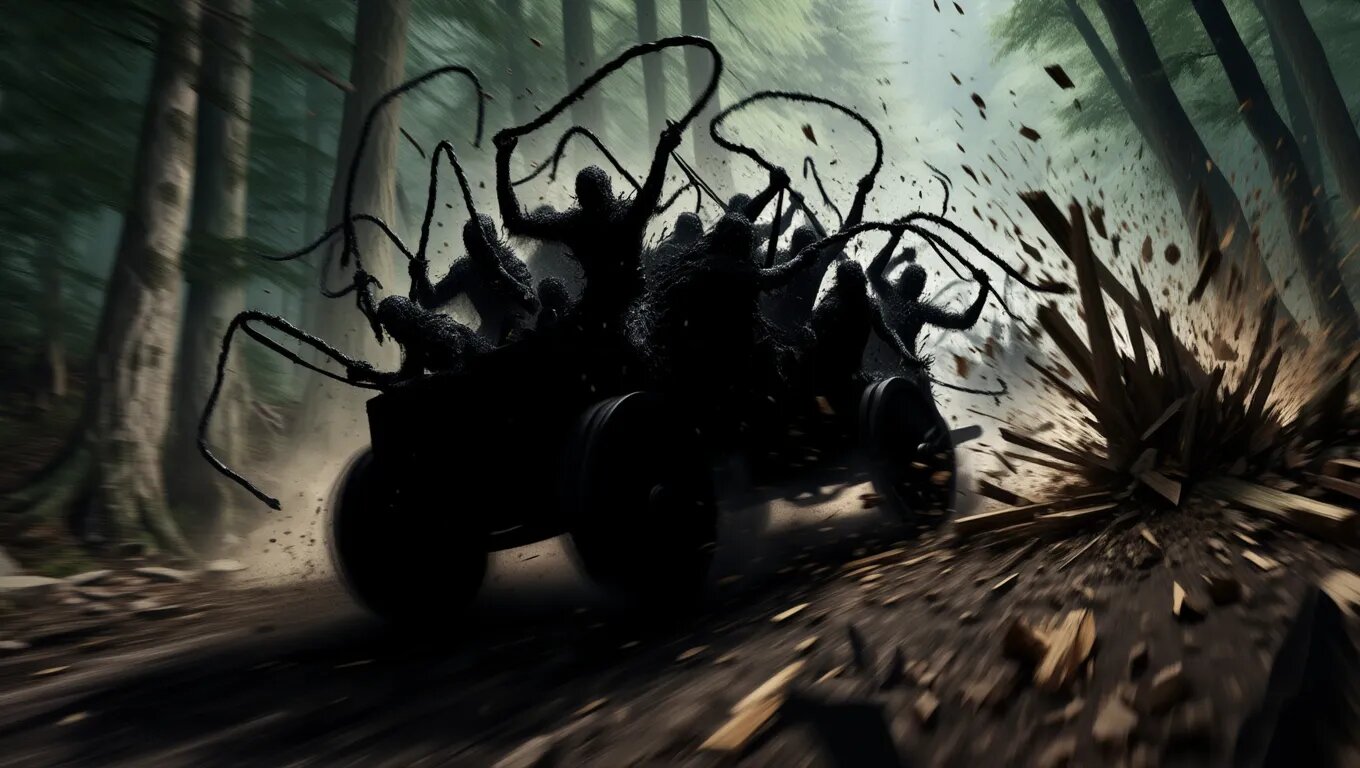
The boy later said he heard the crack of whips echoing through the trees, along with loud shouting and calls of “Hi!” and “Ho!” It sounded as if many unseen men were straining to haul a heavily laden cart up the steep, trackless mountainside. The noise of wheels, crashing wood, and clattering harness rang through the forest, though no one could be seen.

Panic seized the woman. She ran to her child, snatched up what she had brought from home, and took his hand. Behind them the din grew louder — the shouts, the cracking whips, the grinding of the burdened wagon — as if the unseen drivers were drawing ever nearer.

Without looking back, she fled with the boy down the mountain toward the village.

That evening she told the men who had already returned from their work:

“When the bell rang for vespers, they came with the Heavy Wagon. Never again will I stay on the Hattert once the church bell rings.”

And from that time on, people remembered the tale and kept to the old custom, leaving the mountain fields when the bells began to sound.


Gallery


Sources

sagen.at contributors. (n.d.). Der schwere Wagen. In sagen.at, from https://www.sagen.at/texte/sagen/rumaenien/siebenbuergen/derschwerewagen.html


Interpretive Lenses

Religious Readings
  • Christian Ascetic Deep Dive
Philosophical Readings
  • Nietzschean Deep Dive
Psychological Readings
  • Jungian Deep Dive
Esoteric Deep Dive
  • Hermetic Deep Dive
Political / Social Readings
  • Marxist Deep Dive

Smo of Minarken

Tradition / Region: Romanian Mythology
Alternate Names:
Category: Dragon


The Myth

A shepherd from Minarken once told how his companion Simon proved himself against the dreaded Smo.

In those days, the young men of the village often kept watch over their masters’ flocks at night. They would gather around their fire in the hills, laughing, boasting, and telling stories to pass the long hours.

One night Simon suddenly said, half in jest, “Do you think I could summon the Smo if I saw him flying past?”

The others laughed, but wagers were quickly made. Bottles of brandy were promised if he could do it, and Simon agreed.

Not long afterward, a flash of lightning appeared in the western sky. Soon the men saw what they feared most — the fiery Smo drawing nearer. Sparks streamed from it as it flew high through the darkness.

Simon sprang up. From his belt he drew the small iron fork he carried beside his knife. He swung it three times above his head and hurled it into the ground before him. Then he shouted across the mountains:

“When I call you, you must follow me and come to this place!”

Far away, the blazing dragon suddenly turned and came snarling toward them. At Simon’s command it halted before him.

“Where are you going?” Simon demanded.

With a dull voice and fire pouring from its mouth and eyes, the Smo answered, “I go to my sweetheart in the village below.”

“She is mine, not yours,” Simon declared. “You will stay here as long as I wish.”

And the spirit obeyed him.

For a long time Simon held the fiery dragon there beside the fire while the others watched in fear and amazement. Only toward morning did he lift the fork again, cast it once more into the ground, and command:

“Go back where you came from — but you shall not go to my village.”

At once the Smo rose into the air and drifted westward, slowly vanishing toward the dark horizon. By then the roosters were already crowing and the sky over the mountains was turning pale.

For when dawn comes, the spirits of the night must withdraw, and the world belongs again to humankind.


Gallery


Sources

sagen.at contributors. (n.d.). Stephan und der Drachen. In sagen.at, from https://www.sagen.at/texte/sagen/rumaenien/siebenbuergen/stephan.html

sagen.at contributors. (n.d.). Berufung des Smo. In sagen.at, from https://www.sagen.at/texte/sagen/rumaenien/siebenbuergen/berufungdessmo.html


Interpretive Lenses

Religious Readings
  • Christian Ascetic Deep Dive
Philosophical Readings
  • Nietzschean Deep Dive
Psychological Readings
  • Jungian Deep Dive
Esoteric Deep Dive
  • Hermetic Deep Dive
Political / Social Readings
  • Marxist Deep Dive

Crowned Lizards of the Windau Moor

Tradition / Region: Romanian Mythology
Alternate Names: The Windau Moor Lizards; The Crowned Lizard Prince
Category: Lizard


The Myth

In the deepest and darkest part of the Windau Forest lies a lonely moor, ringed about with stones of strange and wondrous shapes. People say this desolate place is the domain of two gigantic lizards.

One of them wears a splendid crown that gleams with a radiant light. Whenever a human passes near the moor, the creatures crawl out from their hiding places and look upon the traveler with pleading eyes, as though begging for help.

But the sight of the monstrous beasts fills people with terror. Instead of pity, they seize stones and hurl them at the lizards. At once a dreadful punishment falls upon them — those who cast the stones are themselves turned into stone, adding to the strange ring that surrounds the moor.

For the crowned creature is said to be no ordinary beast but a prince, cursed long ago by his cruel father. With him were cursed his beautiful bride and his whole kingdom, bound to this lonely place in enchanted form.

Yet the tale also says that the curse is not eternal. One day a pure and strong-hearted maiden will come to the moor. She alone will understand the creatures’ pleading gaze, and through her courage and compassion the prince, his bride, and his lost realm will finally be redeemed.


Gallery


Sources

sagen.at contributors. (n.d.). Das Windauer Moor. In sagen.at, from https://www.sagen.at/texte/sagen/rumaenien/siebenbuergen/windauermoor.html


Interpretive Lenses

Religious Readings
  • Christian Ascetic Deep Dive
Philosophical Readings
  • Nietzschean Deep Dive
Psychological Readings
  • Jungian Deep Dive
Esoteric Deep Dive
  • Hermetic Deep Dive
Political / Social Readings
  • Marxist Deep Dive

Linddur of the Peak

Tradition / Region: Romanian Mythology
Alternate Names: The Kronstadt Lindworm; Peak Dragon; The Mountain Linddur
Category: Dragon


The Myth

Not long after the town of Kronstadt was founded among the mountains, people said a dreadful dragon lived in a small cave high on a peak above the settlement. The creature, called the Linddur, would fly down into the valley whenever hunger drove it, devouring both people and animals and filling the region with fear.

One day the son of the town judge, a student preparing to preach, went outside the walls to memorize his sermon. Near the city wall he found a quiet place and began to recite his words aloud. He spoke so loudly and earnestly that the Linddur heard him from its mountain cave.

The dragon swooped down before the youth could escape and swallowed him whole.

Grief spread through the town, for the young man was well loved, and his parents were overcome with sorrow. While they mourned, a stranger came before the judge and said, “Strength cannot defeat such a beast, but cunning may. If we act quickly, your son may yet be saved.”

The judge promised him a rich reward. The stranger took a calfskin and filled it with quicklime. He laid it out in an open patch of grass near the castle and hid nearby, bleating like a calf.

Hearing the sound, the Linddur descended at once. It saw what it thought was prey and devoured the calfskin greedily. Soon afterward it was seized by a terrible thirst and flew to the nearest water to drink deeply.

But the quicklime within it drank the water faster still and burned with such heat that the dragon’s body swelled and burst apart. When the beast split open, the student was found still alive inside and was rescued.

In gratitude, the judge rewarded the clever stranger with many gifts. And to remember the deliverance, the image of the Lindworm was set upon the wall that leads from the eastern corner of the city up toward the archer’s battlement, so that all would recall the dragon that once haunted the peak above Kronstadt.


Gallery


Sources

sagen.at contributors. (n.d.). Der Lindwurm auf der Zinne. In sagen.at, from https://www.sagen.at/texte/sagen/rumaenien/siebenbuergen/lindwurm.html


Interpretive Lenses

Religious Readings
  • Christian Ascetic Deep Dive
Philosophical Readings
  • Nietzschean Deep Dive
Psychological Readings
  • Jungian Deep Dive
Esoteric Deep Dive
  • Hermetic Deep Dive
Political / Social Readings
  • Marxist Deep Dive