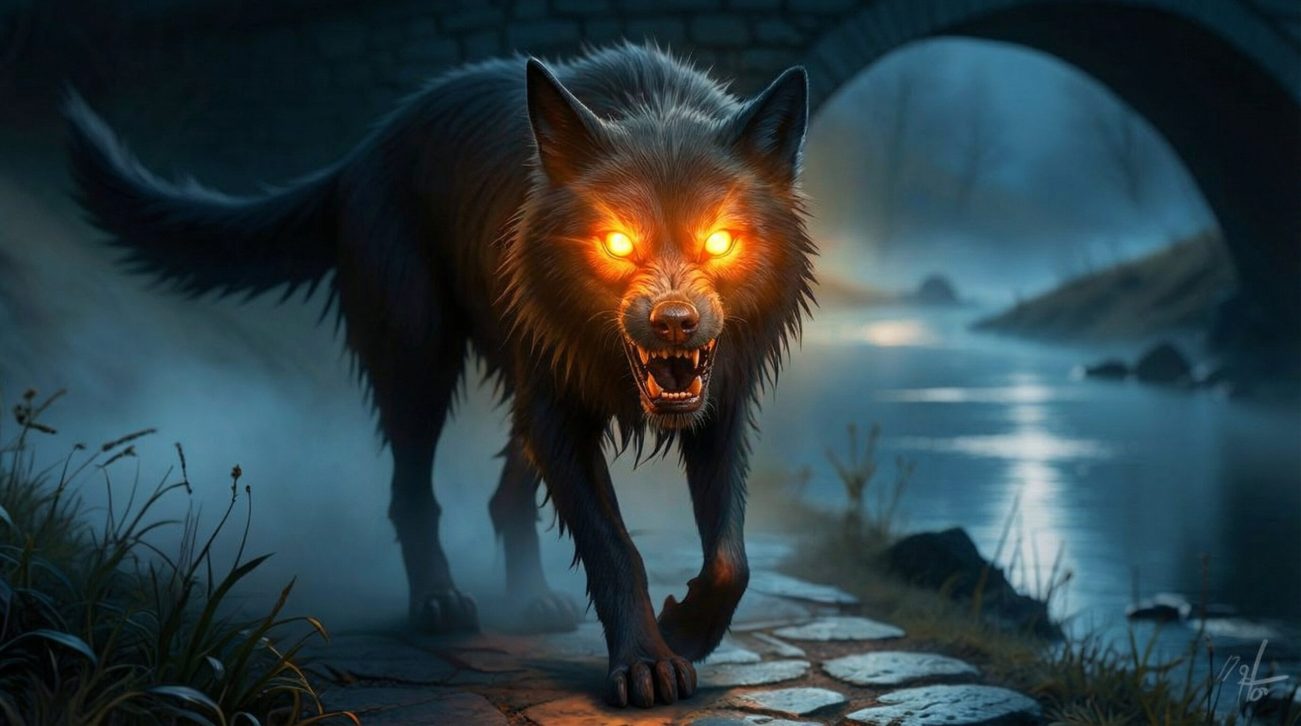
In Russian folklore, Endar is a scarcely described mythical being known primarily for its unusual way of sustaining itself. According to legends recorded in the Vyatka Province, the Endar lives beneath an old oak tree and feeds not on food or flesh, but on air itself.
Marina Vlasova, in her Encyclopedia of Russian Superstitions, notes that little else is known about this creature. Its form is not clearly described, and no detailed accounts of its behavior survive. The Endar remains largely undefined, existing more as a name and a location than as a fully formed figure.
Later retellings, particularly in modern sources, add that the Endar is said to be roughly the size of a boar. Beyond this single detail, however, its appearance remains uncertain.
The Endar thus occupies a quiet place in folklore: a being tied to a specific landscape, sustained by invisible means, and remembered more for its mystery than for any deeds or encounters.
In Slavic folklore, Bomka is a vague and unnamed terror used by adults to frighten disobedient children. It belongs to the broad class of bogeymen—creatures invoked in warnings rather than described in stories.
Parents would threaten naughty children with words such as: “I’ll put you in the golbets, and the Bomka will snatch you from there.” The golbets, a dark storage space beneath the house or stove, was imagined as a place where Bomka could reach its victims.
Bomka has no fixed appearance. No specific shape, size, or features are known. It exists more as an idea than a creature—an unseen presence associated with darkness, hiding places, and punishment for misbehavior.
The power of Bomka lies not in what it is, but in what it represents: an unknown danger waiting in the dark, ready to take children who do not listen.
Gallery
Sources
Bestiary.us contributors. (n.d.). Bomka. In Bestiary.us, from https://www.bestiary.us/Bomka/
In Mordvin and Chuvash folklore, kuygorozh are mythical beings that bring wealth, goods, and prosperity to a household. They serve their owner by secretly delivering grain, money, livestock benefits, and other valuables—often by stealing these things from neighboring households. Because of this, families believed to possess a kuygorozh were often regarded with suspicion and hostility by others in the community.
A kuygorozh is not always acquired by chance. According to Moksha tradition, one way to obtain such a being is through a long and deliberate process. A rooster must be kept for seven years, after which it will lay two small eggs. These eggs are then incubated by the owner—an old man or woman—by keeping them under the arm for three, five, six, or seven weeks, depending on the account. From these eggs hatch kuigorysh, small spirits of enrichment and theft.
Kuigorysh are described as small, cat-sized beings that move unseen. Though invisible to most people, they are physical and active. They walk about stealing grain from other barns and carrying it back to their master. Their cheeks contain natural pouches that expand when filled, each capable of holding a considerable amount of grain or goods. When empty, they are barely noticeable; when full, their cheeks swell like bladders.
Other traditions describe different origins. A kuigorysh may hatch from the egg of a red rooster, the first egg of spring, an owl’s egg stolen from the forest, or the egg of a black hen—producing a black, invisible spirit. In some villages, kuigorozhi are not hatched from eggs at all but are invited. In such cases, the owner must go to a cemetery on the first dark night of spring and call out to the spirits. Small humanoid beings then rise from the ground, surrounding the petitioner and pleading in thin voices to be taken. The chosen ones follow the person home, while the others cry as they fade away.
These cemetery-invited kuigorozhi are often understood as ancestral spirits who continue to help their descendants. They must be fed and treated with care, just as ancestors once were. Kuigorozhi are tireless workers: they demand constant tasks and cannot remain idle. In a single night, they are said to be capable of building houses, barns, plowing and sowing fields, harvesting crops, caring for livestock, and preparing enormous quantities of food.
Although generally helpful, kuigorozhi are demanding. If neglected, treated harshly, or left without work, they may become destructive—spoiling food, mixing grain with manure, scattering sand into meals, or stealing excessively and bringing ruin upon their owner. Driving them away is difficult. One method involves assigning them an impossible task, such as weaving a rope from sand or scooping water from a swamp. If this succeeds, the kuigorozh departs, taking all wealth it brought with it.
It was widely believed that households keeping kuigorozhi could be identified by signs of disorder or by ritual tests. One such belief held that kuigorozhi always consumed festive porridge beneath the crust, leaving the surface intact. Priests were sometimes said to press the crust during visits; if the hand sank in, the household was suspected of keeping such spirits.
Kuigorozhi were believed to have individual personalities—some mischievous, some obedient, some bold, others timid—and even individual physical traits. Legends tell of people attempting to acquire new kuigorozhi only to find that the same ones returned, recognizable by defects such as a missing eye or a limp.
Over time, many Mordvins came to regard kuigorozhi as fairy-tale beings rather than literal spirits. Still, until the twentieth century, widespread belief held that unexplained wealth was often the work of such helpers. Similar figures appear in neighboring traditions under different names, but the kuygorozh remains one of the most detailed and persistent images of a spirit that brings prosperity—at a cost.
According to the tales of Mordvin peasants from the Saratov province, Buka is a strange and unsettling class of werewolf. Unlike creatures that take animal or human form, Buka appears at night in the shape of a haystack, blending almost perfectly into the rural landscape.
Buka is said to roam mainly after dark. It chases passers-by, pursuing them through fields and paths while emitting frightening sounds—described as tones resembling the growl of a harsh electric train. These unnatural noises announce its presence before it is fully perceived, filling those who hear them with sudden fear.
The creature is particularly associated with areas around churches, where it is said to circle repeatedly, lingering within the sacred boundary as if bound to it. Those who encounter Buka rarely attempt to confront it, for it is known to behave unpredictably.
If pursued or nearly caught by people, Buka does not fight back. Instead, it suddenly falls straight into the ground, disappearing entirely—“into Tartarus,” as the tales say—leaving no trace behind. After this, it is as if it never existed at all.
Buka remains a night-bound presence in Mordvin belief: a moving shape where none should move, a sound where silence belongs, and a reminder that even the most ordinary objects—like a haystack—can conceal something unnatural once darkness falls.
In Mordvin folklore, Bobo is a short, furry creature used by mothers and grandmothers to frighten naughty children. When children misbehaved, cried too much, or refused to go to bed, elders would warn them: “Here comes Bobo from the forest! He’ll put naughty children in a sack and carry them away!”
Through these warnings, children imagined Bobo as something small but unsettling—furry, sometimes pictured with a bird-like leg, carrying an old sack. He was meant to be frightening, but never truly terrifying. The children always knew, deep down, that their mothers and grandmothers loved them and that Bobo would not really take them away.
Bobo is said to wear a black fur coat and carry a large sack, though he never actually uses it. He lives either in the forest or in vegetable gardens near homes. Late in the evening, he comes out onto the street, peers into windows, and waits. If he hears children whining, crying, or refusing to climb onto the stove or go to sleep, he begins to make noise—rustling, stomping with his furry paw, and muttering ominously, “Bo-bo-bo!”
His role is limited to scaring children into obedience. He does not kidnap anyone. Once the children quiet down and fall asleep, Bobo returns home. There, he chooses the warmest spot to sleep, and while resting, he is said to suck his paw.
Functionally, Bobo is closely related to the Slavic Babai, serving as a familiar and half-playful figure of discipline rather than a true monster. He exists at the boundary between fear and reassurance—scary enough to enforce bedtime, but gentle enough to remain part of childhood imagination rather than nightmare.
Bzionek is a guardian spirit known in Silesian superstition, believed to protect villages from evil spells and misfortune. It was imagined in the form of a small man who lived beneath or within elder bushes, especially the black elder growing close to human dwellings. From this association, the spirit took its name.
Because the bzionek was thought to dwell in elder bushes, these plants were treated with great reverence. Cutting them down, digging them up, or burning elder wood in an oven was strictly forbidden, as such acts might offend the spirit and bring harm upon the household or village.
Certain customs were connected to the elder bush and the bzionek. After washing the body of a deceased person, people would pour the used water beneath the elder bush to avert misfortune. In moments of desperation, when a baby was gravely ill, the child might be brought beneath the bush so that the bzionek could drive away the sickness.
The bzionek was not feared as a malicious being, but respected as a quiet protector whose presence demanded careful behavior. Through the elder bush, it stood as a silent guardian between the human world and unseen dangers.
Baga is one of the frightening figures used in children’s horror stories in the Russian countryside. Like many such beings, it belongs to the group of bogeymen invoked to scare children into obedience.
In the folk beliefs of the Nizhny Novgorod province, Baga is described as hunchbacked, a detail that sets it apart from other similar scare-figures such as the bogeyman or vova. Beyond this, little is said about its appearance or actions.
Baga does not appear in long legends or heroic tales. Its role is practical and immediate: a threat spoken aloud to warn children away from misbehavior or dangerous places. The creature’s power lies in fear itself, not in deeds or stories.
Like many rural bogeymen, Baga exists more as a warning than a character—an unseen presence shaped by imagination, meant to keep children cautious and obedient.
Among the Belarusian Budak people living in the Nizhny Novgorod region, Babar was a creature known primarily as a figure of fear used to discipline children.
Babar was not part of heroic tales or elaborate legends. Instead, it existed in everyday speech and warning. Parents and elders invoked Babar’s name to frighten children into obedience, especially when they misbehaved or refused to listen.
No detailed appearance or specific actions are recorded. Babar functioned as an unseen presence, defined by fear rather than form. Its power lay in suggestion—the idea that something dangerous was watching or waiting.
Through Babar, children learned where they should not go and how they should behave. The creature remained vague and undefined, which made it more effective, as imagination filled in what stories did not describe.
In Polish and Silesian folklore, the bebok is a supernatural being associated with darkness and fear. It belongs to the family of bogeymen—creatures invoked to warn, threaten, and discipline, rather than to be seen directly.
In Upper Silesia in particular, the bebok is the most familiar and widely used bogeyman. Parents invoke its name to frighten disobedient or unruly children, warning that the bebok will come for those who misbehave or wander where they should not.
According to legend, beboks dwell in places avoided by people: forests thick with shadow, swamps and marshy ground, dark basements, cellars, and similar hidden or neglected spaces. These are places where light fades and sound carries strangely, and where the presence of the bebok is felt rather than seen.
The bebok is not described in detail, for its power lies in suggestion. It exists as a warning embodied—a lurking threat tied to darkness itself. Through fear of the bebok, children are taught caution, obedience, and respect for the boundaries between safety and danger.
Among the Tingyan people of northwestern Luzon, the Alans are known as wild, winged female spirits who belong to a lower order of supernatural beings. They dwell deep within forests, and at times near rivers, in places seldom visited by humans.
In appearance, the Alans resemble women, but their features are disturbing. Their faces are said to be rough and deeply wrinkled, resembling the hide of a carabao buffalo. They possess wings and are able to fly. Their fingers are inverted, and their toes point backward, emerging from their heels rather than their feet, making them frightening to behold.
The Alans are believed to live in houses much like those of humans, though far more splendid and richly furnished. These dwellings are hidden within the dark forest. At night or when unseen, the Alans are said to hang upside down from tree branches, like bats.
Despite their terrifying appearance, the Alans are credited with a nurturing role. It is believed that when they find drops of menstrual blood, a placenta, or the remains of a miscarriage, they are able to raise a child from it. These children are raised secretly, without the knowledge of their human parents. Once grown, the Alans assist the children throughout their lives, offering help and protection.
Thus, the Alans are remembered not only as fearsome forest spirits, but also as mysterious foster mothers, moving between danger and care, concealment and guardianship.