Utumu

Tradition: Papua New Guinean Mythology
Alternative Names: Utumu
Category: Flame


The Myth

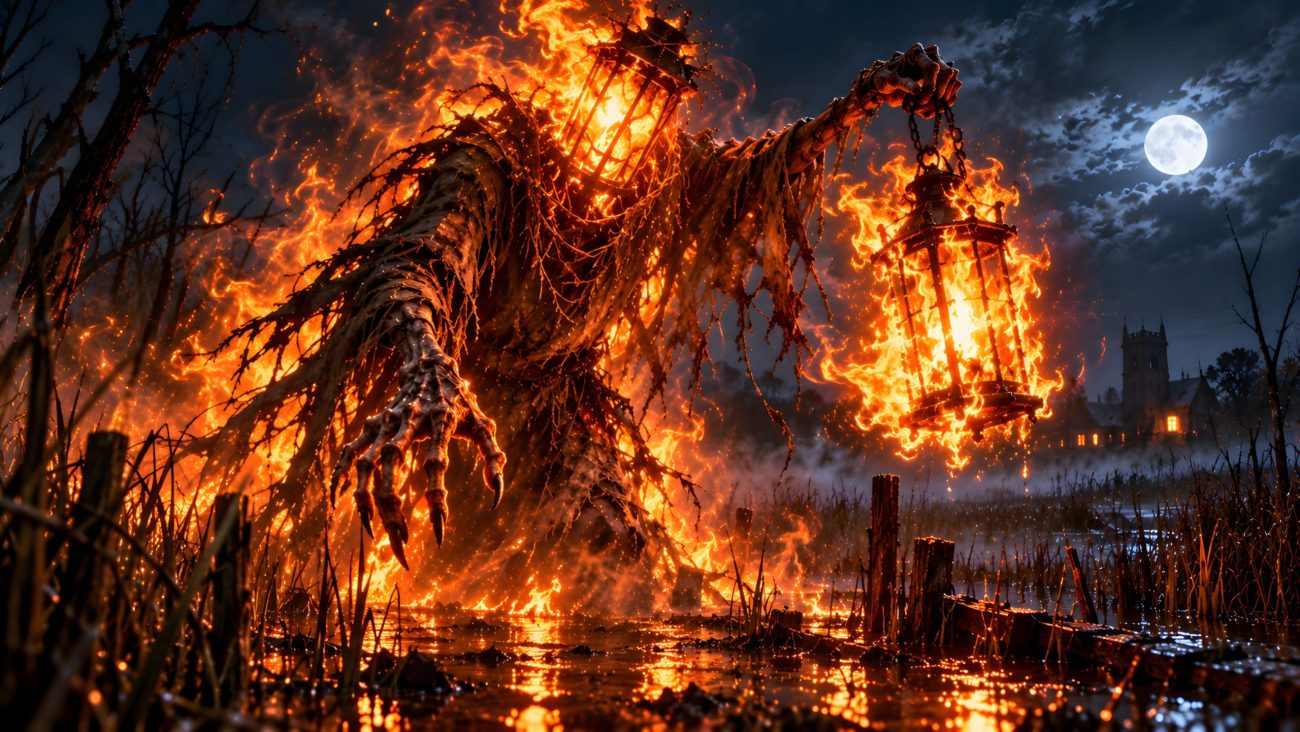
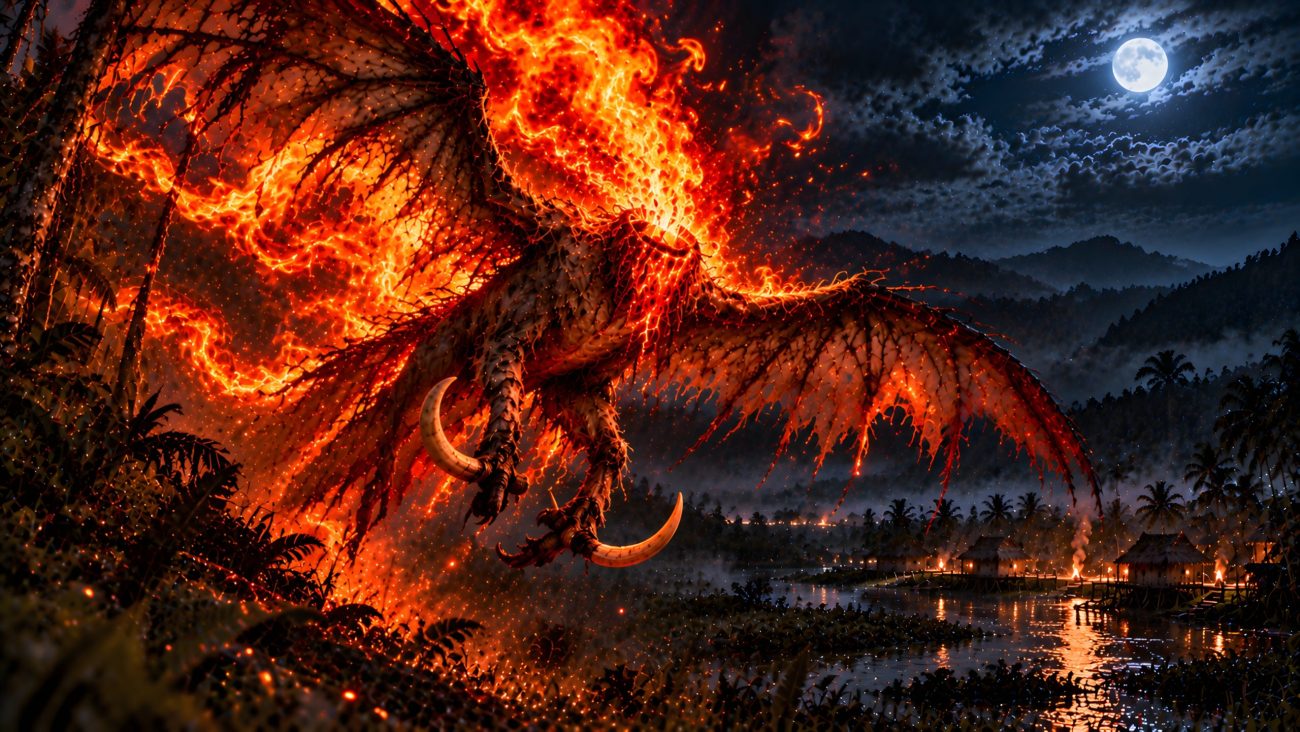
The Utumu is a highly malignant spirit from Papua New Guinean mythology, said to arise from a person whose head has been cut off. The blood spurting from the wound in its neck shines through the darkness like fire, creating a deceptive light that can be mistaken for an ordinary flame. Many people have reportedly walked toward this strange glow, only to fall into the clutches of the monster. The Utumu frequently haunts the place where it was beheaded, although it can also fly through the air like a bird.

The spirit does not emit light continuously. When its fiery glow appears, it is generally regarded as an omen of a coming fight. When the light is absent, the Utumu becomes invisible, though its foul smell can betray its presence. A hollow roar, resembling the beating of a drum, issues from its open throat. The creature has no permanent home and wanders constantly through the landscape, devouring people with its dangerous tusks.

The Utumu attacks by catching its victims around the ankles with its tusks and knocking them to the ground. Such attacks can even occur in water, making the spirit especially dangerous to those travelling alone. Sleeping alone in a house or out in the bush is considered perilous because of the threat it poses. Those forced to sleep alone in the wilderness sometimes protect themselves by lying between two fires or burning a Jurivare plant, whose smell is believed to drive the spirits away.

Ordinary arrows cannot strike an Utumu, but people may frighten it by rattling their bundles of arrows, pretending to shoot, or threatening it aloud. Groups of men sometimes fire arrows randomly into the surrounding bush in an attempt to drive the spirit away, although a lone person would be too afraid to do so. Another method involves speaking a special formula to a stick and then planting it in the ground to keep the Utumu at bay. Despite these protective practices, the spirit remains a feared and dangerous presence, its burning blood serving as a deceptive beacon for those unfortunate enough to encounter it.


Sources

Landtman, Gunnar. The Kiwai Papuans of British New Guinea: A Nature-Born Instance of Rousseau’s Ideal Community. New York: Johnson Reprint Corp., 1970. https://archive.org/details/kiwaipapuansofbr0000land
La Bolefuego

Tradition: Colombian Mythology, Venezuelan Mythology
Alternative Names: La Candileja, Bolefuego
Category: Flame


The Myth

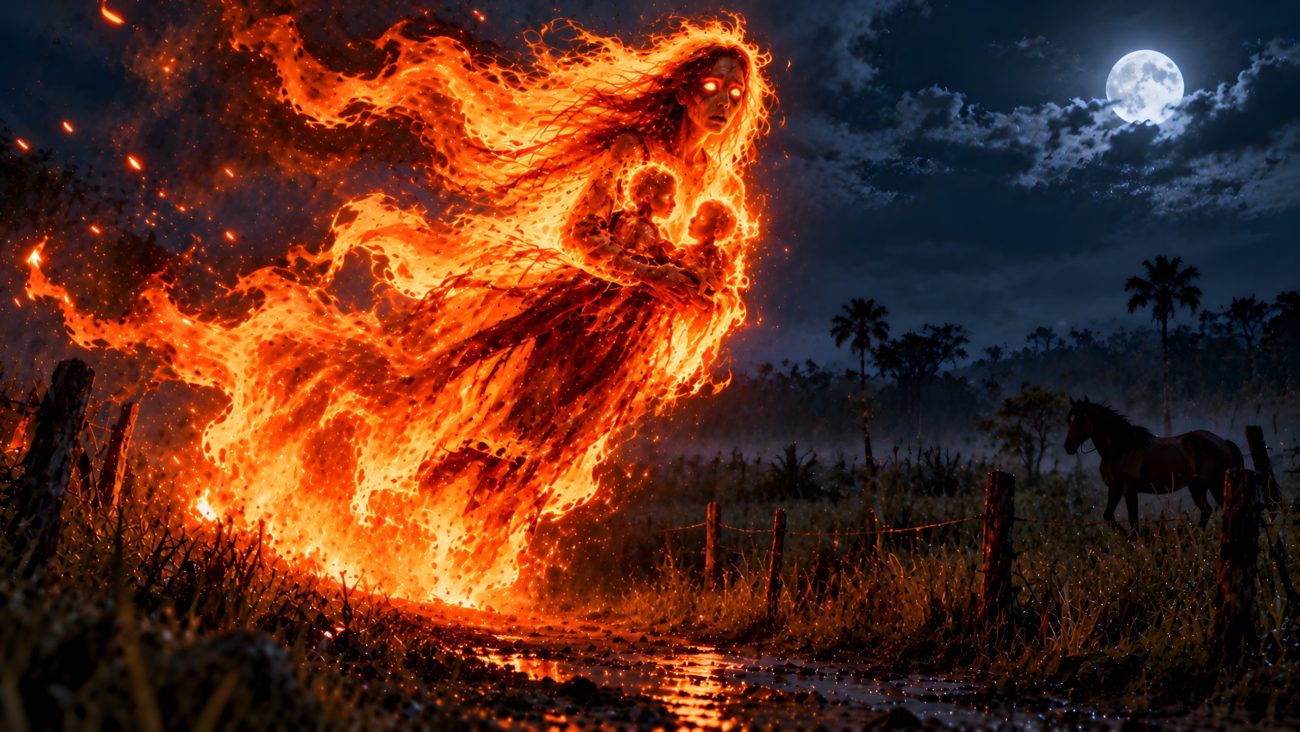
La Bolefuego, also known as La Candileja, is a terrifying supernatural apparition from the folklore of Colombia and Venezuela. It appears on dark nights across the vast plains of Los Llanos as a brilliant, flashing light resembling a lantern. Its fiery glow twists and shakes violently, moving unpredictably through the darkness as it approaches unsuspecting travellers.

According to legend, La Bolefuego is the tormented spirit of a woman who was burned alive in her own home alongside her two children. After her death, she returned as a blazing apparition, haunting the night and attacking travellers who cross her path. Her flickering light is a warning of the danger she brings, as those who encounter her may find themselves pursued by the vengeful spirit.

Unlike many other evil supernatural beings, La Bolefuego is said to be attracted to prayer. Those who face her are warned not to pray, as doing so may draw the fiery apparition closer rather than drive it away. This unusual trait makes her especially frightening, turning an act normally associated with divine protection into something that can invite danger.


Sources

“La Bolefuego.” Wikipedia: The Free Encyclopedia. Wikimedia Foundation. Accessed October 11, 2026. https://en.wikipedia.org/wiki/La_Bolefuego


Canwyll Corph

Tradition: Welsh Mythology
Alternative Names: Corpse Candle, Candle of the Dead
Category: Flame


The Myth

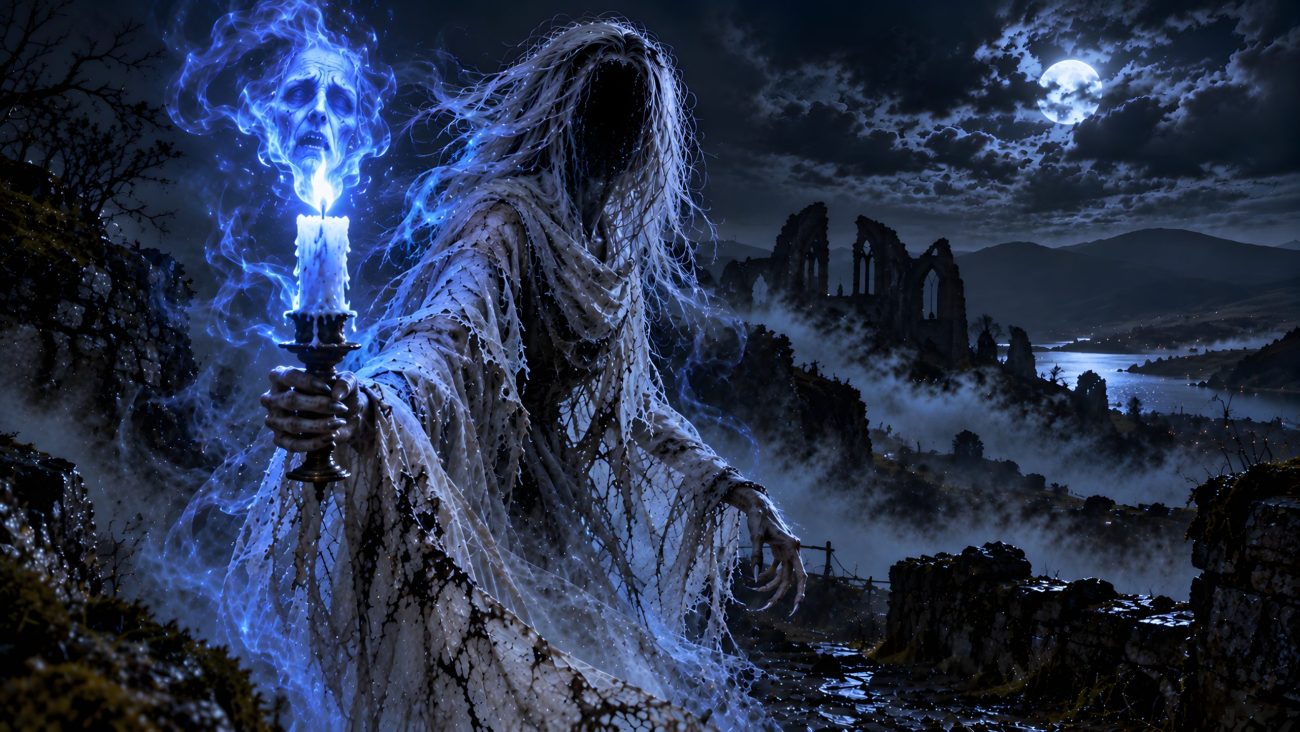
The Canwyll Corph, meaning “Corpse Candle,” is a supernatural light from Welsh folklore and one of the most feared omens of death. It appears as a ghastly blue flame burning like a candle, sometimes floating through the darkness without anyone carrying it. In other accounts, it takes the form of an ordinary tallow candle held by a ghost. When the ghost can be seen clearly, it is believed to resemble a living person whose death is approaching, revealing a spectral double of someone destined to die soon.

The Corpse Candle may also appear as a light emerging directly from a person’s mouth or nostrils. Its size is believed to reveal the age of the person whose death it foretells: a large flame signifies an adult, a smaller one a child, and a still tinier light an infant. When two candles appear together, one large and one small, they are said to predict the deaths of a mother and her child. The colour of the flame is also significant: a white light foretells the death of a woman, while a red flame signals the death of a man.

The Canwyll Corph is invariably regarded as a warning that death is near. Its appearance may be that of a solitary, wandering flame or a ghostly figure carrying a candle, but its message remains the same: someone living is believed to be approaching the end of their life. In Welsh tradition, the candle becomes a spectral sign of fate, illuminating the boundary between the living and the dead.


Sources

Sikes, Wirt. British Goblins: Welsh Folk-Lore, Fairy Mythology, Legends and Traditions. London: Sampson Low, Marston, Searle, & Rivington, 1880.


Aleya

Tradition: Bengali Mythology
Alternative Names: আলেয়া, Marsh Lights, Ghost Lights
Category: Flame


The Myth

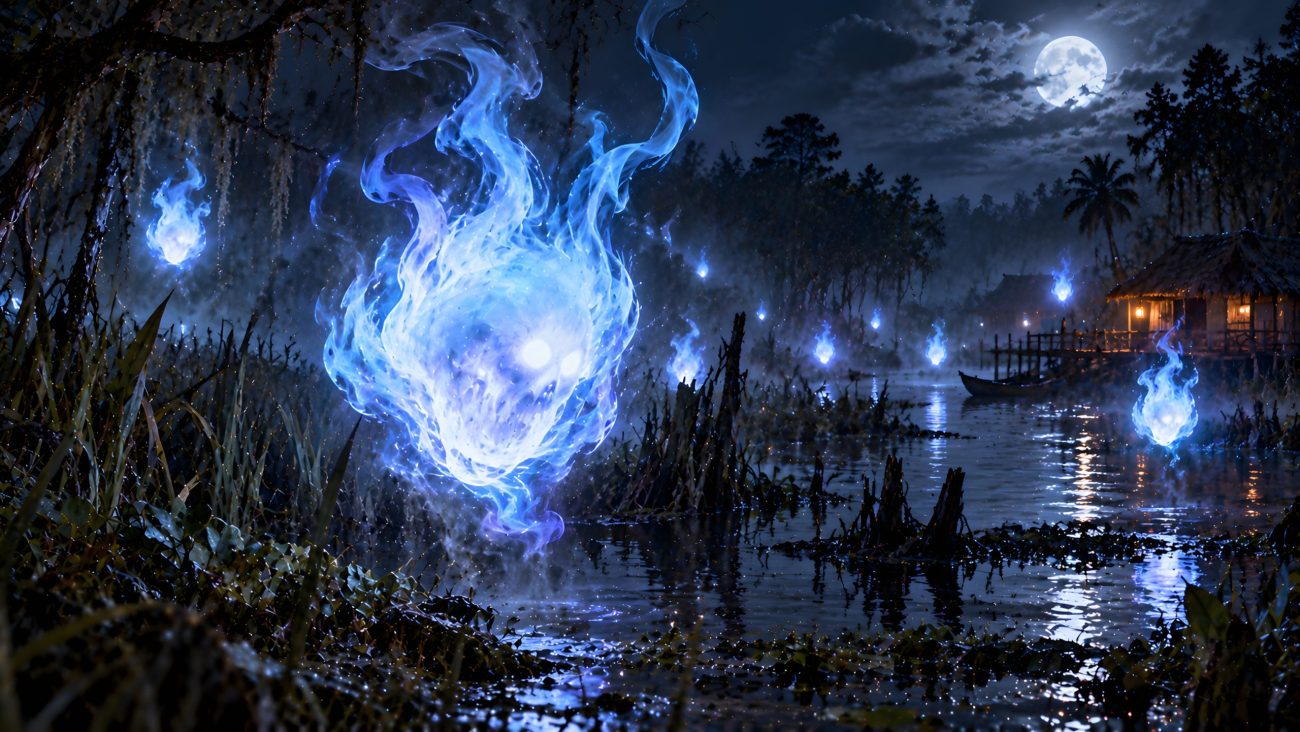
The Aleya is a mysterious supernatural light associated with the marshes and wetlands of Bengal and Bangladesh. It appears at night as a glowing orb of fire that floats above the ground or hovers over the water. These eerie lights are especially feared by fishermen, who believe they are the ghosts of fishermen who died while working on the water. Their flickering glow can appear inviting in the darkness, but those who follow them risk being led away from safety.

According to local folklore, the Aleya deliberately lures fishermen toward the water, confusing them with its strange movements until they lose their way and drown. Like the Nishi, another supernatural being known for drawing people into danger with an irresistible call, the Aleya is sometimes said to possess a voice that its victims cannot resist. Its appearance is therefore regarded as a warning of danger in the marshes, where the spirits of the drowned are believed to continue their haunting.

Fishermen of the Sundarbans delta, particularly members of the Khasti and Manna fishing communities, traditionally take these lights seriously. Before setting out to fish, they perform a ritual known as Atoshi-taron for protection against the dangers associated with the Aleya. The ghost light remains a frightening presence in regional folklore, representing the restless dead and the perilous boundary between the living world and the waters where lost souls are said to wander.


Sources

“Ghosts in Bengali culture.” Wikipedia: The Free Encyclopedia. Wikimedia Foundation. Accessed October 11, 2026. https://en.wikipedia.org/wiki/Ghosts_in_Bengali_culture


Lantern Man

Tradition: English Mythology
Alternative Names: Lantern Man
Category: Flame


The Myth

The Lantern Man is a terrifying supernatural light from the folklore of the Fens in East Anglia, England, particularly associated with Wicken Fen and the surrounding wetlands. It appears at night as a mysterious light that lures travellers away from safe paths and into the dangerous reed beds. According to local stories, these lights are evil spirits that deliberately lead their victims toward their deaths in the marshes. Their deceptive glow resembles that of a lantern carried by someone walking through the darkness, tempting people to follow where they should not.

The Lantern Man is said to be attracted by whistling. Folklorist L. F. Newman recorded accounts describing how people who whistled in the fens risked attracting the spirit’s attention. One local fisherman reportedly escaped by throwing himself face down onto the ground when a Lantern Man approached him after hearing his whistle. Traditional advice for evading the creature was to lie flat with one’s mouth pressed into the mud, making oneself less noticeable to the pursuing spirit.

Another tale describes a man who attracted a Lantern Man while whistling to his dog during a walk across the fen. He sought refuge at a friend’s house, where his companion hung a horn from a long pole to distract the spirit. By the following morning, the horn had been burned away. These accounts portray the Lantern Man as a dangerous presence that could pursue those who attracted its attention, even when they attempted to find shelter.


Sources

“Lantern man.” Wikipedia: The Free Encyclopedia. Wikimedia Foundation. Accessed October 11, 2026. https://en.wikipedia.org/wiki/Lantern_man


Herwisch

Tradition: Swiss Mythology, German Mythology
Alternative Names: Herwisch
Category: Flame


The Myth

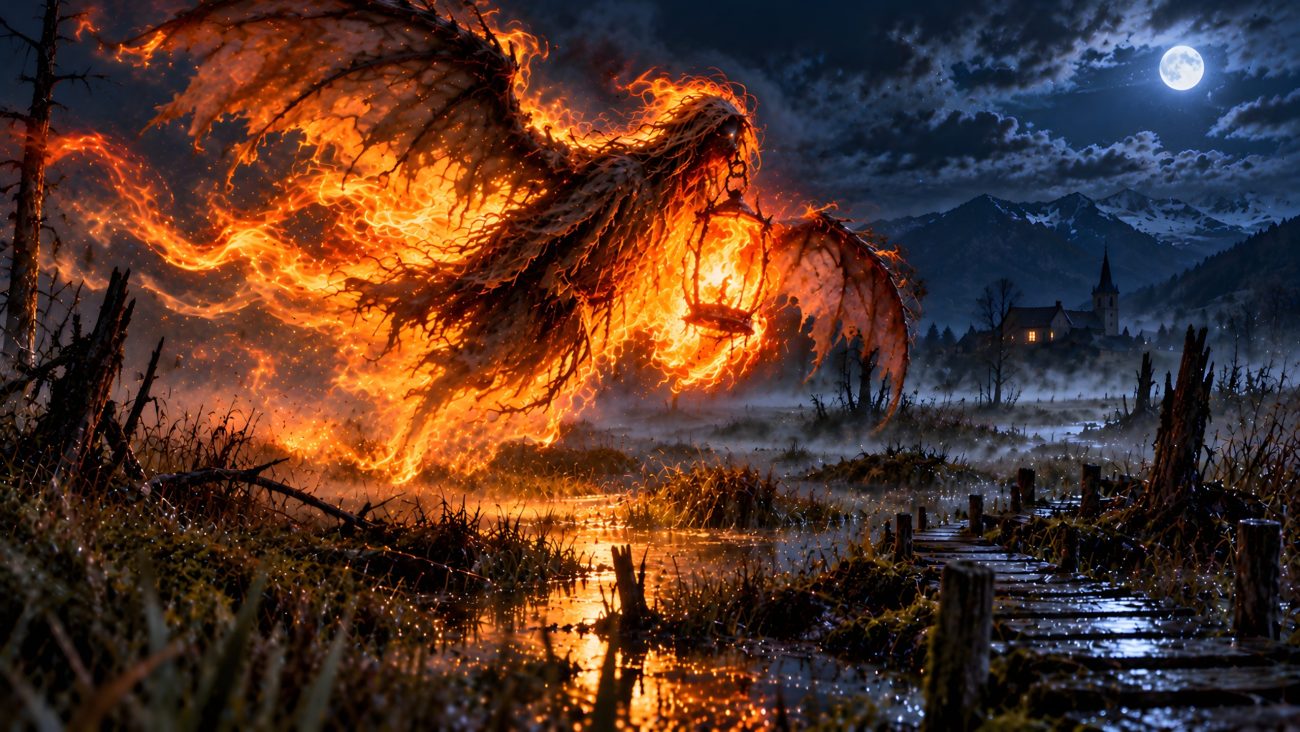
The Herwisch is a mysterious supernatural being resembling a will-o’-the-wisp, known in the folklore of Switzerland and Germany. It inhabits marshes and other waterlogged landscapes, emerging at night with a lantern-like light. By illuminating the darkness, the Herwisch lures unsuspecting travellers away from safe paths and into treacherous waters, where they may stumble, become trapped, or struggle helplessly in the marsh.

The Herwisch is not always content merely to mislead travellers. Those who mock or anger it risk provoking its more frightening nature. In such cases, the creature chases its offender and flaps its wings directly into their face, terrifying them with its sudden pursuit. Its combination of deceptive lights and aggressive behaviour makes the Herwisch a dangerous presence in the darkness, particularly for people crossing isolated wetlands at night.


Sources

“Swiss folklore.” Wikipedia: The Free Encyclopedia. Wikimedia Foundation. Accessed October 11, 2026. https://en.wikipedia.org/wiki/Swiss_folklore


Katawaguruma

Tradition: Japanese Mythology
Alternative Names: 片輪車, かたわぐるま, One-Wheeled Cart
Category: Flame


The Myth

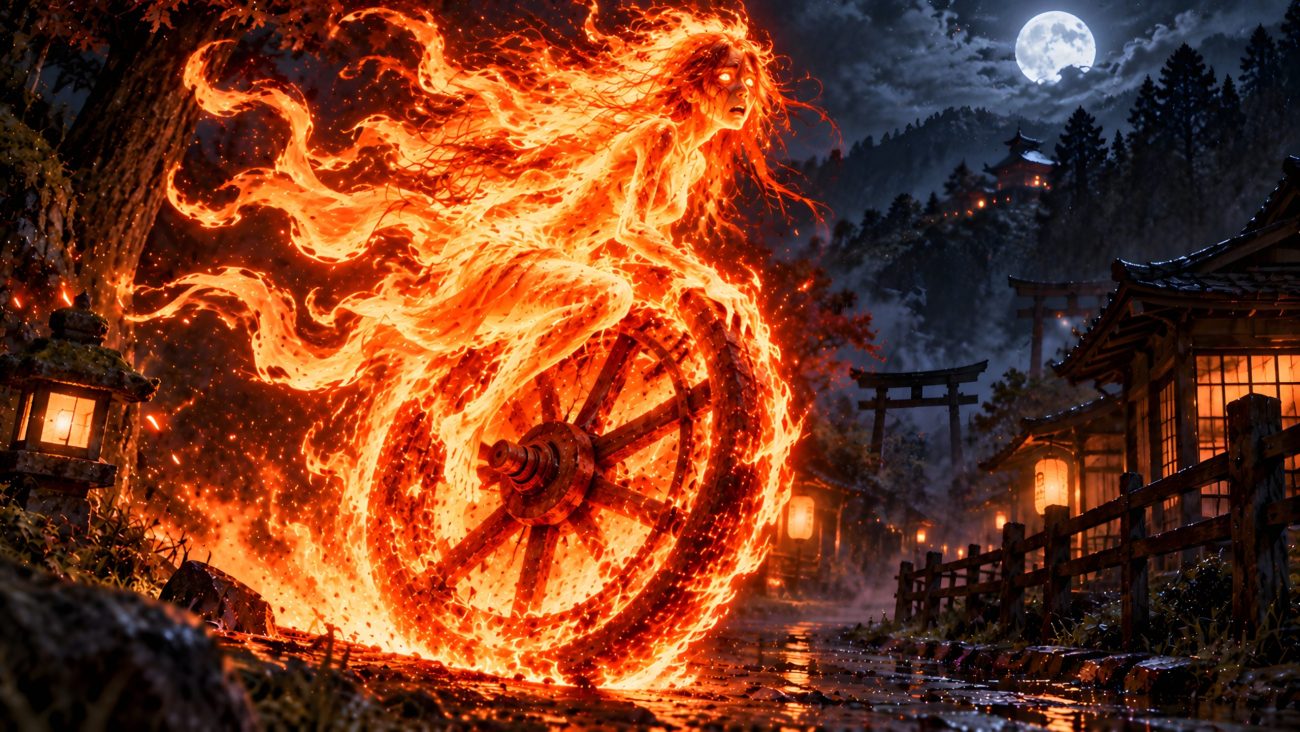
The Katawaguruma, meaning “crippled wheel,” is a terrifying supernatural being from Japanese mythology. It appears as a tormented, naked woman riding upon a single enormous wheel engulfed in flames. Unlike the Wanyūdō, which is commonly depicted with a monk’s head attached to a burning wheel, the Katawaguruma retains the appearance of a suffering woman, condemned to burn eternally. It is associated with hell and is said to travel along roads and mountain passes, sometimes entering villages in search of impure souls to drag back to its infernal masters.

The Katawaguruma is feared because merely seeing it can bring powerful curses. As stories about the demon spread through gossip and rumours, its curse is believed to travel with them, eventually bringing calamity upon an entire community. Yet, despite its terrifying appearance and destructive powers, the Katawaguruma is also said to possess a capacity for mercy.

A seventeenth-century legend from what is now Shiga Prefecture tells of the demon attacking a village and abducting the child of a woman who watched it through a crack in her door. The Katawaguruma rebuked her, declaring that she should have been watching her child instead of staring at the supernatural visitor. Overcome with guilt, the woman composed a poem acknowledging her fault and displayed it throughout the village as a warning to others to watch their children carefully. When the Katawaguruma returned the following night, it recognised the woman’s sincere remorse and returned the child unharmed. After this act of mercy, the demon was never seen in the village again.


Sources

“Katawaguruma.” Yokai.com: The Database of Japanese Folklore. https://yokai.com/katawaguruma/


Ubagabi

Tradition: Japanese Mythology
Alternative Names: 姥ヶ火, 姥火, Old Woman’s Fire
Category: Flame


The Myth

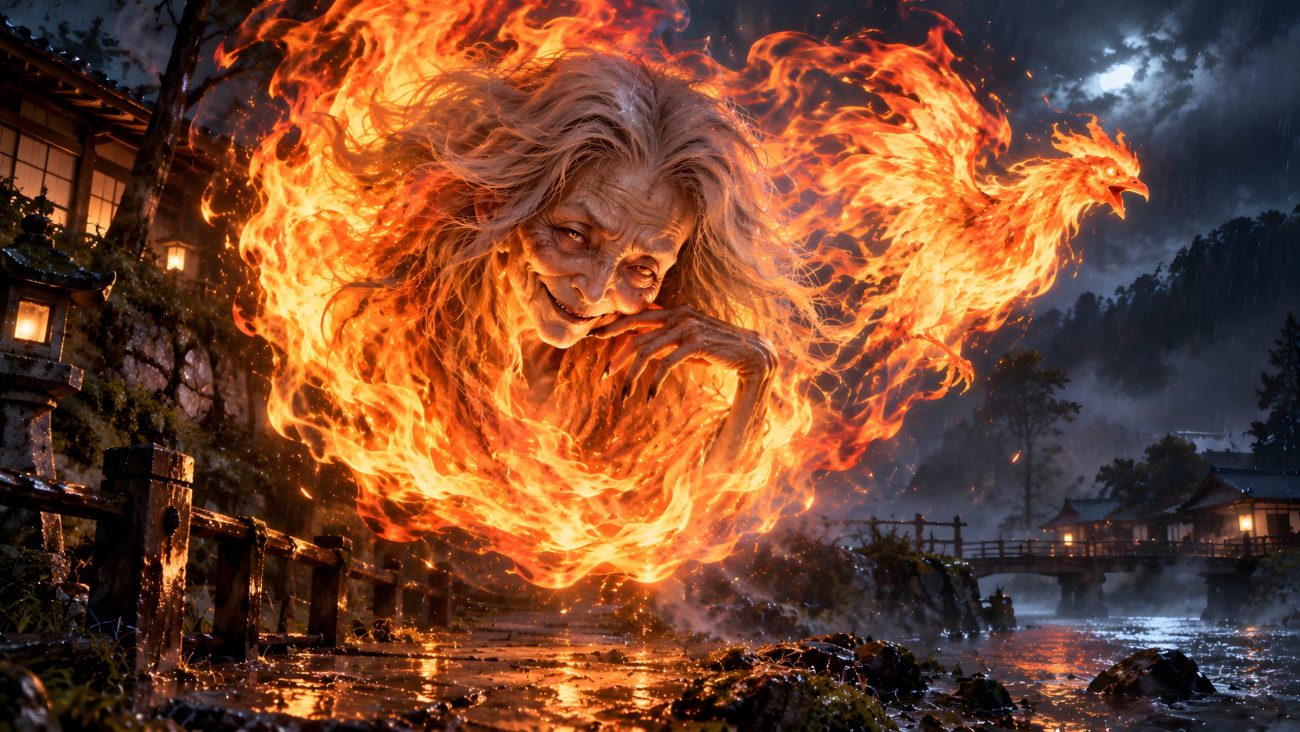
The Ubagabi, meaning “Old Woman’s Fire,” is a mysterious ghost light from Japanese mythology, associated with Kawachi Province, now part of Osaka Prefecture, and Tanba Province, in northern Kyoto Prefecture. It typically appears on rainy nights as a glowing ball of fire approximately thirty centimetres in diameter. In some accounts, the flame can suddenly rush toward a traveller and strike them in the face before transforming into a strange, chicken-like bird. When the creature flies away, it returns to its original form as a ball of fire.

One legend from Kawachi tells of an old woman who stole oil from Hiraoka Shrine. As punishment for her theft, she was transformed into the Ubagabi, condemned to wander as a supernatural flame. According to another account, recorded in Ihara Saikaku’s collection of tales, the fire could travel approximately four kilometres in an instant. Anyone whose shoulder it brushed was said to die within three years. However, the Ubagabi could supposedly be made to disappear by calling out the words “abura-sashi,” meaning “oil pourer,” a reference to the theft that caused its transformation.

Another legend, associated with the Hozu River near Kameoka in Kyoto Prefecture, tells of an old woman who accepted money from parents on the promise that she would take them to people they wished to visit. Instead, she threw their children into the river. Eventually, a flood drowned the woman, which was interpreted as divine punishment for her crimes. After her death, a mysterious flame began appearing near the river, and people came to know it as the Ubagabi.

The Ubagabi also appears in Toriyama Sekien’s illustrated collection Gazu Hyakki Yagyō, where its supernatural flames contain the face of an old woman. The accompanying description associates the creature with Kawachi Province. Across these different accounts, the Ubagabi is linked to wrongdoing and punishment, its ghostly fire serving as the lingering manifestation of an old woman’s crimes.


Sources

“Ubagabi.” Wikipedia: The Free Encyclopedia. Wikimedia Foundation. Accessed October 11, 2026. https://en.wikipedia.org/wiki/Ubagabi


Will-o’-the-Wisp

Tradition: Scottish Mythology
Alternative Names: Teine Biorach, Jack-o’-Lantern
Category: Flame


The Myth

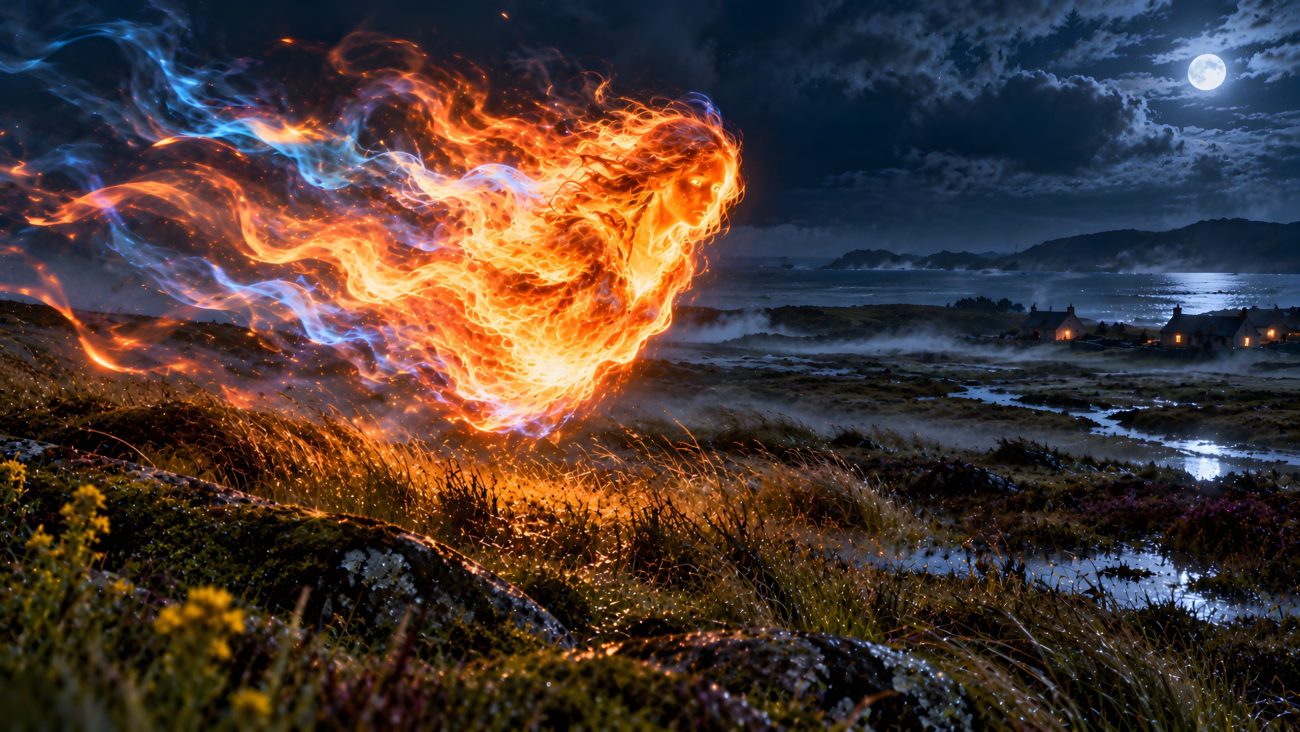
In the Hebrides of Scotland, the Will-o’-the-Wisp, known in Gaelic as Teine Biorach, meaning “sharp fire,” is described as a haunting supernatural light. On South Uist, local tradition claims that it first appeared in 1812 and represents the restless spirit of a young girl from Benbecula. During her life, the girl wandered across the machair, the sandy plain beside the sea, searching for Galium verum, a plant used to dye local cloth and tweed. Her wrongdoing was seeking an unfair share of a resource that was supposed to be divided equally for the common good. The plant was particularly important because it helped bind the sandy soil together on land reclaimed from the sea. After her death, her spirit supposedly returned as a wandering flame, condemned to haunt the landscape because she had placed personal gain above the needs of her community.

Another tale explains the origin of the Jack-o’-Lantern through the fate of a blacksmith whose soul was rejected even by hell. Left without a place to go, the freezing blacksmith begged for a single ember to warm himself. Eventually, someone granted his request, and he has wandered ever since, shivering through the darkness while carrying the tiny flame. Unlike the story of the girl from Benbecula, this legend presents the wandering light as the remnant of a condemned soul seeking warmth.

These stories reflect the distinctive beliefs of the Hebrides, where the cold, damp climate shaped local ideas about the afterlife. The blacksmith’s desperate search for warmth contrasts with the common Hebridean tradition of a cold hell, a belief particularly familiar in South Uist, where mist, rain, and sweeping winds dominate the landscape. In this tradition, even the fires of the underworld might seem comforting compared with the bitter cold of the living world. Hell was consequently described as “the place of the wind of the cold passages” or “the wind of the cold channels,” making the wandering flame a striking image of a soul condemned to endure the cold without relief.


Sources

D. L. Ashliman. “Will-o’-the-Wisp: Ignis Fatuus—Legends about Fiery Fairies.” Folktexts: A Library of Folktales, Folklore, Fairy Tales, and Mythology. Revised February 22, 2021. https://sites.pitt.edu/~dash/willowisp.html#goodrich


Burning Treasures

Tradition / Region: Czech Mythology
Alternate Names: —
Category: Flame


The Myth

Burning Treasures are mysterious flames associated with hidden money and tormented souls.

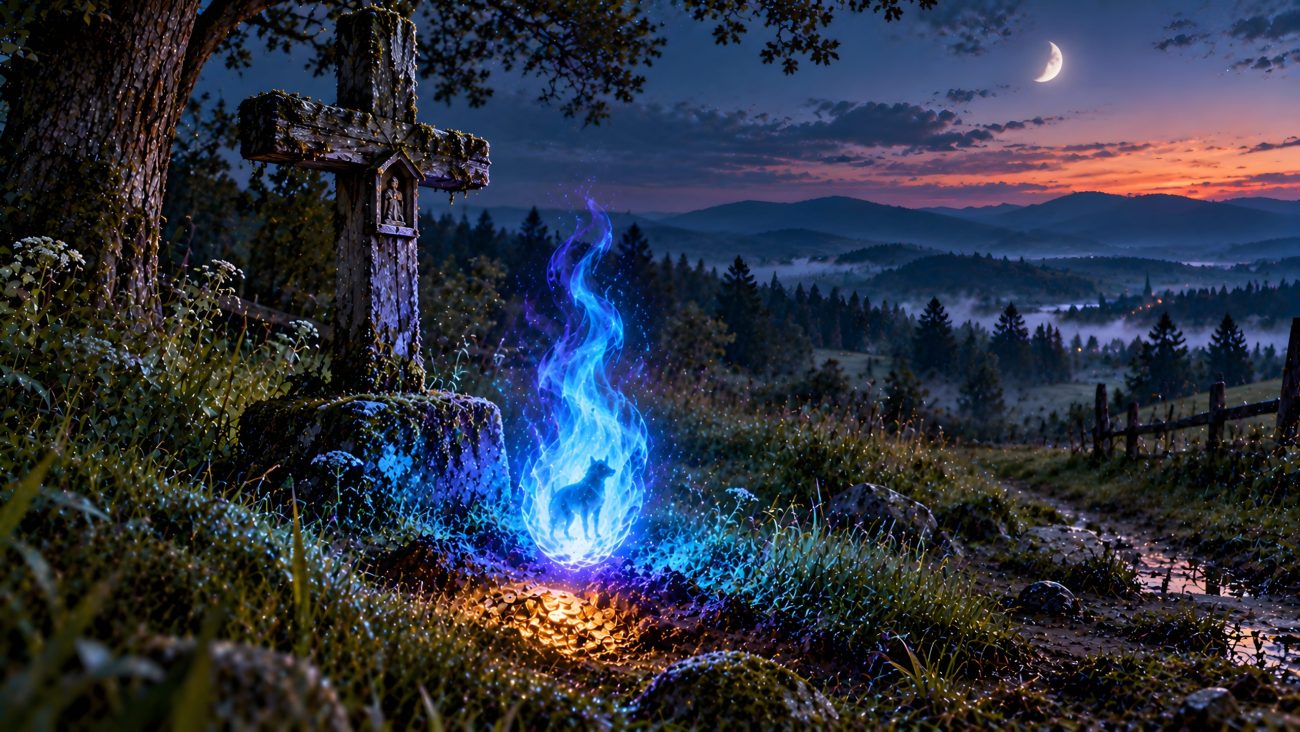
The shepherd of Rindlau was driving his cows out to pasture on Palm Sunday when he saw a tiny flame blooming near a wayside cross. He ran over and found a pot of ancient money there. As he lifted the pot from the ground, a little black dog lay beneath it.

The dog leaped out of the hole with joy, sniffed at him, and gazed at him affectionately. But the shepherd only wanted the heavy money, so he pushed the dog away and cursed it. The dog vanished as if swallowed by the earth, and the pot rattled and sank.

Had the shepherd kissed the dog, he would have helped a tormented soul and become rich himself. But with his kick, he pushed the poor soul even deeper into hell.

A man from Duschowitz was walking through the countryside when he noticed a blue fire beside the path. Since his pipe had just gone out, he relit it from the small blue flame. Later, when he tapped out the pipe at home, an old thaler fell out.


Sources

Hans Watzlik. “Brennende Schätze.” In Böhmerwald-Sagen. Budweis: Böhmerwalder Dorfbücher, 1921, Heft 5. Reproduced by SAGEN.at. https://www.sagen.at/texte/sagen/tschechien/watzlik/brennendeschaetze.html