Tradition: Scottish Mythology
Alternative Names: Teine Biorach, Jack-o’-Lantern
Category: Flame
The Myth
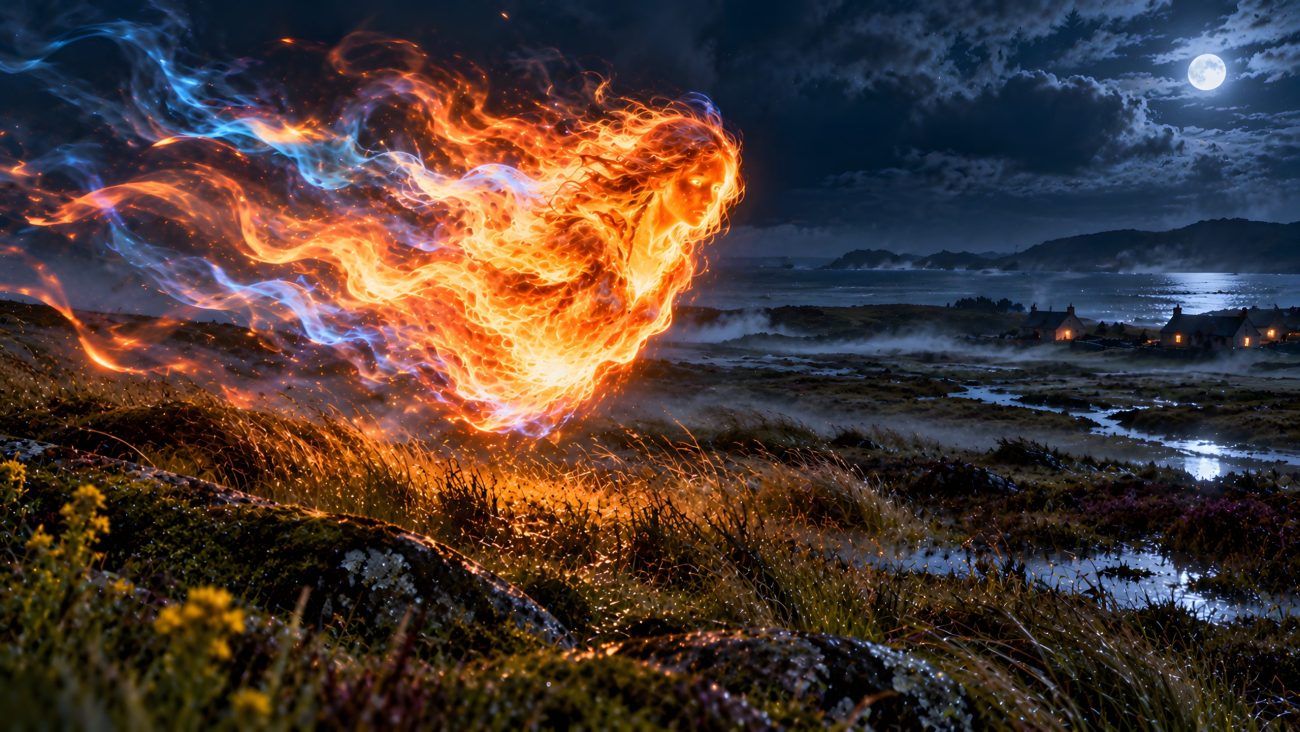
In the Hebrides of Scotland, the Will-o’-the-Wisp, known in Gaelic as Teine Biorach, meaning “sharp fire,” is described as a haunting supernatural light. On South Uist, local tradition claims that it first appeared in 1812 and represents the restless spirit of a young girl from Benbecula. During her life, the girl wandered across the machair, the sandy plain beside the sea, searching for Galium verum, a plant used to dye local cloth and tweed. Her wrongdoing was seeking an unfair share of a resource that was supposed to be divided equally for the common good. The plant was particularly important because it helped bind the sandy soil together on land reclaimed from the sea. After her death, her spirit supposedly returned as a wandering flame, condemned to haunt the landscape because she had placed personal gain above the needs of her community.
Another tale explains the origin of the Jack-o’-Lantern through the fate of a blacksmith whose soul was rejected even by hell. Left without a place to go, the freezing blacksmith begged for a single ember to warm himself. Eventually, someone granted his request, and he has wandered ever since, shivering through the darkness while carrying the tiny flame. Unlike the story of the girl from Benbecula, this legend presents the wandering light as the remnant of a condemned soul seeking warmth.
These stories reflect the distinctive beliefs of the Hebrides, where the cold, damp climate shaped local ideas about the afterlife. The blacksmith’s desperate search for warmth contrasts with the common Hebridean tradition of a cold hell, a belief particularly familiar in South Uist, where mist, rain, and sweeping winds dominate the landscape. In this tradition, even the fires of the underworld might seem comforting compared with the bitter cold of the living world. Hell was consequently described as “the place of the wind of the cold passages” or “the wind of the cold channels,” making the wandering flame a striking image of a soul condemned to endure the cold without relief.
Sources
D. L. Ashliman. “Will-o’-the-Wisp: Ignis Fatuus—Legends about Fiery Fairies.” Folktexts: A Library of Folktales, Folklore, Fairy Tales, and Mythology. Revised February 22, 2021. https://sites.pitt.edu/~dash/willowisp.html#goodrich