Spunkie

Tradition: Scottish Mythology
Alternative Names: Spunkie, Teine Sith, Fairy Light
Category: Flame


The Myth

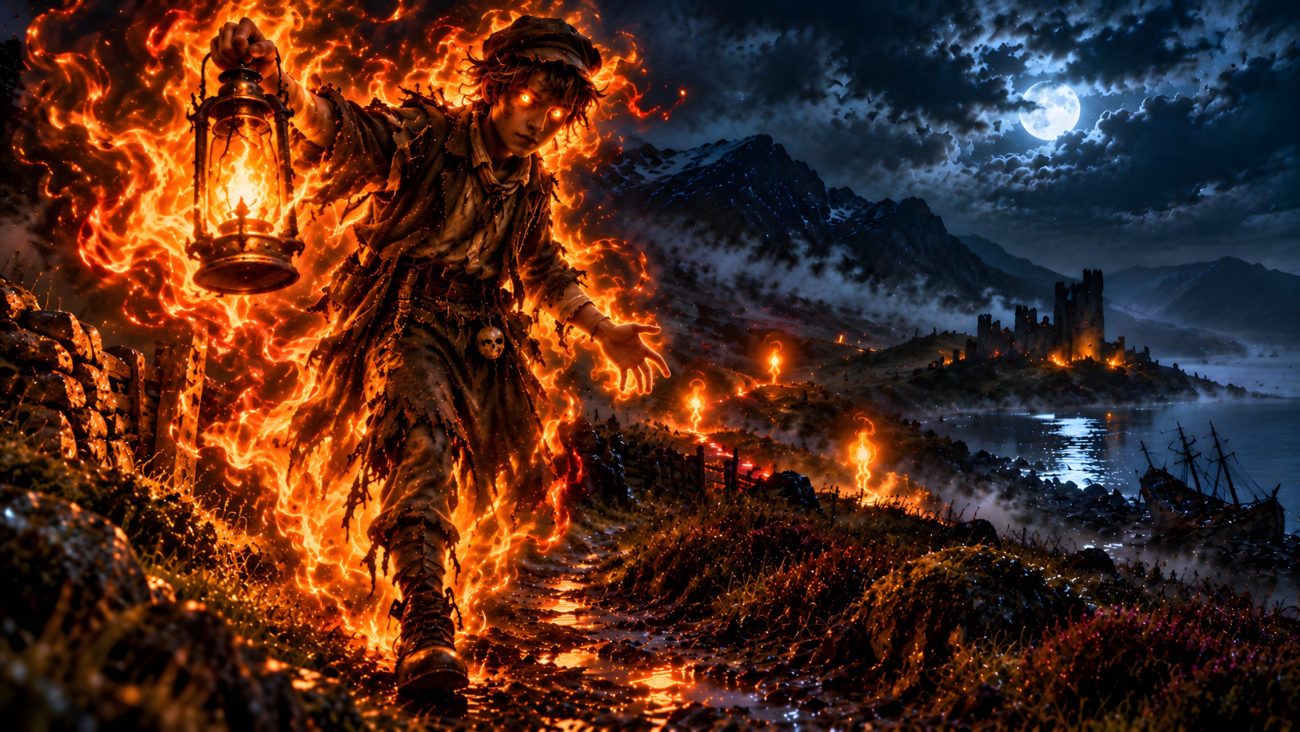
The Spunkie is a mysterious wandering fire from Scottish mythology, particularly associated with the Scottish Highlands. It appears as a strange light that lures unsuspecting travellers away from safety and toward danger. Sometimes it takes the form of a linkboy, a boy who carries a burning torch to guide pedestrians through the darkness in exchange for payment. At other times, it appears simply as a distant light that continually retreats as someone approaches, tempting them to follow it farther into the wilderness.

The Spunkie is notorious for leading travellers to their doom. Its deceptive lights can draw people away from familiar roads and into dangerous places. It has also been blamed for shipwrecks, as sailors have mistaken a light shining from the shore for a harbour beacon, only to discover too late that it offered no safe passage. Such tales made the Spunkie a feared presence around Scotland’s coasts and darkened landscapes.

Other Scottish traditions regard these mysterious lights as omens of death or the ghosts of deceased people. They are said to appear above lochs and along roads used by funeral processions, linking their flickering glow with the dead and the passage between life and death. In the Hebrides, a strange light is sometimes called the teine sith, meaning “fairy light,” although this name does not necessarily indicate any connection with the fairy race.


Sources

“Will-o’-the-wisp.” Wikipedia: The Free Encyclopedia. Wikimedia Foundation. Accessed October 11, 2026. https://en.wikipedia.org/wiki/Will-o%27-the-wisp

Will-o’-the-Wisp

Tradition: Scottish Mythology
Alternative Names: Teine Biorach, Jack-o’-Lantern
Category: Flame


The Myth

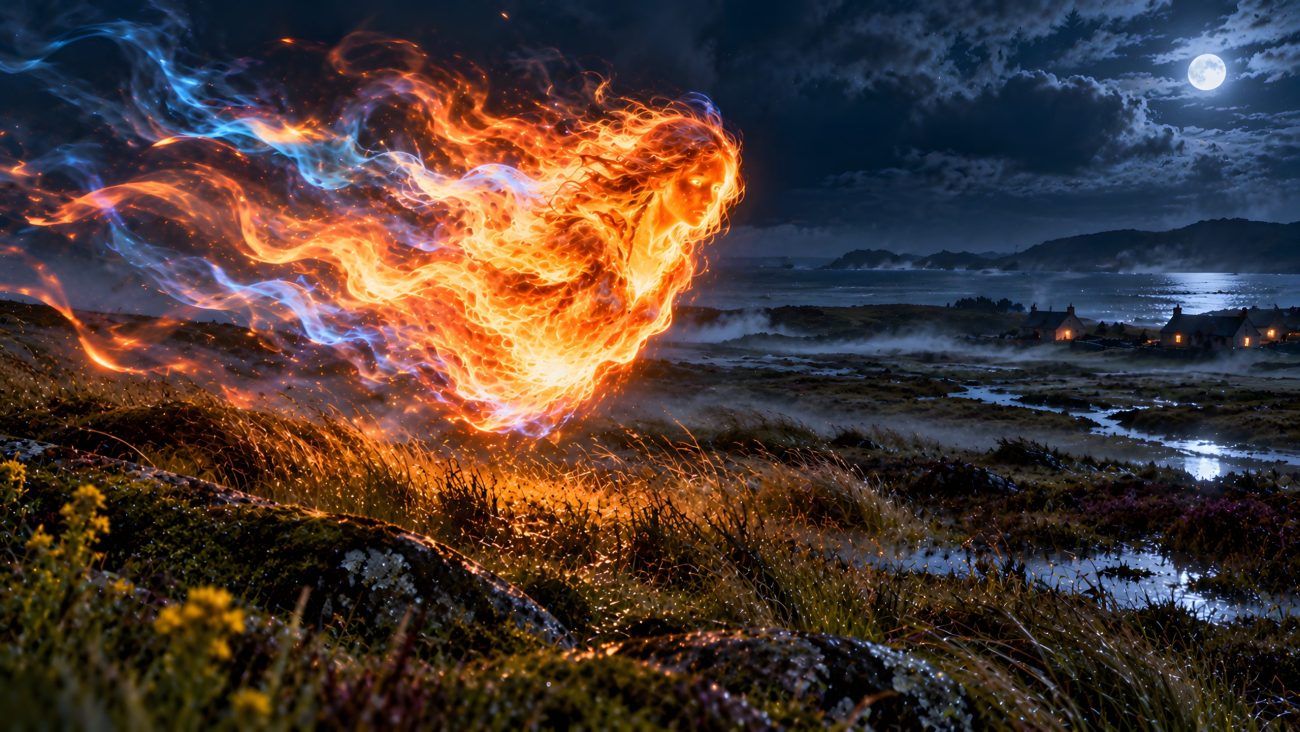
In the Hebrides of Scotland, the Will-o’-the-Wisp, known in Gaelic as Teine Biorach, meaning “sharp fire,” is described as a haunting supernatural light. On South Uist, local tradition claims that it first appeared in 1812 and represents the restless spirit of a young girl from Benbecula. During her life, the girl wandered across the machair, the sandy plain beside the sea, searching for Galium verum, a plant used to dye local cloth and tweed. Her wrongdoing was seeking an unfair share of a resource that was supposed to be divided equally for the common good. The plant was particularly important because it helped bind the sandy soil together on land reclaimed from the sea. After her death, her spirit supposedly returned as a wandering flame, condemned to haunt the landscape because she had placed personal gain above the needs of her community.

Another tale explains the origin of the Jack-o’-Lantern through the fate of a blacksmith whose soul was rejected even by hell. Left without a place to go, the freezing blacksmith begged for a single ember to warm himself. Eventually, someone granted his request, and he has wandered ever since, shivering through the darkness while carrying the tiny flame. Unlike the story of the girl from Benbecula, this legend presents the wandering light as the remnant of a condemned soul seeking warmth.

These stories reflect the distinctive beliefs of the Hebrides, where the cold, damp climate shaped local ideas about the afterlife. The blacksmith’s desperate search for warmth contrasts with the common Hebridean tradition of a cold hell, a belief particularly familiar in South Uist, where mist, rain, and sweeping winds dominate the landscape. In this tradition, even the fires of the underworld might seem comforting compared with the bitter cold of the living world. Hell was consequently described as “the place of the wind of the cold passages” or “the wind of the cold channels,” making the wandering flame a striking image of a soul condemned to endure the cold without relief.


Sources

D. L. Ashliman. “Will-o’-the-Wisp: Ignis Fatuus—Legends about Fiery Fairies.” Folktexts: A Library of Folktales, Folklore, Fairy Tales, and Mythology. Revised February 22, 2021. https://sites.pitt.edu/~dash/willowisp.html#goodrich