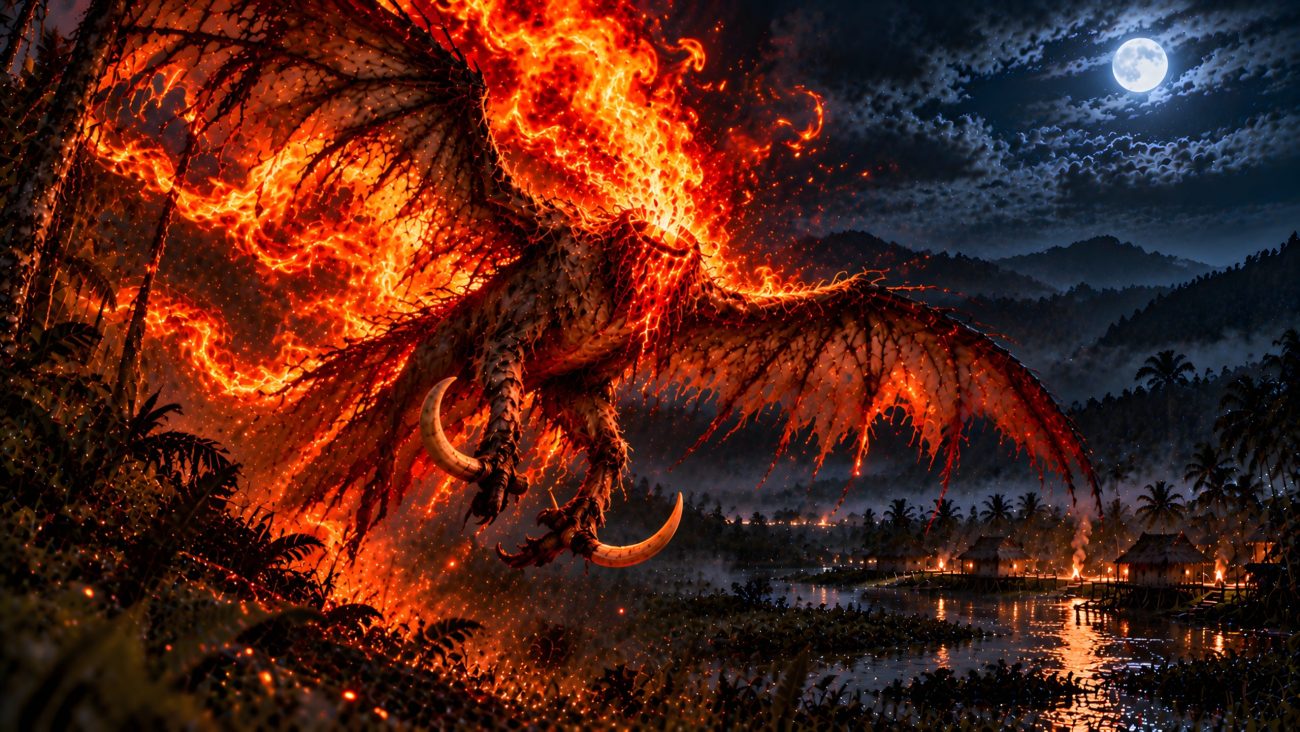
Tradition: Papua New Guinean Mythology
Alternative Names: Utumu
Category: Flame
The Myth
The Utumu is a highly malignant spirit from Papua New Guinean mythology, said to arise from a person whose head has been cut off. The blood spurting from the wound in its neck shines through the darkness like fire, creating a deceptive light that can be mistaken for an ordinary flame. Many people have reportedly walked toward this strange glow, only to fall into the clutches of the monster. The Utumu frequently haunts the place where it was beheaded, although it can also fly through the air like a bird.
The spirit does not emit light continuously. When its fiery glow appears, it is generally regarded as an omen of a coming fight. When the light is absent, the Utumu becomes invisible, though its foul smell can betray its presence. A hollow roar, resembling the beating of a drum, issues from its open throat. The creature has no permanent home and wanders constantly through the landscape, devouring people with its dangerous tusks.
The Utumu attacks by catching its victims around the ankles with its tusks and knocking them to the ground. Such attacks can even occur in water, making the spirit especially dangerous to those travelling alone. Sleeping alone in a house or out in the bush is considered perilous because of the threat it poses. Those forced to sleep alone in the wilderness sometimes protect themselves by lying between two fires or burning a Jurivare plant, whose smell is believed to drive the spirits away.
Ordinary arrows cannot strike an Utumu, but people may frighten it by rattling their bundles of arrows, pretending to shoot, or threatening it aloud. Groups of men sometimes fire arrows randomly into the surrounding bush in an attempt to drive the spirit away, although a lone person would be too afraid to do so. Another method involves speaking a special formula to a stick and then planting it in the ground to keep the Utumu at bay. Despite these protective practices, the spirit remains a feared and dangerous presence, its burning blood serving as a deceptive beacon for those unfortunate enough to encounter it.
Sources
Landtman, Gunnar. The Kiwai Papuans of British New Guinea: A Nature-Born Instance of Rousseau’s Ideal Community. New York: Johnson Reprint Corp., 1970. https://archive.org/details/kiwaipapuansofbr0000land