Mokele-Mbembe

Tradition / Region: Congo Mythology, Bantu Mythology
Alternate Names: Mokèlé-mbèmbé
Category: Lizard, Lake dweller


The Myth

Deep within the rivers, swamps, and dense jungles of the Congo Basin, there are stories of a powerful and mysterious being known as Mokele-Mbembe. It is said to dwell in remote waterways—hidden lakes, slow-moving rivers, and thick marshlands where the water is dark and the vegetation nearly impenetrable.

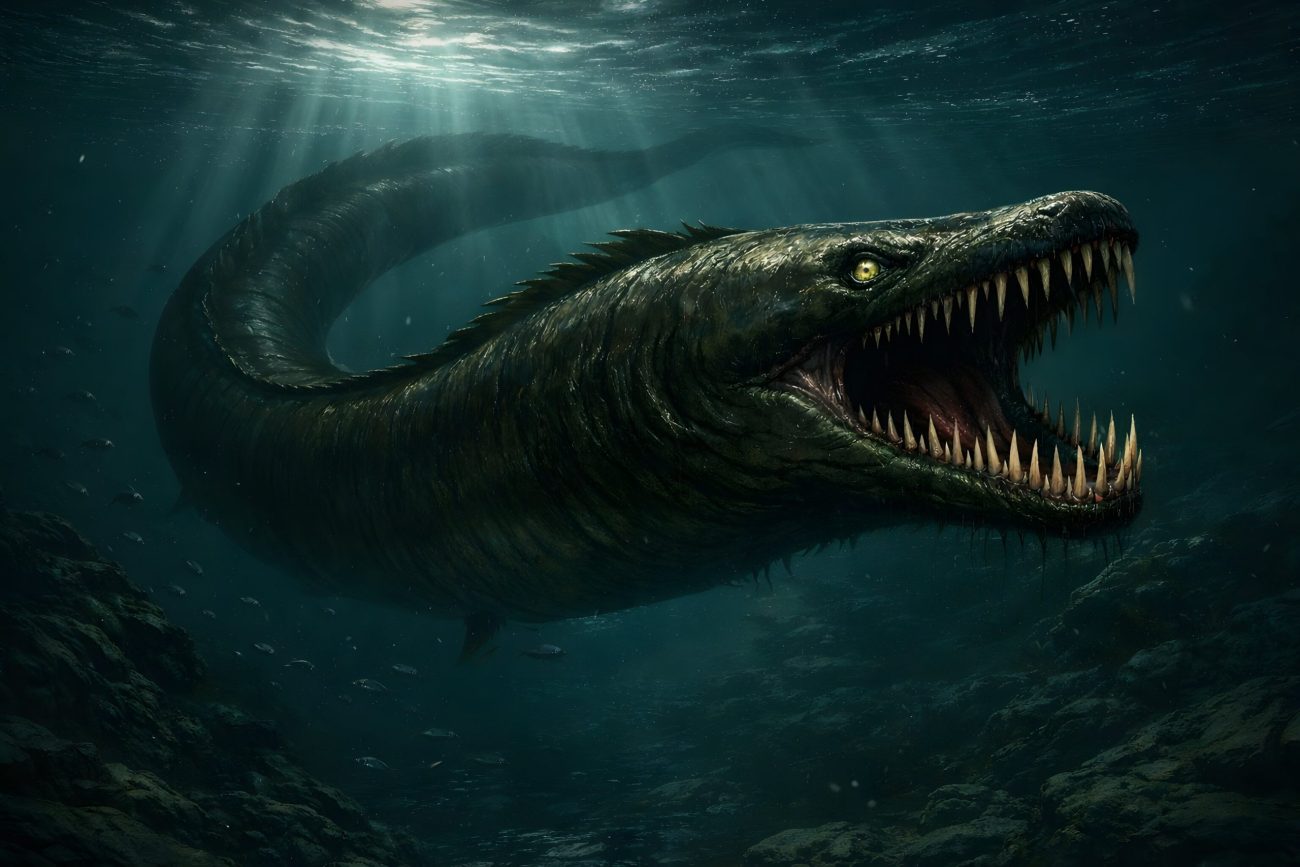
The creature is described as enormous, with a body comparable in size to an elephant or hippopotamus. Its form is unlike any ordinary animal: a heavy, muscular body, a long flexible neck, a small head often compared to that of a snake, and a long tail that moves through the water with great force. Its skin is smooth and dark, usually said to be reddish-brown or gray.

Mokele-Mbembe is not just large—it is territorial and feared.

It is said to guard certain stretches of river and will attack intruders, especially boats or canoes that pass too close. Those who encounter it risk being overturned into the water, where they may drown or disappear entirely. In many accounts, the creature destroys vessels without consuming the people, suggesting that its aggression is not driven by hunger but by dominance over its domain.

Unlike typical monsters, it is often described as herbivorous. It feeds on vegetation growing along riverbanks—particularly certain plants with large leaves or white blossoms. Despite this, it reacts violently to disturbance, making it one of the most feared beings of the waterways.

Mokele-Mbembe is said to live in deep, hidden places—caves carved into riverbanks or secluded bends in the water where the current slows. It moves between land and water, sometimes emerging during the day to feed, leaving behind paths where vegetation has been trampled or pushed aside.

Its presence is rarely seen directly. Instead, it is known through signs: massive disturbances in the water, sudden waves in otherwise still areas, broken plants along the shore, or the feeling that something enormous is moving just beneath the surface.

In some traditions, it is described almost like a guardian spirit of the river—an embodiment of its danger and power. It does not hunt humans for food, but it enforces boundaries. Those who respect the river may never encounter it. Those who intrude carelessly may not return.


Sources

Wikipedia contributors. (n.d.). Mokele-mbembe. In Wikipedia, from https://en.wikipedia.org/wiki/Mokele-mbembe


Loch Oich Monster

Tradition / Region: Scottish Mythology
Alternate Names:
Category: Dog, Lake dweller


The Myth

The Loch Oich Monster is a lesser-known creature from Scottish legend, associated with Loch Oich in the Great Glen of Inverness-shire. Though overshadowed by the famous Loch Ness Monster, it occupies a similar place in Highland folklore as a mysterious aquatic beast.

One of the most notable reported sightings occurred on 13 August 1936, when Alderman Richards and companions saw a strange creature while boating near Laggan. They described it as a black animal with two humps, resembling coils of a serpent rising above the water. Each hump was said to be about three feet high and spaced a few feet apart.

Most strikingly, the creature’s head was described as shaggy and dog-like, giving the monster a hybrid appearance between a lake serpent and a giant canine. This unusual combination of features led to its reputation as a rare example of a dog-headed water monster in Scottish tradition.

Unlike Nessie, the Loch Oich creature never became widely mythologized, but it remains part of local Highland lore about strange beings inhabiting the deep, dark lochs.


Gallery


Sources

A Book of Creatures. (2021, January 18). Loch Oich Monster. From https://abookofcreatures.com/2021/01/18/loch-oich-monster/


Interpretive Lenses

Religious Readings
  • Christian Ascetic Deep Dive
Philosophical Readings
  • Nietzschean Deep Dive
Psychological Readings
  • Jungian Deep Dive
Esoteric Deep Dive
  • Hermetic Deep Dive
Political / Social Readings
  • Marxist Deep Dive

Dobhar-chú

Tradition / Region: Irish Mythology
Alternate Names: King Otter, Dobharcu, Dorraghow, Anchu
Category: Dog, Lake dweller


The Myth

The Dobhar-chú is a feared creature of lakes and rivers in Irish tradition, remembered as a monstrous water hound.

It is said to resemble a great otter but with the strength and build of a dog. Far larger than any natural animal, it could grow many times the size of a normal otter. Some tales describe it with a pale coat marked by darker patches, while others say its fur appears dark from the waters it inhabits. Its body is powerful, with strong limbs and a long tail, and it moves easily both on land and in water.

The creature is believed to dwell in deep lakes and hidden waters, rarely seen but greatly feared by those who live nearby. Stories of it were passed down mostly by word of mouth, and many people believed it to be a dangerous predator of both livestock and humans.

One well-known tale tells of a woman who went to the lakeshore to wash clothes. When she did not return, her husband went to search for her and found her dead by the water. Lying beside her was the great beast itself, resting near its kill.

The man hurried home, armed himself, and returned to face the creature. After a struggle he managed to kill it. But as the beast died, it gave out a piercing cry. From the lake rose another of its kind, drawn by the call. The second monster pursued him, and after a fierce fight he killed that one as well.

The place where the woman died was long remembered, and a stone marking her grave was said to bear the image of a great dog-like animal, keeping alive the memory of the water hound.

Thus the Dobhar-chú was remembered as the king of the waters — a great lake beast shaped like a hound, feared along lonely shores and whispered about in stories of the deep.


Sources

Wikipedia contributors. (n.d.). Dobhar-chú. In Wikipedia, from https://en.wikipedia.org/wiki/Dobhar-ch%C3%BA


Witch of Bitschter Pond

Tradition / Region: Luxembourg Mythology
Alternate Names: The Old Witch of Bits; Matchmaking Witch of the Bits Pond
Category: Witch, Forest dweller, Lake dweller


The Myth

In earlier times, the Bitschter Pond lay in the deep valley between Buderscheid and the Pirmesknapp. The large body of water stretched from the Buderscheid mill to the Pirmesberg hill, surrounded by dense, wild forest. People said the place was haunted, for many spirits were believed to dwell there.

Among them lived the infamous old witch of Bits. She practiced fortune-telling and matchmaking, and young men and women who longed for marriage would seek her out. The witch possessed a mysterious bottle in which there was an egg and a crucified Christ. By means of this bottle, she told those who consulted her whom they would marry, where that person lived, and what they must do to win them.

At night, she was said to fly like a bird over the pond, crying out with a hoarse, croaking voice. Around the pond, other witches gathered, and in the moonlight they danced wildly in the trees, making music and raising a dreadful noise. They were also seen hovering around the Pirmesberg, reveling in the forest and floating through the air.

At last the witch’s deeds became known. She was seized and blown into the Bitschter Pond. At once a violent thunderstorm broke out, flooding the waters and turning the place into a great quagmire.

Even long afterward, people said the place was not a pleasant one, and many were afraid to pass the site of the old pond at night.


Gallery


Sources

sagen.at contributors. (n.d.). Der Bitschter Weiher. In sagen.at, from https://www.sagen.at/texte/sagen/luxemburg/Bischter_Weiher.html


Interpretive Lenses

Religious Readings
  • Christian Ascetic Deep Dive
Philosophical Readings
  • Nietzschean Deep Dive
Psychological Readings
  • Jungian Deep Dive
Esoteric Deep Dive
  • Hermetic Deep Dive
Political / Social Readings
  • Marxist Deep Dive

Haunting at the Enerèweschter Weiher

Tradition / Region: Luxembourg Mythology
Alternate Names: Spirits of the Enerèweschter Pond
Category: Ghost, Lake dweller


The Myth

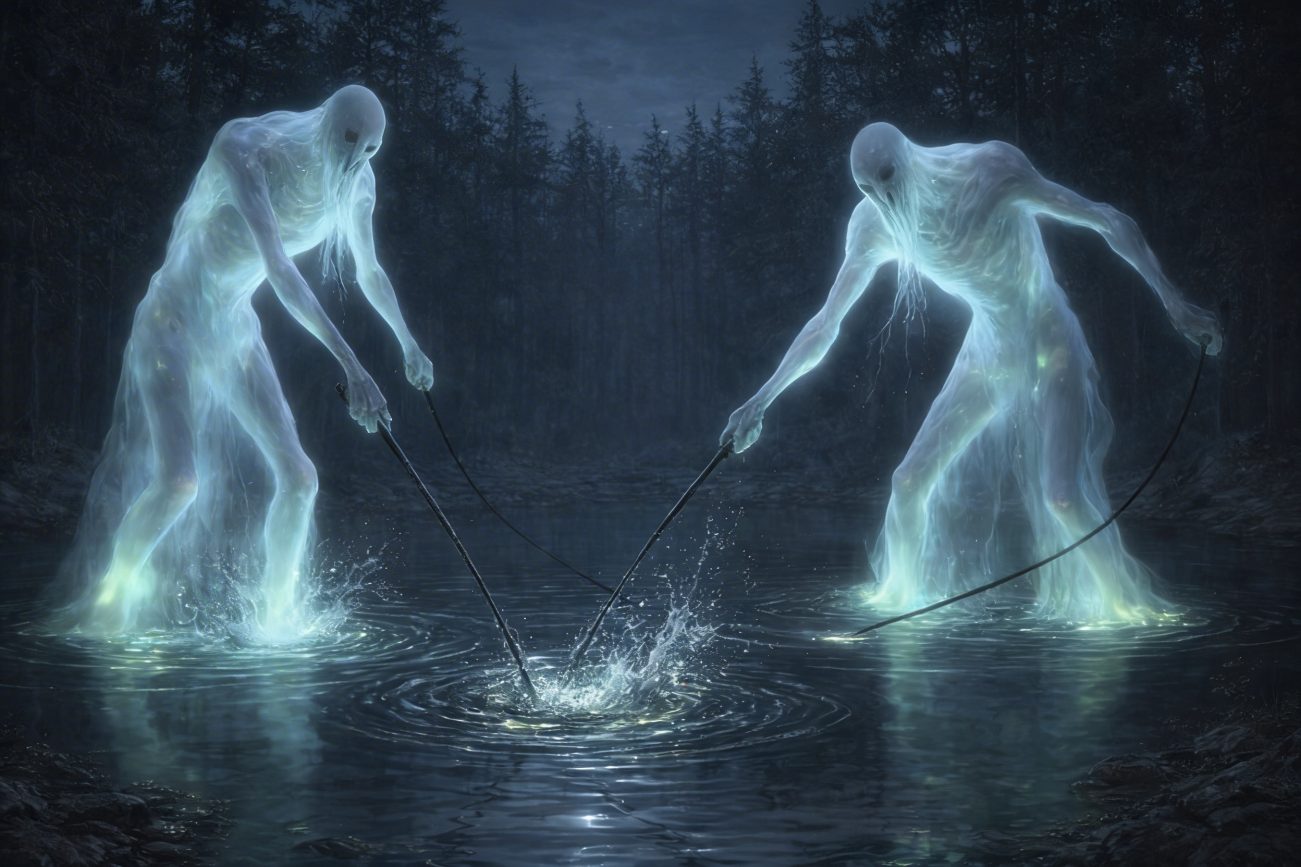
Many years ago, on Friday nights, two enormous human figures were said to appear at the pond called Enerèweschter Weiher in the forest near Lintgen. Each carried a long whip and lashed the water with such force that the noise echoed far and wide. At the same time, strange cries of “Hoo-hoo! Hoo-hoo!” rang through the night.

Afterward, the figures would perform a circle dance around the pond. Whenever anyone tried to approach them, they vanished at the slightest sound, leaving only a loud splash behind in the water.

One night, several daring young men from the village hid behind thick tree trunks, each armed with a club, determined to uncover the truth. As midnight drew near, they again heard the whipping and the eerie cries, and they saw the figures dancing. At a signal, they rushed forward and struck with all their strength. But their blows met nothing. They heard only a splash in the pond, and then all was still.

From that time on, the haunting ceased. Yet even today, some villagers believe that invisible spirits still play their tricks at the Enerèweschter Weiher.


Gallery


Sources

sagen.at contributors. (n.d.). Der Spuk am Enerèweschter Weiher zu Lintgen. In sagen.at, from https://www.sagen.at/texte/sagen/luxemburg/Spuk_Lintgen.html


Interpretive Lenses

Religious Readings
  • Christian Ascetic Deep Dive
Philosophical Readings
  • Nietzschean Deep Dive
Psychological Readings
  • Jungian Deep Dive
Esoteric Deep Dive
  • Hermetic Deep Dive
Political / Social Readings
  • Marxist Deep Dive

Washerwomen at the Pond Rahloch

Tradition / Region: Luxembourg Mythology
Alternate Names: Rahloch washerwomen
Category: Ghost, Lake dweller


The Myth

Between Sandweiler and Itzig lies a pond known as the Rahloch, a place once regarded as eerie and feared.

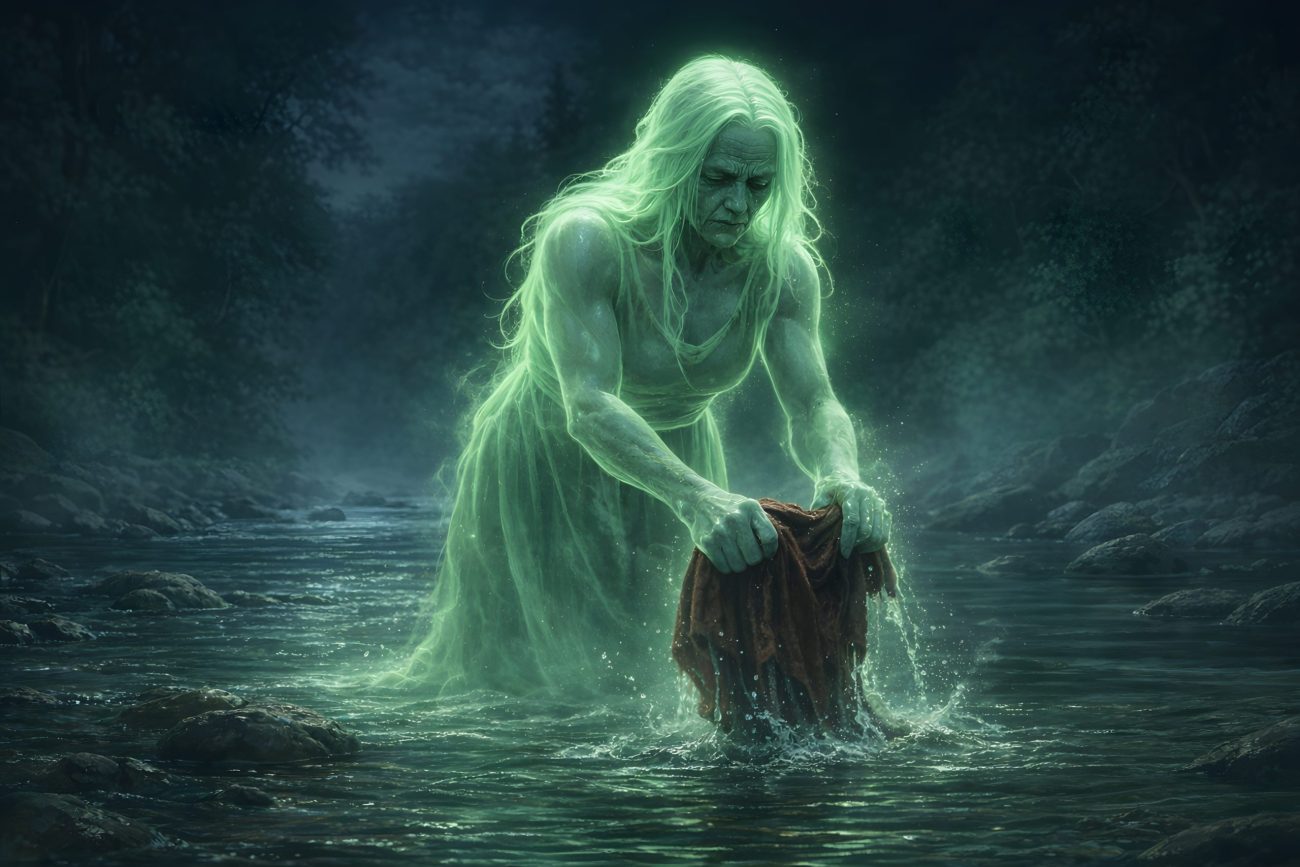
One night, a lone wanderer passed by the pond and heard the sharp echo of washerwomen’s sheets sounding through the still air. As he approached, he saw several old women standing at the water’s edge, silently beating laundry before them.

Seeing nothing strange in their work, he called out, “You are washing very late!” But the women gave no answer. Thinking to jest, he spoke again: “Ah, you wretched women, won’t you wash my clothes too?”

Hardly had he spoken when the women rushed upon him and beat him so severely that he fell senseless to the ground. When he later came to, he found his clothes completely soaked, and realized that the washerwomen had stripped him and washed them while he lay unconscious.

Filled with terror, he fled home as fast as he could. Only the next day did he notice that his hair had turned gray from the fright.


Gallery


Sources

sagen.at contributors. (n.d.). Die Wäscherinnen am Weiher „Rahloch“. In sagen.at, from https://www.sagen.at/texte/sagen/luxemburg/Waescherinnen_Rahloch.html


Interpretive Lenses

Religious Readings
  • Christian Ascetic Deep Dive
Philosophical Readings
  • Nietzschean Deep Dive
Psychological Readings
  • Jungian Deep Dive
Esoteric Deep Dive
  • Hermetic Deep Dive
Political / Social Readings
  • Marxist Deep Dive

Arenal Lake Beast

Tradition / Region: Costa Rican Mythology
Alternate Names:
Category: Lake dweller, Cow, Snake


The Myth

Beneath the dark waters of Lake Arenal, it is said that an enormous creature lies hidden. Few have seen it clearly, for it dwells in the depths and rises only briefly, as if unwilling to be known.

Those who glimpse it speak of a beast with the head of a cow, crowned with curving horns, joined to a long, serpentine body that moves through the lake with silent power. When it shifts below, the water above trembles, rippling as though something immense has turned in its sleep.

The creature is said to surface only at certain moments—at dawn or dusk, or when storms draw near and the lake grows uneasy. In those times, a dark shape may break the surface, a horned head may rise for a breath and sink again, and the waters quickly return to calm.

No trace of the beast remains once it vanishes. No proof can be held, only stories carried by fishermen and villagers who know the lake too well to believe it is empty.

Thus the people say that Lake Arenal is never truly still, for deep below its surface coils a horned, cow-headed serpent, unseen yet always present.


Sources

LakeLubbers contributors. (n.d.). Lake Arenal, Alajuela & Guanacaste, Costa Rica. In LakeLubbers.com, from https://lakelubbers.com/lake/lake-arenal-alajuela-costa-rica/


Abaia

Tradition / Region: Papua New Guinea Mythology
Alternate Names:
Category: Eel, Fish, Lake Dweller


The Myth

There is a deep lake in British New Guinea, rich with fish, and at its bottom dwells Abaia, a powerful and magical eel. Abaia is ancient and territorial, and like many great serpents and eels of Melanesian belief, it is bound to the forces of weather, storms, and floods. It does not tolerate disturbance.

One day, a man discovered Abaia’s lake and found that the fish within it were plentiful beyond measure. He caught many and returned to his village, telling the others of the endless bounty. Soon the people came together to the lake, casting their nets and hauling out fish in great numbers. In their greed, they took without restraint.

Among them, one woman caught Abaia himself in her net. The great eel struggled and escaped, slipping back into the depths of the lake.

That night, Abaia took revenge. Rain fell without pause. The lake swelled and overflowed its banks, and the floodwaters rose until the entire village was drowned. Men, women, and children were swept away by the storm.

Only one old woman survived. She had refused to eat the fish taken from the lake and climbed into a tree as the waters rose. When the flood receded, she alone remained, spared because she had not partaken in what belonged to Abaia.

Thus the people learned that the gifts of the water are not without guardians, and that greed awakens the wrath of those who dwell beneath the surface.


Sources

Dixon, R. B. (1916) The Mythology of All Races v. IX: Oceanic. Marshall Jones Company, Boston.

A Book of Creatures contributors. (n.d.). Abaia. In A Book of Creatures, from https://abookofcreatures.com/2019/01/04/abaia/

Peri

Tradition / Region: Azerbaijani mythology
Alternate Names:
Category: Nymph, Pigeon, Deer, Lake Dweller


The Myth

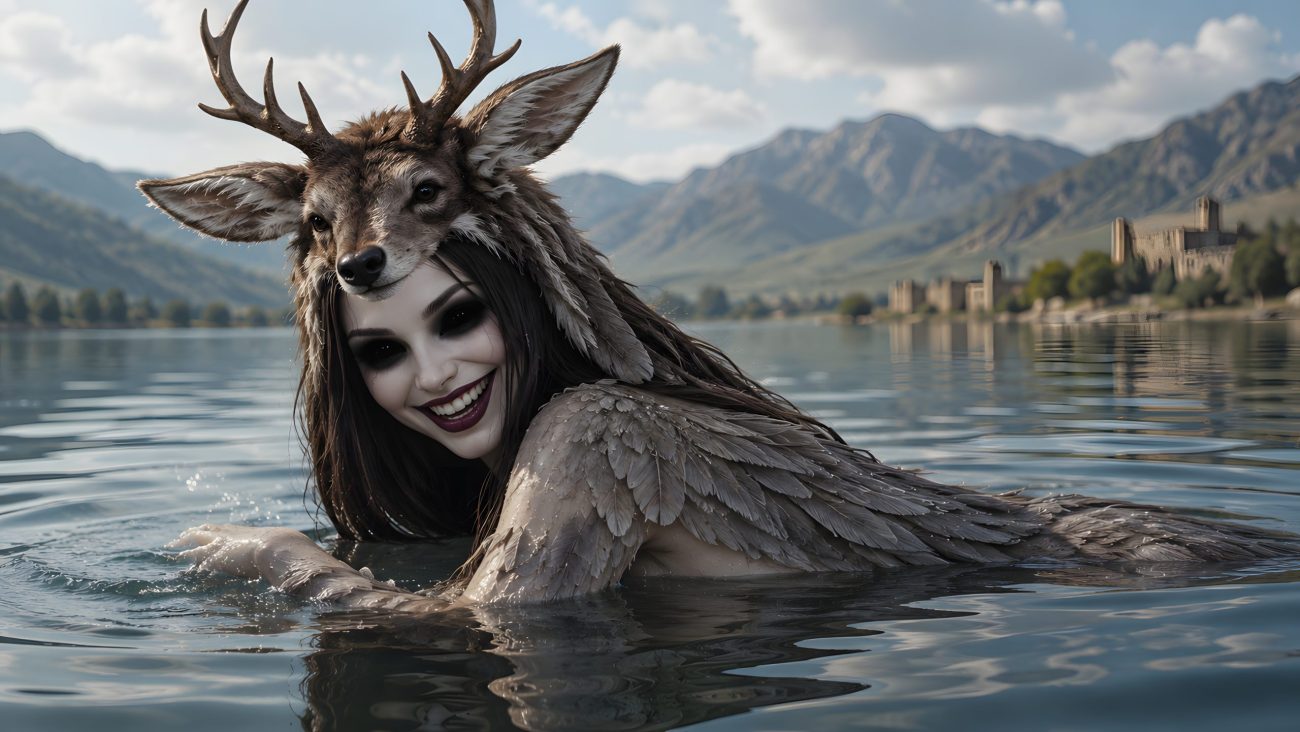
The Peri is a beautiful supernatural maiden, gentle by nature and radiant in form. She often appears as a pigeon or a deer, coming to ponds or rivers where she removes her animal skin and bathes as a human woman.

If someone steals this skin, the Peri is trapped and can be forced to obey, performing magic or granting favors. Yet such acts are dangerous, for Peris are not evil beings. They are kind-hearted, capable of fighting demons, and may even marry humans.

A Peri must be treated with respect. When offended or humiliated, her sorrow can turn into power, bringing misfortune or supernatural disaster. Thus she is remembered as a being of beauty and kindness, but one whose dignity must never be violated.


Sources

JAMnews.net. (2017). The magical creatures of Azerbaijani mythology. Retrieved from https://jam-news.net/azerbaijani-demons/