Yara-ma-yha-who

Tradition: Australian Mythology
Alternative Names: Yara-ma-yha-who
Category: Frog


The Myth

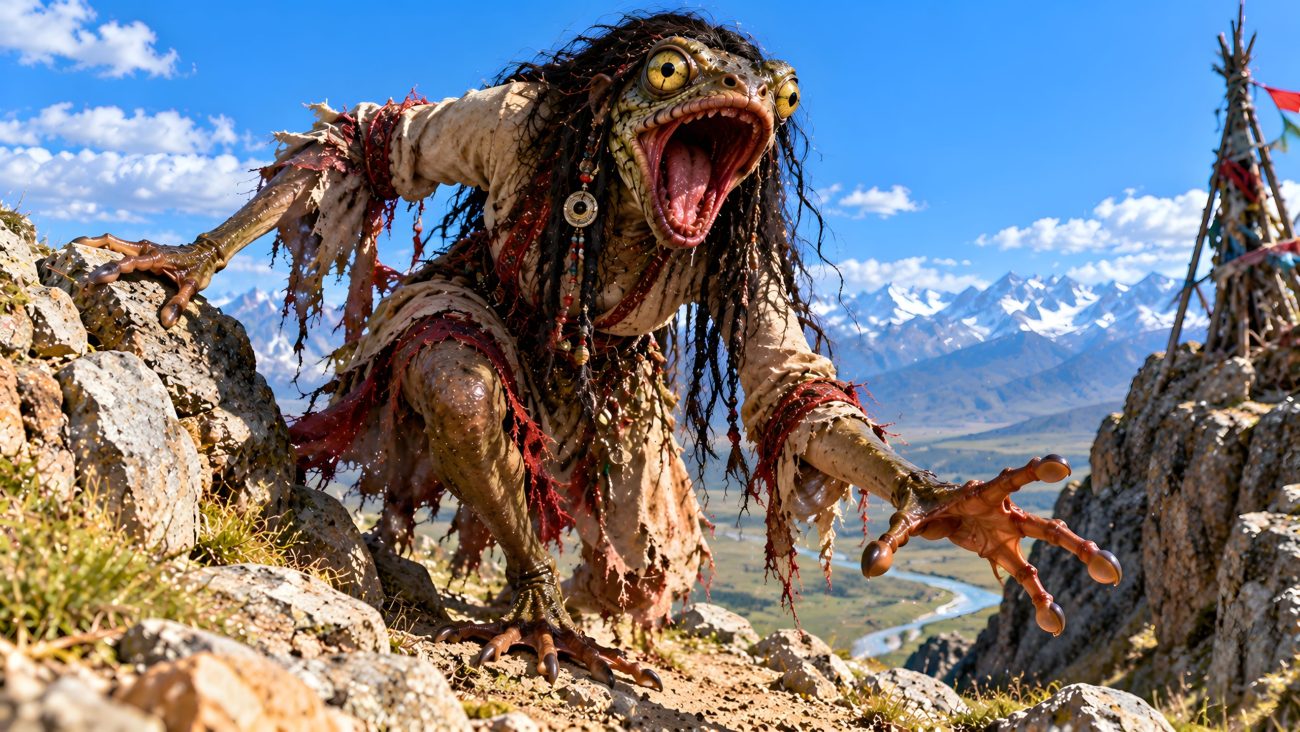
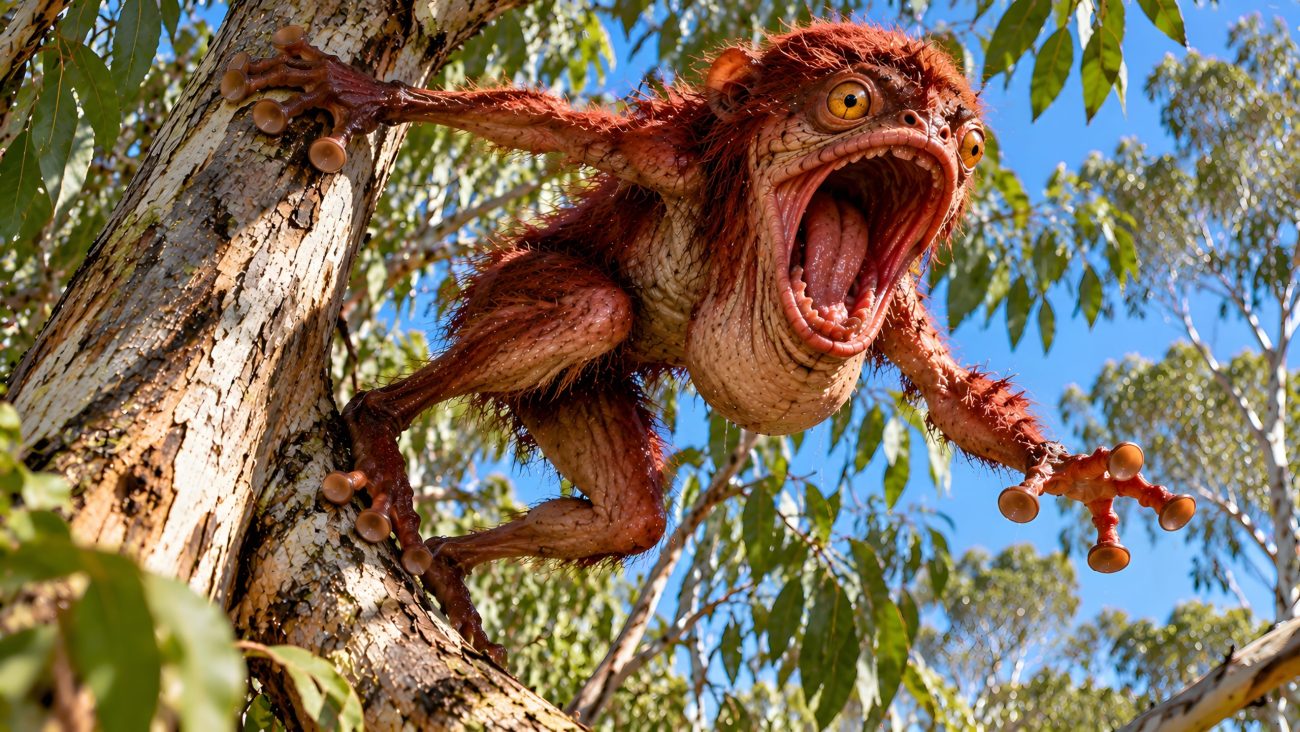
The Yara-ma-yha-who is a grotesque, blood-draining creature that inhabits the forests along Australia’s Pacific coast. It is a small, red, furry being standing no more than four feet tall, with a disproportionately large head and a wide, toothless mouth that can stretch open like a snake’s. Its throat and belly are extraordinarily expandable, allowing it to swallow an adult human whole. Its fingers and toes are equipped with suction cups that it uses to attach itself to its victims and drain their blood. Although it is an excellent climber, it moves awkwardly on the ground, waddling like a cockatoo. Thick-leaved fig trees are its favourite haunts, where it can wait for days among the branches for an unsuspecting traveller to rest beneath them. Lone children are its preferred prey, and stories of the creature serve as warnings against wandering into dangerous places.

When a Yara-ma-yha-who attacks, it clings to its victim with its suction-cup fingers and toes, draining enough blood to make the person faint without killing them outright. It then leaves the victim for a time before returning to swallow them whole, head first. A little dance helps the food slide down its throat, after which it drinks water and settles down for a nap. When it awakens, the creature regurgitates its prey. The victim is usually still alive and must remain still, pretending to be dead, because fighting back against the monster is futile. The Yara-ma-yha-who then walks five paces away before returning to poke the victim’s sides with a stick. It retreats ten paces and comes back to tickle the person beneath the arm or neck. After walking fifty yards, it returns for another round of tickling before finally going behind a bush to sleep.

This strange ritual must be completed, for the Yara-ma-yha-wha fears the spirit of the fig tree, which will whisper in its ears if it fails to perform the required actions. The punishment is a transformation into glowing mushrooms that grow on trees. Once the creature has gone to sleep, a victim can finally escape. If the Yara-ma-yha-who hears the fleeing person, it may call out in confusion and attempt to give chase, but its clumsy gait makes it relatively easy to outrun. A frustrated creature may retaliate by drinking all the water from nearby wells and waterholes, forcing people to seek moisture from tree sap and exposing themselves to further attacks.

Surviving an encounter does not guarantee that a person will remain human. Each time a Yara-ma-yha-who swallows and regurgitates its victim, the person’s body changes. After the second swallowing, the victim becomes shorter and completely hairless. After the third, the person shrinks further and grows a thick covering of hair. If the process continues, the victim gradually becomes a Yara-ma-yha-who themselves, joining the ranks of the creatures that haunt the fig trees.


Sources

“Yara-ma-yha-who.” Wikipedia: The Free Encyclopedia. Wikimedia Foundation. Accessed October 14, 2026. https://en.wikipedia.org/wiki/Yara-ma-yha-who
Yadomori

Tradition: Japanese Mythology
Alternative Names: Toad Monster
Category: Frog


The Myth

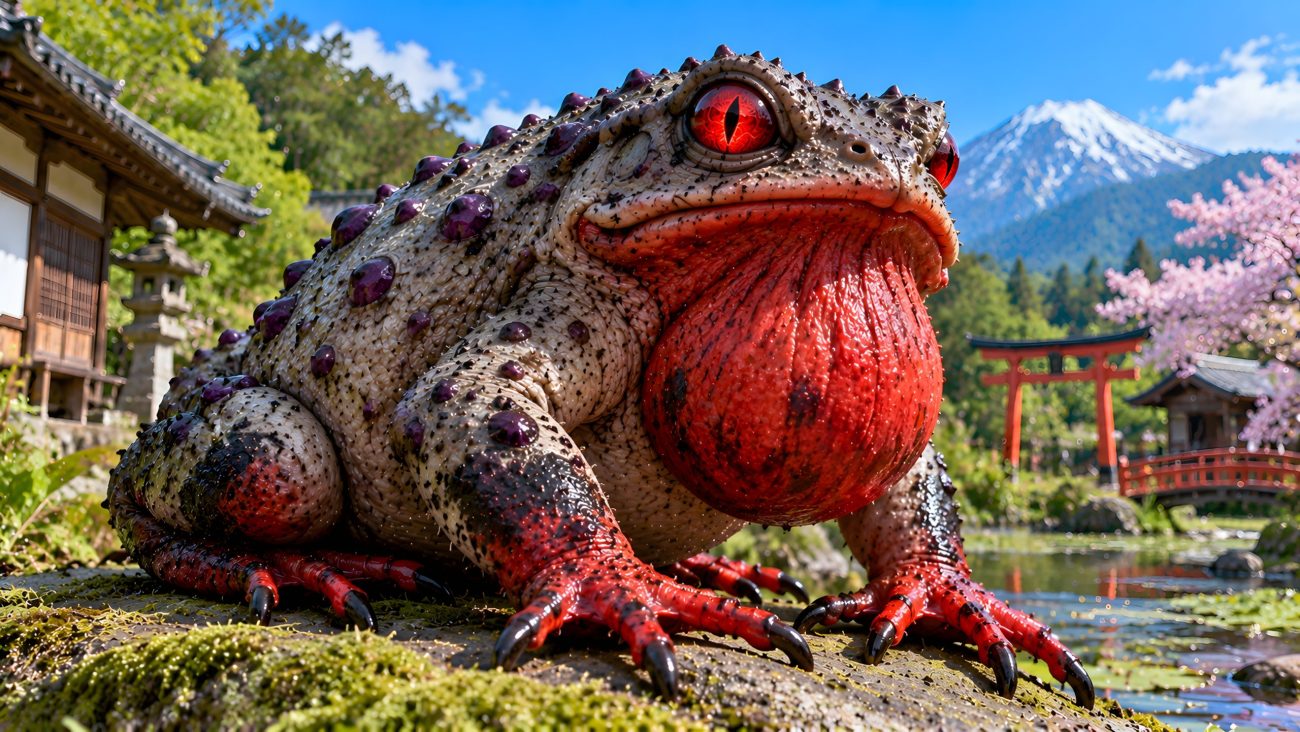
Yadomori is a supernatural toad associated with a frightening warning against killing its kind. According to Japanese legend, anyone who kills a Yadomori will face a terrible consequence, as the slain toad transforms into a monstrous spirit that returns to haunt people in their beds.

The creature is depicted alongside Umakotsu, a supernatural being associated with horse bones, in the Tosa Obake Zōshi, a Japanese ghost scroll. Its legend centres on vengeance after death, portraying the toad as a creature whose killing can bring about a terrifying supernatural visitation.


Sources

“宿守 (Yadomori).” 新版TYZ 妖怪図鑑 (New TYZ Yokai Encyclopedia). https://tyz-yokai.blog.jp/archives/1010654263.html


Witch as a Toad

Tradition: Austrian Mythology
Alternative Names: Toad Witch, Frog Witch
Category: Frog


The Myth

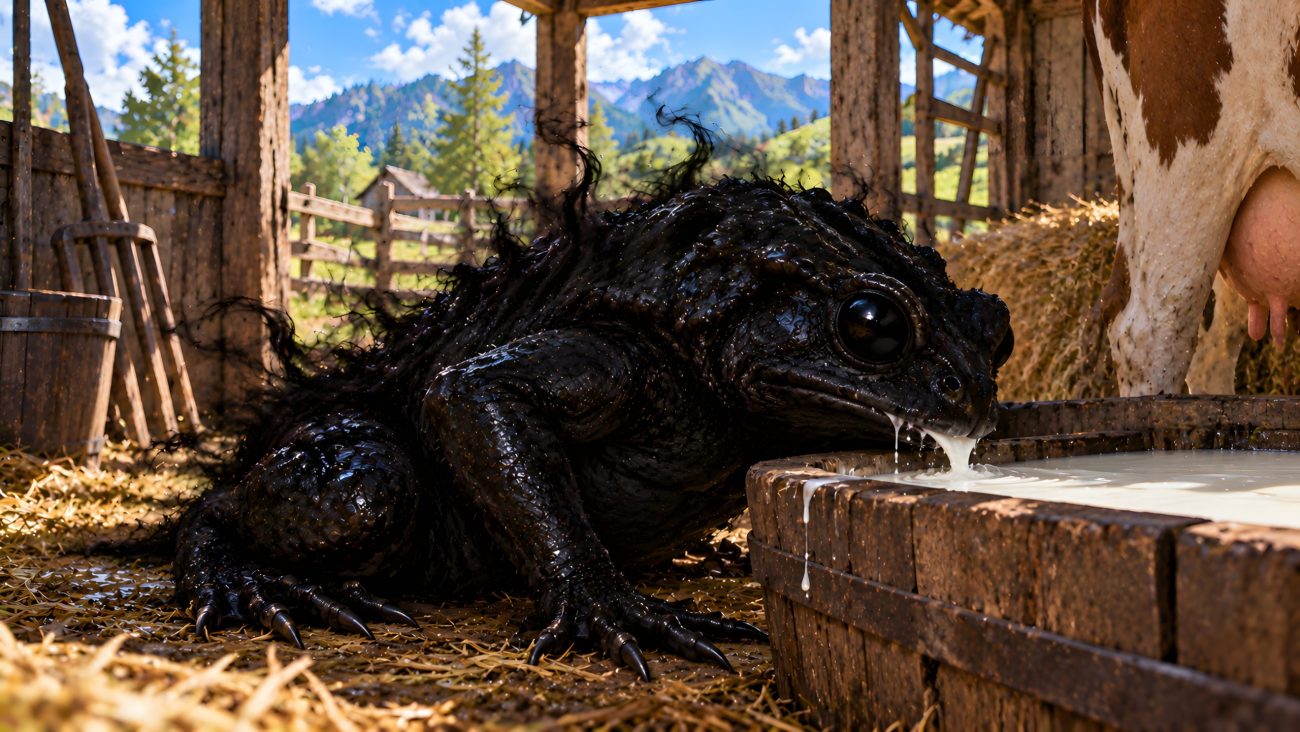
Witches in Burgenland mythology were believed to transform themselves into large frogs or toads to enter stables and steal milk from cows. They crept into barns and drank directly from the cows while the animals were lying down. After such a visit, a cow might have a swollen udder but produce no milk, or give blood instead. These strange occurrences were blamed on witches who had taken the form of enormous toads.

One tale tells of a family whose great-grandmother knew how to drive away witches. When the cows began losing their milk, a man was instructed to keep watch in the barn with an iron-tined pitchfork. He was told to attack any creature that entered, whether it was a cat, a dog, or a frog. During the night, a large toad appeared, and the man pinned it to the ground with his pitchfork. The creature began screaming and pleading with him to stop, insisting that it would not return.

The man refused to release the toad, accusing it of causing trouble by stealing the cows’ milk. As he held it down, the creature cried out that its blood was flowing and promised never to come back. Eventually, it disappeared, leaving the family to believe that the witch had been driven away. The following day, a woman was found lying in her home with the door locked. Nobody was allowed to enter, and no doctor was called. The tale presents the wounded toad and the suffering woman as two forms of the same witch, punished for stealing milk from the cattle.


Sources

Petzoldt, Franz. “Die Hexe als Kröte.” SAGEN.at – Sagen aus dem Burgenland. Reproduced by SAGEN.at. https://www.sagen.at/texte/sagen/oesterreich/burgenland/petzoldt/hexe_kroete.html


Tuyamin

Tradition: Chinese Mythology
Alternative Names: 土狗龟, Hard Frog
Category: Frog


The Myth

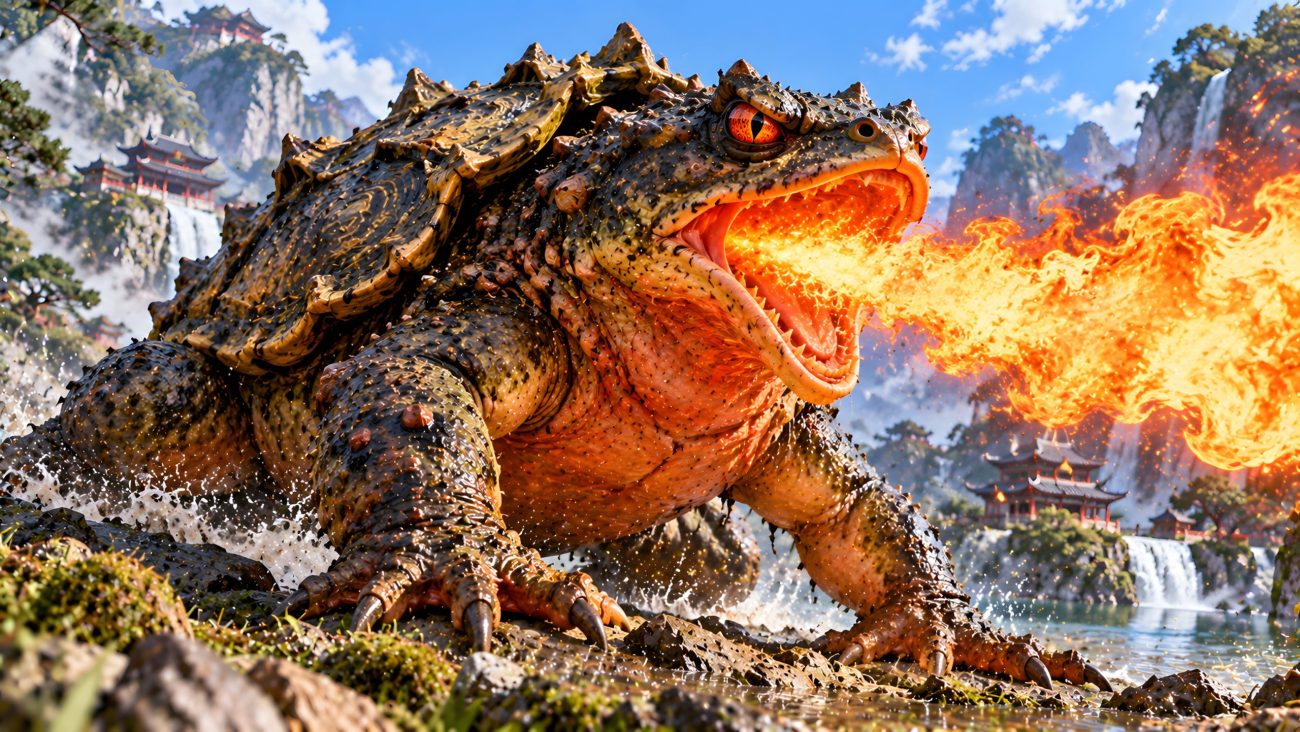
Tuyamin is a fantastical amphibian in Chinese mythology. It has a dark-colored body resembling a frog and a hard, tortoiseshell-like shield covering its back. This unusual combination gives it the appearance of an armored toad.

The Tuyamin possesses the extraordinary ability to breathe fire, making it a fearsome creature despite its frog-like shape. Its hard shell serves as a distinctive feature, setting it apart from ordinary amphibians. It is known as the “hard frog,” a name that reflects its tough, turtle-like armor.


Sources

“Туяминь (Tuyamin).” New Bestiary (Bestiary.us). https://www.bestiary.us/tuyamin


Shulmusy

Tradition: Mongolian Mythology, Russian Mythology
Alternative Names: Shulmus, Shulmas, Shumnasy, Chulbusy, Chulgusy, Chulme, Chulmysy, Shimnus, Sholmosy, Shulmy, Shulbus, Shulbys
Category: Frog


The Myth

Shulmusy are evil spirits of the underworld who enter the world of the living to spread harm and misfortune. They serve Erlik, the ruler of the underworld, and act as his messengers, bringing illness, stealing human souls, and carrying them down into the realm of the dead. They are often described as appearing in the form of a black whirlwind, resembling their dark master in both appearance and destructive nature.

Despite their terrifying nature, Shulmusy can also take the form of beautiful young women. In this guise, they deceive unsuspecting people and lure travellers into danger. Among the Kalmyks, these spirits may possess strange animal features, such as goat legs, a beard, a camel’s tail in place of a braid, or even the head of a frog. They can disguise themselves as attractive girls who offer travellers poisoned drinks, concealing their deadly intentions beneath a pleasing appearance.

Shulmusy gather in groups known as turgak, meeting at crossroads, mountain passes, and near gorges. These gatherings make such places dangerous to pass through, as the spirits may ambush travellers, spread sickness, or steal their souls. People therefore regard these locations with fear and caution, especially when crossing them near the spirits’ gathering places.


Sources

“Шулмусы (Shulmusy).” New Bestiary (Bestiary.us). https://www.bestiary.us/shulmusy


Lizun

Tradition: Belarusian Mythology
Alternative Names: Lickun, Slime
Category: Frog


The Myth

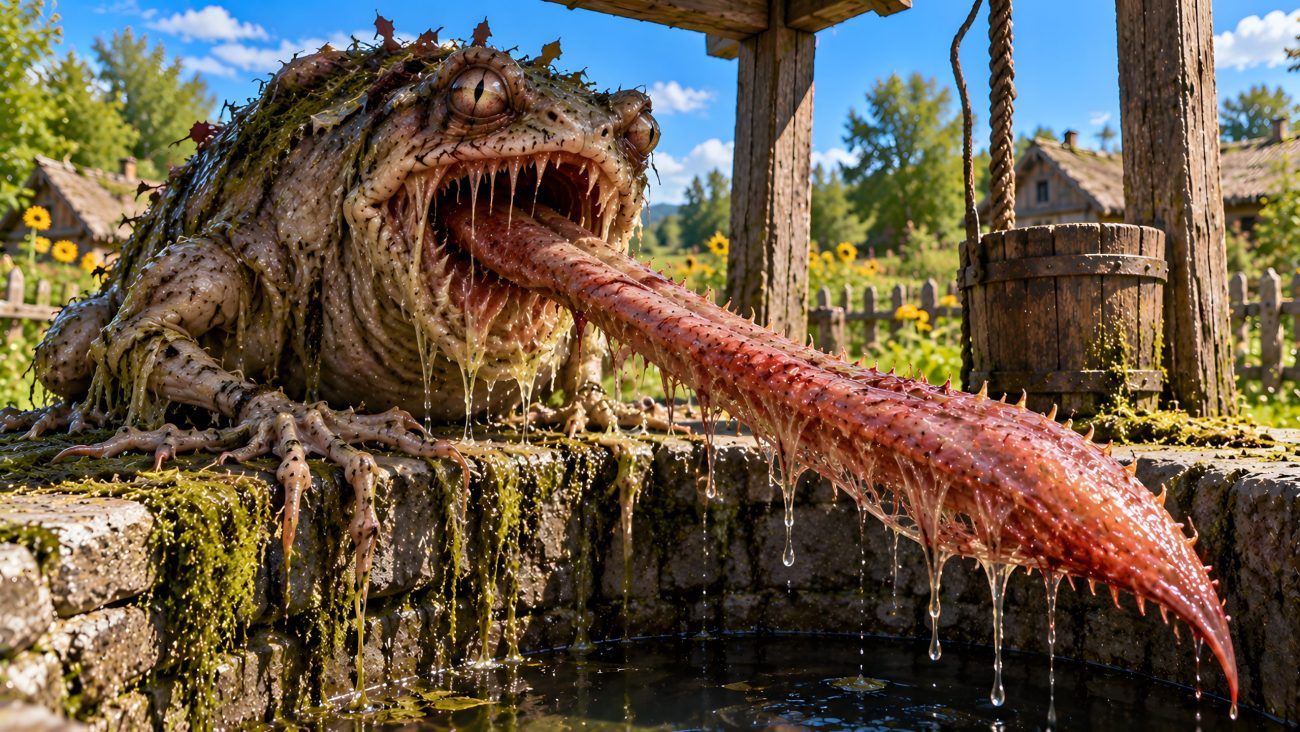
Lizun is a frightening supernatural creature said to live in wells and gardens in the northeastern Vitebsk region of Belarus and the neighbouring areas of Russia’s Pskov region. It is described as a long-tongued, slime-covered being that lurks in dark wells, waiting for unsuspecting children. Some accounts describe it as a pale, slippery mass resembling a finger, while others imagine a terrifying creature with an enormous tongue. Its tongue is said to be capable of licking children until they bleed, leaving them helpless and terrified.

Lizun is especially associated with warnings used to frighten naughty children and keep them away from dangerous wells and water sources. Adults would threaten that the creature was waiting in the well and would drag children into the water if they approached too closely. In some stories, Lizun sits beside a well with a tongue resembling a grater, ready to seize anyone who comes within reach. Other versions describe it simply as a slime that waits in hidden places, threatening to lick anyone who ventures too near.

The creature’s long, deadly tongue is central to its terrifying reputation. Children were warned that once Lizun had licked them until their skin bled, no doctor could cure them. These frightening tales made the creature an effective guardian of forbidden places, ensuring that children stayed away from wells, gardens, and other locations where they might get into danger.


Sources

“Лизун (Lizun).” New Bestiary (Bestiary.us). https://www.bestiary.us/lizun


Cursed Toads of Lasarraz

Tradition: Swiss Mythology
Alternative Names: The Knight of Lasarraz’s Toads
Category: Frog


The Myth

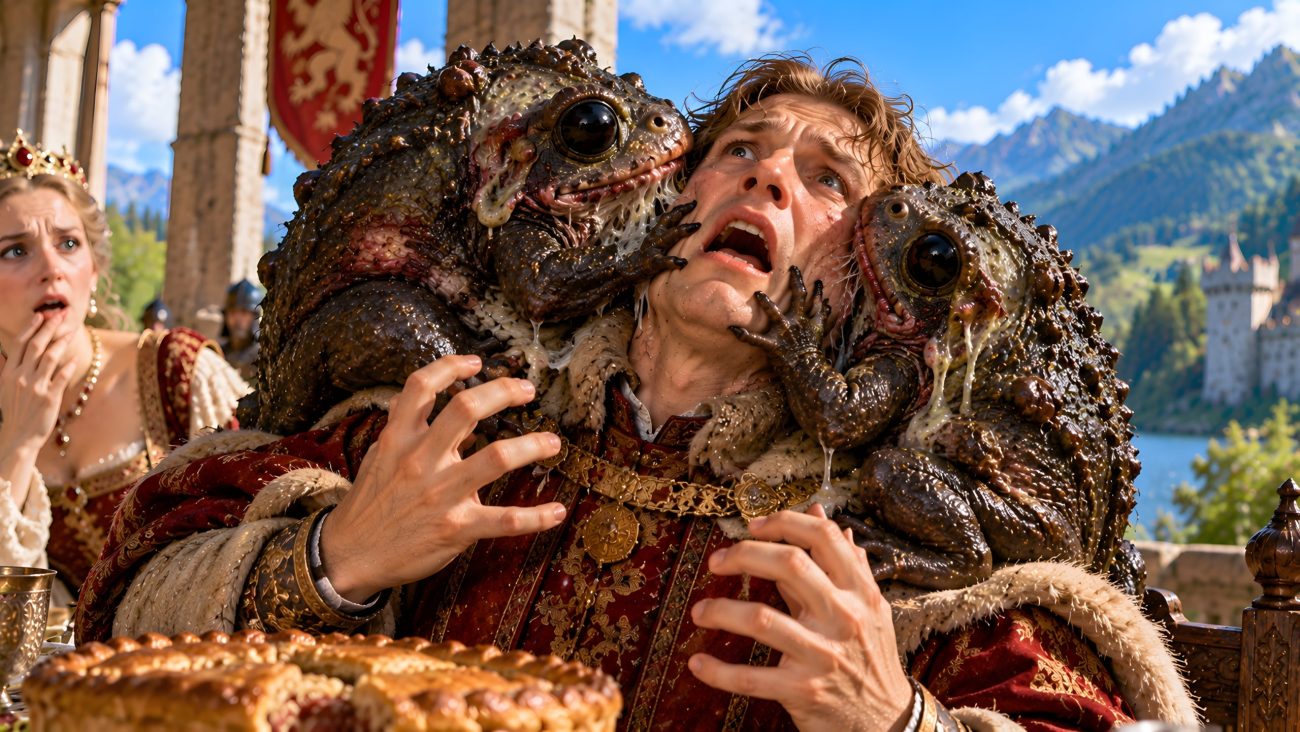
The Cursed Toads of Lasarraz are two hideous supernatural toads that cling to the face and back of a knight who commits a terrible crime against his elderly parents. The creatures possess gruesome, poisonous eyes and grip their victim so tightly that neither servants nor household attendants can tear them away. They first appear when the knight opens a magnificent venison pie beside his wife. Instead of the expected meal, two revolting toads leap from the pie and attach themselves firmly to his cheeks, drawing ever closer to his eyes as though intending to devour them.

The curse begins with the Knight of Lasarraz, a wealthy and courageous young nobleman who falls in love with the daughter of his overlord, the count. To win her hand, he promises to provide a castle and three hundred fine cows. His elderly parents willingly surrender their entire fortune to fulfil his wish, leaving themselves destitute. After the marriage, however, the knight’s wife treats the old couple cruelly, and the knight allows their suffering to continue. When winter brings bitter cold and hunger, his parents seek shelter at his magnificent palace. At his wife’s urging, he eventually casts them out into the freezing night, leaving them to wander without food or warmth.

The toads appear that very evening, as the knight enjoys a feast beside his wife. Horrified by the creatures clinging to his face, he summons servants and maids, but nobody can remove them. Realizing that his cruelty toward his parents has brought divine punishment upon him, he confesses his crime to the castle chaplain. The chaplain sends him to the bishop, who in turn directs him to the Pope in Rome. The Pope orders him to return home, find his parents, and seek their forgiveness, declaring that the shameful mark will disappear if they forgive him.

The knight searches for his parents day and night, but eventually discovers their bodies in a lonely hermitage in a snow-covered forest. They have already died from hunger and cold. Weeping, he throws himself upon them and begs for forgiveness. At once, the two toads leave his cheeks, but crawl onto his back and fasten themselves there instead. Since he found his parents too late to receive their living forgiveness, his guilt is only partially atoned for. For the next twenty years, he must carry the toads hidden beneath his clothing. His punishment continues through further family tragedy: his wife is killed by a snake, and his only son murders him out of greed for his inheritance. After the knight’s death, the son is torn apart by a bear, bringing the family line to a miserable end. In remembrance of the terrible events, a statue is erected in the castle chapel depicting the knight with two monstrous toads attached to his cheeks and back.


Sources

“Ritter Lasarraz.” SAGEN.at – Traditionelle Sagen aus der Schweiz. https://www.sagen.at/texte/sagen/schweiz/allgemein/ritter_lasarraz.html


Alan-Melekey

Tradition: Tuvan and Altai Mythology, Russian Mythology
Alternative Names: Alan-Melekey
Category: Frog


The Myth

Alan-Melekey is a gigantic frog that carries the earth on its back. According to Tuvan mythology, the entire world rests upon this enormous amphibian, whose slightest movements can disturb the natural order. When Alan-Melekey moves even a little, the sea becomes violently agitated, as though it were boiling, and its waters overflow their banks.

One day, an old man foresaw that the earth would be overwhelmed by a great flood. Preparing for the disaster, he built an iron-bound raft and boarded it with a few people and supplies. When the flood came, the waters rose and swept away the other people and animals, but the old man and his companions survived. The raft eventually came to rest in the taiga, on a hill where it remained stranded.

A similar legend is told among the Altai people. In this version, the location of the stranded raft is identified south of the village of Ulala, near Mount Adygan on the right bank of the Katyn River. The story connects Alan-Melekey, the giant frog bearing the earth, with a great flood that destroys the world and leaves only a small number of survivors.


Sources

Алан-мелекей (Alan-Melekej).” New Bestiary (Bestiary.us). https://www.bestiary.us/alan-melekej/ru


Kek

Tradition: Egyptian Mythology
Alternative Names: Kekui, Kekuy, Kekuit
Category: Frog, Deity


The Myth

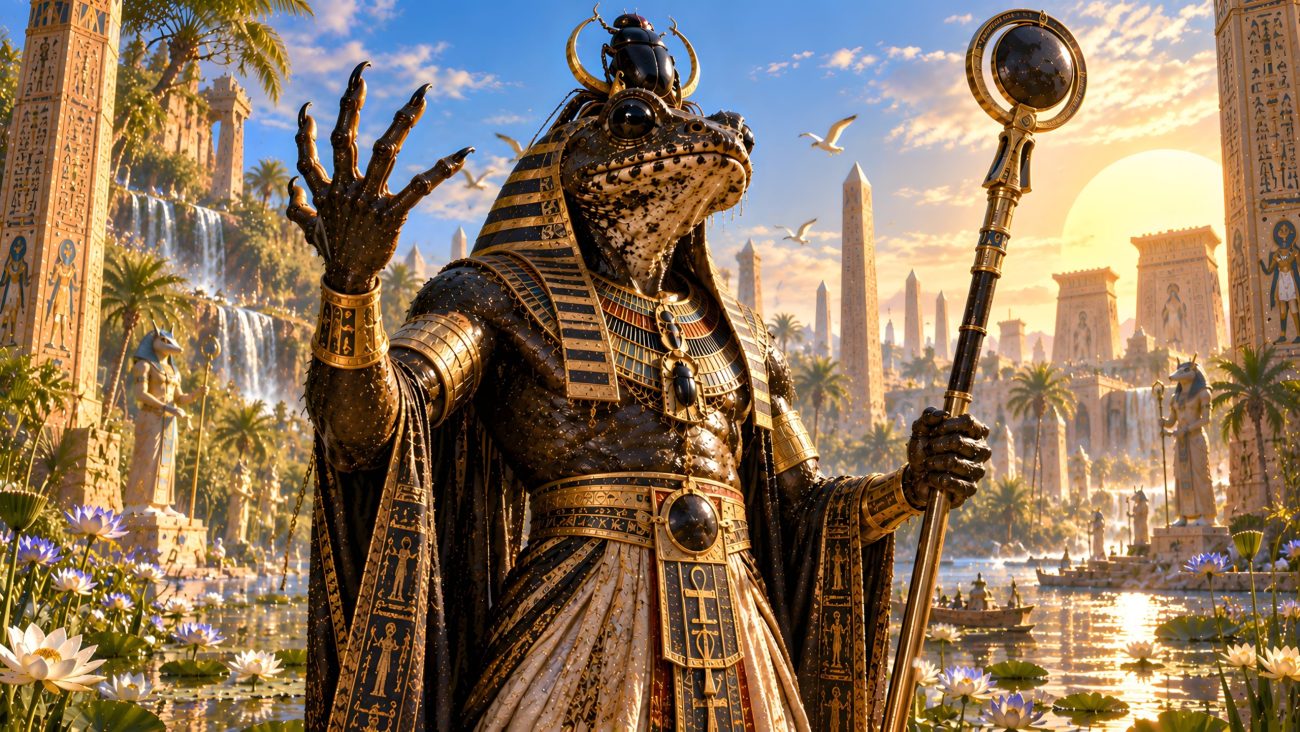
Kek is the ancient Egyptian deification of primordial darkness, one of the fundamental forces that existed before the creation of the world. He belongs to the Ogdoad of Hermopolis, a group of eight primordial deities arranged in four male-female pairs. Together, these divine beings represented the original conditions of existence from which creation emerged. Kek’s female counterpart is Kauket, who shares his association with darkness and the primordial world.

Kek is traditionally depicted as a man with the head of a frog, while Kauket appears as a woman with the head of a serpent. In some representations, Kek’s frog head is surmounted by a beetle, while Kauket’s serpent head bears a disk. These animal features distinguish the pair among the primordial gods and connect them with the mysterious forces that existed before the ordered world.

Kek and Kauket are also associated with night and day. Their complementary roles express the movement between darkness and the arrival of light, with Kek connected to the rising of the day and Kauket to the coming of night in certain traditions. As members of the Ogdoad, they embody the primordial darkness from which the ordered universe would eventually emerge.


Sources

“Kek (mythology).” Wikipedia: The Free Encyclopedia. Wikimedia Foundation. Accessed October 14, 2026. https://en.wikipedia.org/wiki/Kek_%28mythology%29


Llamhigyn y Dŵr

Tradition: Welsh Mythology
Alternative Names: Water Leaper
Category: Frog


The Myth

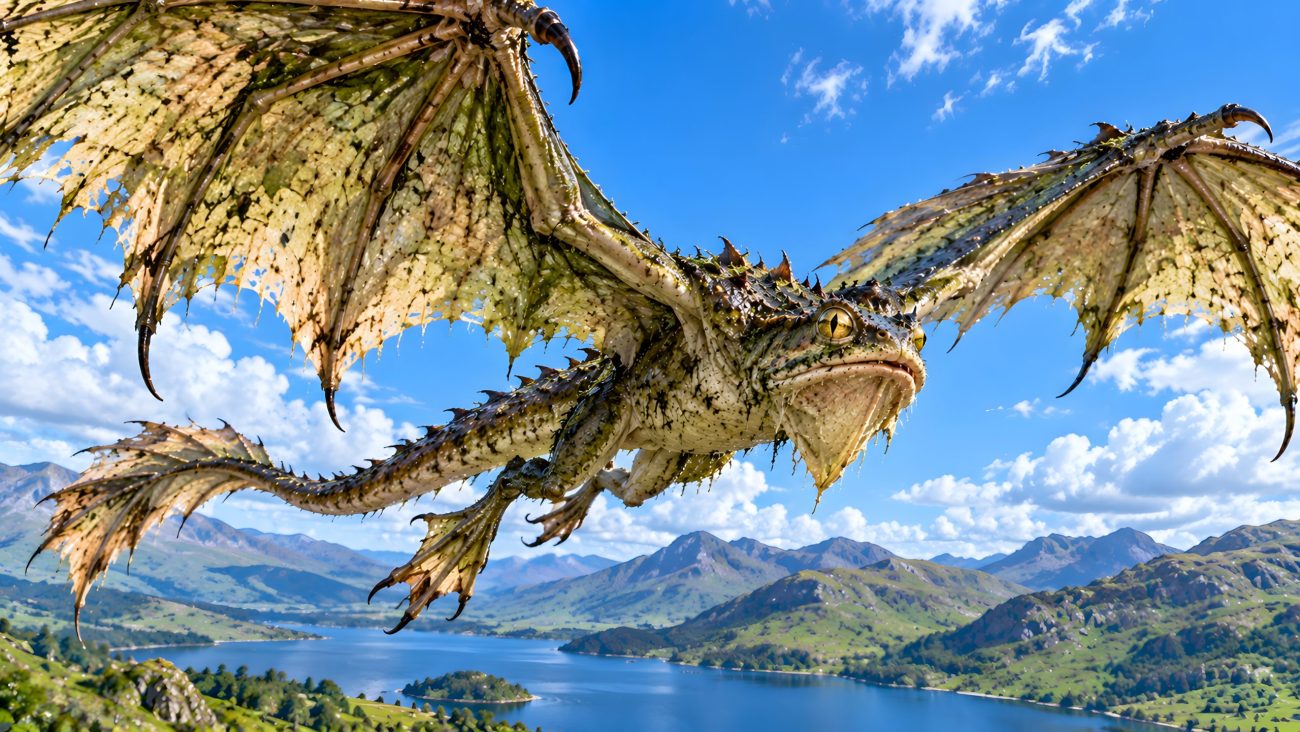
The Llamhigyn y Dŵr is a monstrous water spirit that inhabits lakes and other bodies of water in Wales, particularly around Llyn Gwynan and Llyn Glas. It resembles an enormous, grotesque toad, but instead of ordinary legs it has wings, and a long tail extends behind its body. It is a powerful swimmer and a dangerous predator that lurks beneath the water, waiting for unsuspecting prey to approach the shore.

The creature preys on sheep, dogs, and other animals that venture too close to the water’s edge. Shepherds know to keep their flocks away from the lakes, for the Water Leaper may suddenly spring from the water, seize an animal, and drag it beneath the surface. Its presence also torments fishermen, stealing their catches and taking bait directly from their hooks. Sometimes it seizes the entire fishing line, rod, and angler, pulling its victim into the lake with tremendous strength.

The Llamhigyn y Dŵr is known for its extraordinary speed and its terrifying shriek. One fisherman reportedly hooked the creature, only for it to emit an ear-splitting scream and nearly pull him from his boat. He escaped only because a companion was there to help him. Welsh fishermen regard the Water Leaper as a troublesome and dangerous inhabitant of their lakes, blaming it for lost fish, broken fishing lines, and unexplained disappearances near the water.


Sources

“Llamhigyn Y Dwr.” A Book of Creatures. July 1, 2015. https://abookofcreatures.com/2015/07/01/llamhigyn-y-dwr/