Kaeru Nyōbō

Tradition: Japanese Mythology
Alternative Names: Bikki no Yomekko, Frog Wife, Kaeru Nyobo
Category: Frog


The Myth

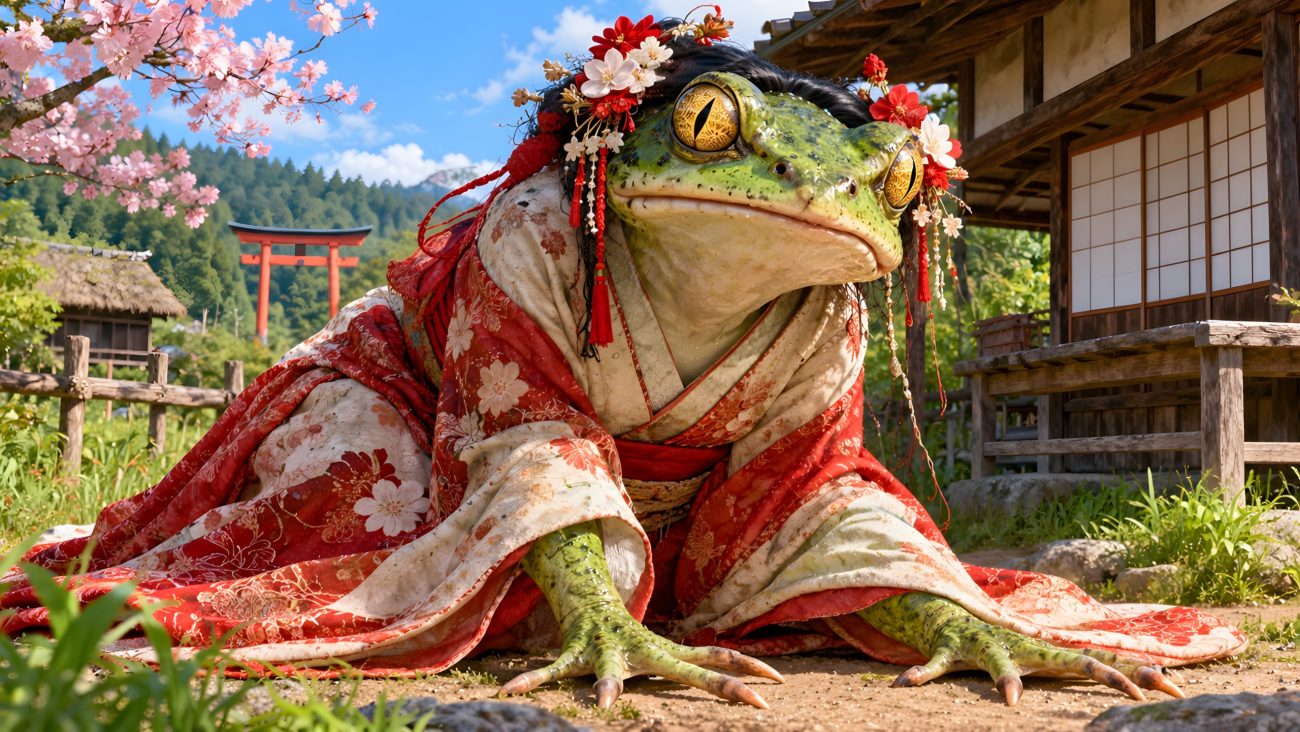
Kaeru Nyōbō, meaning “frog wife,” is a magical frog that transforms into a human woman to marry a human man. In her human form, she behaves like an ordinary wife, but she is usually extremely small and fragile, sometimes no taller than a child of three or four years. Although willing to help with household chores, she lacks the strength to perform heavy work. As long as her true identity remains hidden, she can live happily with her human husband for many years. However, if he discovers her secret and sees her transform back into a frog, the marriage ends in tragedy.

One legend tells of an impoverished old man and his son who desperately wished for a wife for the young man. One day, a tiny woman arrived at their door and asked whether they would accept her as a bride. The delighted father welcomed her, and she married his son. The woman was soaking wet despite the absence of rain, but the family warmed her by the fire and accepted her despite her unusual size. She could not perform heavy household work, yet the men were satisfied with their new family member.

Some time later, the woman needed to attend a memorial service for her father. Although they were poor, her husband and father-in-law gave her a sack of rice to bring as a gift. The load was so heavy that she was crushed flat beneath it. The men removed rice until only five cups remained, allowing her to regain her normal shape and carry the smaller load. Suspicious of her strange weakness, the old man told his son to follow her. The young husband watched her travel deep into the mountains until she reached a marsh, looked around, and leapt into the water. Unable to see her beneath the surface, he listened to the croaking of frogs and realized that they were speaking. His wife explained that the sack of rice had delayed her, and the frogs began chanting Buddhist prayers for the memorial service.

Horrified to discover that he had married a frog, the young man threw a rock into the water, striking the frog priest and abruptly silencing the prayers. He returned home and told his father what had happened. When his wife arrived later that night, she explained that a huge rock had fallen from the sky and struck the priest during the ceremony. Her husband confronted her, revealing that he had witnessed everything and had thrown the stone himself. The woman was devastated that her secret had been exposed. She covered her face in embarrassment, transformed back into a frog, and hopped out of the house. She was never seen again. The tale ends with a warning that one should not accept just anyone as a marriage partner simply because one is desperate to find a spouse.


Sources

“Kaeru Nyōbō (蛙女房).” Yokai.com: The Database of Japanese Folklore. https://yokai.com/kaerunyoubou/
Dousai

Tradition: Japanese Mythology
Alternative Names: Toad
Category: Frog


The Myth

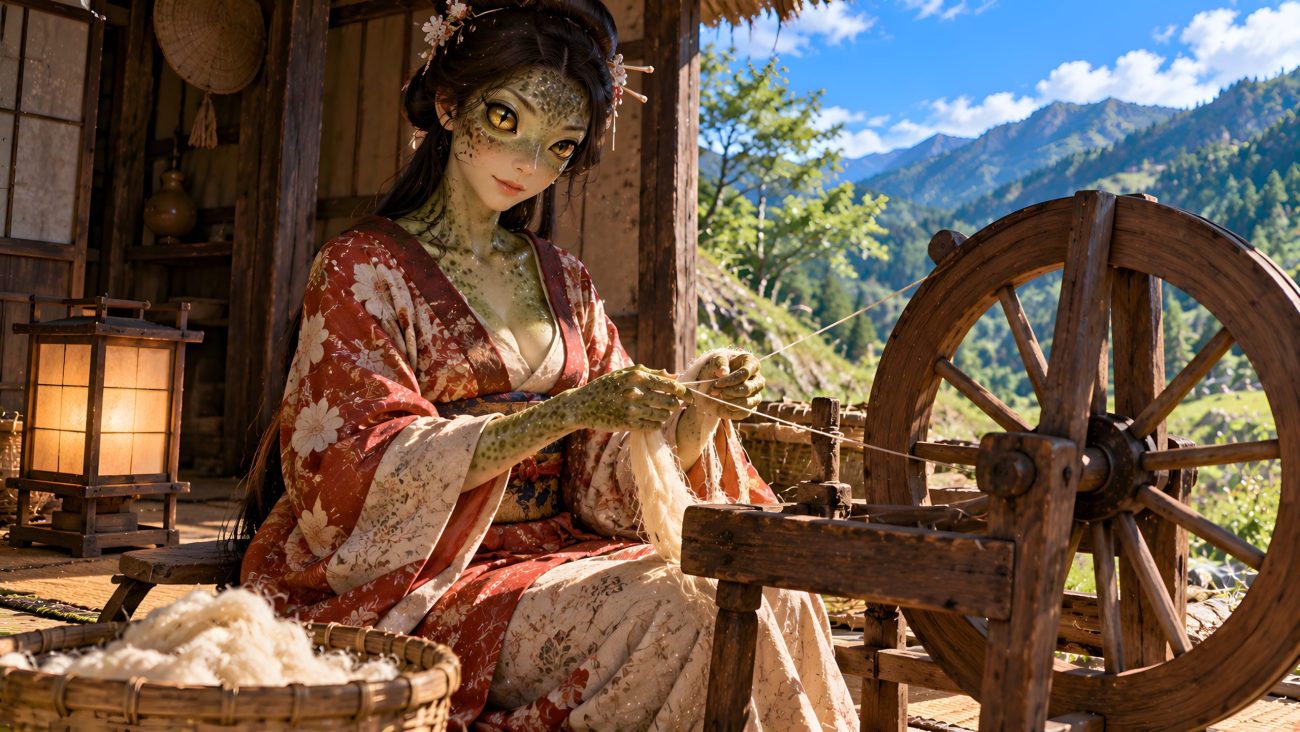
Dousai is a supernatural toad said to be capable of taking the form of a beautiful woman. One night, a woodcutter staying in a mountain hut witnessed a mysterious woman spinning thread on a spinning wheel by the light of a lantern. Her presence in the remote hut was strange, and the woodcutter grew suspicious of the apparition.

Remaining awake throughout the night, the woodcutter took aim with his gun and fired at the lantern. The bullet struck the Dousai in the eye, revealing the creature’s true nature. The toad died from the wound, ending its mysterious appearance in the mountain hut.


Sources

“道災 (Dōsai).” 新版TYZ 妖怪図鑑 (New TYZ Yokai Encyclopedia). https://tyz-yokai.blog.jp/archives/1010655107.html


Yadomori

Tradition: Japanese Mythology
Alternative Names: Toad Monster
Category: Frog


The Myth

Yadomori is a supernatural toad associated with a frightening warning against killing its kind. According to Japanese legend, anyone who kills a Yadomori will face a terrible consequence, as the slain toad transforms into a monstrous spirit that returns to haunt people in their beds.

The creature is depicted alongside Umakotsu, a supernatural being associated with horse bones, in the Tosa Obake Zōshi, a Japanese ghost scroll. Its legend centres on vengeance after death, portraying the toad as a creature whose killing can bring about a terrifying supernatural visitation.


Sources

“宿守 (Yadomori).” 新版TYZ 妖怪図鑑 (New TYZ Yokai Encyclopedia). https://tyz-yokai.blog.jp/archives/1010654263.html


Ōgama

Tradition: Japanese Mythology
Alternative Names: Bakegama, Giant Toad
Category: Frog


The Myth

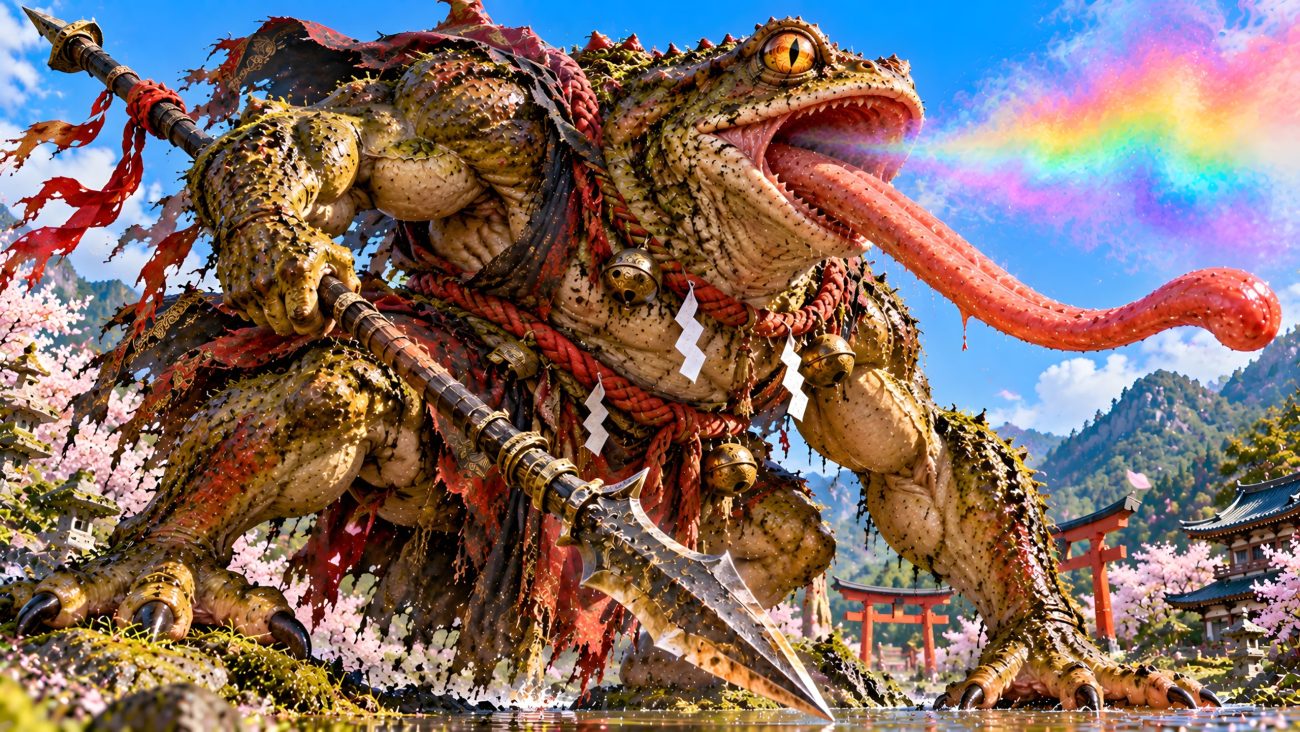
Ōgama are enormous supernatural toads that inhabit remote mountains and rivers. They can grow to incredible sizes, becoming more dangerous as they age. Their bodies may be so large that they resemble boulders or other natural features, allowing them to remain unnoticed beside ponds and streams. Their long, powerful tongues are both agile and sticky, capable of snatching creatures and dragging them into their enormous mouths. When they exhale, their breath appears in rainbow colours. Some Ōgama can also wield spears to attack humans and transform themselves into human shapes to deceive unsuspecting travellers.

According to Japanese tradition, an ordinary Japanese toad becomes an Ōgama after living for a thousand years. These creatures retain many of the habits of ordinary toads, hunting insects, birds, and snakes in the wilderness. They breathe their strange rainbow-coloured vapour upon their prey before catching it with their powerful tongues. Although they usually avoid human settlements, the largest Ōgama may regard humans as food once they grow beyond three metres in length. Even smaller individuals can be dangerous when provoked, using their intelligence and weapons to pursue people.

In Miyagi Prefecture, a famous marksman heard stories of an old woman who appeared at a dilapidated house beside a bridge every night to spin thread. Her neighbours feared that she was a demon. When the marksman first confronted her, her disturbing smile and cackle frightened him so much that he fired at her heart. The lantern beside her immediately went out, plunging the surroundings into darkness. The next morning, the woman had disappeared without a trace. Several nights later, he returned and fired directly at her lantern instead. This time, he heard a terrible shriek and a clattering sound as the light vanished. At dawn, he discovered the corpse of an enormous, hideous toad where the old woman had stood. The mysterious woman had been an Ōgama in disguise.

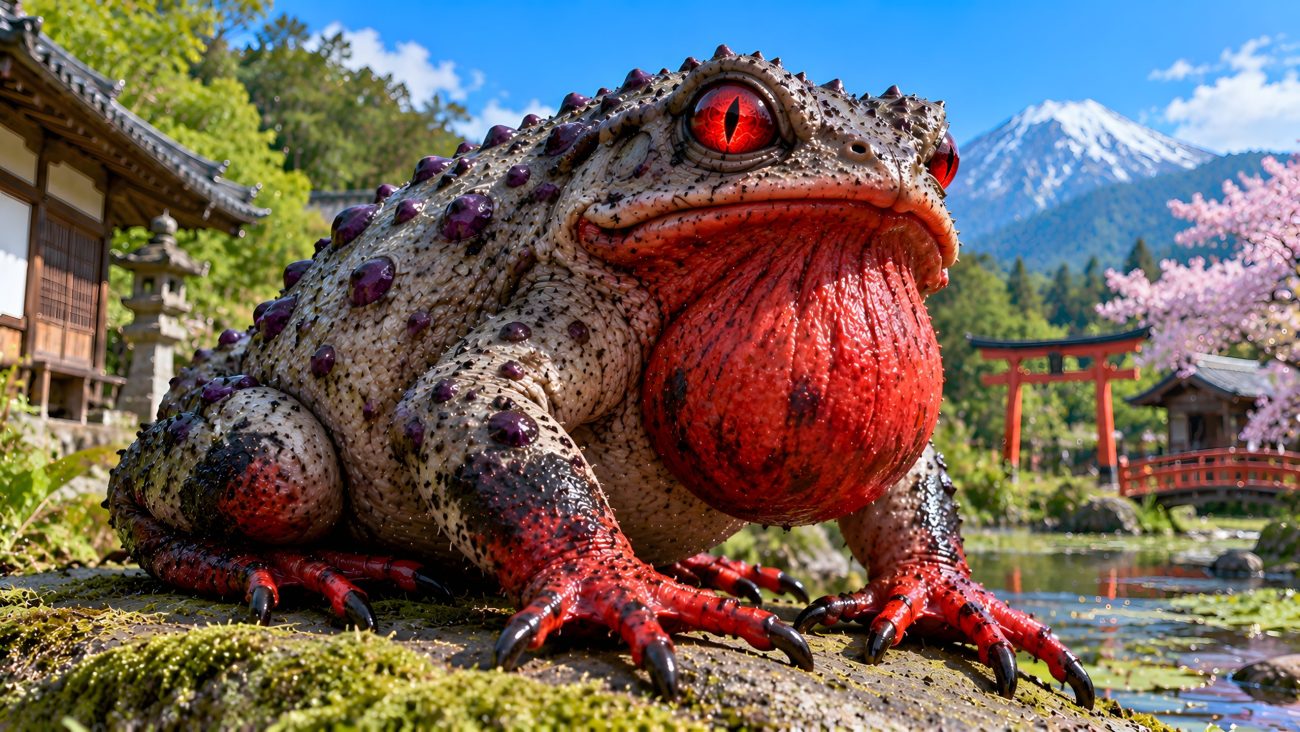
Another encounter occurred in the mountains of Niigata Prefecture, where a man went fishing beside a secluded pond. He settled comfortably upon a large boulder at the water’s edge and cast his line. A fisherman on the opposite bank suddenly noticed something horrifying and hurriedly gathered his equipment before fleeing. He motioned for the other man to follow, and once they had escaped into the woods, he explained what he had witnessed: the supposed boulder had opened an enormous eye, red as fire, and yawned. When the two men returned to investigate, the boulder had vanished completely. The object on which the fisherman had been sitting was actually a gigantic Ōgama, resting motionless beside the pond until its true nature was revealed.


Sources

“Ōgama (大蝦蟇).” Yokai.com: The Database of Japanese Folklore. https://yokai.com/oogama/