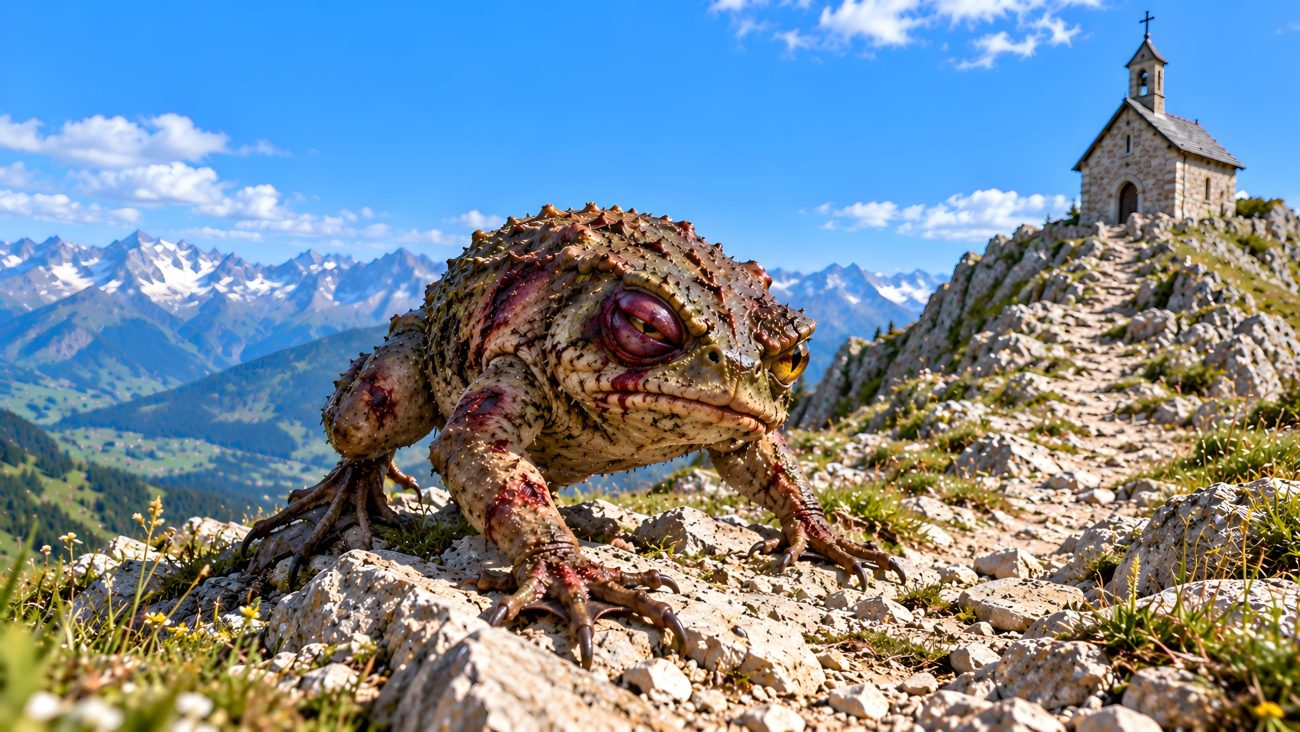
Aptakh-Baga

Tradition: Yakut Mythology, Russian Mythology
Alternative Names: Apt aakh baga, Aptah-Bag, Magic Frog
Category: Frog


The Myth

Aptakh-Baga is a magical frog with two heads, feared and revered for its supernatural powers. According to Yakut beliefs, the creature could be captured in thick grass at sunrise, wrapped in birch bark, and thrown into an anthill. Whoever captured it had to flee immediately, without listening to the screams of the unfortunate frog as the ants devoured it alive. Three days later, the person had to return to the anthill and retrieve two of the frog’s bones.

These magical bones granted their owner the power to influence other people. One bone, shaped like a hook, had to be sewn into the inside of the right sleeve, while the other, shaped like a slingshot, was sewn into the left sleeve. Touching someone with the right hand allowed the owner to gain that person’s favour, while touching someone with the left hand made the person leave them alone. The bones could therefore be used to win affection or drive away unwanted attention.

However, the magical bones brought their own troubles. During summer, frogs gathered around their owner from every direction, even when the bones were brushed aside with the left hand. Those who lacked a change of clothing had to cut the bones from their sleeves and hide them carefully. Despite their powers, using the remains of Aptakh-Baga was considered a grave sin among the Yakuts.


Sources

“Аптах-Бага (Aptah-Baga).” New Bestiary (Bestiary.us). https://www.bestiary.us/aptah-baga
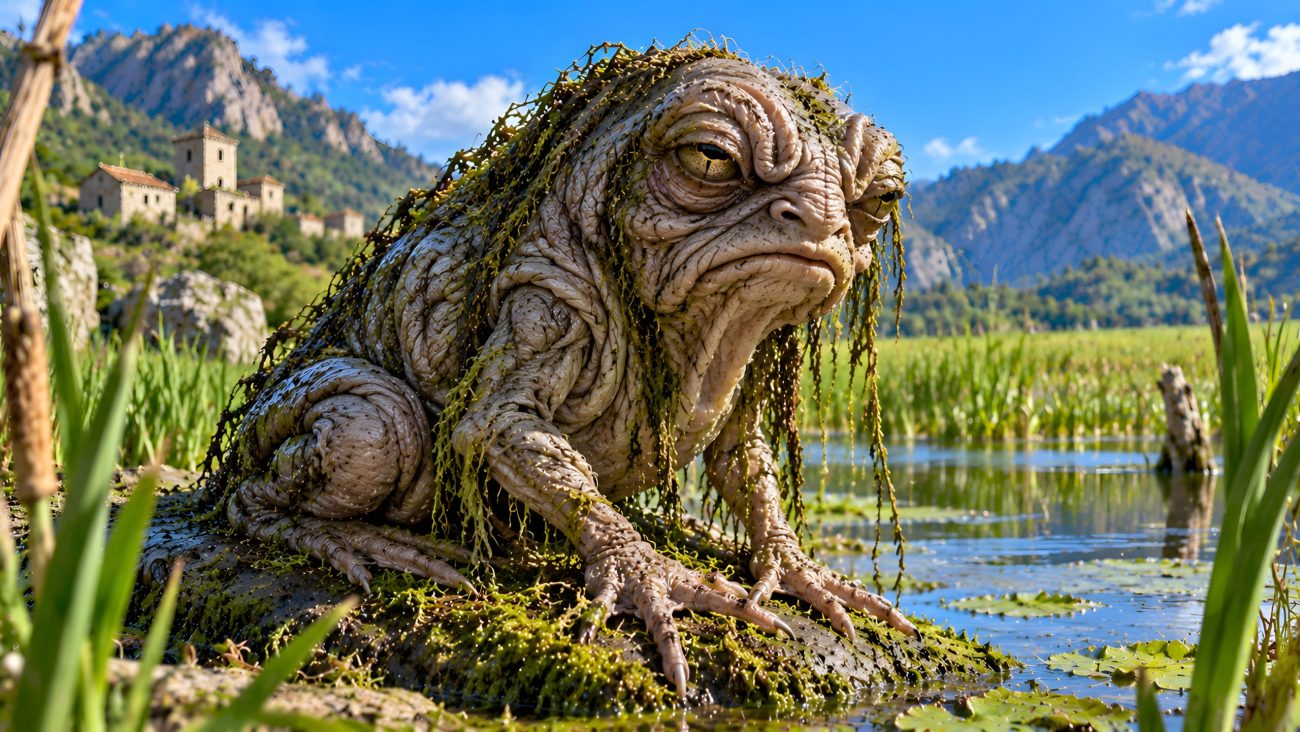

Ljaura

Tradition: Albanian Mythology
Alternative Names: Lyauri, Laura, Laurë
Category: Frog


The Myth

Ljaura is a malevolent supernatural creature from Albanian mythology, usually appearing as an ugly, old woman. She possesses the ability to transform into a small amphibian and is associated with swamps, lakes, and rivers. Although her true appearance is that of a hag, she can hide herself in the water, making her difficult to find.

Ljaura emerges at night along the banks of lakes and rivers, where her eerie cries disturb the darkness. Her voice is hoarse and unsettling, sounding like weeping, sobbing, or a strange trumpet call. If anyone approaches her, she immediately disappears beneath the water. Sometimes she ventures onto roads, where her cries mingle with the barking of village dogs. The dogs seem to sense her presence and begin pursuing her furiously, even when she cannot easily be seen.

The creature is particularly associated with the area around Tirana, where people fear her as an ominous presence near bodies of water. Her nighttime appearances and strange cries make her a frightening figure, an elusive old hag who shifts between human and amphibian forms before vanishing into the darkness.


Sources

“Laura (Ляура).” New Bestiary (Bestiary.us). https://www.bestiary.us/lyaura


Chmuch

Tradition: Polish Mythology
Alternative Names: Ćmuch, Chmukh
Category: Frog


The Myth

Chmuch is a mysterious water demon that inhabits lakes, ponds, and swamps. It resembles an enormous toad about the size of a dog, with a broad, frog-like body, small rounded ears, and a short tail that curls upward to a point. Despite its fearsome reputation, nobody has ever reliably seen the creature with their own eyes, and its appearance is known only through stories passed down by those who claim to have encountered it.

The Chmuch is said to sense approaching intruders long before they can discover it. Its presence is revealed by strange disturbances around the water: a sudden splash as something invisible plunges beneath the surface, an unexpected swirl of air above the water, or peculiar gurgling and splashing sounds coming from a particular spot. The creature quickly escapes into the water, leaving witnesses unable to explain how it managed to avoid being seen. Unlike other evil spirits, the Chmuch does not approach or attack people. Instead, it frightens them, particularly those considered lazy or unwilling to work.

Because of this reputation, people were wary of places where the Chmuch was believed to dwell. Yet anyone who claimed to have seen the demon risked being mocked as both lazy and foolish, since the creature was supposedly interested in frightening only idle people. This belief made it difficult for anyone to speak openly about an encounter without inviting ridicule, and may explain why the elusive Chmuch remained a mysterious creature known almost entirely through hearsay.


Sources

“Чмух (Chmukh).” New Bestiary (Bestiary.us). https://www.bestiary.us/chmukh


Kaeru Nyōbō

Tradition: Japanese Mythology
Alternative Names: Bikki no Yomekko, Frog Wife, Kaeru Nyobo
Category: Frog


The Myth

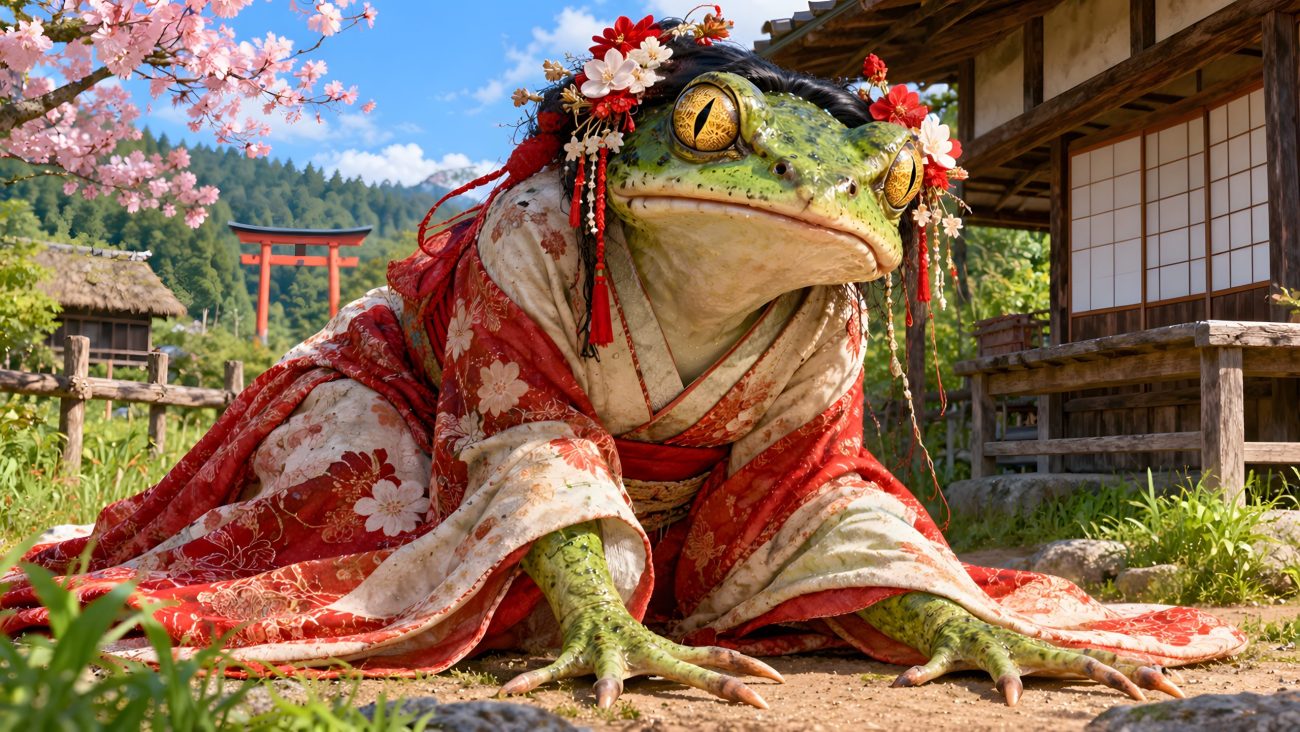
Kaeru Nyōbō, meaning “frog wife,” is a magical frog that transforms into a human woman to marry a human man. In her human form, she behaves like an ordinary wife, but she is usually extremely small and fragile, sometimes no taller than a child of three or four years. Although willing to help with household chores, she lacks the strength to perform heavy work. As long as her true identity remains hidden, she can live happily with her human husband for many years. However, if he discovers her secret and sees her transform back into a frog, the marriage ends in tragedy.

One legend tells of an impoverished old man and his son who desperately wished for a wife for the young man. One day, a tiny woman arrived at their door and asked whether they would accept her as a bride. The delighted father welcomed her, and she married his son. The woman was soaking wet despite the absence of rain, but the family warmed her by the fire and accepted her despite her unusual size. She could not perform heavy household work, yet the men were satisfied with their new family member.

Some time later, the woman needed to attend a memorial service for her father. Although they were poor, her husband and father-in-law gave her a sack of rice to bring as a gift. The load was so heavy that she was crushed flat beneath it. The men removed rice until only five cups remained, allowing her to regain her normal shape and carry the smaller load. Suspicious of her strange weakness, the old man told his son to follow her. The young husband watched her travel deep into the mountains until she reached a marsh, looked around, and leapt into the water. Unable to see her beneath the surface, he listened to the croaking of frogs and realized that they were speaking. His wife explained that the sack of rice had delayed her, and the frogs began chanting Buddhist prayers for the memorial service.

Horrified to discover that he had married a frog, the young man threw a rock into the water, striking the frog priest and abruptly silencing the prayers. He returned home and told his father what had happened. When his wife arrived later that night, she explained that a huge rock had fallen from the sky and struck the priest during the ceremony. Her husband confronted her, revealing that he had witnessed everything and had thrown the stone himself. The woman was devastated that her secret had been exposed. She covered her face in embarrassment, transformed back into a frog, and hopped out of the house. She was never seen again. The tale ends with a warning that one should not accept just anyone as a marriage partner simply because one is desperate to find a spouse.


Sources

“Kaeru Nyōbō (蛙女房).” Yokai.com: The Database of Japanese Folklore. https://yokai.com/kaerunyoubou/


Dousai

Tradition: Japanese Mythology
Alternative Names: Toad
Category: Frog


The Myth

Dousai is a supernatural toad said to be capable of taking the form of a beautiful woman. One night, a woodcutter staying in a mountain hut witnessed a mysterious woman spinning thread on a spinning wheel by the light of a lantern. Her presence in the remote hut was strange, and the woodcutter grew suspicious of the apparition.

Remaining awake throughout the night, the woodcutter took aim with his gun and fired at the lantern. The bullet struck the Dousai in the eye, revealing the creature’s true nature. The toad died from the wound, ending its mysterious appearance in the mountain hut.


Sources

“道災 (Dōsai).” 新版TYZ 妖怪図鑑 (New TYZ Yokai Encyclopedia). https://tyz-yokai.blog.jp/archives/1010655107.html


Káchabuké

Tradition: Costa Rica Mythology
Alternative Names: Achiote Frog, Achiote Red Frog
Category: Frog


The Myth

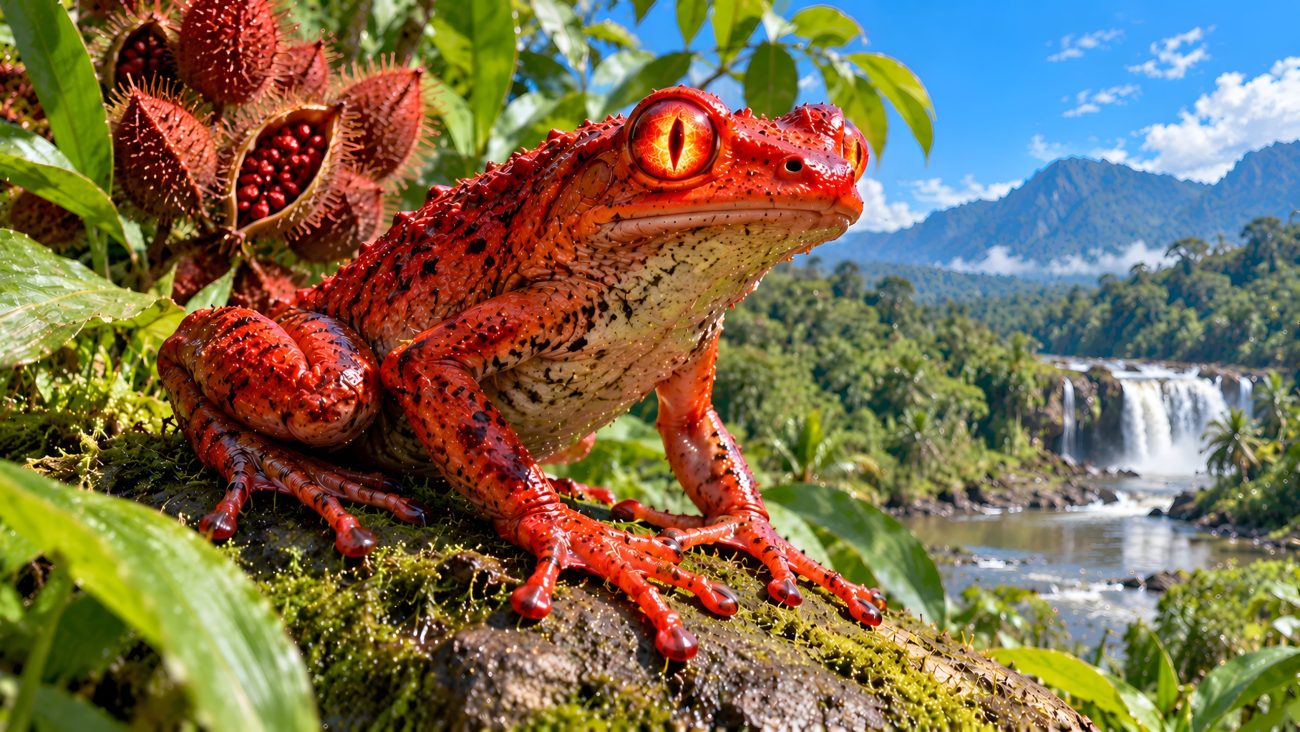
Káchabuké is a poisonous frog involved in the creation of the magical Duluítami tree in Talamancan mythology. The creature was chosen by Sibö, the creator deity, to guard the body of Bulumia after her death. Sibö wrapped her corpse in bijagua leaves and brought it to the ground, where he placed Káchabuké on her belly. He commanded the little frog to remain there for four days without moving, warning that it would be held responsible if anything happened to the body. Proud to have been entrusted with this important duty, Káchabuké settled down to keep watch.

As night fell, however, strange noises emerged from Bulumia’s belly, resembling the sound of ocean waves. The frog grew frightened by the sounds and its loneliness, while hunger gradually became unbearable. Sibö sent a bumblebee for Káchabuké to catch and eat, but the little frog failed to seize it. When the bee collided with some trees and landed, Káchabuké leapt away from its post to catch it. At that moment, the frog heard a gust of wind and hurried back to the corpse, but it was too late. Bulumia’s belly had separated from her body, and a small tree called Duluítami had emerged from within it. This magical tree would give rise to the sea and other sources of water.

The next day, Sibö returned and found Káchabuké playing while the young Duluítami tree stood nearby. When Sibö demanded to know why the frog had disobeyed his command, Káchabuké explained that hunger had driven it to chase the bumblebee. Sibö punished the creature for abandoning its duty by placing it in a tree and transforming it into the fruit of the achiote plant, whose reddish fruits gave the frog its name.


Sources

“Talamancan mythology.” Wikipedia: The Free Encyclopedia. Wikimedia Foundation. Accessed October 14, 2026. https://en.wikipedia.org/wiki/Talamancan_mythology


Sapo Fuerzo

Tradition: Chilean Mythology
Alternative Names: Strong Toad
Category: Frog


The Myth

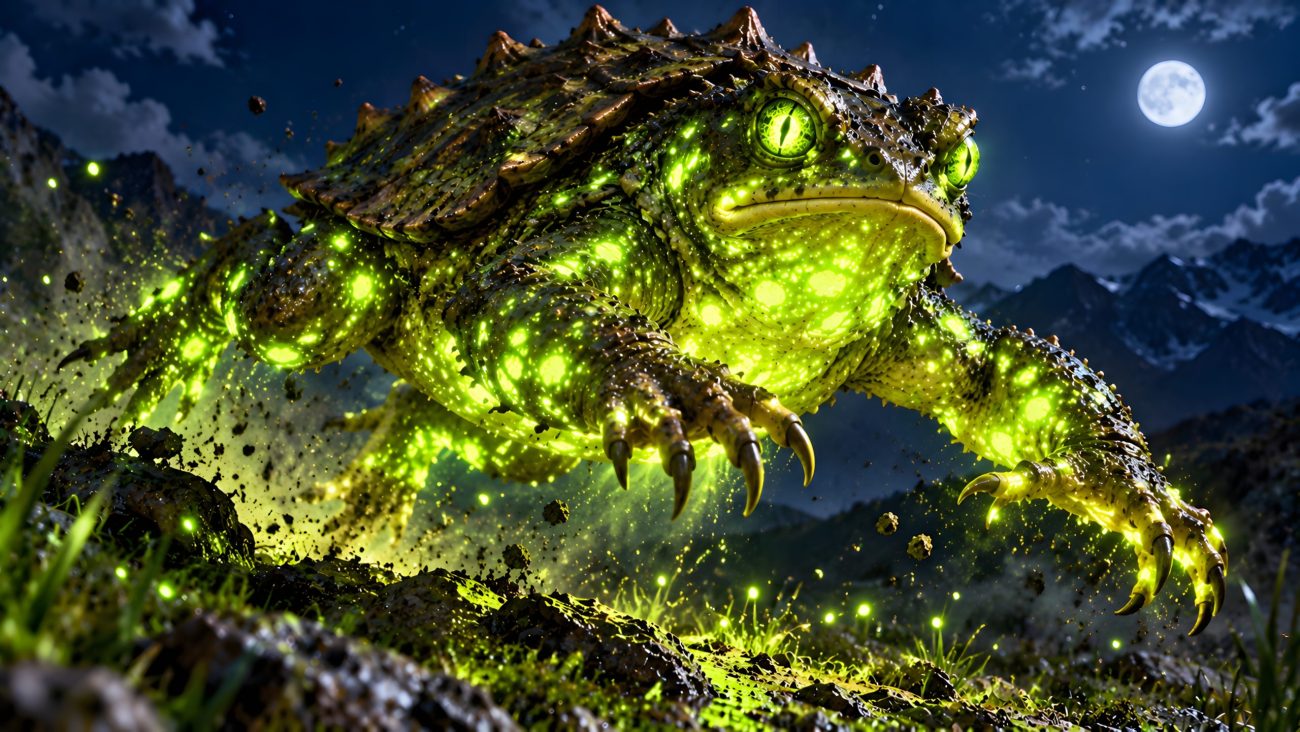
The Sapo Fuerzo, meaning “strong toad,” is a remarkable amphibian said to inhabit the Andes of Chile. Unlike ordinary toads, it possesses a hard, turtle-like shell that protects its body. Its most striking feature is its phosphorescent skin, which glows in the darkness like a firefly, making the creature appear as a mysterious light among the mountains.

The Sapo Fuerzo is renowned for its extraordinary supernatural powers and incredible resilience. Through the sheer force of its gaze, it can attract or repel anything within its reach, drawing objects toward itself or forcing them away. This power makes the creature a formidable presence, capable of influencing its surroundings without physical contact.

The toad is also virtually impossible to kill because of its remarkable ability to regenerate and recover from almost any injury. Wounds that would destroy an ordinary animal are not enough to end its life. There is only one way to kill a Sapo Fuerzo permanently: it must be burned until its body has been completely reduced to ashes. Only then can its extraordinary powers of recovery be overcome.


Sources

“Sapo Fuerzo.” A Book of Creatures. March 20, 2015. https://abookofcreatures.com/2015/03/20/sapo-fuerzo/


Toad and the Carriage Driver

Tradition: Austrian Mythology
Alternative Names: The Seefeld Toad
Category: Frog


The Myth

A mysterious toad once jumped onto the cart of a carriage driver from Innsbruck as he travelled through Leithen. No matter how often the driver tried to shoo the creature away, it kept returning to sit beside him. Unable to rid himself of the persistent passenger, he continued his journey with the toad accompanying him.

When the driver finally stopped in the church square of Seefeld, the toad suddenly disappeared, and a beautiful young woman appeared beside him. She explained that during her lifetime she had promised to make a pilgrimage to Seefeld but had failed to fulfil her vow. After her death, she was forced to undertake the journey in the form of a toad, crawling along the road until she could reach the sacred destination.

The woman explained that she had finally been freed from her punishment because a kind person had carried her along the way. Grateful to the driver for helping her complete the pilgrimage, she thanked him and disappeared into the church. She was never seen again.


Sources

“Die Kröte.” SAGEN.at – Tiroler Sagen (Seefeld). Reproduced by SAGEN.at. https://www.sagen.at/texte/sagen/oesterreich/tirol/seefeld/kroete.htm


Giant Toad of Zurich

Tradition: Swiss Mythology
Alternative Names: Charlemagne’s Giant Toad
Category: Frog


The Myth

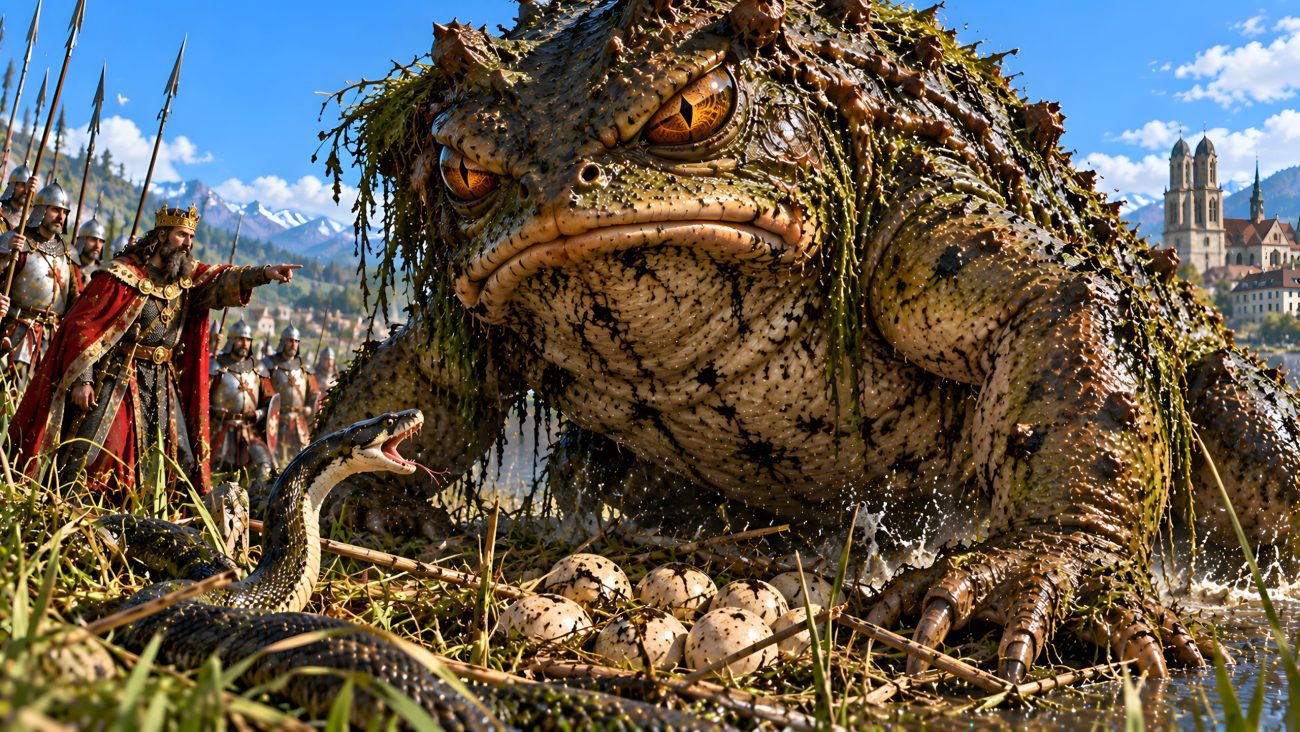
A gigantic, hideous toad once lived among the reeds at the outflow of Lake Zurich, where the Limmat River begins. The creature had settled directly upon a snake’s eggs, threatening the offspring of a serpent that would eventually seek justice from Emperor Charlemagne. The toad was so enormous and dreadful that its presence astonished the emperor when the snake led him to its nest.

The strange events began when a snake repeatedly rang a small bell attached to a pillar in Zurich, where anyone seeking justice could summon Charlemagne while he held court. At first, the emperor’s soldiers could find nobody ringing the bell. Eventually, one soldier discovered a snake coiled around the rope, pulling it to attract the emperor’s attention. Charlemagne approached the serpent, which bowed before him and led him to its nest among the reeds. There, the emperor discovered the enormous toad crouching upon the snake’s eggs.

Recognizing the creature as a threat to the snake’s offspring, Charlemagne ordered the toad removed and condemned it to death by burning. The snake’s appeal had thus been answered, and justice was carried out against the creature that had threatened its young. Some time later, the grateful serpent visited the emperor in his residence, climbed onto his table, and dropped a sparkling gemstone into his golden goblet before disappearing forever. Believing the event to be a sign from Heaven, Charlemagne ordered a church built over the place where he had discovered the snake’s nest. The church became known as the Water Church, while the emperor gave the precious gemstone to his wife, who wore it in a golden capsule over her heart for the rest of her life.


Sources

“Kaiser Karl und die Schlange.” SAGEN.at – Traditionelle Sagen aus der Schweiz. Reproduced by SAGEN.at. https://www.sagen.at/texte/sagen/schweiz/allgemein/kaiser_karl_schlange.html


Salve-Toad

Tradition: Austrian Mythology
Alternative Names: Toad of the Hohe Salve
Category: Frog


The Myth

The Salve-Toad is a supernatural creature associated with the Hohe Salve mountain in Tyrol, Austria. It is said to be the transformed soul of a brigand who lived a wicked life and failed to fulfil a sacred vow. After death, he was condemned to crawl up the mountain in the form of a toad and seek redemption inside the chapel dedicated to St. John the Baptist. His punishment forced him to struggle slowly up the steep mountain while carrying the burden of his past crimes.

According to the legend, the brigand had promised to make a pilgrimage to the summit of the Hohe Salve if Heaven would help him escape his evil companions and return to a righteous life. Although he received the assistance he had prayed for, he forgot his vow. After his death, he was transformed into a toad and compelled to climb the mountain. When he finally reached the chapel, people at the entrance repeatedly pushed and kicked him away, preventing him from entering. Nevertheless, the determined creature continued trying until at last it managed to crawl inside.

Once within the chapel, the toad crawled three times around the altar. At that moment, the curse was lifted, and the creature was instantly transformed into a handsome man. He addressed the people praying there, recounting his former life as a brigand and the long, painful penance he had endured. After revealing his story, he suddenly disappeared, leaving the worshippers to wonder at the strange event.

Another version of the legend tells of a remorseful mother whose son had become the leader of a band of robbers and murderers. After he refused to surrender to justice, a vision of the ghastly head of St. John the Baptist appeared to him in a dream, prompting him to give himself up. He was executed alongside his companions, and his mother buried their heads together on the mountain. In deep repentance, she sold all her possessions and used the money to build the chapel that still stands on the summit of the Hohe Salve.


Sources

Von Günther, Amalia. Tales and Legends of the Tyrol. London: Chapman and Hall, 1874.