Aglebemu

Tradition: Wabanaki Mythology, American Mythology
Alternative Names: Aglabemu, Akwulabemu, Aglebemoo, Hahk-lee-be-mo, Ablegemoo, Ablegemu, Mitche-hant, Kci Cekolhs, Kci-Coqols, Giant Frog, Monster Frog
Category: Frog


The Myth

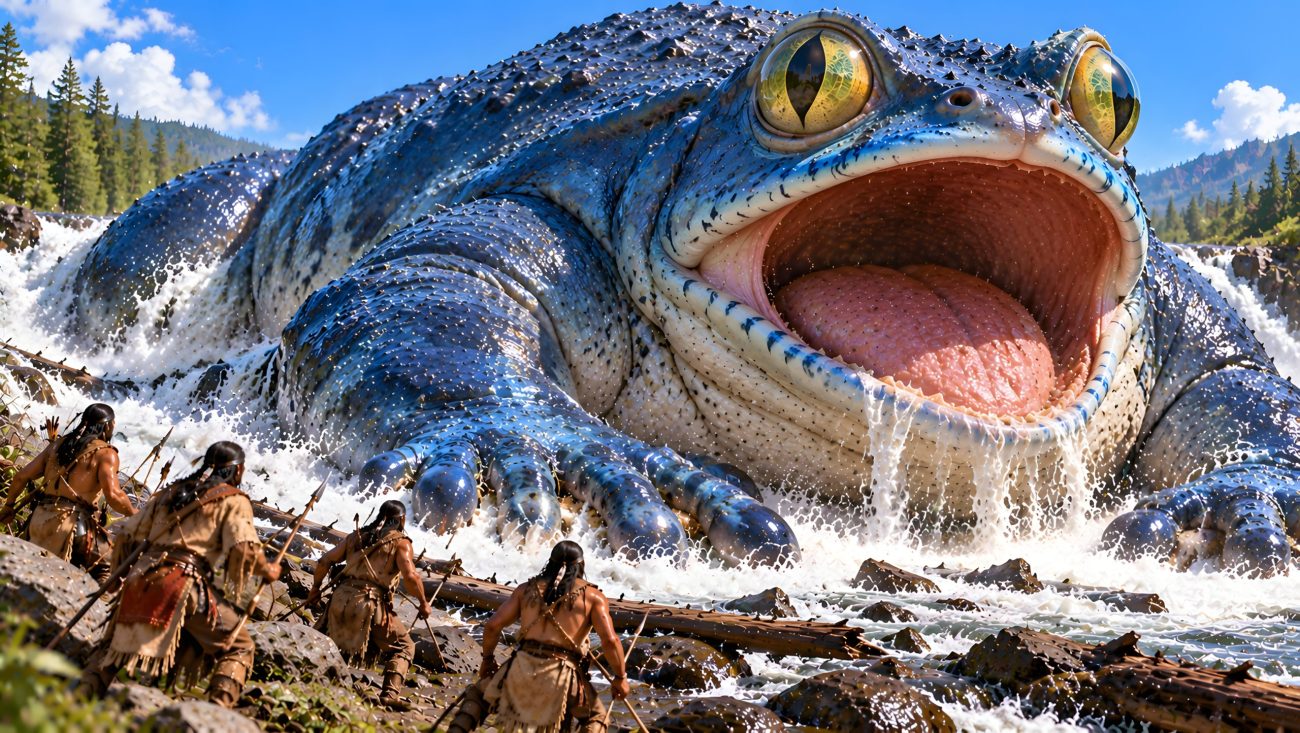
Aglebemu is a gigantic frog-like monster from the traditions of the Penobscot, Maliseet, and Passamaquoddy peoples. Known as the Giant Frog or Monster Frog, it is associated with great lakes and rivers. Its immense size and supernatural power allow it to obstruct entire waterways, making it a dangerous creature capable of bringing disaster to the surrounding lands.

In one of the creature’s most notorious deeds, Aglebemu dammed a great river, often identified as either the St. John River or the Penobscot River. By blocking the flow of water, the monster caused the river to run dry and brought a devastating drought upon the land. The people suffered as the water disappeared, and the creature’s power threatened their survival.

The culture hero Glooskap eventually confronted and defeated Aglebemu, ending the threat it posed to the river and the surrounding people. After its defeat, the enormous monster was transformed into an ordinary bullfrog. Some traditions call the creature Kci Cekolhs or Kci-Coqols, meaning Giant Frog, while Mitche-hant is a broader name meaning evil creature that can refer to various monsters.


Sources

“Aglebemu: The Giant Frog.” Native Languages of the Americas. https://www.native-languages.org/aglebemu.htm
Toad of Grafenberg

Tradition: Liechtenstein Mythology
Alternative Names: The Treasure Toad of the Old Castle
Category: Frog


The Myth

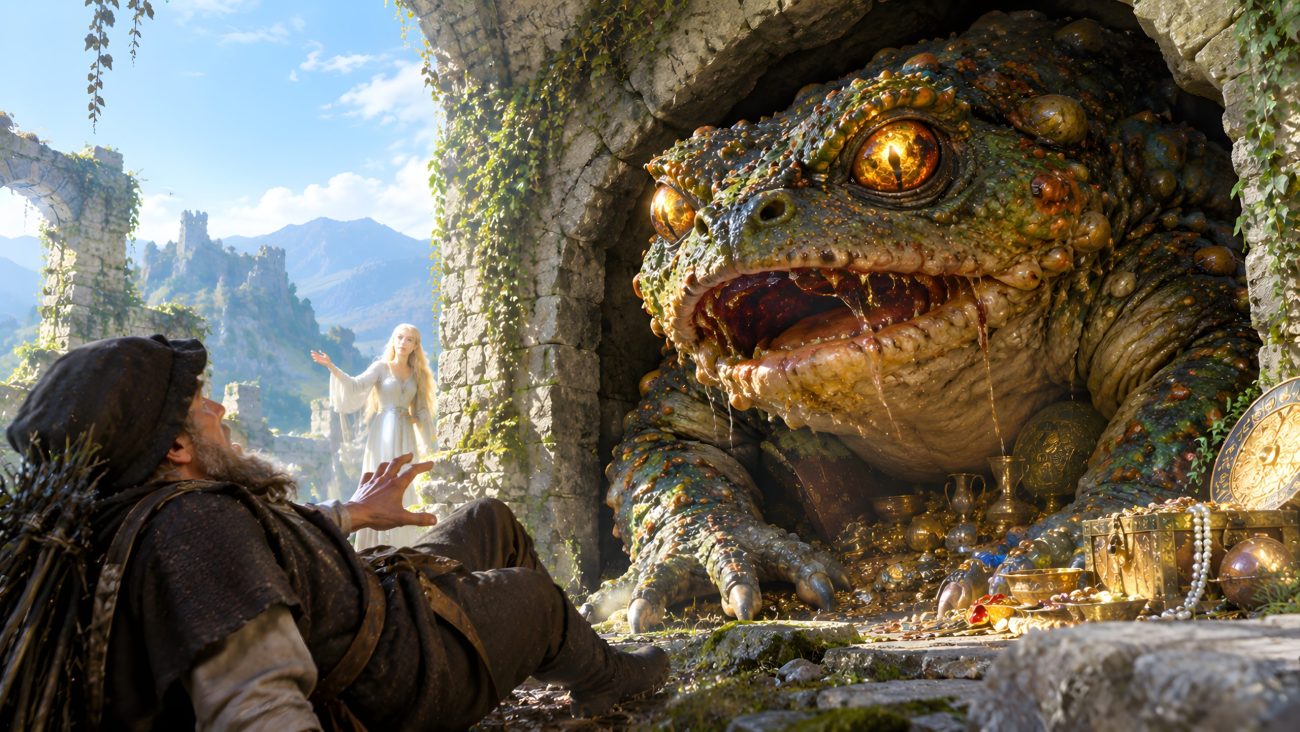
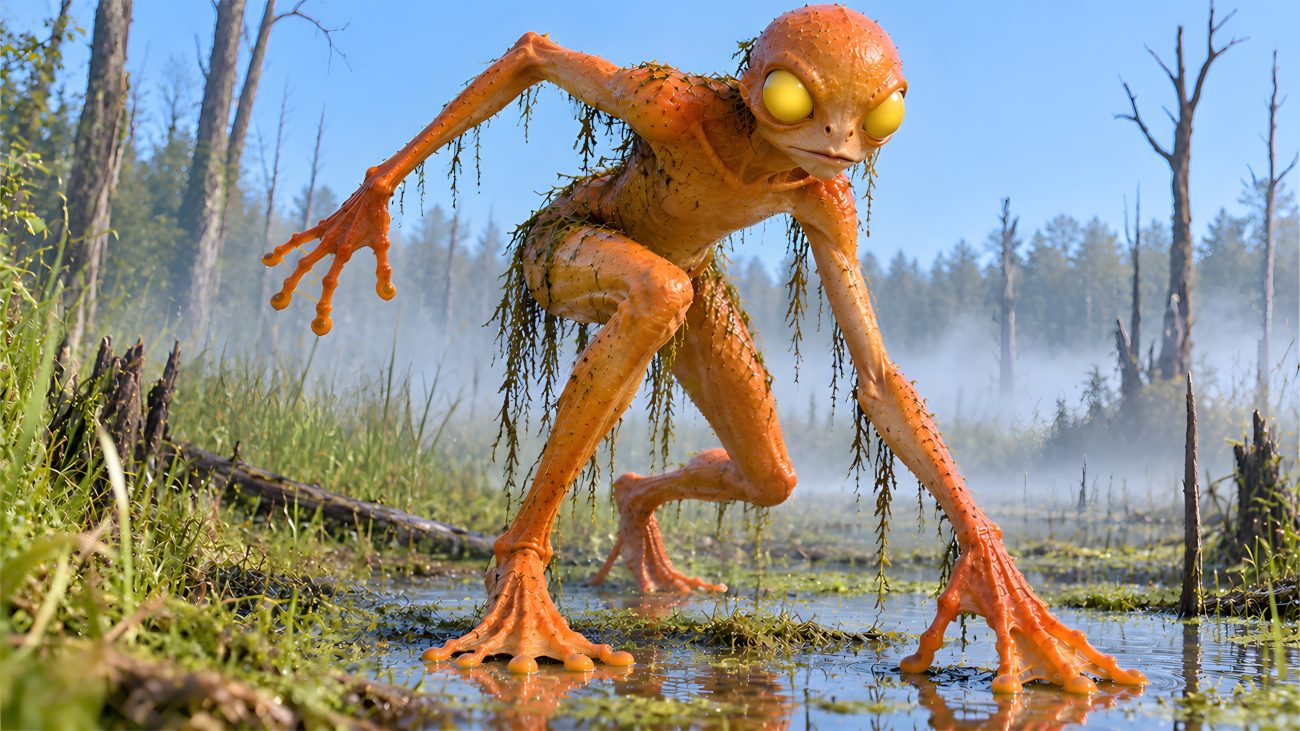
The Toad of Grafenberg is a mysterious supernatural creature that guards a hidden treasure within a vault beneath the ruins of the old castle Grafenberg in Liechtenstein. It appears as a wild, monstrous toad concealed in a niche in the wall. When disturbed, it grows larger and larger, while its eyes sparkle and spit fire. The creature’s terrifying appearance makes it a formidable obstacle for anyone seeking the treasure.

One day, an old chimney sweep from Balzers was gathering brushwood for making brooms in the undergrowth near a place known as the Old Schlüssle. Tired from his work, he sat down to rest upon an old wall. Suddenly, a maiden appeared before him and silently beckoned him to follow her. She led him into a great underground vault, where she revealed that he could become wealthy and free her from her enchantment if he knocked down the wild toad hidden in a niche in the wall.

The chimney sweep approached the creature and attempted to touch it, but the toad began to grow enormously. Its eyes glittered and spewed fire, filling him with terror. Unable to overcome his fear, the man leapt away and fled. In an instant, he found himself back at the very spot where he had originally sat down to rest. The treasure remained undiscovered, and the maiden’s enchantment remained unbroken.


Sources

“Grafenberg.” SAGEN.at – Liechtensteiner Sagen, collected by Otto Seger. https://www.sagen.at/texte/sagen/liechtenstein/seger/grafenberg.html


Ōgama

Tradition: Japanese Mythology
Alternative Names: Bakegama, Giant Toad
Category: Frog


The Myth

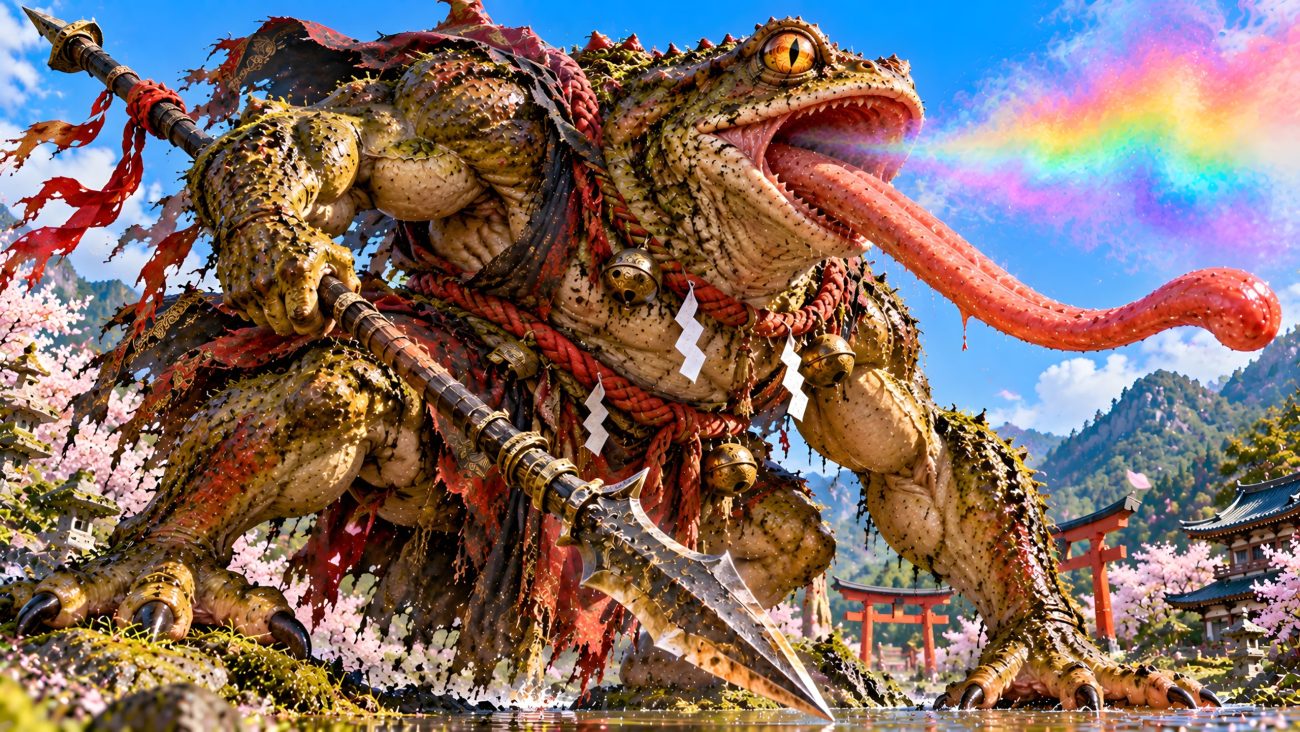
Ōgama are enormous supernatural toads that inhabit remote mountains and rivers. They can grow to incredible sizes, becoming more dangerous as they age. Their bodies may be so large that they resemble boulders or other natural features, allowing them to remain unnoticed beside ponds and streams. Their long, powerful tongues are both agile and sticky, capable of snatching creatures and dragging them into their enormous mouths. When they exhale, their breath appears in rainbow colours. Some Ōgama can also wield spears to attack humans and transform themselves into human shapes to deceive unsuspecting travellers.

According to Japanese tradition, an ordinary Japanese toad becomes an Ōgama after living for a thousand years. These creatures retain many of the habits of ordinary toads, hunting insects, birds, and snakes in the wilderness. They breathe their strange rainbow-coloured vapour upon their prey before catching it with their powerful tongues. Although they usually avoid human settlements, the largest Ōgama may regard humans as food once they grow beyond three metres in length. Even smaller individuals can be dangerous when provoked, using their intelligence and weapons to pursue people.

In Miyagi Prefecture, a famous marksman heard stories of an old woman who appeared at a dilapidated house beside a bridge every night to spin thread. Her neighbours feared that she was a demon. When the marksman first confronted her, her disturbing smile and cackle frightened him so much that he fired at her heart. The lantern beside her immediately went out, plunging the surroundings into darkness. The next morning, the woman had disappeared without a trace. Several nights later, he returned and fired directly at her lantern instead. This time, he heard a terrible shriek and a clattering sound as the light vanished. At dawn, he discovered the corpse of an enormous, hideous toad where the old woman had stood. The mysterious woman had been an Ōgama in disguise.

Another encounter occurred in the mountains of Niigata Prefecture, where a man went fishing beside a secluded pond. He settled comfortably upon a large boulder at the water’s edge and cast his line. A fisherman on the opposite bank suddenly noticed something horrifying and hurriedly gathered his equipment before fleeing. He motioned for the other man to follow, and once they had escaped into the woods, he explained what he had witnessed: the supposed boulder had opened an enormous eye, red as fire, and yawned. When the two men returned to investigate, the boulder had vanished completely. The object on which the fisherman had been sitting was actually a gigantic Ōgama, resting motionless beside the pond until its true nature was revealed.


Sources

“Ōgama (大蝦蟇).” Yokai.com: The Database of Japanese Folklore. https://yokai.com/oogama/


Zhabalaka

Tradition: Belarusian Mythology
Alternative Names: Zhabataka, Koštalačen’
Category: Frog


The Myth

Zhabalaka is a shapeshifting being in Belarusian mythology that can take the form of a toad or frog. Despite its amphibian appearance, it is a werewolf-like creature capable of changing its shape. It belongs to a group of supernatural beings that may also appear as cats, blurring the boundary between animal and human forms.

Zhabalaka is associated with the Frog Princess of Slavic fairy tales. In these stories, a princess or other enchanted figure may be trapped in the form of a frog until a spell is broken. The frog’s skin acts as a magical covering, concealing the beautiful woman beneath it. Burning the skin can release her from the enchantment, although doing so may have unexpected consequences for the transformation.

In one tale, the hero Koschei encounters an enormous toad with bulging, heavily made-up eyes. The toad offers to carry him wherever he wishes, promising to help him escape his troubles. Koschei reluctantly accepts, preferring the strange creature to the other dangerous beings lurking nearby. The encounter presents Zhabalaka as an uncanny shapeshifter whose grotesque animal form conceals a supernatural nature.


Sources

“Zhabalaka.” New Bestiary (Bestiary.us). https://www.bestiary.us/Zhabalaka


Tlaltecuhtli

Tradition: Aztec Mythology, Mexican Mythology
Alternative Names: Tlaltecutli, Tlaltekutli
Category: Frog, Deity


The Myth

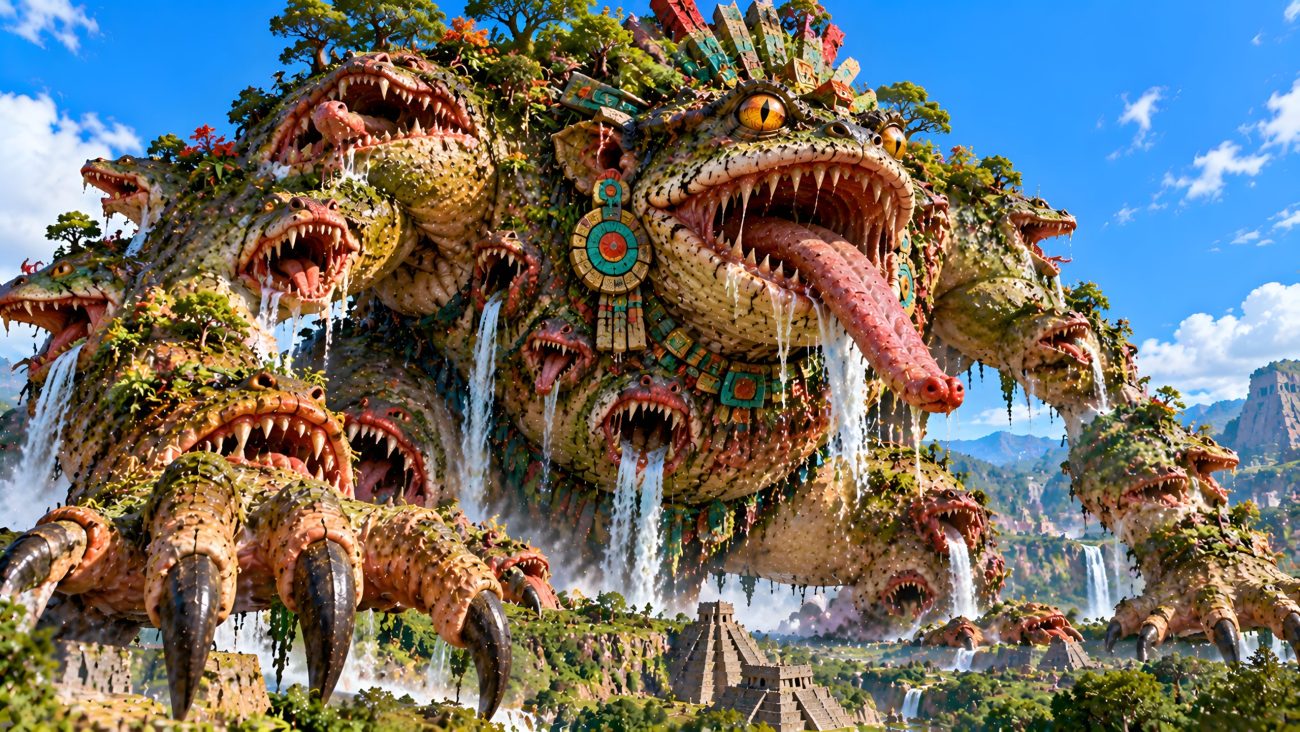
Tlaltecuhtli is a gigantic and terrifying monster who personifies the Earth. She is described as a monstrous creature combining the features of a toad and an alligator, sometimes appearing as an enormous furry frog with sharp claws. Her body is covered with mouths and biting heads at every joint, allowing her to bite like a wild beast. In some depictions, she resembles a fearsome cross between a toad and a crocodile.

In the beginning, when only the Sky and Water existed, the gods decided to create the Earth. The gods Quetzalcoatl and Tezcatlipoca seized Tlaltecuhtli and tore her in two. One half became the Earth, while the other was returned to the sky. The other gods were angered by the terrible harm inflicted upon her, so they descended from heaven to console her and compensate her for her suffering.

The gods decreed that everything necessary for human life would grow from Tlaltecuhtli’s body. Trees, flowers, and herbs sprang from her hair, while smaller plants and flowers emerged from her skin. Wells, springs, and small caves came from her eyes, rivers and great caves from her mouth, valleys from her nose, and mountains from her shoulders. From then on, Tlaltecuhtli was revered as the goddess of the Earth, whose monstrous body provided the natural world with everything needed for life.

In some traditions, Tlaltecuhtli is described as the wife of Cipactli, another monstrous being with the appearance of a creature half-fish and half-crocodile. The gods were also said to have attempted to create the Earth from Cipactli by tearing the creature apart in a similar manner.


Sources

“Tlaltecuhtli.” Wikipedia: The Free Encyclopedia. Wikimedia Foundation. Accessed October 14, 2026. https://en.wikipedia.org/wiki/Tlaltecuhtli


Heqet

Tradition: Egyptian Mythology
Alternative Names: Heket, Heqtit, Ḥqtyt
Category: Frog


The Myth

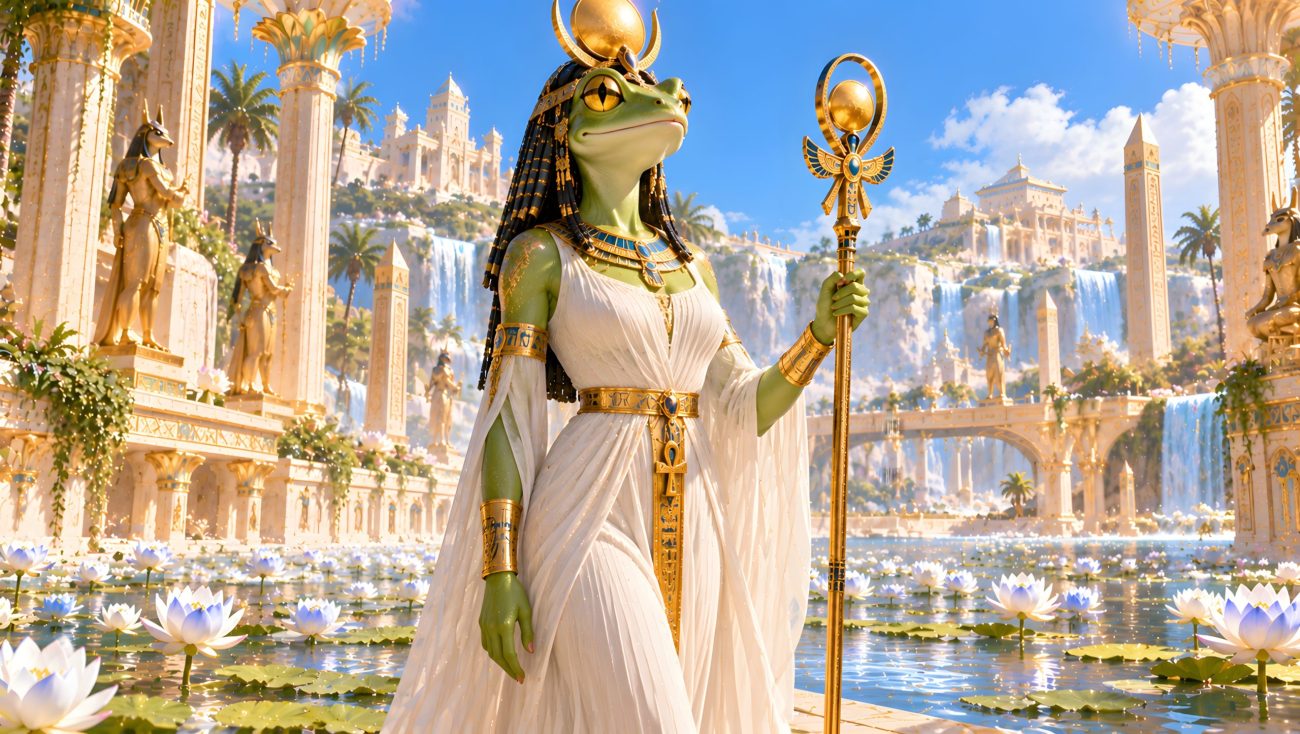
Heqet is an Egyptian goddess of fertility, childbirth, and resurrection, represented as a frog or a woman with the head of a frog. The frog was a symbol of fertility and new life, associated with the annual flooding of the Nile and the growth of crops. Heqet was believed to bring life and renewal, and she was closely connected to the final stages of childbirth. She was known as the one who hastens birth, helping children enter the world safely.

Heqet was the wife of Khnum, the ram-headed god who shaped human bodies on his potter’s wheel. While Khnum formed the bodies of unborn children, Heqet helped bring them to life. She was also associated with the birth of Horus. In the myth of Osiris, Heqet breathed life into the newborn Horus, giving her an important role in the divine cycle of birth, death, and resurrection.

Her power extended beyond childbirth to the renewal of life itself. As the myths of Osiris and Horus became connected with resurrection, Heqet also came to represent the return of life after death. Frog-shaped amulets bearing her image were worn by women seeking protection during childbirth and an easier delivery. Through her association with fertility, birth, and resurrection, Heqet embodied the power that allows life to emerge, flourish, and begin again.


Sources

“Heqet.” Wikipedia: The Free Encyclopedia. Wikimedia Foundation. Accessed October 14, 2026. https://en.wikipedia.org/wiki/Heqet


Whowie

Tradition: Australian Mythology
Alternative Names: Whowie
Category: Frog


The Myth

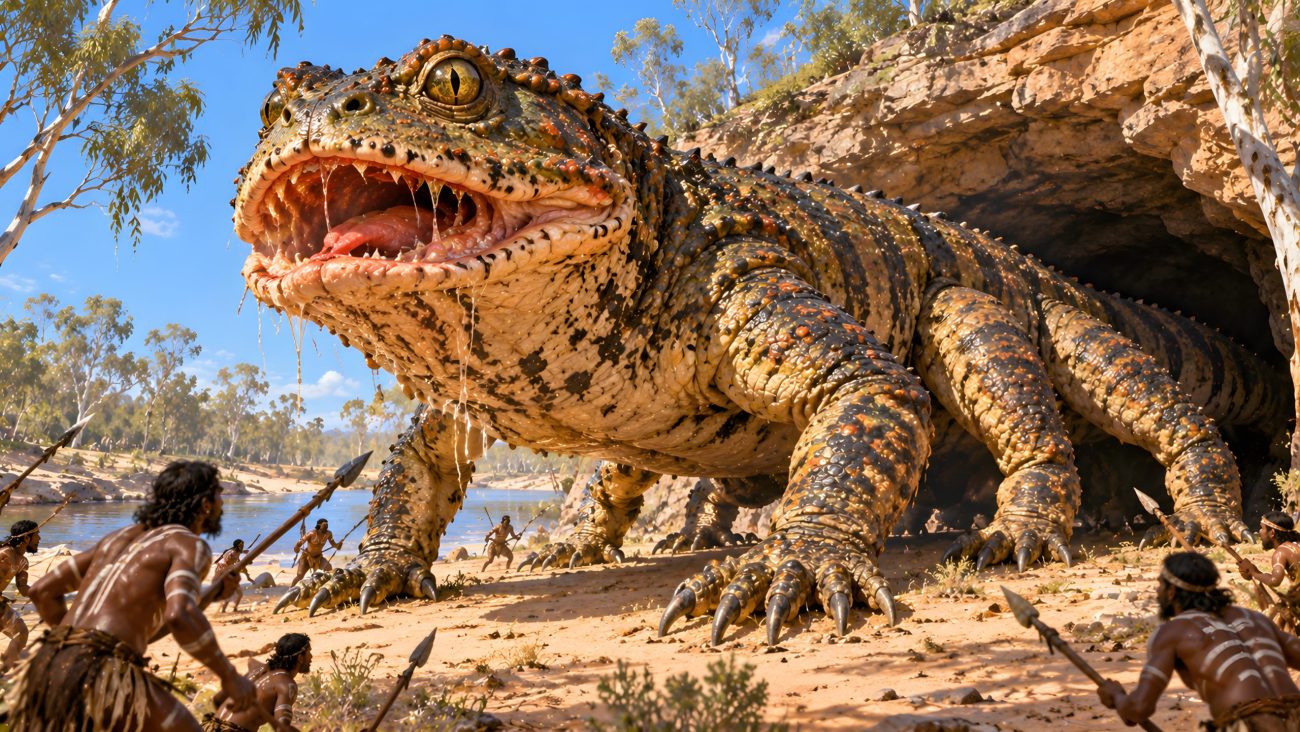
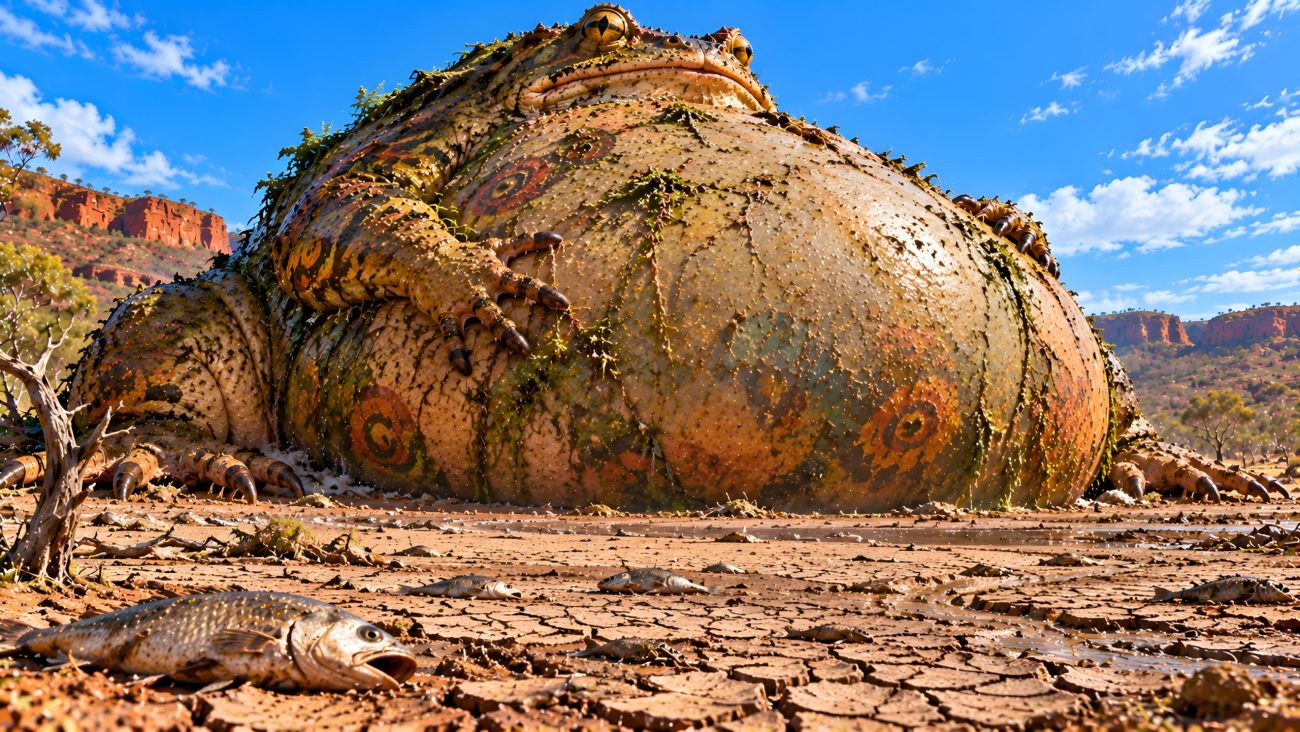
The Whowie is a gigantic and terrifying monster from southeastern Australian Aboriginal mythology. It resembles an enormous goanna, around seven metres long, with a huge frog-shaped head and six powerful legs. It lives in a vast cave on the banks of the Murray River, whose passages extend deep beneath the ground. The creature’s heavy trampling along the riverbanks is said to have formed the sandhills of the Riverina district.

Despite its enormous size, the Whowie moves slowly and is exceptionally stealthy, making it a deadly predator. It can kill and devour an entire tribe in a single meal, and its attacks brought misery and terror to the people living in the surrounding lands. For a long time, the tribes suffered under the monster’s constant threat.

Eventually, the water rat tribe decided that the Whowie had to be destroyed. They instructed the surrounding tribes to gather spears, stone axes, waddies, and great bundles of sticks. When the Whowie was deep inside its cave, the people piled the sticks at the entrance and set them on fire, filling the cave with smoke. After seven days, the blinded and disoriented monster finally emerged. The assembled tribes attacked it with their weapons and killed it, freeing the land from its terrible menace.


Sources

“Whowie.” Wikipedia: The Free Encyclopedia. Wikimedia Foundation. Accessed October 14, 2026. https://en.wikipedia.org/wiki/Whowie


Toad Demon

Tradition: Chinese Mythology
Alternative Names: Toad Spirit, Frog Spirit
Category: Frog


The Myth

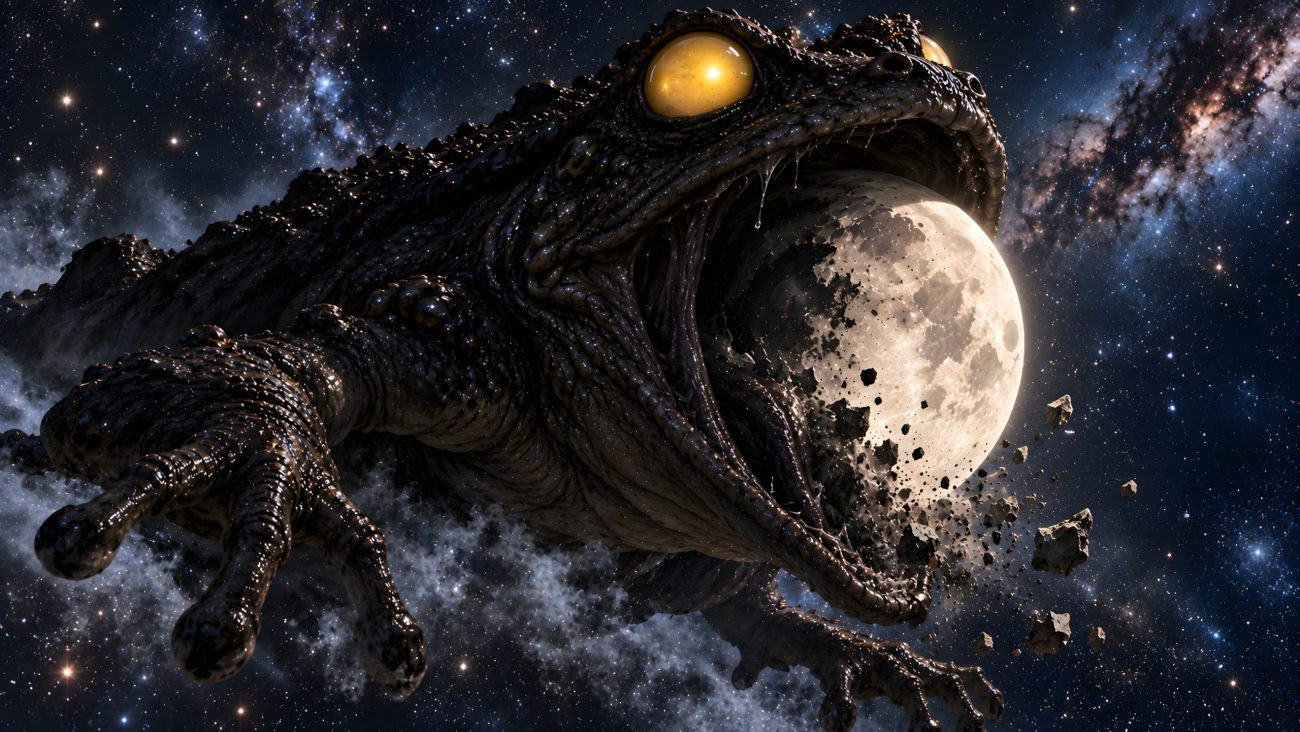
The Toad Demon is a supernatural toad spirit associated with eclipses and the mysterious shadows on the Moon. According to one belief, a lunar eclipse occurs when a giant toad devours the Moon. The dark shape visible on the lunar surface was understood as the toad itself, as though the creature were swallowing the heavenly body. The Toad Demon was therefore feared as a being capable of disturbing the natural order of the heavens.

Whenever a solar or lunar eclipse occurred, people would beat gongs and drums and bang pots and pans to create a tremendous noise. These rituals were intended to save the Sun or Moon by frightening away the celestial dog or the toad believed to be devouring it. In another Chinese tale, a toad travelled to the Moon and brought great chaos to the world.

The name Toad Demon also refers more broadly to the spirits that frogs and toads can become in Chinese legends. These creatures are not described in detail in every account, but they belong to a wider tradition in which ordinary amphibians may transform into supernatural beings.


Sources

“蛤蟆精 (Hámájīng).” Chinese Wikipedia. Wikimedia Foundation. Accessed October 14, 2026. https://zh.wikipedia.org/wiki/%E8%9B%A4%E蟆%E7%B2%BE


Tiddalik

Tradition: Australian Mythology
Alternative Names: Molok
Category: Frog


The Myth

Tiddalik is a gigantic frog from Australian Aboriginal creation mythology, remembered for drinking all the fresh water in the world. One morning, he awoke in Wollombi Valley with an unbearable thirst and began gulping down every available source of fresh water. He drank from rivers, lakes, and swamps until they were completely emptied, leaving the land parched. Plants began to wither, animals suffered from thirst, and life across the land faced destruction.

The animals gathered together to find a way to make Tiddalik release the water trapped inside him. A wise old owl helped devise a plan, and Nabunum the eel took on the task of making the enormous frog laugh. The eel twisted and contorted his body into increasingly ridiculous shapes until Tiddalik could no longer contain himself. When the frog finally burst into laughter, the water poured out of his mouth and body, rushing across the land and refilling the rivers, lakes, and swamps.

In an older version of the story, however, the release of the water caused a devastating flood. The waters formed bays, estuaries, inlets, and islands, while many creatures drowned and others became stranded on isolated pieces of land. Borun the pelican rescued those who had been trapped, and his feathers changed from entirely black to a mixture of black and white. Through Tiddalik’s actions, the story explains both the return of water to the world and the dramatic transformation of the surrounding landscape.


Sources

“Tiddalik.” Wikipedia: The Free Encyclopedia. Wikimedia Foundation. Accessed October 14, 2026. https://en.wikipedia.org/wiki/Tiddalik


Khodumodumo

Tradition: South African Mythology, Lesotho Mythology
Alternative Names: Kholomodumo, Modumo o Moholo, Khamapa, Kammapa, Khanyapa
Category: Frog


The Myth

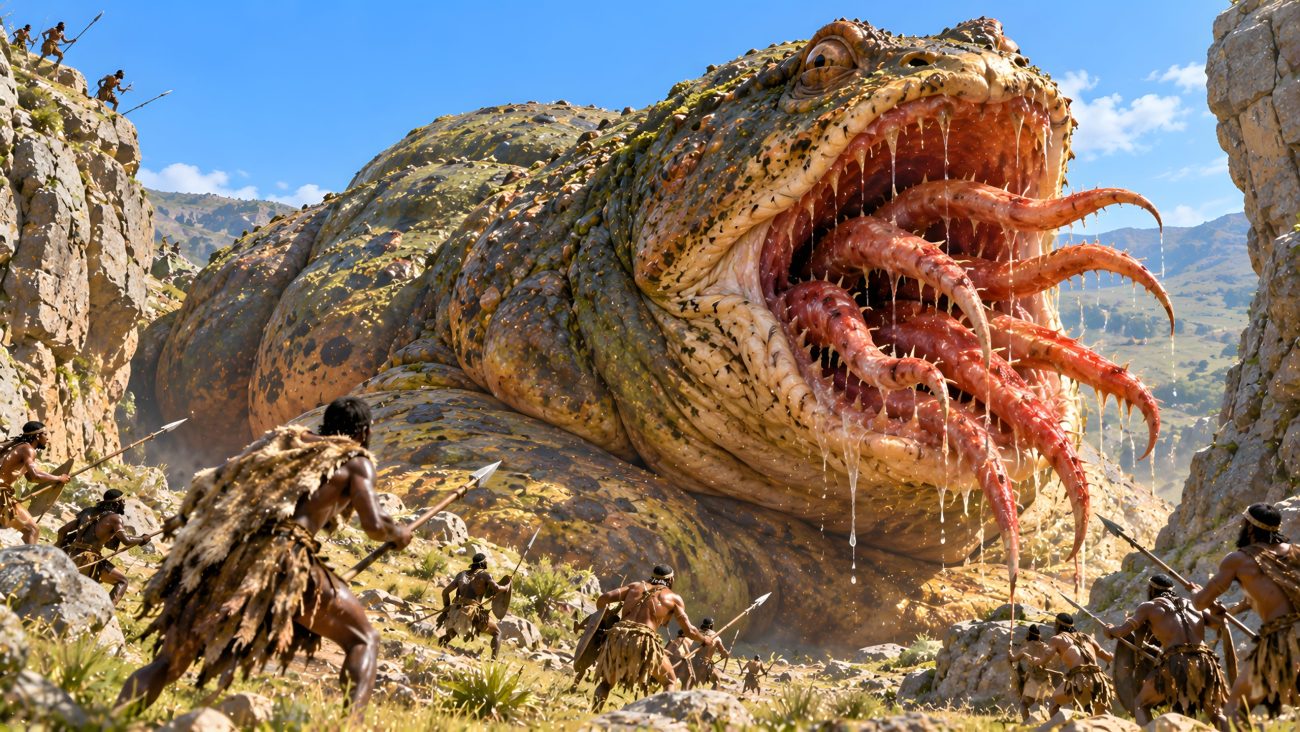
Khodumodumo is a gigantic swallowing monster from Basotho mythology of South Africa and Lesotho. Its enormous body has no clearly defined shape, and it is so vast that it can resemble a hill when lying across a mountain pass. The monster possesses multiple sharp tongues, which it thrusts at its victims like spears. It moves through towns and villages, swallowing every living thing in its path, including people, cattle, dogs, and poultry.

One day, Khodumodumo went on a rampage, devouring entire villages and leaving almost no survivors. Only one pregnant woman escaped by hiding on a manure heap, where the ashes concealed her appearance and scent. After consuming everything around it, the bloated monster dragged itself away and became wedged in a mountain pass. The surviving woman later gave birth to a son. When she went to fetch manure powder, as tradition required, she returned to discover that her baby had already grown into a fully developed warrior. He wore animal skins, carried divining beads around his neck, and was armed with assagais. He introduced himself as Senkatana and demanded to know what had happened to his village, its people, and its animals. His mother explained that Khodumodumo had swallowed them all.

Senkatana insisted on confronting the monster, despite his mother’s warnings. When Khodumodumo opened its enormous mouth and attacked him with its sharp tongues, he chopped them off one by one. The creature was too bloated to turn around quickly, allowing Senkatana to circle it and stab its body repeatedly with his assagais until it died. He then cut open the monster to free its swallowed victims, carefully avoiding the people and animals trapped inside. Although he accidentally injured one man during the rescue, Senkatana successfully released the survivors and eventually became a great chief. However, the injured man and others who envied the hero repeatedly plotted to kill him. Exhausted by their hatred and ingratitude, Senkatana eventually allowed himself to be killed.


Sources

“Khodumodumo.” A Book of Creatures. December 18, 2015. https://abookofcreatures.com/2015/12/18/khodumodumo/