Tokoloshe

Tradition: Nguni Mythology, South African Mythology
Alternative Names: Tikoloshe, Tikolosh, Tonkolosh, Tonkolosi, Tokolotshe, Thokolosi, Hili
Category: Goblin


The Myth

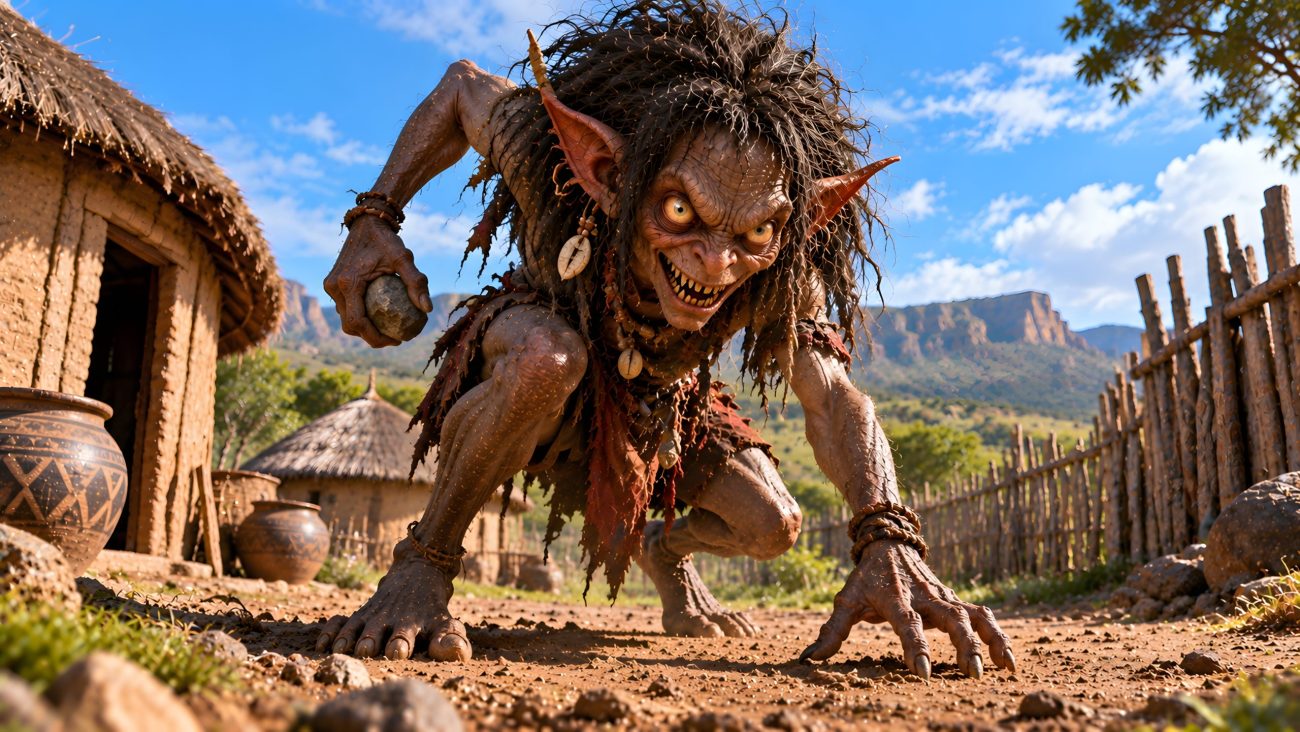
The Tokoloshe is a dwarf-like supernatural being in Nguni mythology, particularly associated with Zulu traditions and other cultures of southern Africa. It is generally described as a mischievous and malevolent spirit capable of becoming invisible by drinking water or swallowing a stone. Although it may sometimes be invoked to frighten children, the Tokoloshe is feared for its ability to cause illness, torment individuals, and even bring about death. It is also associated with witchcraft, as people believed to harbour hostile intentions may summon the creature to attack their enemies.

According to traditional accounts, a person seeking revenge may approach a malevolent witch doctor and request the creation of a Tokoloshe. In one version of the legend, the witch doctor obtains a dead body and prepares it through ritual procedures, piercing its eye sockets and brain with a heated iron rod to prevent it from thinking independently. Special powder is then applied to shrink the body, transforming it into a vessel for the spirit. The Tokoloshe is released against its intended victim, whom it terrorises over a period of weeks, months, or even years. The person who commissions the creature must promise the soul of a loved one, although the Tokoloshe itself chooses whose soul it will claim.

The Tokoloshe is particularly associated with unexplained deaths during the night. In traditional accounts, it was blamed when people sleeping on the floors of their homes died mysteriously. One explanation connects these beliefs to the dangers of indoor fires used for warmth in southern Africa’s cold highland winters. Fires burning in poorly ventilated homes could produce carbon monoxide, which can accumulate dangerously near sleeping people. Those sleeping on raised beds might be less exposed, and this contributed to the belief that the Tokoloshe could be kept away by elevating one’s sleeping place. Placing bricks beneath the legs of a bed became a well-known protective measure.

Protection against the Tokoloshe may also involve spiritual intervention. Traditional healers known as sangomas and certain Christian pastors are believed to possess the power to banish the spirit. The creature remains an influential figure in southern African popular culture, where stories about it can express genuine spiritual fears as well as provide a satirical way to criticise superstition and its influence on social behaviour.


Sources

“Tokoloshe.” Wikipedia: The Free Encyclopedia. Wikimedia Foundation. Accessed October 17, 2026. https://en.wikipedia.org/wiki/Tokoloshe
Khodumodumo

Tradition: South African Mythology, Lesotho Mythology
Alternative Names: Kholomodumo, Modumo o Moholo, Khamapa, Kammapa, Khanyapa
Category: Frog


The Myth

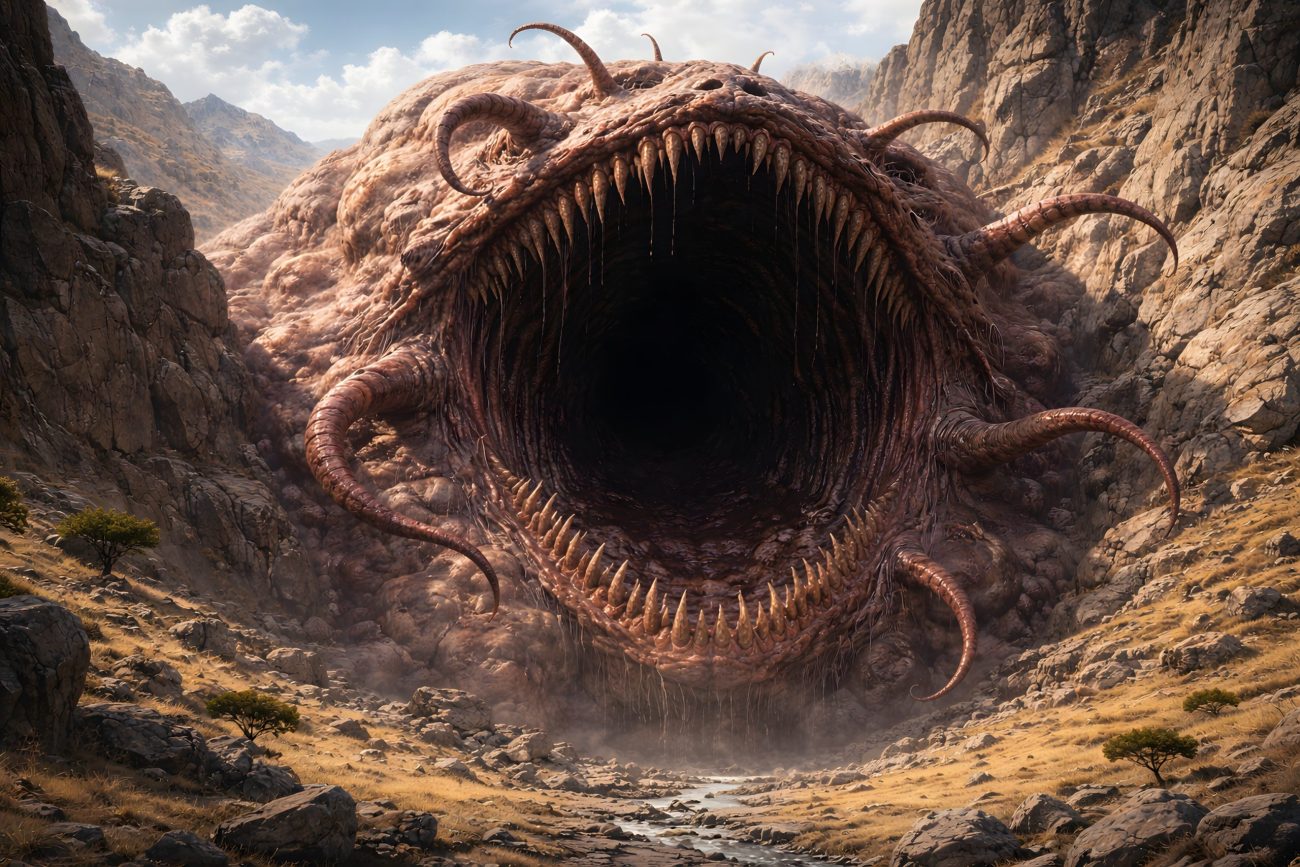
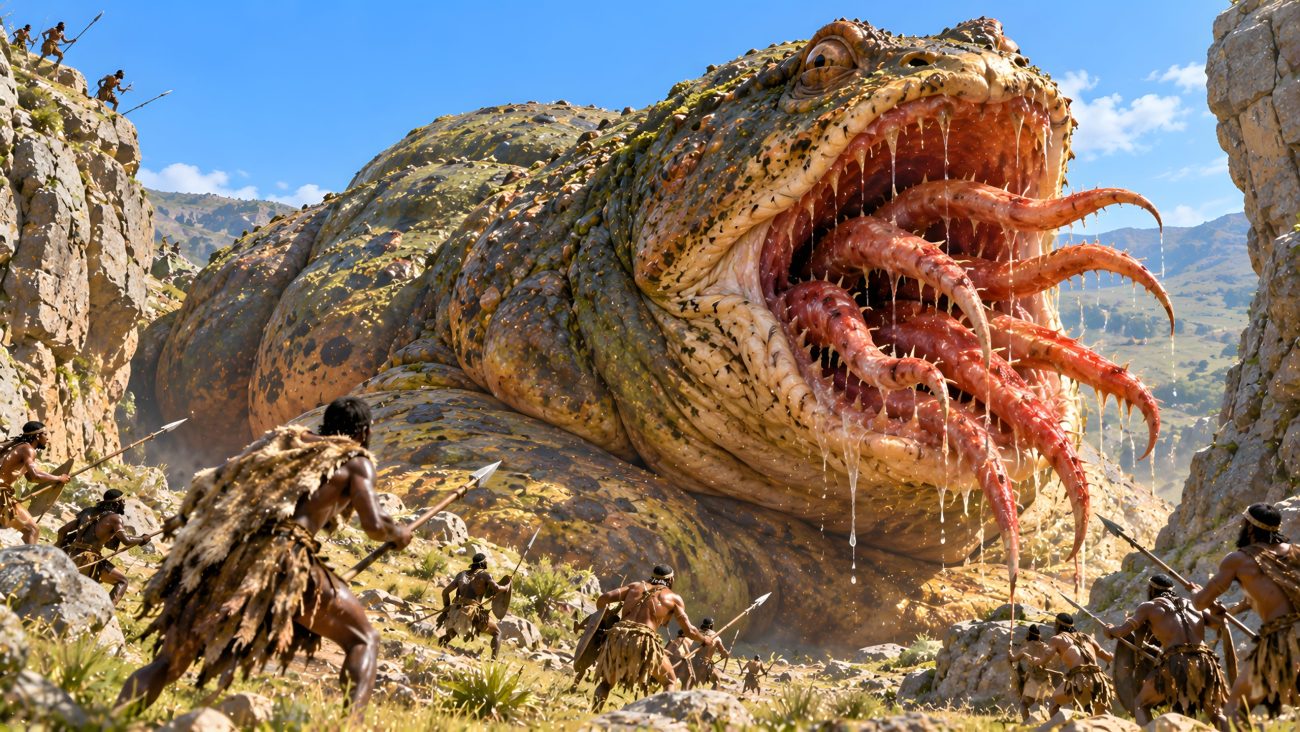
Khodumodumo is a gigantic swallowing monster from Basotho mythology of South Africa and Lesotho. Its enormous body has no clearly defined shape, and it is so vast that it can resemble a hill when lying across a mountain pass. The monster possesses multiple sharp tongues, which it thrusts at its victims like spears. It moves through towns and villages, swallowing every living thing in its path, including people, cattle, dogs, and poultry.

One day, Khodumodumo went on a rampage, devouring entire villages and leaving almost no survivors. Only one pregnant woman escaped by hiding on a manure heap, where the ashes concealed her appearance and scent. After consuming everything around it, the bloated monster dragged itself away and became wedged in a mountain pass. The surviving woman later gave birth to a son. When she went to fetch manure powder, as tradition required, she returned to discover that her baby had already grown into a fully developed warrior. He wore animal skins, carried divining beads around his neck, and was armed with assagais. He introduced himself as Senkatana and demanded to know what had happened to his village, its people, and its animals. His mother explained that Khodumodumo had swallowed them all.

Senkatana insisted on confronting the monster, despite his mother’s warnings. When Khodumodumo opened its enormous mouth and attacked him with its sharp tongues, he chopped them off one by one. The creature was too bloated to turn around quickly, allowing Senkatana to circle it and stab its body repeatedly with his assagais until it died. He then cut open the monster to free its swallowed victims, carefully avoiding the people and animals trapped inside. Although he accidentally injured one man during the rescue, Senkatana successfully released the survivors and eventually became a great chief. However, the injured man and others who envied the hero repeatedly plotted to kill him. Exhausted by their hatred and ingratitude, Senkatana eventually allowed himself to be killed.


Sources

“Khodumodumo.” A Book of Creatures. December 18, 2015. https://abookofcreatures.com/2015/12/18/khodumodumo/


Abatwa

Tradition: Zulu Mythology, South-African Mythology
Alternative Names: Abatwa; Umtuwa
Category: Dwarf


The Myth

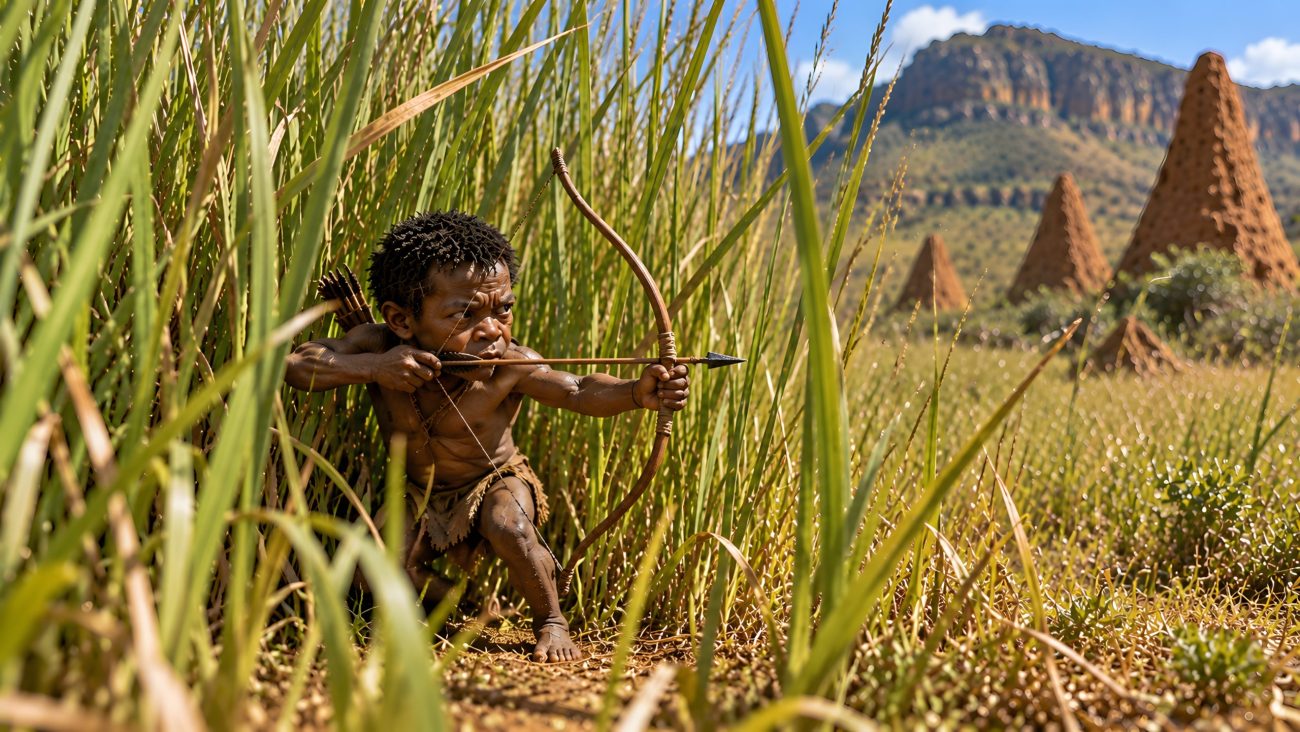
The Abatwa are a mysterious people of dwarfs who wander through the tall grass and sleep inside anthills. They live in the wilderness, far from villages, and are said to move together as a tiny wandering community. Because they are so small, they can hide among the grass and travel without being noticed.

The Abatwa are hunters and gatherers who live from whatever they can find. They hunt game, eat plants, and are known to consume almost anything available to them. When food becomes scarce, they continue wandering until they find another place where they can survive.

A person who unexpectedly encounters an Abatwa must be careful. The little people are said to be extremely sensitive about their size. If someone meets an Abatwa and asks, “Where did you see me?”, the creature may become suspicious and demand to know whether the person is making fun of him. Even a seemingly harmless question can therefore turn dangerous.

One story tells of a man who encountered an Abatwa while traveling. The tiny being asked whether the man had seen him. The man replied that he had, explaining that he had seen him while standing on a mountain. The Abatwa was delighted that the man had not mocked his small stature and became his friend. When the man encountered him again, he greeted him warmly and said that he had seen him on a mountain while he himself was far away. The Abatwa rejoiced, declaring that he had finally met someone who could see him from such a distance.

The Abatwa can also become dangerous when they are hunting. According to another tradition, when game becomes scarce, the little people may attack a horse, mounting it one behind another and riding away on its back. If they cannot find any animals to hunt, they may eat the horse instead.

Their greatest strength is not physical size but their ability to remain hidden. The Abatwa are said to be almost invisible while moving through the tall grass. A person may walk toward one without realizing that a tiny hunter is standing nearby. Suddenly, the Abatwa can appear and shoot a poisoned arrow. Their arrows are so deadly that even a small wound can prove fatal.

Because of this, encountering an Abatwa is considered extremely dangerous despite their tiny stature. Their small size allows them to disappear into the grass, approach unnoticed, and strike before their victim realizes that anyone is there.

The Abatwa are also associated with other traditions of small forest-dwelling peoples in southern Africa. They are described as living in groups, wandering through the wilderness, and sometimes settling among ordinary people. Those who leave the forest and become farmers are still regarded with suspicion, since their supernatural reputation remains attached to them.


Sources

“Abatva.” New Bestiary (Bestiary.us). Accessed October 4, 2026. https://www.bestiary.us/abatva


Impundulu

Tradition / Region: South African Mythology
Alternative names: Lightning-bird; Intakezulu; Chimungu; Inyoni Yezulu; Isivolovolo; Izulu
Category: Bird


The Myth

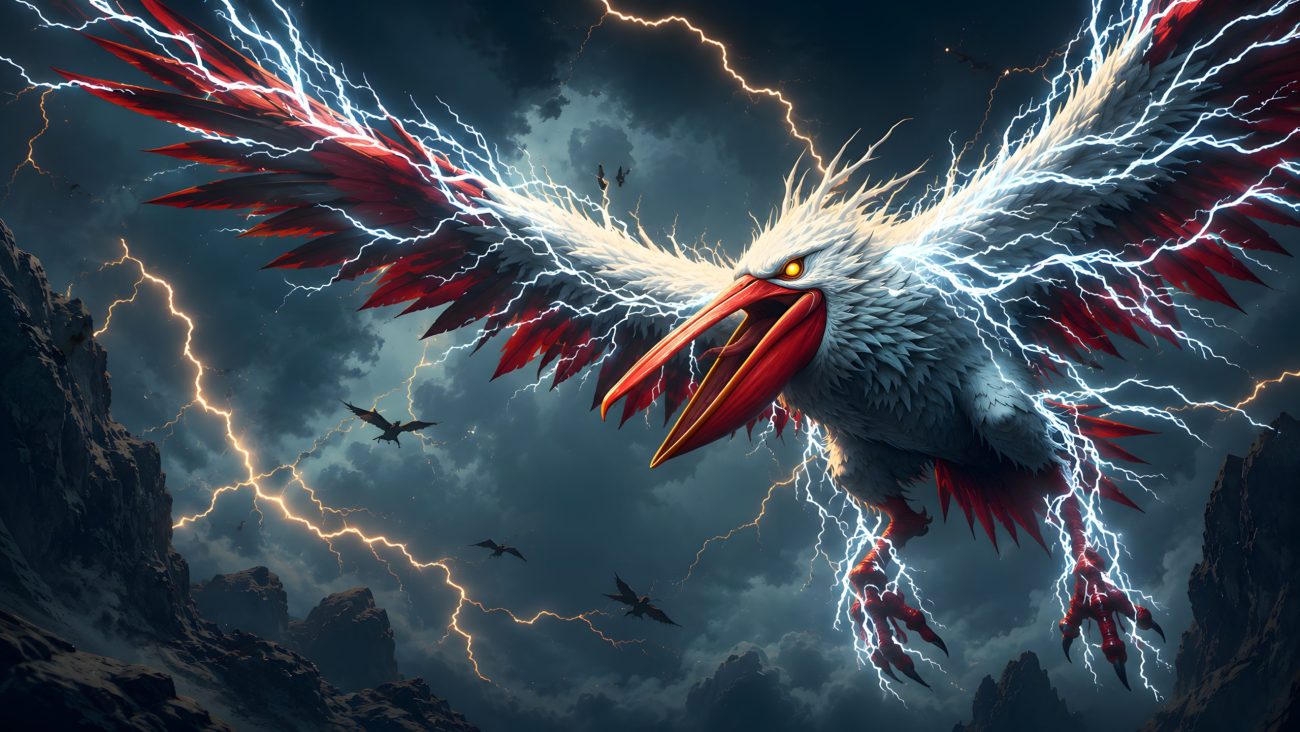
The Impundulu, or Lightning-bird, is a supernatural bird of storms that appears throughout southern African folklore in many different forms. Among the Xhosa it is usually described as a great white bird with red wings, red legs, and a short red tail, though it can also take the shape of a human. The beating of its wings creates thunder, while flashes of lightning mark its descent to the earth to bury a single enormous egg beneath the ground.

The bird is closely connected with witches and shamans. Witches are said to keep an Impundulu as a familiar spirit, sending it to attack their enemies, while shamans search for its buried eggs and destroy them before they hatch, preventing more Lightning-birds from entering the world. Warriors also throw spears into the sky to discourage the creature from landing during storms.

The Impundulu is feared as a vampire that drinks human blood until its victims die. It is also blamed for carrying away unprotected children and for causing illnesses by stealing a person’s breath. Although it craves blood, it is also said to love milk, and poisoned milk is one of the few ways to kill it.

When the Impundulu assumes human form, it may seduce women, and legends claim that any children born from such unions become birds. Despite its fearsome reputation, the bird also appears in local sayings, where being “visited by the Impundulu” can refer either to misfortune, such as a nosebleed, or to an unexpected stroke of good luck.


Sources

A Book of Creatures. (2016, November 7). Impundulu. Retrieved June 29, 2026, from https://abookofcreatures.com/2016/11/07/impundulu/. (abookofcreatures.com)


Nanabolele

Tradition / Region: Lesotho Mythology, South African Mythology
Alternative names: Dinanabolele, Linanabolele (plural)
Category: Crocodile


The Myth

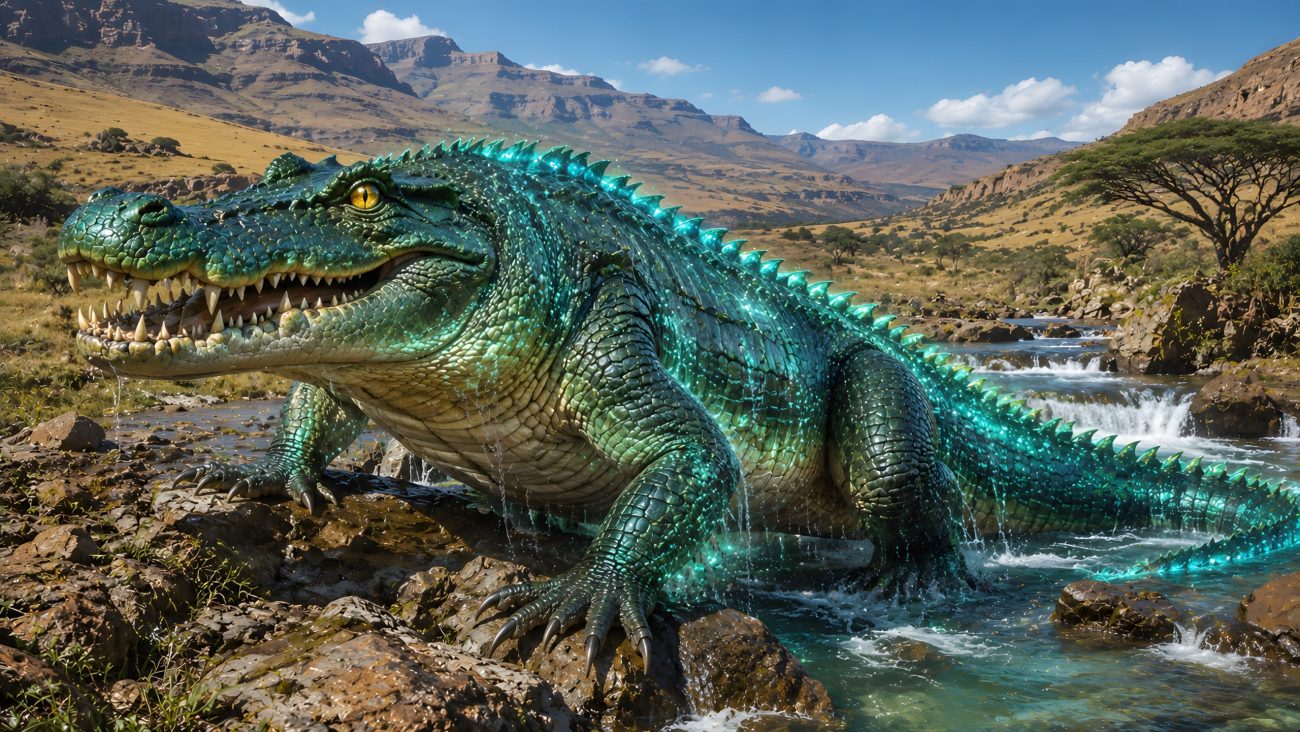
The Nanabolele are fearsome reptilian creatures of Basotho folklore that dwell beneath rivers and underground. Their bodies shine in the darkness like the moon and stars, making them as beautiful as they are terrifying. They are powerful predators that devour both people and animals.

The creatures appear in the legend of Thakáne and her brothers. After her brothers completed their initiation rites, they refused to leave the mophato until they received shields, clothing, shoes, hats, and spear bindings made from Nanabolele skin. Determined to fulfill their impossible request, Thakáne journeyed in search of the monsters, guided from river to river by frogs.

At the deepest river, an old woman led Thakáne into a hidden settlement beneath the water. There she learned that the Nanabolele had devoured all the inhabitants, sparing only the old woman to serve them. When the glowing reptiles returned, Thakáne and her companions hid until the creatures fell asleep, then silently killed the largest Nanabolele and removed its hide.

The old woman gave Thakáne a magical pebble before she departed, warning that the surviving Nanabolele would pursue her. Each time the creatures caught up, the pebble transformed into a towering mountain that exhausted the reptiles as they struggled to climb it. Once they were worn out, the mountain shrank back into a pebble, allowing Thakáne to continue her journey.

When Thakáne finally reached home, she called upon the village dogs to drive the Nanabolele away. The reptiles fled back to their underwater home, and the luminous hide of the slain creature was fashioned into the clothing and equipment her brothers had demanded. In recognition of her courage and perseverance, her brothers rewarded Thakáne with one hundred head of cattle.


Sources

A Book of Creatures. (2021, April 16). Nanabolele. Retrieved June 29, 2026, from https://abookofcreatures.com/2021/04/16/nanabolele/


Amadlozi

Tradition / Region: Nguni peoples of South African Mythology
Alternative names: Ancestors, Ancestral Spirits
Category: Ghost


The Myth

The Amadlozi are the ancestral spirits of the Nguni peoples and are regarded as powerful spiritual beings who remain closely connected to their descendants. They are believed to watch over the living, offering protection, guidance, and assistance when properly honored and remembered.

The Amadlozi are associated with all aspects of life, including fertility, health, fortune, misfortune, birth, and death. They are believed to direct their descendants toward lives of purpose, morality, and integrity, helping to maintain harmony between the spiritual and physical worlds.

Above the Amadlozi stand higher spiritual beings known as iThonga, who are regarded as the primary guardians of the umsamo, the sacred physical and spiritual center of the household.

Among the Nguni, life is considered incomplete without honoring the ancestors. Forgetting or neglecting them is believed to bring imbalance and misfortune, while gratitude and respect ensure their continued blessings.

People communicate with the Amadlozi through prayers, rituals, and offerings. Sacrifices of cattle, goats, or chickens are performed to appease them and seek their favor. Such acts are viewed not as worship of the dead, but as maintaining the bond between generations.

The Amadlozi are therefore remembered as life-giving ancestral spirits who continue to care for their descendants long after death, preserving the connection between the living and those who came before.


Sources

Wikipedia contributors. (n.d.). Amadlozi. In Wikipedia. Retrieved June 20, 2026, from https://en.wikipedia.org/wiki/Amadlozi


Crowing Crested Cobra

Tradition / Region: Botswana Mythology, Malawi Mythology, South African Mythology, Kenyan Mythology, Mozambique Mythology
Also Known As: Njoka Tambala, Bubu, Hongo, Indlondlo, Inkhomi, Kovoko, Limba, Nguluka, Ngoshe, Noga-putsane, Songo, Songwe
Category: Snake


The Myth

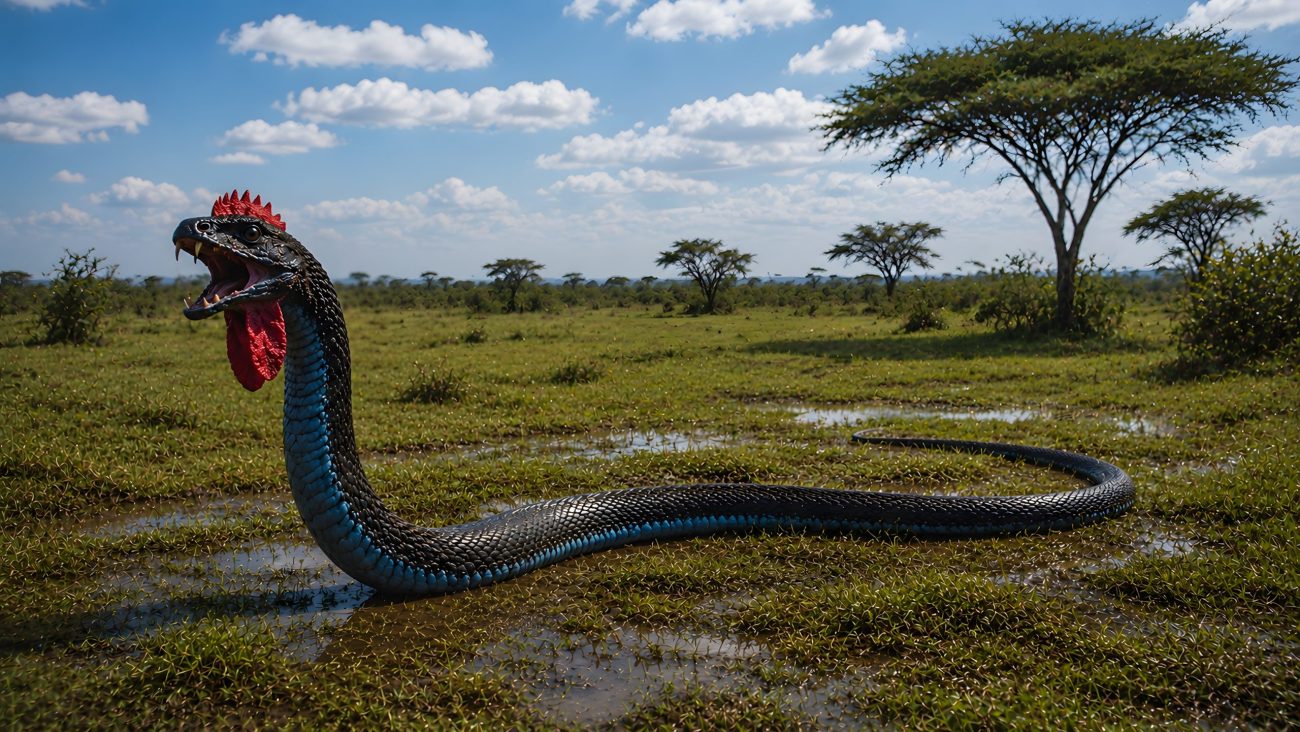
The Crowing Crested Cobra is a legendary serpent found throughout East African folklore. It is usually described as a huge venomous snake resembling a cobra but distinguished by a fleshy crest on its head, sometimes accompanied by rooster-like wattles. Unlike ordinary snakes, it is said to make strange animal sounds, especially crowing like a rooster, though some traditions describe bell-like cries, clucking noises, or even goat-like bleating.

Stories portray the creature as extremely dangerous. It hides in trees, near paths, or in tall grass, striking travelers without warning. Some legends describe it attacking several people in succession before retreating into holes or dense vegetation. The serpent is often said to move with unnatural speed and to climb trees with ease.

In parts of Mozambique, the creature was known as the Bubu, a massive dark snake marked with red growths resembling a rooster’s comb. Other traditions describe male snakes crowing loudly while females cluck softly. Some accounts claim the creature kills indiscriminately and is associated with sorcery, witchcraft, and powerful magical medicines.

Across East Africa, related serpent legends appear under many names. Some versions possess feather-like crests, others have birdlike traits, and certain stories even describe snake creatures whose cries lure victims toward them at night.

The creature became one of the most widespread serpent legends in African folklore, blending features of deadly snakes, birds, and supernatural omens into a single feared being.


Sources

A Book of Creatures. (2021, June 25). Crowing crested cobra. Retrieved May 10, 2026, from https://abookofcreatures.com/2021/06/25/crowing-crested-cobra/


Isiququmadevu

Tradition / Region: Zulu Mythology, South African Mythology
Alternate Names: Smelly Whiskers; Unomabunge; O’gaul’-iminga; O-nsiba-zimakqembe
Category: Mountain dweller


The Myth

When Untombinde, the king’s daughter, set out for the sacred pools of the Ilulange River, her parents warned her not to go. She ignored them and traveled there with two hundred maidens as her escort.

At the river they bathed and played in the water. But when they came out, their clothes, jewels, and bracelets were gone. They had been taken by Isiququmadevu.

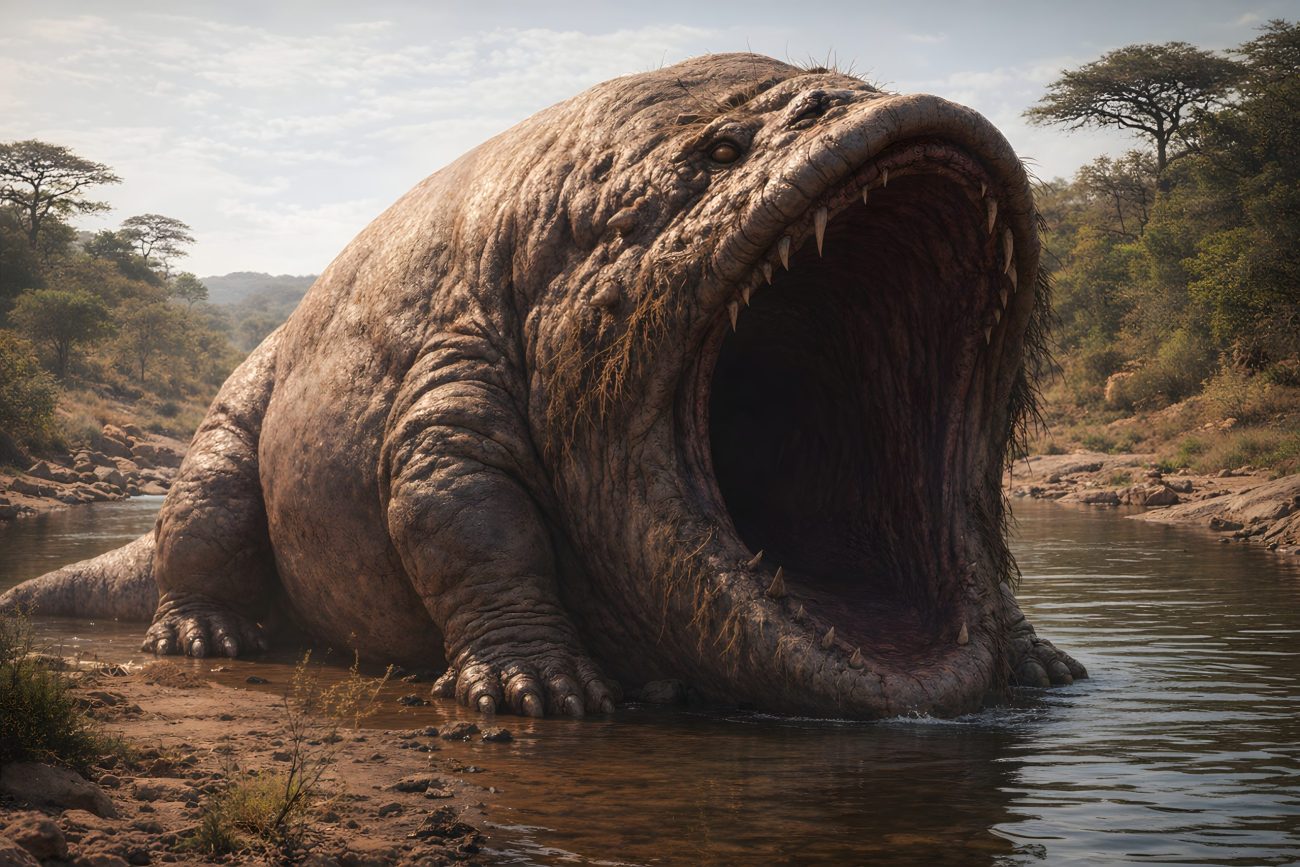
The monster was a vast, bloated being with an enormous mouth, said to be large enough to swallow whole villages. Terrified, the maidens begged for their possessions back. One by one, as they pleaded, the monster returned their things. At last only Untombinde remained.

The others urged her to beg the creature for mercy, but she refused proudly, saying she would not humble herself before it. At once Isiququmadevu seized her and dragged her into the pool.

When King Usikulumi heard what had happened, he sent his army to kill the monster. But Isiququmadevu rose up and swallowed the entire force in one gulp. She then went to the village and devoured everyone there—men, women, children, and cattle—leaving only one man alive. Among the swallowed were his twin children.

The man armed himself with a spear and went in search of the creature. Along the way he asked the animals he met where she had gone, and each told him, “Forward, forward.”

At last he found Isiququmadevu, swollen from all she had eaten and resting in the forest. When he declared that he had come for his children, the monster again tried to mislead him, saying only, “Forward, forward.” But he attacked her with his spear and killed her.

He cut open her body, and from inside came the army, the villagers, and the cattle, all alive. Untombinde came out last.

Other tales tell how a young woman named Usitungusobenthle once cut open the sleeping monster and freed a village she had swallowed, and how a princess named Uluthlazase escaped her by refusing to release her clothes and fleeing while the creature went to seek help.

Thus Isiququmadevu is remembered as a devouring monster who swallows whole communities, yet can be overcome by courage and determination.


Sources

abookofcreatures.com contributors. (n.d.). Isiququmadevu. In abookofcreatures.com, from https://abookofcreatures.com/2015/12/04/isiququmadevu/


Khanyapa

Tradition / Region: Basotho Mythology, Lesotho Mythology, South African Mythology
Alternate Names: Kholumolumo; Kgodumodumo
Category: Mountain dweller


The Myth

Long ago, in the valleys and mountains of the Basotho, there arose a monstrous being called Khanyapa.

It had no fixed shape. It was vast, bloated, and ever-growing. Its hunger knew no limit. As it roamed from village to village, it swallowed everything in its path—men, women, children, cattle, wild beasts. The more it devoured, the larger it became. From its body lashed multiple sharp tongues, which it wielded like weapons. Its voice was so terrible that it made the rocks tremble.

Soon there were no towns left standing. The valleys were silent. Humanity had vanished.

Only one woman survived. She had hidden herself in ashes, masking her scent and appearance, and so the monster did not detect her. When Khanyapa had eaten all it could find, its swollen body dragged itself into a mountain pass and became wedged there, too distended to move further.

Alone in the emptied world, the woman wept and prayed that humankind should not end. The gods heard her plea. She conceived and bore a son in an abandoned stable.

When she looked upon the child, she saw around his neck a necklace of divining charms. She named him Ditaolane—the Diviner.

But Ditaolane was no ordinary child. In the time it took his mother to prepare straw for his bed, he had already grown into a full man, wise in speech. Seeing the desolation around him, he asked why the earth lay empty. His mother told him of the monster whose hunger had devoured the world. She pointed to the mountain pass where the great body of Khanyapa lay.

Though she warned him, Ditaolane took up a knife and went alone to confront the devourer.

Khanyapa swallowed him as it had swallowed all others.

But Ditaolane did not die.

Inside the monster’s vast belly, among the swallowed multitudes, he drew his knife and began to cut. He tore at the entrails of Khanyapa. The monster roared, shaking the earth, but at last it collapsed and died.

Still trapped inside, Ditaolane cut his way outward. As the blade pierced flesh, thousands of voices cried out—those who had been swallowed alive. He opened a great wound, and through it poured the nations of the earth, restored to life.

The people rejoiced at first, but soon suspicion took root in their hearts. Who was this man who had survived the beast? What power did he possess? Fearing him, they plotted his death.

But Ditaolane would not be taken. He escaped them by turning himself into stone.

And so the world was freed from the devouring monster, yet the savior who restored humanity withdrew from it, leaving behind the memory of the time when all living things were swallowed and reborn from the belly of Khanyapa.


Sources

Wikipedia contributors. (n.d.). Kamappa. In Wikipedia, The Free Encyclopedia. Retrieved February 14, 2026, from https://en.wikipedia.org/wiki/Kamappa


Isitwalangcengce

Tradition / Region: Zulu mythology, South African Mythology
Alternate Names: Basket-bearer
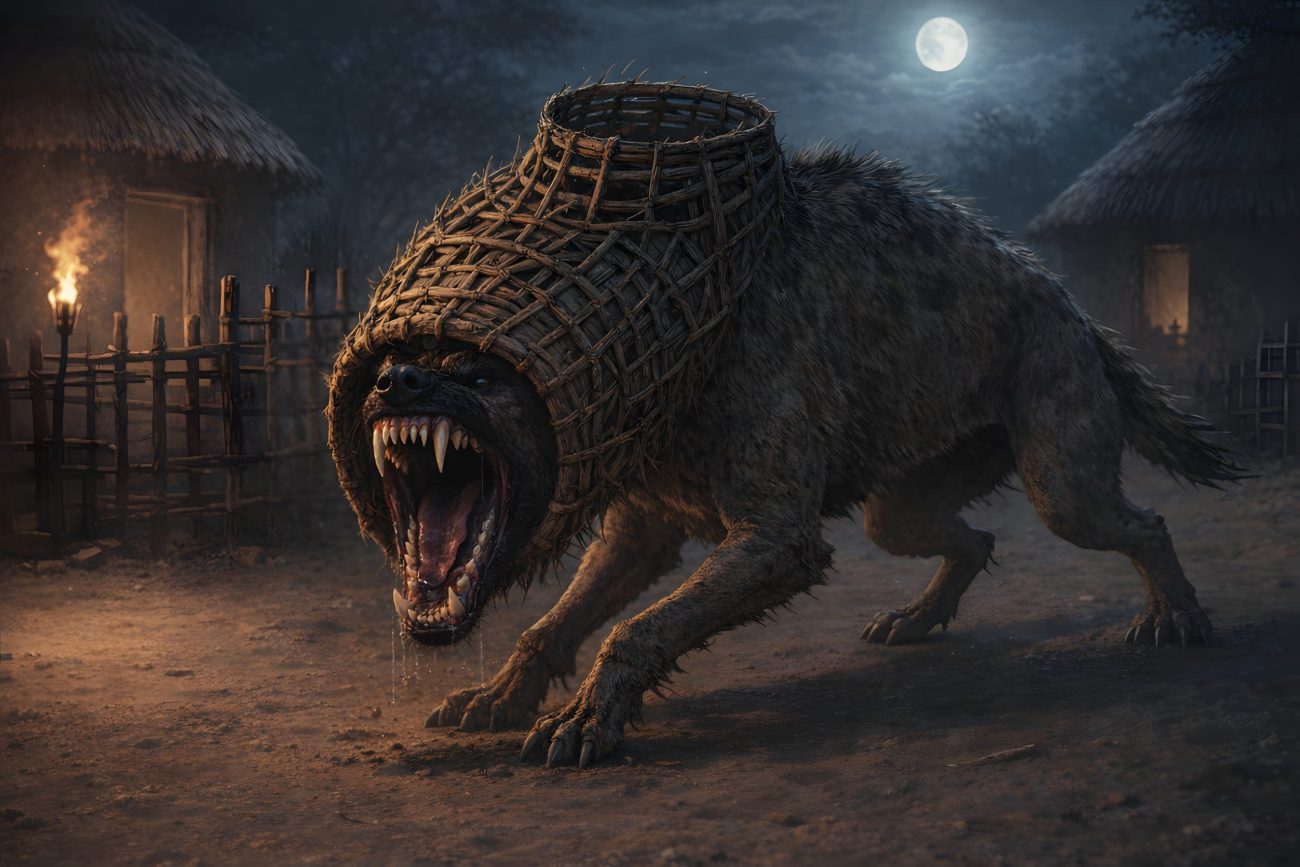
Category: Mountain dweller, Hyena


The Myth

Among the Zulu people there was once a feared creature called the Isitwalangcengce—the Basket-bearer.

It was shaped somewhat like a hyena, low and powerful, but its most terrible feature was its head. Its skull was shaped like a woven basket, hollow within, with an opening at the top. Into this living basket it placed its victims.

The Isitwalangcengce was immensely strong. Even the bravest warrior could be overcome by it. It did not attack at random, but chose its moments carefully. On feast days, when meat was freshly butchered and children carried portions from house to house, the monster crept near the village. It hid beside doorways or behind fences, waiting in silence.

When a child passed close enough, the Isitwalangcengce would seize them in an instant and thrust them into the hollow of its basket-head. Then it would run off into the bush before anyone realized what had happened.

The creature did not eat its prey whole. It had a favorite rock somewhere in the wilderness. There it would smash the heads of its captives against the stone and lap up their brains, leaving the rest of the body behind.

Yet for all its strength, the Isitwalangcengce was foolish.

Once, a man was captured and carried away inside the creature’s head. As they passed through thick bush, he reached out quietly and snapped off branches, stuffing them into the hollow around him. When the cavity was filled with twigs and leaves, he grasped a tree and pulled himself free, leaving the basket-head still heavy with branches.

The Isitwalangcengce noticed nothing. It continued on to its rock. Only when it tipped its head to pour out its meal did a heap of branches tumble onto the stone instead of a victim. By then, the man was long gone.

When he returned safely to the village, he told everyone exactly how he had escaped. Word spread quickly. From then on, if anyone was seized, they knew what to do—fill the monster’s head with branches and slip away.

With its trick discovered, the Isitwalangcengce lost much of its terror. Over time it became little more than a warning told to children: behave, or the Basket-bearer will carry you off.

And the children, hearing the tale, smile quietly—because they know the way out.


Gallery


Sources

abookofcreatures.com contributors. (n.d.). Isitwalangcengce. In abookofcreatures.com, from https://abookofcreatures.com/2015/03/23/isitwalangcengce/


Interpretive Lenses

Religious Readings
  • Christian Ascetic Deep Dive
Philosophical Readings
  • Nietzschean Deep Dive
Psychological Readings
  • Jungian Deep Dive
Esoteric Deep Dive
  • Hermetic Deep Dive
Political / Social Readings
  • Marxist Deep Dive
Other
  • How to Invite The Isitwalangcengce