Ocheretyanyk

Tradition / Region: Ukrainian Mythology
Also Known As: Reed Devil, Spirit of the Reeds
Category: Demon, Swamp Dweller


The Myth

The Ocheretyanyk is a mysterious spirit from Slavic folklore associated with reeds, marshes, and wetlands. Its name comes from the Ukrainian word ocheret, meaning “reed,” and the creature was believed to dwell deep within thick reed beds near rivers and swamps.

Very little is known about the Ocheretyanyk compared to other Slavic spirits. Folklore usually describes it as a devil-like being tied to a specific place rather than a wandering demon. It was feared as a strange supernatural presence capable of terrifying travelers who passed too close to the reeds at night.

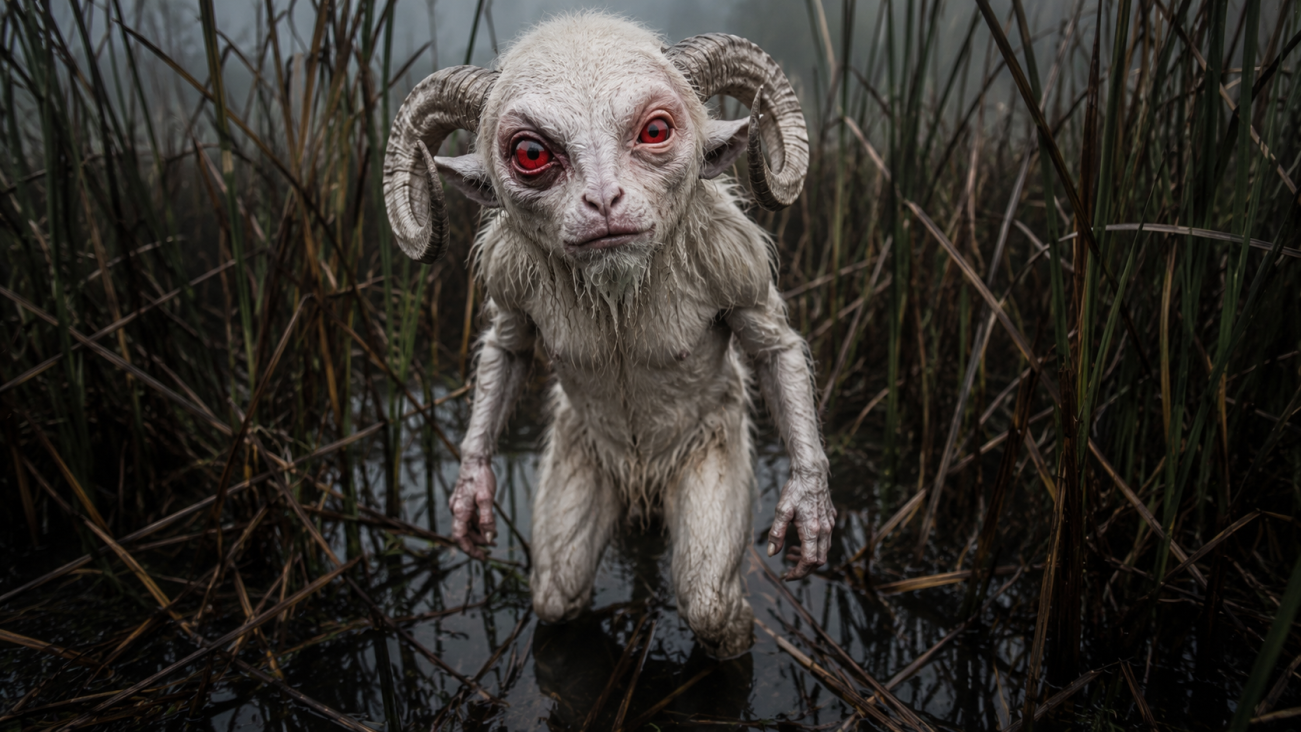
One surviving legend tells of a man riding near a marsh who encountered a strange white ram with claws, screaming unnaturally beside the reeds. Believing it to be an ordinary animal, the man lifted it onto his cart. Immediately the horses became unable to move under its weight. When he tried to throw the creature off, it would not leave the cart no matter how hard he struggled.

Only when the roosters crowed at dawn did the creature finally leap away on its own. Laughing mockingly, it disappeared back into the reeds.

Stories about the Ocheretyanyk often resemble broader Slavic tales about supernatural fear spirits—unknown beings that appear suddenly in strange forms such as animals, objects, or distorted humans in order to frighten people wandering near dangerous places at night.


Sources

Bestiary.us. (n.d.). Ocheretjanyk. Retrieved May 10, 2026, from https://www.bestiary.us/ocheretjanyk/

Palm Tree King

Tradition / Region: Iraqi Mythology, Mesopotamian Mythology, Sumerian Mythology
Alternative Name: –
Category: Demon


The Myth

The Palm Tree King was one of the strange and monstrous beings known as the Slain Heroes in ancient Sumerian mythology. These creatures appear in the epic Lugale, which tells the story of the warrior god Ninurta battling monstrous enemies to recover the stolen Tablets of Destiny.

The Slain Heroes served the monstrous being Imdugud, also known later as Anzu, who had stolen the divine Tablets of Destiny from the god Enlil, ruler of wind, storms, and the heavens. Ninurta set out to defeat these creatures and reclaim the tablets.

Very little survives about the Palm Tree King compared to the other monsters in the epic. Ancient texts mention him among the creatures allied with Imdugud, but few details describe his appearance or powers. His unusual name suggests a connection to sacred trees, fertility, or the wilderness of southern Mesopotamia.

Unlike many of the other Slain Heroes defeated by Ninurta during his campaign, the Palm Tree King may have escaped destruction. Some interpretations of the surviving myths describe him as the only monstrous servant of Imdugud not clearly slain in battle.


Sources

Wikipedia contributors. (n.d.). Palm Tree King. In Wikipedia. Retrieved May 10, 2026, from https://en.wikipedia.org/wiki/Palm_Tree_King


Reamso

Tradition / Region: Cambodian Mythology
Alternative Name: –
Category: Demon


The Myth

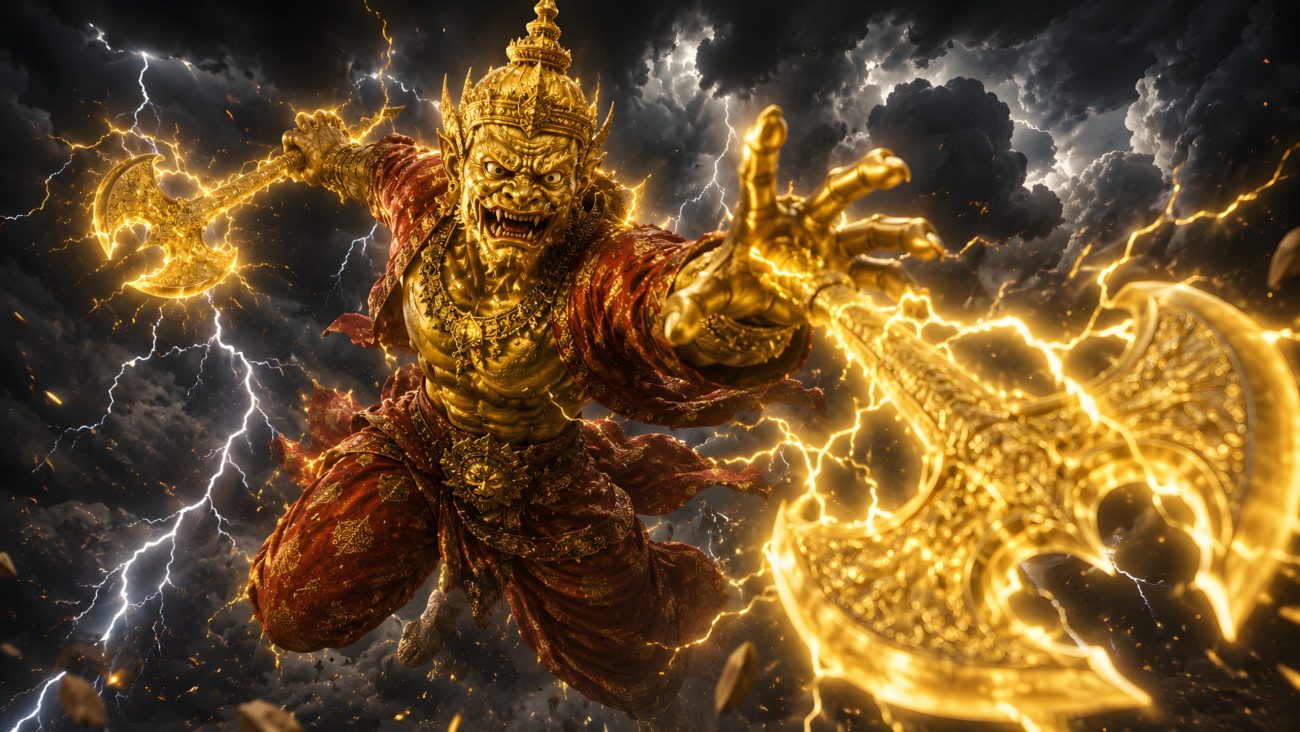
Reamso is a powerful storm demon in Cambodian mythology associated with thunder, storms, and violent weather. He is most famous for his eternal battle against the sea goddess Moni Mekhala, a conflict believed to create thunder, lightning, and rain across the sky.

According to the legend, Reamso studied alongside the sea goddess Moni Mekhala and a princely figure named Vorachhun under the wise hermit Lok Ta Moni Eisei. One day, the hermit announced that he would reward the most clever student with a magical crystal ball of great power. To decide the winner, he challenged his students to collect a glass of morning dew.

Moni Mekhala used her intelligence to win the contest. She spread a cloth across the grass overnight and squeezed the collected dew into a glass the next morning. Impressed by her ingenuity, the hermit rewarded her with the magical crystal ball. Reamso received a magical diamond axe, while Vorachhun received a magical dagger.

Reamso became jealous of Moni Mekhala and desired the crystal ball for himself. Determined to seize it, he set out to hunt her down. During his pursuit, he encountered Vorachhun and killed him before continuing after the goddess.

When Reamso finally confronted Moni Mekhala, she attempted to evade him rather than fight. Furious, the storm demon hurled his diamond axe at her through the sky. Each throw of the axe created the sound of thunder. To defend herself, Moni Mekhala raised her crystal ball into the heavens, producing brilliant flashes of lightning that blinded Reamso and allowed her to escape.

As the battle continued across the sky, the clash between thunder and lightning created rain that fell upon the earth. Some of the rain touched the body of Vorachhun, reviving him, and he then rose into the heavens to continue searching for Moni Mekhala and Reamso.

In Cambodian tradition, storms, thunder, lightning, and rain are believed to be the result of the endless chase and battle between Reamso and Moni Mekhala in the sky.


Sources

Wikipedia contributors. (n.d.). Robam Moni Mekhala. In Wikipedia, from https://en.wikipedia.org/wiki/Robam_Moni_Mekhala


Mystan Kempir

Tradition / Region: Kazakhstan Mythology, Kyrgyzstan Mythology, Uzbekistan Mythology, and Tatar Mythology
Alternate Names: None Recorded
Category: Witch, Demon


The Myth

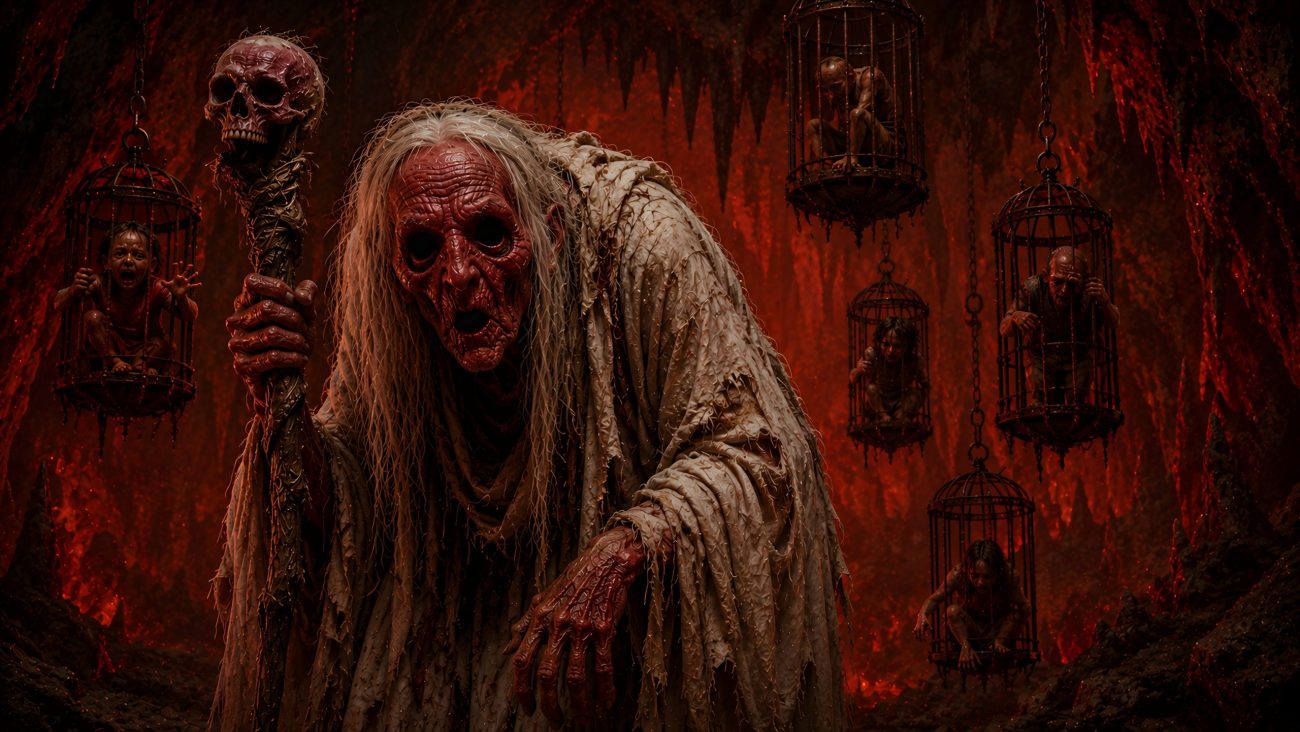
Mystan Kempir is a demonic old woman from Central Asian folklore. She is feared as a witch who steals and replaces children, poisons food, and places curses upon people. Some legends also describe her keeping captives in the underworld, where she devours them alive.

Although she appears as an elderly woman, Mystan Kempir is said to possess unnatural speed and strength, capable of outrunning or even catching a galloping horse. She is known more for deception than direct violence, often defeating people through tricks, manipulation, and cunning rather than force.

Stories describe Mystan Kempir disguising herself as an ordinary old woman in order to enter homes unnoticed. Once welcomed inside, she brings misfortune, danger, or death. In heroic tales, even powerful batyrs can struggle against her schemes and magical tricks.


Sources

Bestiary contributors. (n.d.). Мыстан кемпір (Mystan Kempir). In Bestiary, from https://www.bestiary.us/mystan-kemp%D1%96r


Krinmo

Tradition / Region: Bhutan Mythology
Alternate Names: None Recorded
Category: Demon


The Myth

The Krinmo are female demons from Bhutanese folklore. In the folktale Saved by Acho Lala, they are portrayed as man-eating beings who trick humans, capture them, and cook them in boiling cauldrons. The story also describes a krinmo disguising herself as a beautiful girl in order to deceive her victim.

In the tale, a young girl is left alone after her mother flees from a land filled with demons. Soon after, the daughter of a krinmo approaches the girl disguised as a beautiful human and gains her trust. The next day the krinmo returns carrying a sack and tricks the girl into reaching down from an orange tree, allowing the demon to grab her and carry her away.

During the journey, the girl convinces the krinmo to rest. While the demon sleeps, the girl secretly fills the sack with stones and escapes. The krinmo later empties the sack into a boiling cauldron, expecting meat, only to discover stones instead.

The following day the krinmo captures the girl again and brings her to the demon family’s home to be eaten. The girl persuades the mother krinmo to spare her until she grows larger. While left alone with the krinmo daughter, she tricks her into exchanging clothes and taking her place on a swing suspended above a boiling cauldron. The girl cuts the rope, causing the krinmo to fall into the boiling water.

That evening the krinmo family unknowingly eats their own daughter. When they later discover the deception, they chase the escaping girl up a cypress tree. As a krinmo climbs after her, the girl calls to Acho Lala, the moon, for help. Acho Lala lowers an iron chain, allowing the girl to escape to the moon. One krinmo attempts to follow her using a woollen rope, but the rope snaps and the demon falls to her death. The story says the curve on human feet was caused when the krinmo’s claws tore flesh from the girl’s feet as she escaped.


Sources

Penjore, D. (2011). Dangphu Dingphu: A Collection of Bhutanese Folktales.


Krinpo

Tradition / Region: Bhutan Mythology
Alternate Names: None Recorded
Category: Demon


The Myth

The Krinpo are man-eating demons from Bhutanese folklore. In the folktale Saved by Acho Lala, they are portrayed as dangerous beings who hunt humans and devour them as food. The story describes them living together as a family and preparing human victims in boiling cauldrons.

In the tale, a young girl is abandoned by her mother, who flees from a land filled with krinpo demons. The girl is later captured and brought to the home of the demons, where the krinpo family intends to eat her. She manages to delay her death by convincing them she is too small to cook.

While the other demons are away, the girl tricks one of the demon children into taking her place above a boiling cauldron. The demon falls into the pot and dies. That evening, the krinpo family unknowingly eats their own child while believing they are eating the captured girl.

The girl escapes while the demons are distracted and flees into a cypress tree as the krinpo pursue her. She calls upon Acho Lala, the moon, for help. Acho Lala lowers an iron chain from the sky, allowing her to climb safely to the moon while the demons fail to follow her.


Sources

Penjore, D. (2011). Dangphu Dingphu: A Collection of Bhutanese Folktales.


Boba

Tradition / Region: Bengali Mythology, Indian Mythology
Alternate Names: Boba Jinn, Bobay Dhora
Category: Demon, Spirit


The Myth

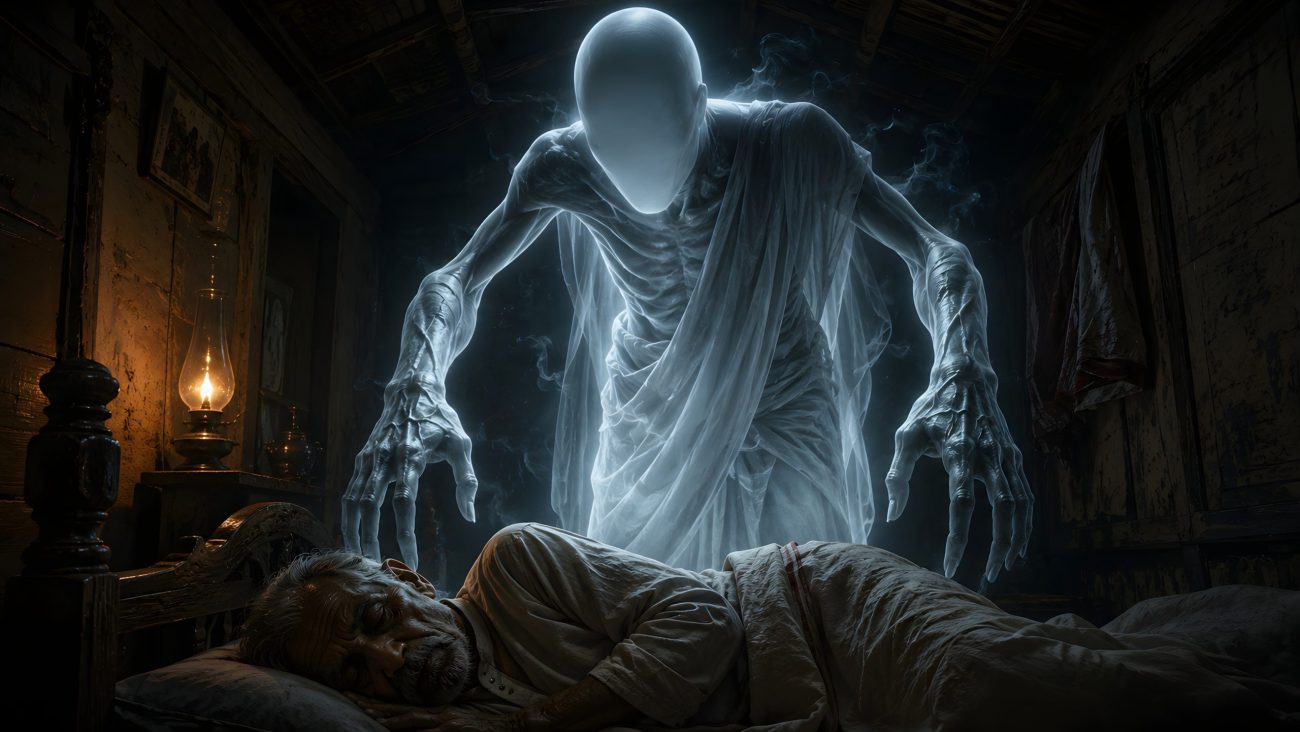
Boba is a terrifying nocturnal spirit from Bengali folklore, feared for attacking people while they sleep. The name Boba means “mute” or “speechless,” referring to the helpless condition its victims experience during an encounter. In many traditions, the entity is described as a type of jinn or malevolent spirit that preys upon sleeping humans, especially those lying flat on their backs during the night.

According to the legend, Boba attacks silently in the deepest hours of darkness. Victims suddenly awaken but find themselves completely unable to move, speak, or cry for help. They remain conscious while an invisible force pins them down. Many report feeling immense pressure on their chest, as though something heavy is crushing them, making breathing extremely difficult. The experience is accompanied by overwhelming terror and the sensation of being strangled.

Although the spirit is not always fully visible, witnesses often describe seeing a shadowy figure sitting on their chest or crouching nearby in the darkness. Some accounts portray Boba as a dark humanoid being with glowing eyes, while others describe it only as a suffocating presence lurking in the room. The victim may hear whispers, breathing, footsteps, or strange sounds while remaining unable to move even a finger. In some stories the spirit leans close to the victim’s face, watching silently while choking them.

The attack usually ends suddenly. After several moments — or what feels like an eternity — the pressure disappears and the victim regains the ability to move and speak. Many people are left shaken for hours afterward, convinced they narrowly escaped death. Because the experience feels completely real, belief in Boba became deeply rooted in Bengali culture, particularly in rural areas where stories of nighttime attacks were passed down for generations.

The phenomenon is commonly called Bobay Dhora, meaning “being seized by Boba.” Traditional beliefs warn people against sleeping alone, sleeping on their back, or falling asleep in spiritually unclean places. Some families recite prayers, verses, or protective rituals before bed to ward the spirit away. In certain stories, repeated attacks by Boba are believed to weaken a person physically and spiritually over time.

Unlike many monsters that haunt forests or rivers, Boba invades the safety of the home itself. It attacks in silence, during the most vulnerable moment of human weakness — sleep — turning the darkness of the bedroom into something terrifying and inescapable.


Sources

Wikipedia contributors. (n.d.). Ghosts in Bengali culture. In Wikipedia, from https://en.wikipedia.org/wiki/Ghosts_in_Bengali_culture


Ördög

Tradition / Region: Hungarian Mythology
Alternate Names: Ürdüng (Old Hungarian)
Category: Demon


The Myth

The Ördög is a shape-shifting demonic being in Hungarian mythology, representing dark and destructive forces. In earlier traditions, he was not purely identical to the Christian devil, but after Christianization he became directly associated with the concept of Satan.

In some accounts, the Ördög even plays a role in the creation of the world, acting as a helper or counterpart to God. This reflects an older dualistic belief system where opposing forces both contributed to existence.

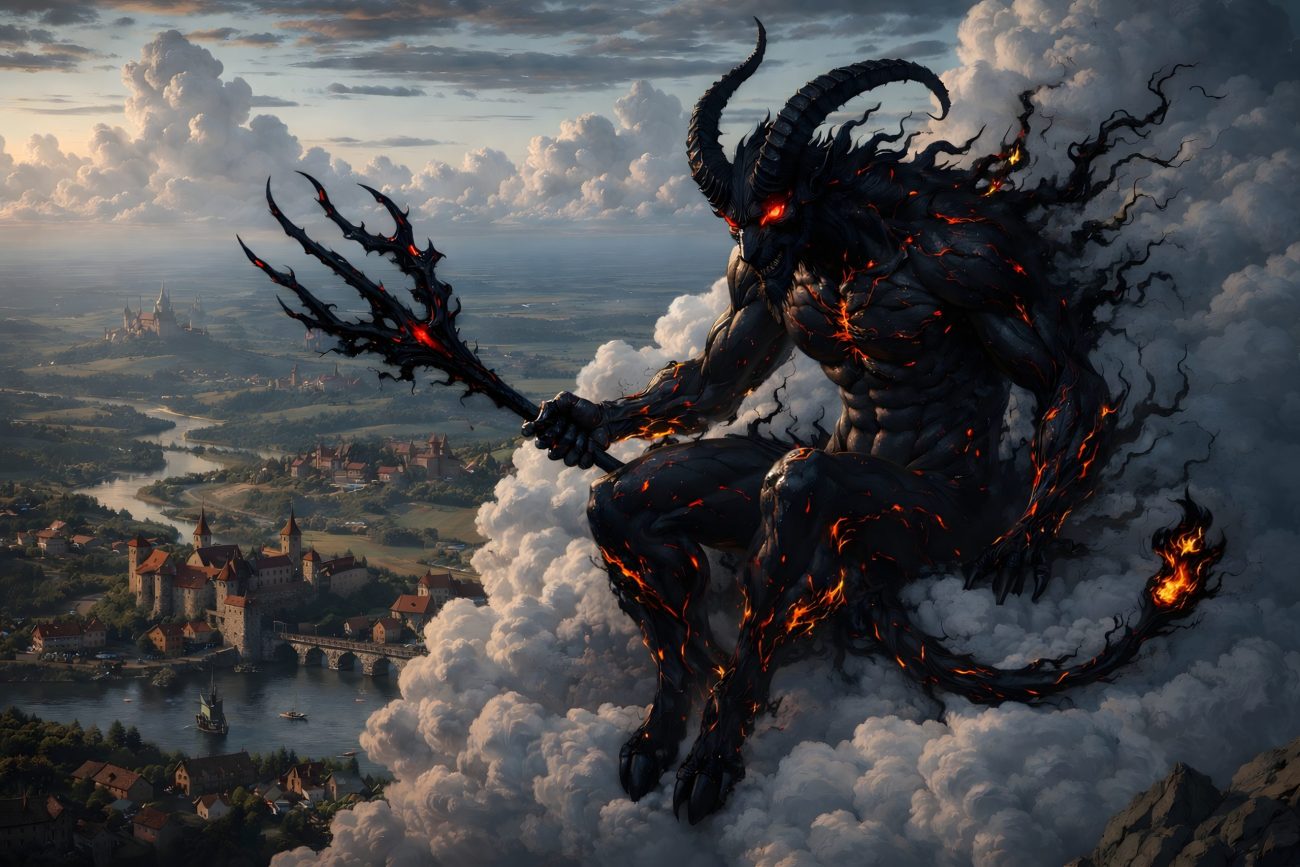
He is commonly described as a humanoid creature with goat-like features: horns, cloven hooves, and a tail, resembling a satyr or faun. His body is often depicted as black, and he may carry a pitchfork. However, he is not limited to this form and is known for his ability to shapeshift.

When appearing among humans, the Ördög may take the form of a fox, a dark flame, or even a human—often a shepherd with unsettling, glowing eyes. He is said to hide within walls, making strange, high-pitched noises to disturb or influence people.

The Ördög is strongly associated with the underworld, known as Pokol, where he stirs a great cauldron filled with the souls of sinful humans. However, this idea may be influenced by later Christian beliefs, as earlier traditions did not necessarily describe the underworld strictly as a place of punishment.

A defining trait of the Ördög is his tendency to make bargains or bets with humans. Through these deals, he attempts to corrupt individuals and claim their souls. His ultimate goal is the accumulation of human souls, making him a persistent and dangerous adversary in Hungarian folklore.


Sources

Wikipedia contributors. (n.d.). Ördög. In Wikipedia, from https://en.wikipedia.org/wiki/%C3%96rd%C3%B6g


Nine-Headed Dev

Tradition / Region: Georgian Mythology
Alternate Names: —
Category: Demon


The Myth

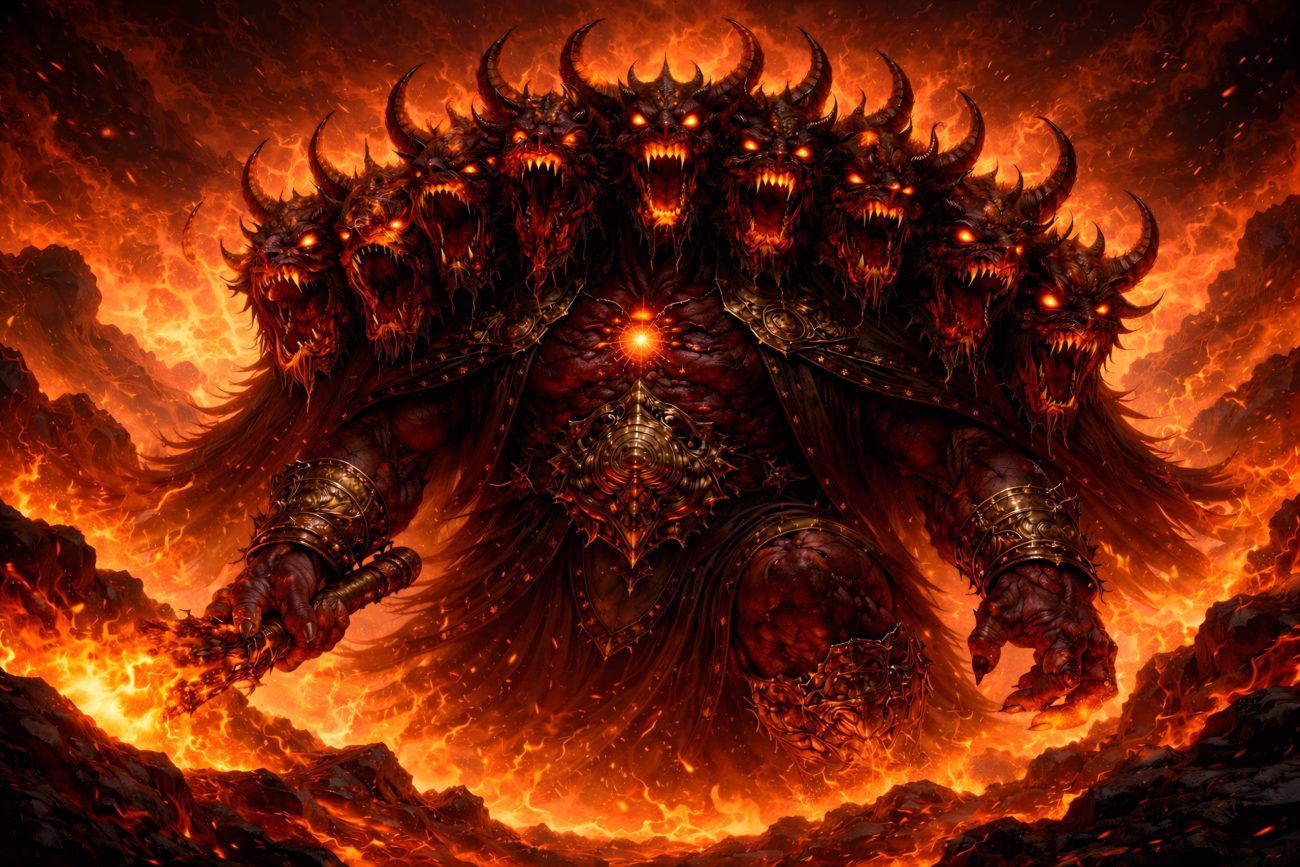
The Nine-Headed Dev was the chief of the devs, ruling over their stronghold at Tsikhe-Gora near the village of Avusho. As their leader, he commanded the other devs and dominated the region.

At one time, the devs captured a traveling woman who carried her small child, Kopala. They brought both before the Nine-Headed Dev. He immediately devoured the woman, but spared the child, deciding to keep him until he grew older and could be eaten later.

Kopala grew up among the devs and witnessed their behavior. He could not endure their cruelty and longed to avenge his mother. Realizing that the devs intended to kill him, he escaped one night and fled to a church, where he prayed for strength.

His prayer was answered, and he was granted great power. He prepared for battle and forged a weapon, a mace that, when thrown, struck like lightning, roaring and igniting fire.

Kopala returned to Tsikhe-Gora and approached the devs in disguise, claiming to be a lost hunter. They did not recognize him and received him as a guest. The next day, they challenged him, asking why he had come. Kopala declared that the place should belong to him and that they must leave.

They agreed to settle the matter with a contest of strength, throwing massive stones toward the stronghold. The devs secretly placed kaji nearby to interfere, intending to move Kopala’s stones if he surpassed them. Despite this, Kopala’s throw reached far beyond theirs.

When Kopala discovered their deception, he became enraged. Taking up his mace, he attacked the devs and destroyed them, including the Nine-Headed Dev.

After this, Kopala remained at Tsikhe-Gora, living there and protecting people from other devs.


Sources

Tsanava, A. (1992). ქართული მითოლოგია [Georgian Mythology]. In Tbilisi: Merani P. 18.


Dev Blacksmith

Tradition / Region: Georgian Mythology
Alternate Names: —
Category: Demon


The Myth

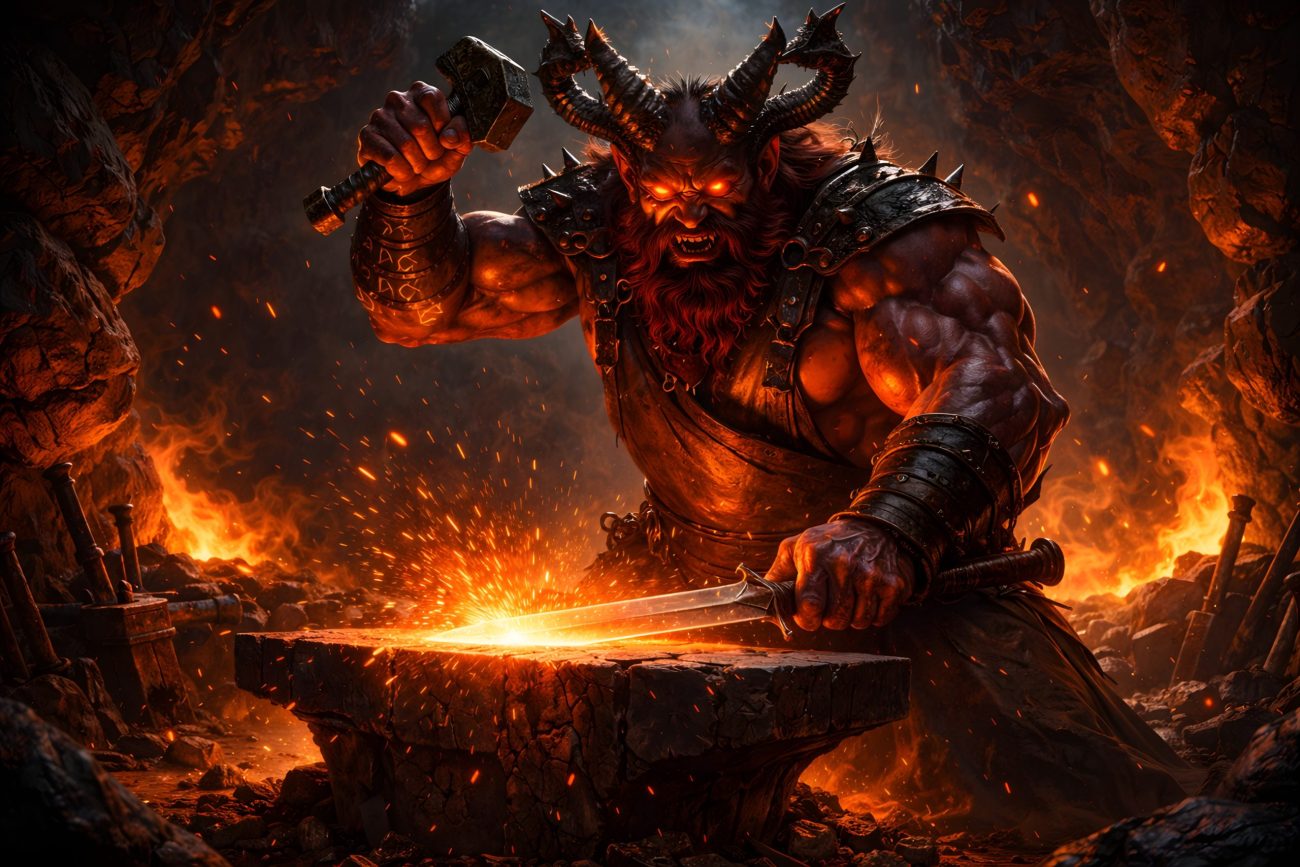
The Dev Blacksmiths are powerful devs who controlled all metalworking in the land, holding dominance over essential tools and survival. They lived in their own strongholds and possessed the only forges, meaning humans depended entirely on them for weapons and agricultural tools.

Anyone who brought metal to be worked had to meet their demands. Instead of ordinary payment, the devs required women from the household—wives, daughters, or daughters-in-law—forcing people to comply. Without tools, people would starve, so they had no choice but to obey.

In one account, a man sent his wife to the devs in exchange for plough equipment. When she returned, she lamented that death would have been better than what she endured. This revealed the suffering imposed by the devs and the extent of their cruelty.

The devs’ control over metal and tools gave them power over human survival itself. They used this power to dominate, exploit, and oppress, facing no resistance.

Their rule continued until divine intervention began, when forces were sent to oppose them and end their control.

The Dev Blacksmiths represent
a force that controls creation and survival, but uses it for domination, demanding submission in exchange for the means to live.


Sources

Tsanava, A. (1992). ქართული მითოლოგია [Georgian Mythology]. In Tbilisi: Merani P. 4.