Druk

Tradition / Region: Bhutan Mythology
Alternate Names: Duk, Dug
Category: Dragon


The Myth

The Druk is the thunder dragon of Tibetan and Bhutanese mythology and the national symbol of Bhutan. It is associated with thunder, storms, and the sound of dragons roaring in the sky. The Druk is traditionally depicted as a dragon connected to clouds and lightning, and on the flag of Bhutan it is shown holding jewels that symbolize wealth.

According to tradition, the symbol of the Druk originated with the Drukpa Lineage in Tibet. When Tsangpa Gyare, the founder of the lineage, began building Ralung Monastery, a violent storm appeared. The thunder was interpreted as the roar of a dragon and seen as an auspicious omen. Because of this event, the monastery was named Drug-Ralung, meaning “Thunder Dragon.” The followers of the monastery became known as Drugpa, or “People of the Thunder Dragon.”

As the Drukpa Lineage spread into Bhutan, the thunder dragon became closely associated with the country itself. Bhutan came to be known as Druk Yul, meaning “Land of the Thunder Dragon,” while its rulers became known as Druk Gyalpo, or “Thunder Dragon Kings.” The Druk eventually became the central national symbol of Bhutan and remains closely tied to Bhutanese identity, religion, and kingship.


Sources

Wikipedia contributors. (n.d.). Druk. In Wikipedia, from https://en.wikipedia.org/wiki/Druk


Krinmo

Tradition / Region: Bhutan Mythology
Alternate Names: None Recorded
Category: Demon


The Myth

The Krinmo are female demons from Bhutanese folklore. In the folktale Saved by Acho Lala, they are portrayed as man-eating beings who trick humans, capture them, and cook them in boiling cauldrons. The story also describes a krinmo disguising herself as a beautiful girl in order to deceive her victim.

In the tale, a young girl is left alone after her mother flees from a land filled with demons. Soon after, the daughter of a krinmo approaches the girl disguised as a beautiful human and gains her trust. The next day the krinmo returns carrying a sack and tricks the girl into reaching down from an orange tree, allowing the demon to grab her and carry her away.

During the journey, the girl convinces the krinmo to rest. While the demon sleeps, the girl secretly fills the sack with stones and escapes. The krinmo later empties the sack into a boiling cauldron, expecting meat, only to discover stones instead.

The following day the krinmo captures the girl again and brings her to the demon family’s home to be eaten. The girl persuades the mother krinmo to spare her until she grows larger. While left alone with the krinmo daughter, she tricks her into exchanging clothes and taking her place on a swing suspended above a boiling cauldron. The girl cuts the rope, causing the krinmo to fall into the boiling water.

That evening the krinmo family unknowingly eats their own daughter. When they later discover the deception, they chase the escaping girl up a cypress tree. As a krinmo climbs after her, the girl calls to Acho Lala, the moon, for help. Acho Lala lowers an iron chain, allowing the girl to escape to the moon. One krinmo attempts to follow her using a woollen rope, but the rope snaps and the demon falls to her death. The story says the curve on human feet was caused when the krinmo’s claws tore flesh from the girl’s feet as she escaped.


Sources

Penjore, D. (2011). Dangphu Dingphu: A Collection of Bhutanese Folktales.


Krinpo

Tradition / Region: Bhutan Mythology
Alternate Names: None Recorded
Category: Demon


The Myth

The Krinpo are man-eating demons from Bhutanese folklore. In the folktale Saved by Acho Lala, they are portrayed as dangerous beings who hunt humans and devour them as food. The story describes them living together as a family and preparing human victims in boiling cauldrons.

In the tale, a young girl is abandoned by her mother, who flees from a land filled with krinpo demons. The girl is later captured and brought to the home of the demons, where the krinpo family intends to eat her. She manages to delay her death by convincing them she is too small to cook.

While the other demons are away, the girl tricks one of the demon children into taking her place above a boiling cauldron. The demon falls into the pot and dies. That evening, the krinpo family unknowingly eats their own child while believing they are eating the captured girl.

The girl escapes while the demons are distracted and flees into a cypress tree as the krinpo pursue her. She calls upon Acho Lala, the moon, for help. Acho Lala lowers an iron chain from the sky, allowing her to climb safely to the moon while the demons fail to follow her.


Sources

Penjore, D. (2011). Dangphu Dingphu: A Collection of Bhutanese Folktales.


Monmo Tashi Khyidren

Tradition / Region: Bhutan Mythology, Buddhist Tradition
Alternate Names: Tashi Kyidren, Tashi Chidren, Tashi Khyé’u Dren, Mönmo Tashi Chidren
Category: Tiger, Hero


The Myth

Monmo Tashi Khyidren was a legendary Bhutanese princess and one of the five principal consorts of Guru Padmasambhava, also known as Guru Rinpoche. She was the daughter of Sendha Gyalpo, the ruler of Bumthang, and became one of the most revered female figures in Bhutanese Buddhist tradition. She is especially associated with tigers, transformation, and spiritual devotion, and is remembered as the only Bhutanese woman among Guru Rinpoche’s principal consorts.

According to the tradition, Tashi Khyidren first encountered Yeshe Tsogyal while the great yogini was meditating in Bhutan. Deeply moved by her wisdom and spiritual power, the young princess became her disciple and devoted herself completely to Buddhist practice. Through her training under Yeshe Tsogyal and Guru Rinpoche, she became known for her spiritual accomplishments and dedication to spreading Vajrayana Buddhism throughout Bhutan.

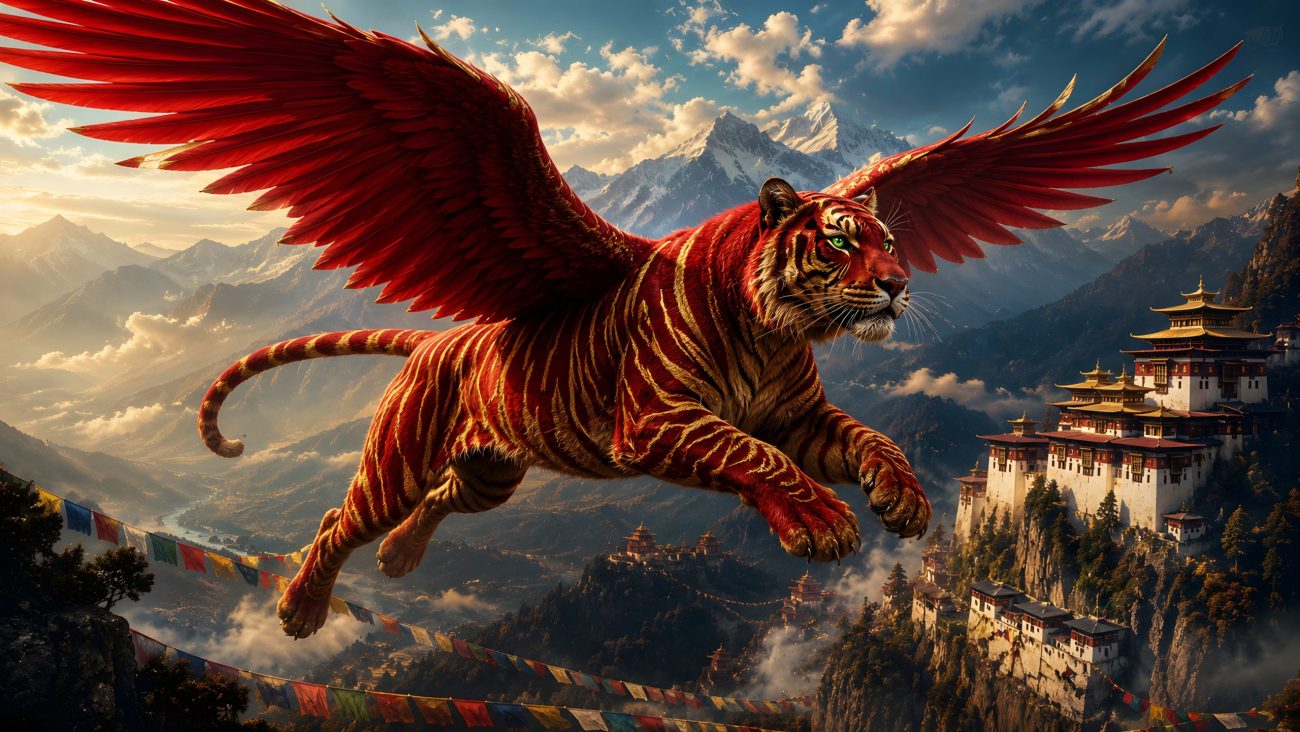
The most famous legend surrounding Monmo Tashi Khyidren concerns the subjugation of powerful demonic forces troubling the land. Guru Rinpoche had come to Bhutan after being invited by her father, King Sendha Gyalpo, who was suffering from illness caused by an evil deity known as Shelging Karpo. To defeat these harmful spirits and establish Buddhist teachings, Guru Rinpoche assumed one of his wrathful manifestations, Guru Dorje Drolo. At the same time, Yeshe Tsogyal transformed into the fierce goddess Ekajati, while Monmo Tashi Khyidren transformed herself into a flying tigress.

Mounted upon the back of the tigress, Guru Dorje Drolo and Yeshe Tsogyal flew through the mountains from Sengye Dzong to the sacred cliffs of Paro Taktsang, the famous Tiger’s Nest monastery. There they meditated in hidden caves and subdued the dangerous spirits haunting the region. Because Monmo Tashi Khyidren became the tigress that carried Guru Rinpoche through the sky, she became forever associated with tigers in Bhutanese religious tradition.

Many Bhutanese legends claim her spiritual presence still remains near sacred monasteries connected to her life. At Sangchen Ogyen Tsuklag Monastery in Trongsa, founded by Monmo Tashi Khyidren herself, tigers are occasionally said to roam the mountains nearby. Some believe these sightings are signs that her blessings continue to protect the area, or even that she still exists spiritually in the form of a tigress watching over the land.

Monmo Tashi Khyidren is remembered not only as a mystical figure, but as a symbol of devotion, spiritual strength, and the important role women played in the spread of Buddhism across Bhutan and the Himalayas.


Sources

Khedrup Foundation contributors. (n.d.). Monmo Tashi Khyidren Initiative. In Khedrup Foundation, from https://khedrupfoundation.org/monmo-tashi-khyidren-initiative/

Rigpa Wiki contributors. (n.d.). Tashi Khyidren. In Rigpa Wiki, from https://www.rigpawiki.org/index.php?title=Tashi_Khyidren

Samye Institute contributors. (n.d.). Tashi Kyidren. In Samye Institute, from https://www.samyeinstitute.org/wiki/tashi-kyidren/



Yeti

Tradition / Region: Bhutan Mythology, Nepali Mythology, Indian Mythology, Chinese Mythology, Russian Mythology
Alternate Names: Abominable Snowman, Mi-rgod, Wild Man
Category: Mountain Dweller


The Myth

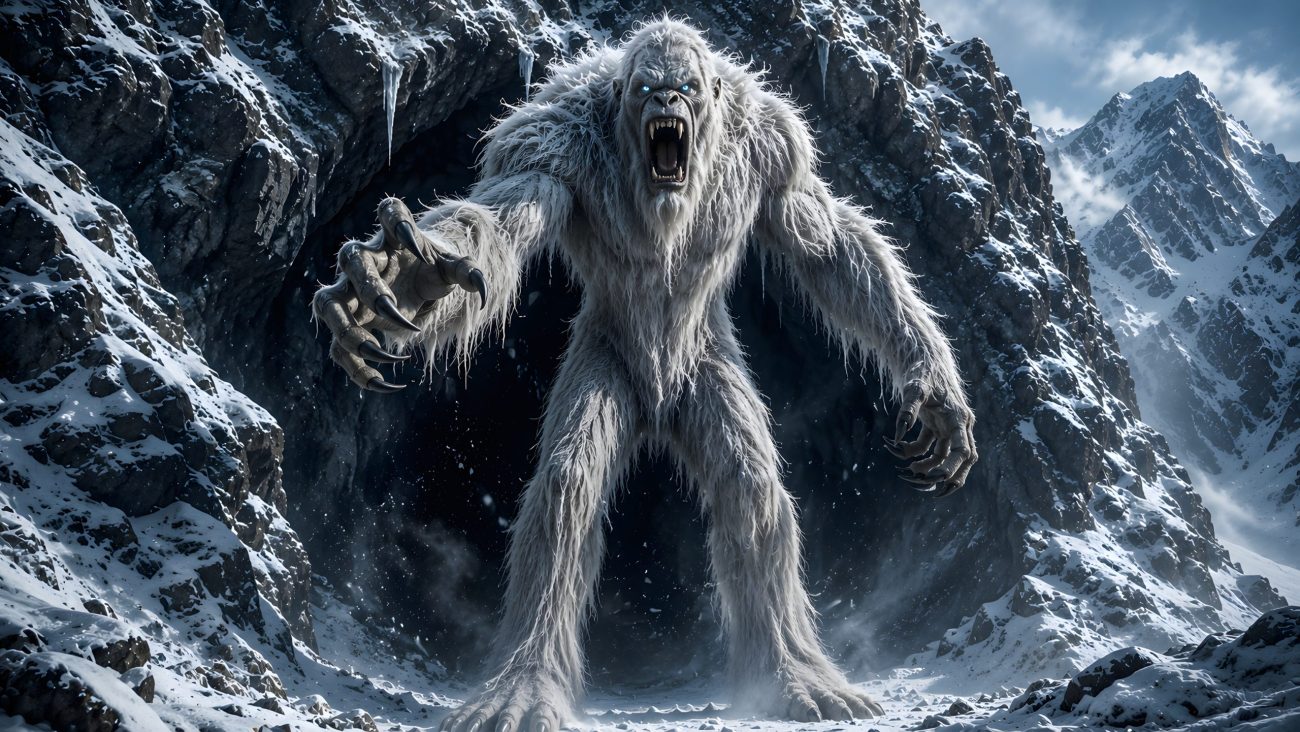
The Yeti is a legendary ape-like being said to inhabit the remote mountains and glaciers of the Himalayas. Descriptions vary between regions, but it is most often portrayed as a massive hairy humanoid creature that walks upright like a man. Its body is covered in dark or reddish fur, and it is associated with enormous footprints found in snow and ice. In older Himalayan traditions, the Yeti was not merely viewed as an animal but as a mysterious supernatural being connected to mountains, wilderness, and spiritual power.

Among several Himalayan peoples, especially before the spread of Buddhism, the Yeti was tied to religious beliefs. Some Lepcha traditions described a “Glacier Being” worshipped as a spirit or god of the hunt. Followers of the ancient Bön religion believed the blood of the wild mountain being possessed ritual power and could be used in spiritual ceremonies. In these stories the creature was depicted carrying large stones as weapons and roaming isolated snowy valleys far from human settlements.

In Tibetan Buddhist traditions, the Yeti became less of a god and more of a powerful nonhuman creature living beyond civilization. Some stories describe Yetis helping monks, saints, or religious figures after being tamed through spiritual teachings. Images of Yetis were sometimes carried in ceremonies as protective guardians against evil spirits. Despite this, encountering one was usually considered a terrible omen. Hearing its cries or glimpsing it in the mountains was believed to foretell danger, death, or misfortune unless the witness performed religious acts to cleanse the bad luck.

The Yeti became widely known outside the Himalayas during the nineteenth century when explorers and travelers reported seeing strange footprints and hairy creatures in remote mountain regions. Trekkers described tall bipedal figures covered in dark hair fleeing across snowy slopes, while guides told stories of wild mountain men wandering glaciers and forests. Reports of massive footprints in the snow became especially famous, though many later believed they may have belonged to bears or other animals distorted by melting ice.

Despite skepticism and many suspected hoaxes, the legend of the Yeti endured throughout the Himalayas and later spread into global popular culture as the “Abominable Snowman.” In folklore, however, the creature remained something more mysterious than a simple monster: a hidden being of the mountains, existing somewhere between animal, spirit, and wild man.


Sources

Wikipedia contributors. (n.d.). Yeti – Pre-19th century. In Wikipedia, from https://en.wikipedia.org/wiki/Yeti#Pre-19th_century