Murkatta

Tradition / Region: Nepali Mythology
Alternative names: Murkatta
Category: Ghost


The Myth

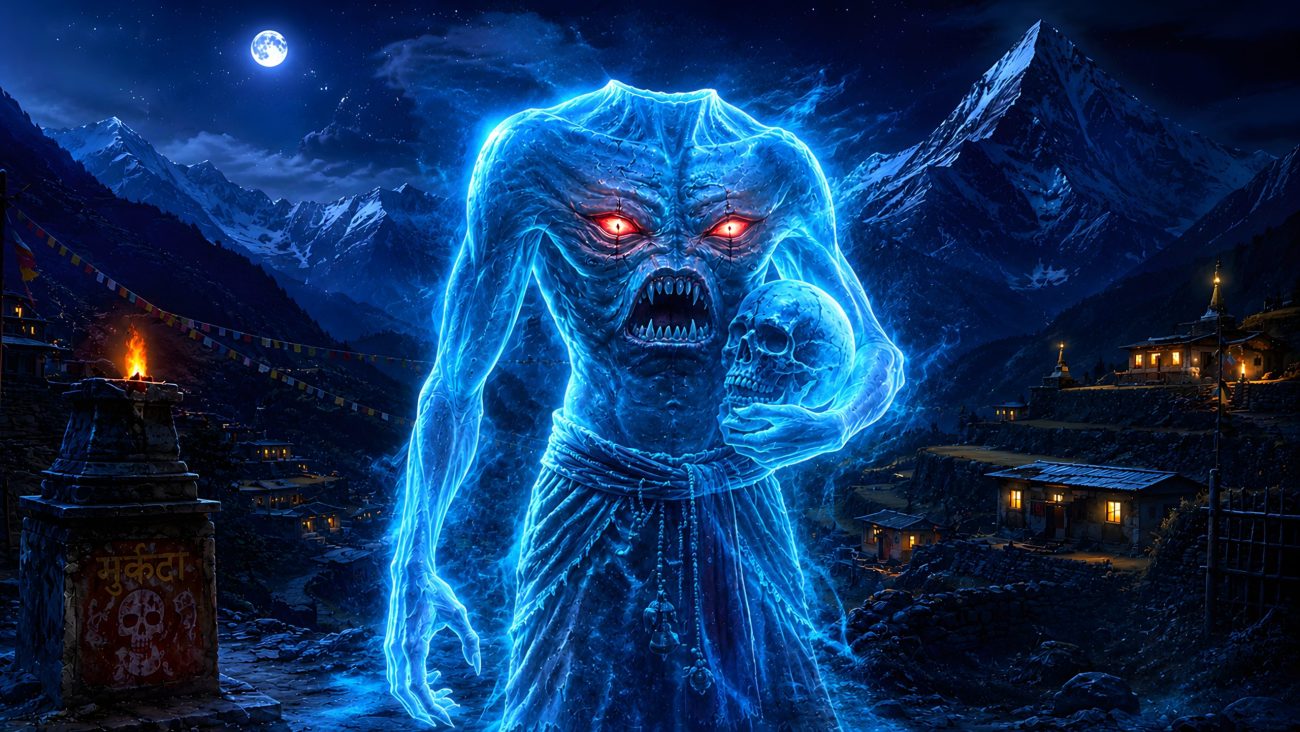
The Murkatta is a terrifying headless ghost found in Nepali folklore. It is believed to be the spirit of a dead person whose head has been severed. Despite lacking a head, the creature is not blind or mute, for its eyes and mouth are located upon its chest, while its severed head is carried beneath one arm.

The Murkatta wanders the world of the living as a restless spirit. Its strange appearance and unnatural form make it one of the most frightening ghosts in Nepalese tradition. Encounters with the creature are associated with fear and misfortune, and its presence is regarded as an omen connected with death and tragedy.

Beyond its role as a supernatural being, the Murkatta is also seen as a symbol of defeat or the loss of reason and intellect, representing a person who has been figuratively or literally deprived of their head.

Remembered as a headless spectre carrying its own severed head while gazing through the eyes embedded in its chest, the Murkatta remains one of the most distinctive and unsettling ghosts of Nepalese folklore.


Sources

Wikipedia contributors. (n.d.). Murkatta. In Wikipedia. Retrieved June 20, 2026, from https://en.wikipedia.org/wiki/Murkatta


Kichkanya

Tradition / Region: Nepali Mythology
Alternative names: Kichkandi
Category: Ghost


The Myth

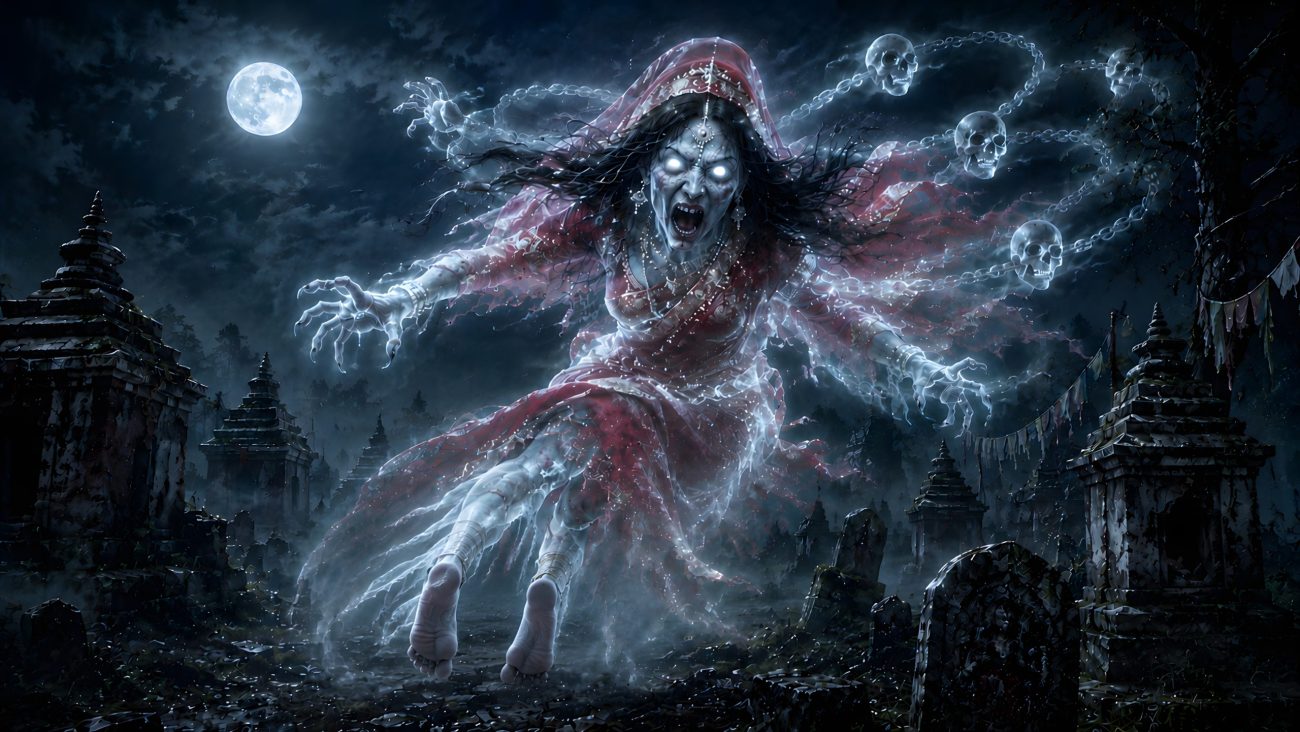
The Kichkanya is the restless spirit of a woman whose body was not completely cremated, leaving part of her remains—usually a bone—behind in the world of the living. Bound to this fragment, she wanders alone and haunts the place where she suffered an untimely death.

These spirits are often said to be the souls of women who were mistreated during life or who died during pregnancy or childbirth. They are remembered as tragic and tortured beings unable to find peace.

A Kichkanya appears as a beautiful young woman with unusually long black hair, a pale and bony complexion, and a red bridal dress. Her most disturbing feature is revealed by her feet, which point backward.

She uses her beauty to lure lonely male travelers. Those who fall under her influence are said to have their life force drained away, becoming thin, weak, and exhausted. Some victims are believed to waste away entirely.

Another common tale describes the Kichkanya as a ghostly hitchhiker who appears on deserted roads late at night. Drivers who stop for her and obey her directions eventually find themselves led to cremation grounds, temple cemeteries, or lonely places of death.

Solitary and mournful, the Kichkanya is one of Nepal’s most feared female spirits—a beautiful phantom in red, forever wandering the places where her suffering began.


Sources

Wikipedia contributors. (n.d.). Kichkandi. In Wikipedia. Retrieved June 20, 2026, from https://en.wikipedia.org/wiki/Kichkandi


Yeti

Tradition / Region: Bhutan Mythology, Nepali Mythology, Indian Mythology, Chinese Mythology, Russian Mythology
Alternate Names: Abominable Snowman, Mi-rgod, Wild Man
Category: Mountain Dweller


The Myth

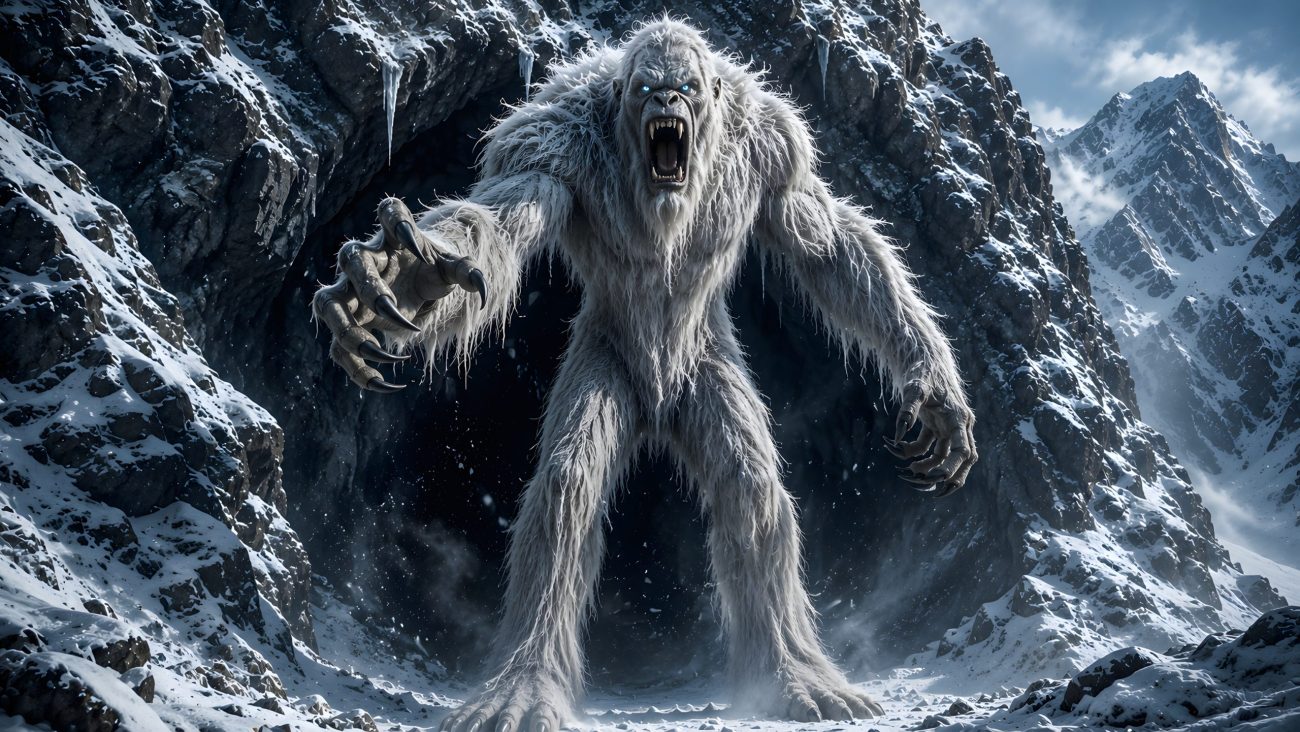
The Yeti is a legendary ape-like being said to inhabit the remote mountains and glaciers of the Himalayas. Descriptions vary between regions, but it is most often portrayed as a massive hairy humanoid creature that walks upright like a man. Its body is covered in dark or reddish fur, and it is associated with enormous footprints found in snow and ice. In older Himalayan traditions, the Yeti was not merely viewed as an animal but as a mysterious supernatural being connected to mountains, wilderness, and spiritual power.

Among several Himalayan peoples, especially before the spread of Buddhism, the Yeti was tied to religious beliefs. Some Lepcha traditions described a “Glacier Being” worshipped as a spirit or god of the hunt. Followers of the ancient Bön religion believed the blood of the wild mountain being possessed ritual power and could be used in spiritual ceremonies. In these stories the creature was depicted carrying large stones as weapons and roaming isolated snowy valleys far from human settlements.

In Tibetan Buddhist traditions, the Yeti became less of a god and more of a powerful nonhuman creature living beyond civilization. Some stories describe Yetis helping monks, saints, or religious figures after being tamed through spiritual teachings. Images of Yetis were sometimes carried in ceremonies as protective guardians against evil spirits. Despite this, encountering one was usually considered a terrible omen. Hearing its cries or glimpsing it in the mountains was believed to foretell danger, death, or misfortune unless the witness performed religious acts to cleanse the bad luck.

The Yeti became widely known outside the Himalayas during the nineteenth century when explorers and travelers reported seeing strange footprints and hairy creatures in remote mountain regions. Trekkers described tall bipedal figures covered in dark hair fleeing across snowy slopes, while guides told stories of wild mountain men wandering glaciers and forests. Reports of massive footprints in the snow became especially famous, though many later believed they may have belonged to bears or other animals distorted by melting ice.

Despite skepticism and many suspected hoaxes, the legend of the Yeti endured throughout the Himalayas and later spread into global popular culture as the “Abominable Snowman.” In folklore, however, the creature remained something more mysterious than a simple monster: a hidden being of the mountains, existing somewhere between animal, spirit, and wild man.


Sources

Wikipedia contributors. (n.d.). Yeti – Pre-19th century. In Wikipedia, from https://en.wikipedia.org/wiki/Yeti#Pre-19th_century