Picolaton

Tradition / Region: French Mythology
Alternative names: Pique-au-mollet, Quiperlibresson, Cacalambri
Category: Bird


The Myth

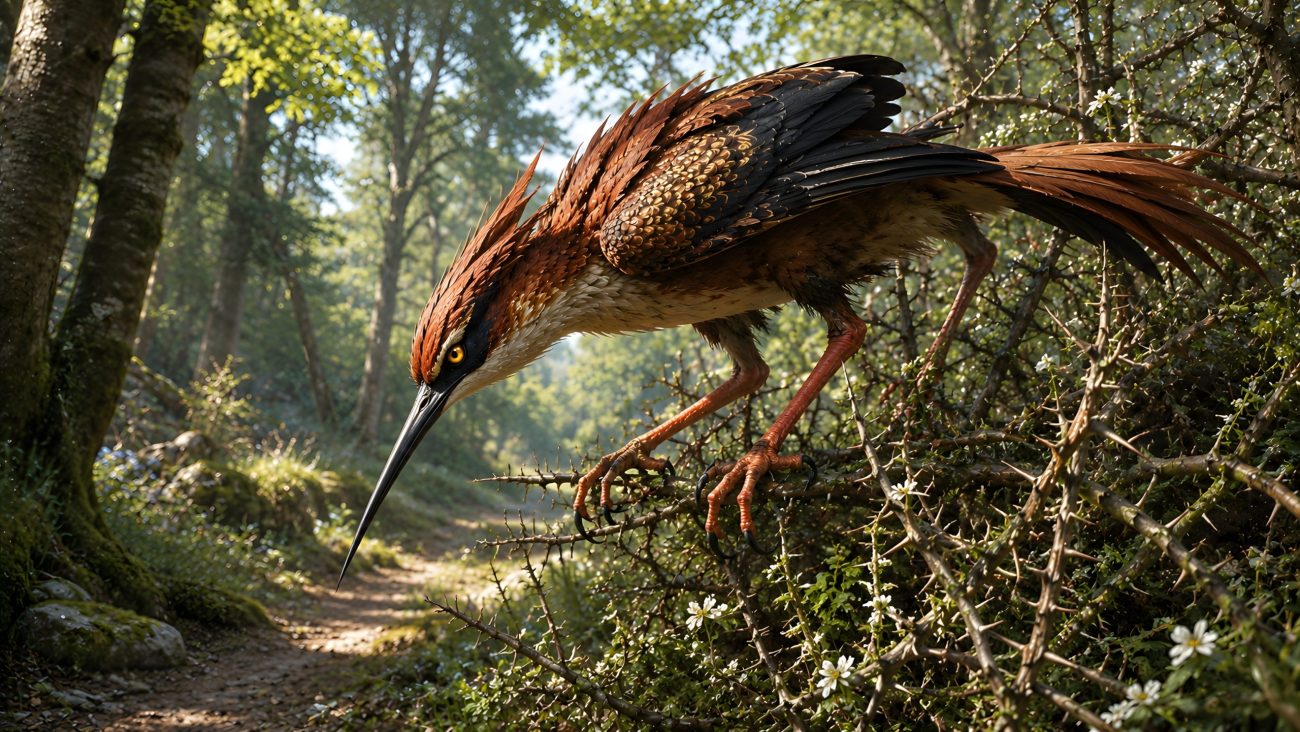
The Picolaton is an imaginary bird from the folklore of Franche-Comté in eastern France. It is best known as a creature used to frighten children into behaving properly and hurrying along.

According to the tales, the Picolaton lurks in thorn bushes, waiting for lazy or slow-moving children. If they dawdle or refuse to obey their parents, the bird swoops down to nip their heels and peck at their buttocks, encouraging them to move more quickly.

Children who are especially mischievous are sometimes promised a chance to see the Picolaton’s marvelous nest, but only if they remain perfectly obedient. The promised visit, often around April Fool’s Day, is nothing more than a playful trick, ensuring that the fabulous bird and its nest are never actually found.


Sources

Wikipedia contributors. (n.d.). Picolaton. In Wikipedia. Retrieved June 29, 2026, from https://en.wikipedia.org/wiki/Picolaton


Hercinia

Tradition / Region: German Mythology
Alternative names:
Category: Bird


The Myth

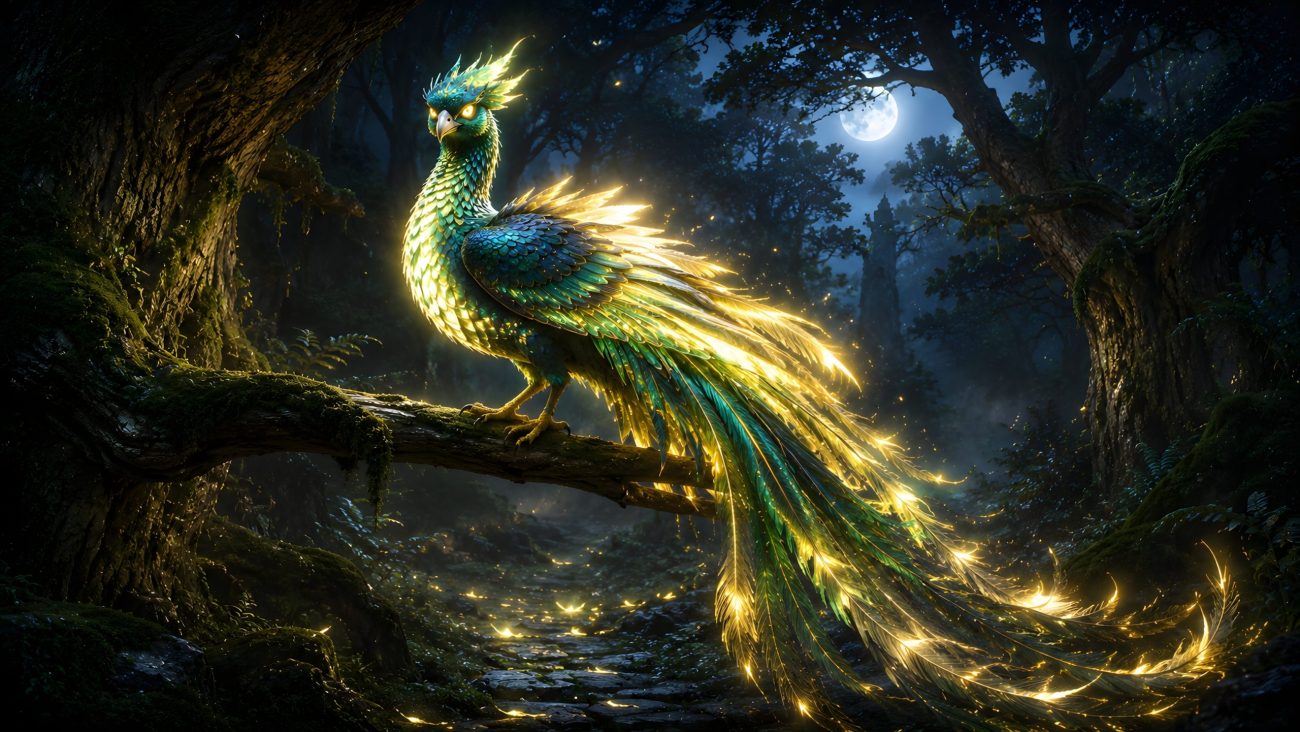
The Hercinia is a legendary bird said to inhabit the vast Hercynian Forest of ancient Germany. It was famed for one extraordinary trait: its feathers glowed like fire in the darkness.

According to ancient accounts, the bird’s plumage shone so brightly at night that individual feathers could be placed upon the ground to illuminate the forest. Even beneath the thick canopy and in the deepest shadows, their radiant glow marked the path and guided travelers through the wilderness.

Because of this miraculous light, the Hercinia became one of the marvels associated with the mysterious Hercynian Forest, a place long regarded as remote, untamed, and filled with strange creatures. Its glowing feathers were remembered as one of the forest’s greatest wonders, capable of turning the darkest night into a visible trail.


Sources

Wikipedia contributors. (n.d.). Hercinia. In Wikipedia. Retrieved June 29, 2026, from https://en.wikipedia.org/wiki/Hercinia


Finnguala

Tradition / Region: Irish Mythology
Alternative names: Fionnghuala, Fionnuala, Finola, Fenella, Nuala
Category: Bird


The Myth

Finnguala was the daughter of Lir of the Tuatha Dé Danann and the eldest of the four Children of Lir. Out of jealousy, their stepmother Aoife cursed Finnguala and her brothers—Fiachra, Conn, and Aodh—transforming them into swans.

The curse condemned the four siblings to wander the lakes, rivers, and seas of Ireland for nine hundred years. Though they retained their human minds and voices, they were forced to live as swans, enduring loneliness, harsh winters, and the passing of kingdoms and generations while singing mournful songs.

At the end of the long exile, the curse could only be broken by the marriage of Lairgren, son of Colman, and Deoch, daughter of Finghin. When the prophecy was fulfilled, the swans regained their human forms, but they had become ancient with age. After receiving Christian baptism, Finnguala and her brothers peacefully died, bringing their centuries of suffering to an end.


Sources

Wikipedia contributors. (n.d.). Fionnuala. In Wikipedia. Retrieved June 29, 2026, from https://en.wikipedia.org/wiki/Fionnuala.


Belled Buzzard

Tradition / Region: American Mythology
Alternative names:
Category: Bird


The Myth

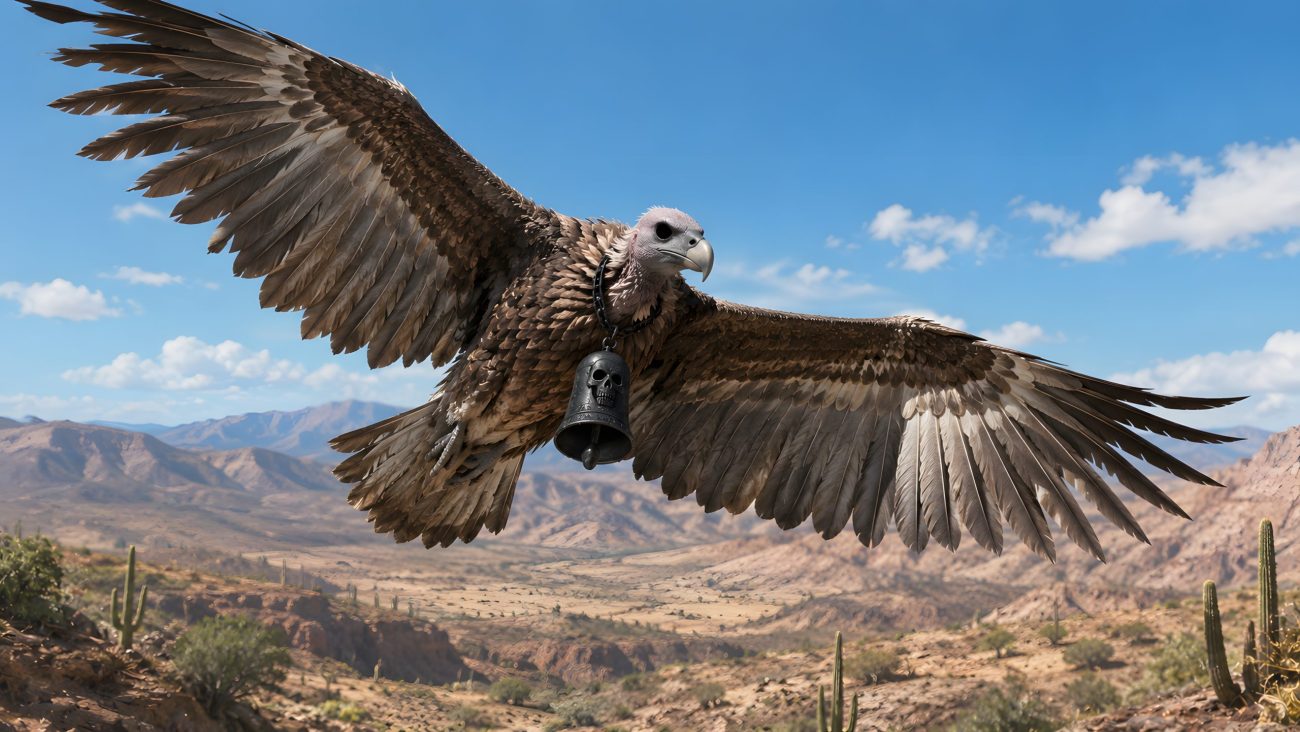
The Belled Buzzard is a legendary bird of American folklore, remembered as a harbinger of disaster. It appears as an ordinary turkey vulture except for a bell fastened around its neck, whose eerie ringing announces misfortune. Its appearance was said to foretell calamities such as epidemics, death, war, or other disasters.

The legend became especially famous after the yellow fever epidemic of 1878 in Brownsville, Tennessee. The strange bird was reported shortly before the outbreak, and many came to believe that the tolling of its bell warned of approaching tragedy. As stories spread throughout the Southern United States, sightings of the Belled Buzzard were repeatedly linked to impending doom, earning it a fearsome reputation.

Although many different buzzards were said to have been fitted with cowbells or sleigh bells over the years, popular tradition gradually treated the Belled Buzzard as a single mysterious creature that wandered from state to state for decades. Numerous people claimed to have captured, released, or even killed it, yet reports of its ghostly bell continued to appear, strengthening the belief that the bird could never truly be accounted for.

The Belled Buzzard became one of the best-known “fearsome critters” of American folklore, its mournful bell serving as an unforgettable omen that disaster was near.


Sources

Wikipedia contributors. (n.d.). Belled buzzard. In Wikipedia. Retrieved June 29, 2026, from https://en.wikipedia.org/wiki/Belled_buzzard


Limokun

Tradition / Region: Philippine Mythology
Alternative names:
Category: Bird


The Myth

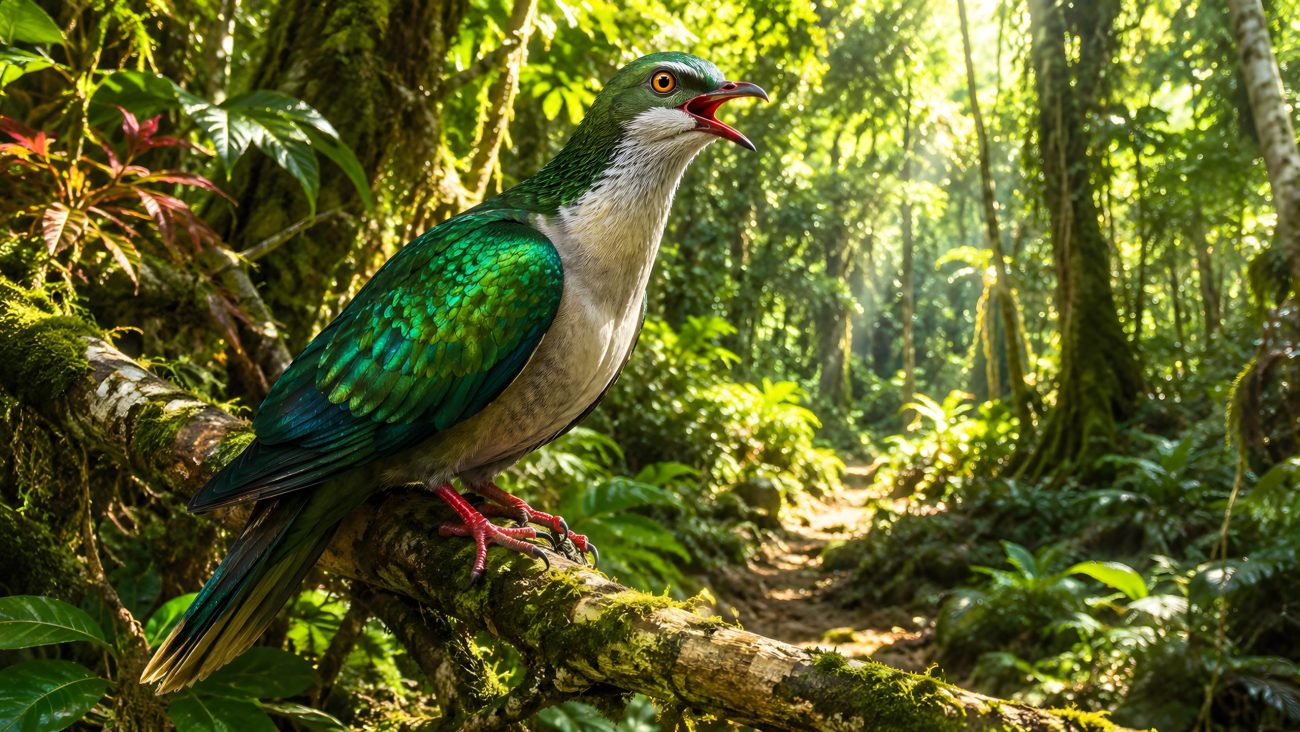
The Limokun is the sacred omen bird of the Bagobo people of Mindanao. It is identified as a beautiful green-and-white wood pigeon with red feet and a red beak, and its call is believed to carry messages that foretell fortune or disaster. Before beginning a journey, hunting expedition, or other important undertaking, people listen carefully for the Limokun’s voice to determine whether it is safe to proceed.

If the bird whistles at an unfavorable moment, the journey is abandoned or delayed until another day, preventing the misfortune that would otherwise occur. Some traditions also interpret the omen according to the direction from which the bird calls or flies, while others say travelers should look around for a sign in their surroundings. If the Limokun’s warning is ignored, disaster is expected to follow.

Because of its sacred status, the Limokun is known as the king of birds. Young men who have never slain an enemy are forbidden to eat its flesh, for doing so is believed to cause their skin to turn yellow, their bodies to waste away, and ultimately bring death. Only warriors who have earned distinction in battle may eat the bird without fear, making it a privilege reserved for the renowned rather than an ordinary source of food.

The Limokun also possesses healing associations. When a person suffers from fever and chills caused by a supernatural river spirit, one traditional remedy is to burn the abandoned nest of a Limokun and allow the patient to inhale the smoke. Thus, the bird is revered not only as a bearer of omens but also as a creature whose remains can help drive away illness.


Sources

Benedict, L. E. W. (1916). A study of Bagobo ceremonial, magic and myth. [s.n.].


Makalala

Tradition / Region: Tanzania Mythology
Alternative names:
Category: Bird


The Myth

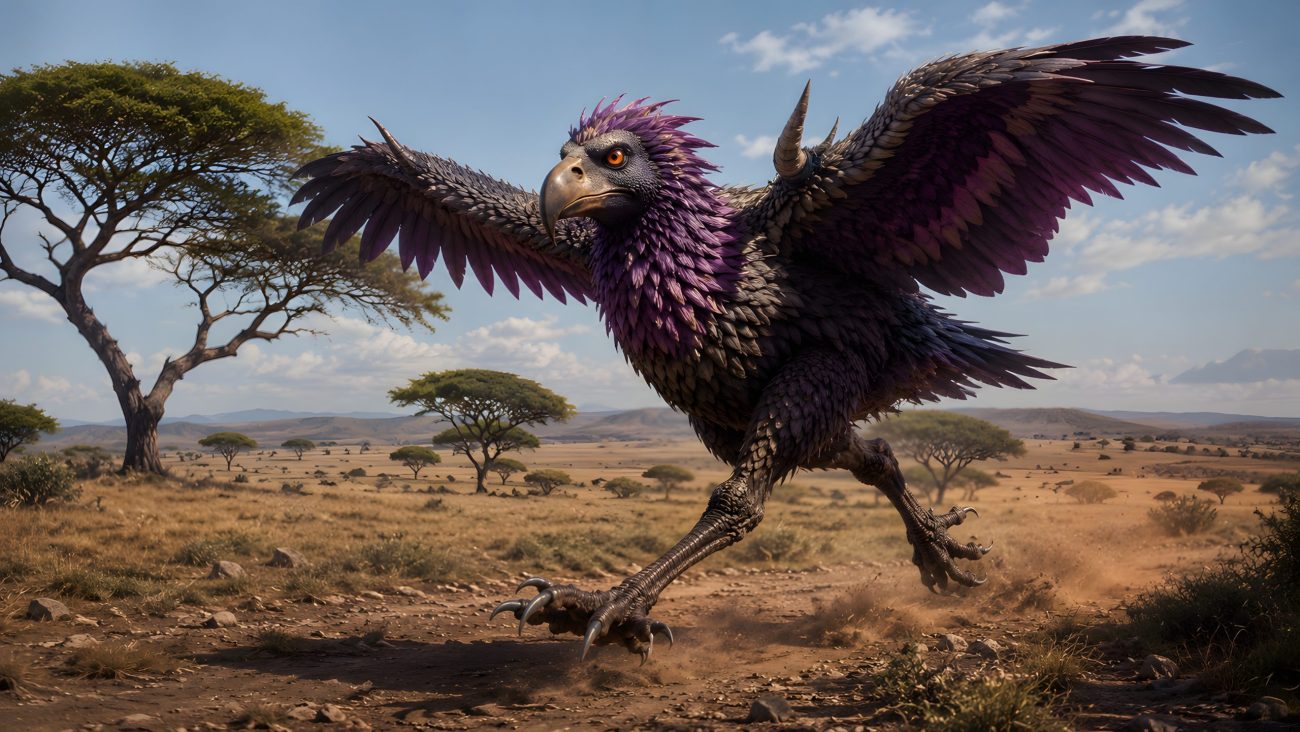
The Makalala is a gigantic bird of Wasegua tradition, said to live in the lands inland from Zanzibar. It is described as standing even taller than an ostrich, with extremely long legs, the head and hooked beak of a bird of prey, and the ability to soar powerfully through the sky while feeding on carrion.

Its most remarkable feature is its wings, which end in hard, horn-like plates. When these plates strike together during flight, they produce a loud clattering sound that can be heard from afar, giving the creature its name, “Makalala,” meaning “noisemaker.”

Despite its enormous size, the Makalala is said to be timid and easily frightened. Hunters cannot approach it openly. Instead, they must pretend to be dead until the curious bird comes close, at which point they leap up and strike it down.

According to the tradition, the skulls of slain Makalala were prized as ceremonial helmets worn by the chiefs of the Wasegua, making the great bird both a fearsome creature and a symbol of prestige.


Sources

A Book of Creatures. (2021, March 12). Makalala. Retrieved June 29, 2026, from https://abookofcreatures.com/2021/03/12/makalala/


Inmō Oni

Tradition / Region: Japanese Mythology
Alternative names: Possibly Immora Oni
Category: Bird


The Myth

The Inmō Oni is a bird-like yōkai said to inhabit abandoned and neglected temples.

According to the legend, there was once a ruined temple in the castle town of Ina Takatō. Its former head priest, Mugai, had trained at the head temple in Kyoto, but he suddenly lost his sanity. He stopped chanting sutras, wandered aimlessly, and the temple gradually fell into decay.

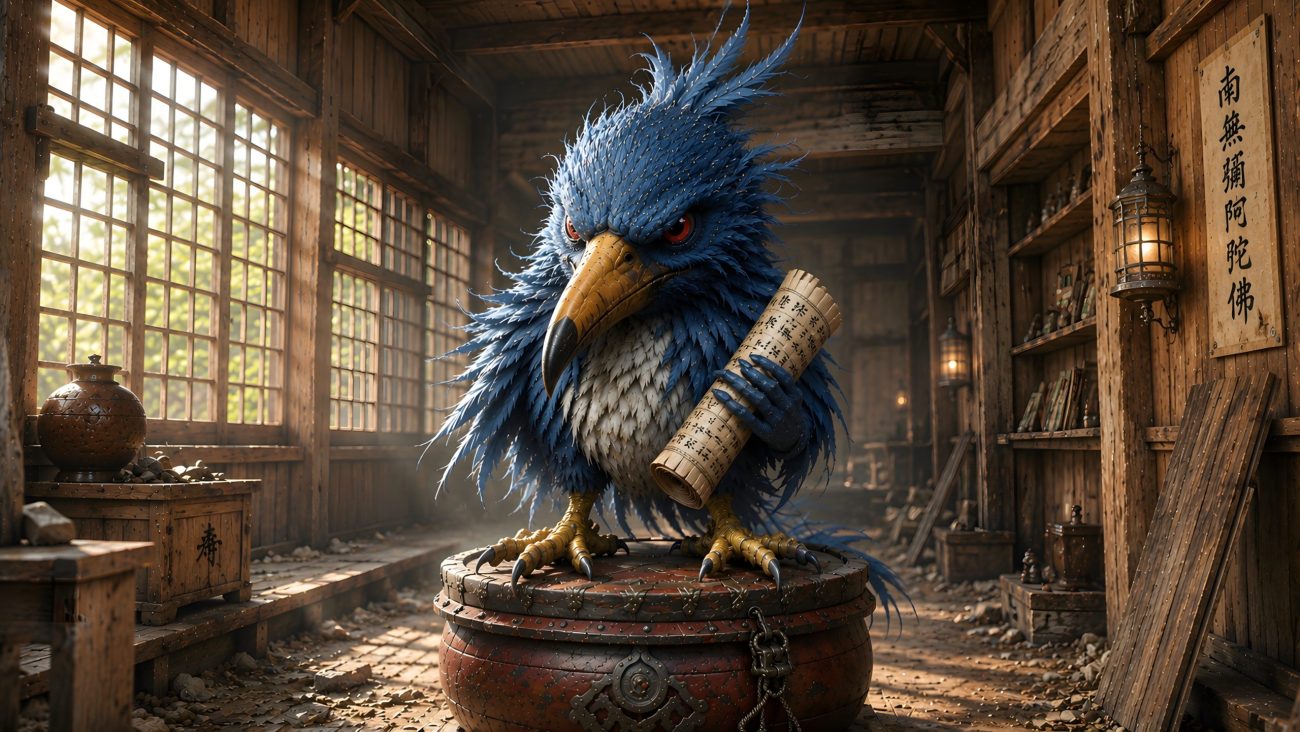
When an official from the Takatō domain inspected the abandoned temple, he found a strange blue bird, about the size of a chicken, perched upon a wooden fish drum. The creature had long ornamental feathers growing from its head and held a Buddhist sutra in its beak. As soon as it noticed the visitor, it spread its wings and flew wildly around the temple hall.

The mysterious bird was identified as the Inmō Oni, a yōkai said to dwell within ruined temples. Of the priest Mugai, however, there was no trace, leaving only the strange bird as the temple’s silent inhabitant.


Sources

TYZ. (n.d.). 陰毛鬼 (Inmō Oni). In 新版TYZ 妖怪図鑑. Retrieved June 29, 2026, from https://tyz-yokai.blog.jp/archives/1072742115.html


Gumyōchō

Tradition / Region: Japanese Mythology
Alternative names: Meimyōchō, Seiseichō, Jivajivaka
Category: Bird


The Myth

The Gumyōchō, or Joint Life Bird, is a sacred bird described in the Amitabha Sutra as one of the six wondrous birds that dwell in the Pure Land. It has one body with two heads, and in some traditions it is also portrayed with a human face and the body of a bird. Its beautiful song proclaims the teachings of the Buddha, inspiring all who hear it to contemplate the Three Jewels: the Buddha, the Dharma, and the Sangha.

Another famous legend tells of the bird’s tragic fate.

Long ago, on a snowy mountain, there lived a Joint Life Bird whose two heads were named Karuda and Upakaruda. Although they shared a single body, each head had its own thoughts and emotions. When one remained awake, the other slept.

One day, while Upakaruda slept, Karuda found a beautiful Mathuka fruit and ate it without sharing. When Upakaruda awoke and realized what had happened, he became consumed by jealousy and resentment.

Later, Upakaruda discovered a poisonous fruit. Knowing it would kill them both, he deliberately ate it to take revenge on Karuda. The poison spread through their shared body, and both heads perished together.

The Buddha explained that this story reflected events from a previous life. Karuda was later reborn as Siddhartha Gautama, while Upakaruda was reborn as Devadatta, the Buddha’s jealous cousin and rival. Because they had once shared the same body, Devadatta’s hatred followed him into his next life, leading him to repeatedly oppose and seek to harm the Buddha.


Sources

TYZ. (n.d.). 共命鳥 (Gumyōchō). In 新版TYZ 妖怪図鑑. Retrieved June 29, 2026, from https://tyz-yokai.blog.jp/archives/1064714812.html


Qinglong

Tradition / Region: Chinese Mythology
Alternative names: Blue Bird
Category: Bird


The Myth

The Qinglong is a mythical bird described in the Classic of Mountains and Seas. It is one of four strange birds that dwell upon Xuandan Mountain, alongside the Huangyu, Qingniao, and Huangniao.

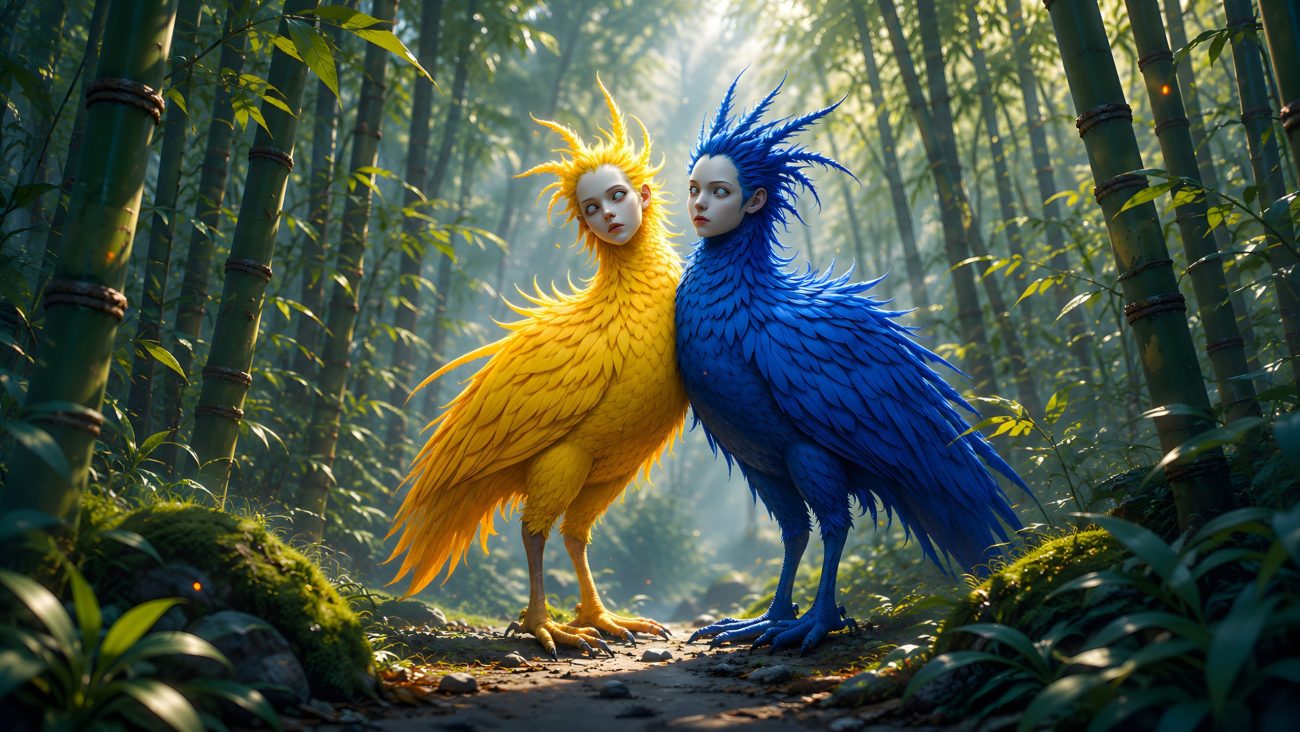
These birds are said to possess human faces, long hair, and brilliantly colored plumage. The Qinglong itself is associated with the color blue.

The appearance of these birds together is considered a terrible omen. Whenever the Qinglong, Huangyu, Qingniao, and Huangniao gather in or above a kingdom, it foretells the destruction of that nation. Their arrival is not a cause of the disaster but a supernatural sign that the country’s downfall is imminent.


Sources

Wikipedia contributors. (n.d.). 青鴍. In 维基百科,自由的百科全书. Retrieved June 29, 2026, from https://zh.wikipedia.org/wiki/%E9%9D%92%E9%B4%8D


Jianke

Tradition / Region: Chinese Mythology
Alternative names:
Category: Bird


The Myth

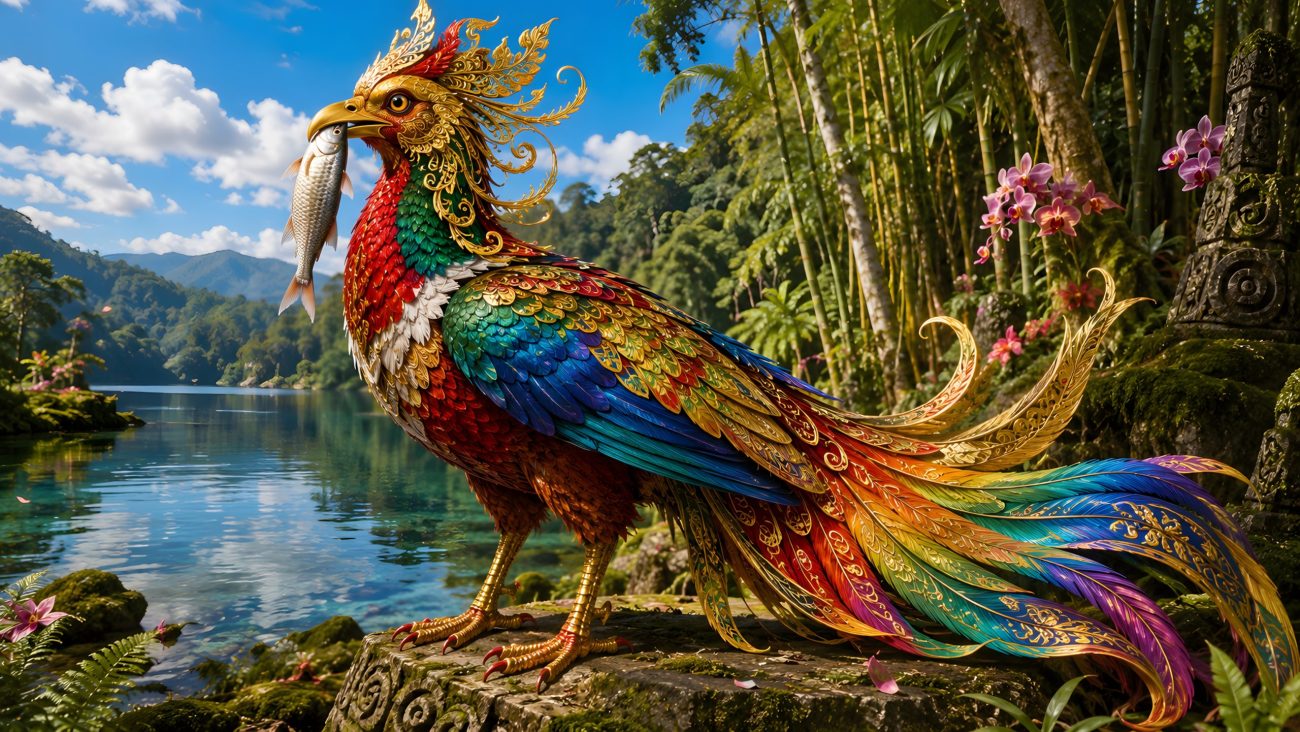
Jianke is a legendary bird described in ancient Chinese tradition as a strange creature with a striped body and bright red feet. Unlike ordinary birds, it is said to hate other birds while showing an unusual affection for foxes.

According to the Shuoyuan (“Garden of Persuasions”), Duke Ping of Jin once noticed a mysterious bird circling above him throughout an entire court session. Wondering if it was a phoenix—a sign of a great ruler—he asked the musician and sage Shi Kuang for its identity.

Shi Kuang replied that it was not a phoenix, but the Jianke, a rare bird said to dwell in the eastern lands, recognizable by its striped body, red feet, hatred of birds, and fondness for foxes.

Later tradition also lists the Jianke as one of the remarkable mythical creatures associated with the East, alongside other legendary animals linked to the cardinal directions.


Sources

Wikipedia contributors. (n.d.). 谏珂. In 维基百科,自由的百科全书. Retrieved June 29, 2026, from https://zh.wikipedia.org/wiki/%E8%B0%8F%E7%8F%82