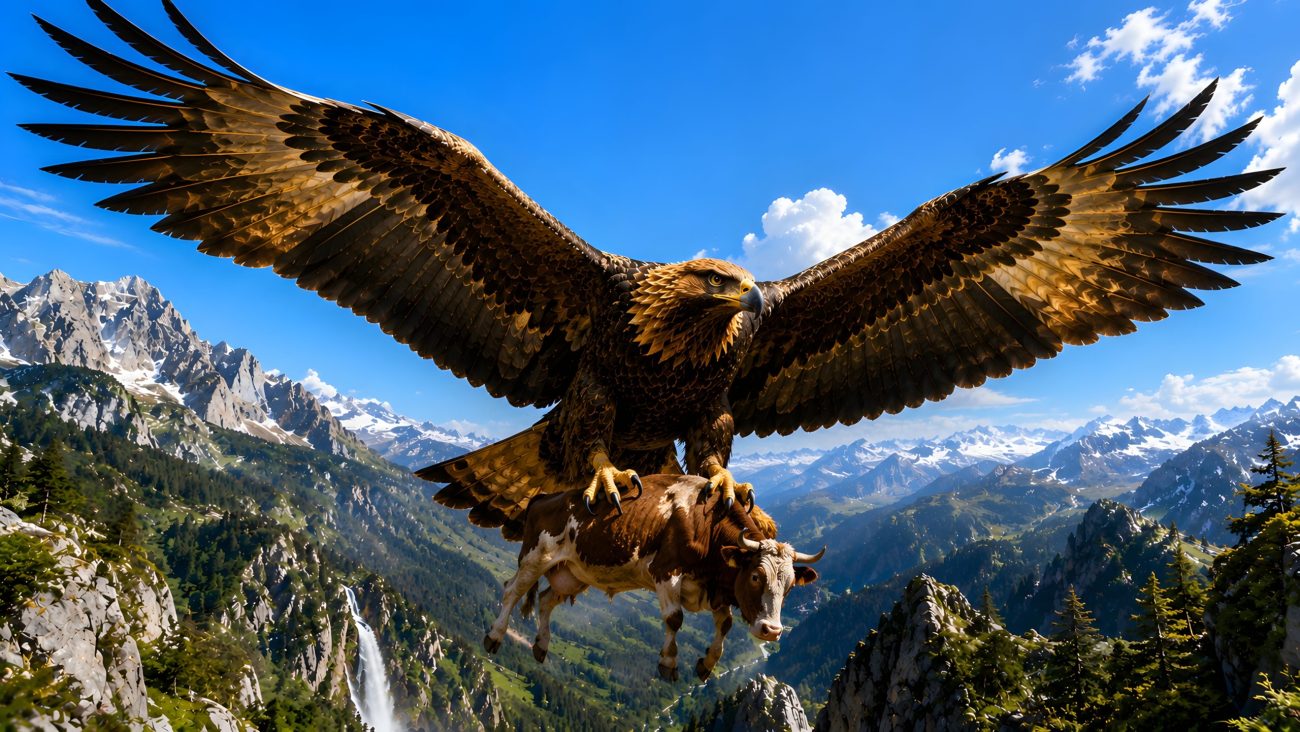
Giant Eagle

Tradition / Region: Albanian Mythology
Alternative names: Mother Eagle
Category: Bird


The Myth

A Giant Eagle appears in the Albanian tale of The Scurfhead after the hero is betrayed by his brothers and trapped in the underworld. Wandering in despair, he discovers a nest of young eagles threatened by a great serpent. Taking pity on them, he slays the snake and saves the eaglets before resting beneath their tree.

When the mother eagle returns, she first believes the sleeping stranger has harmed her young. The eaglets quickly reveal that he is their savior, and the grateful bird promises to repay his kindness. At the hero’s request, she agrees to carry him back to the world above, but only after he gathers enough bread, roasted meat, and water to sustain the long journey through the skies.

The Giant Eagle bears the hero out of the underworld on her back, returning him safely to the surface. Thanks to the eagle’s aid, the Scurfhead survives his brothers’ betrayal, completes his adventures, and is ultimately reunited with the maiden who had remained faithful to him.


Sources

Jarník, J. U. (1883). For the Love of a Dove. In Příspěvky ku poznání nářečí albánských (Rada VI, díl 12). Abhandlungen der Königlich-Böhmischen Gesellschaft der Wissenschaften zu Prag. Tiskem Dra. Edvarda Grégra. English translation by Robert Elsie. Retrieved June 29, 2026, from http://www.albanianliterature.net/folktales/tale_02.html
Mother Eagle

Tradition / Region: Albanian Mythology
Alternative names:
Category: Bird


The Myth

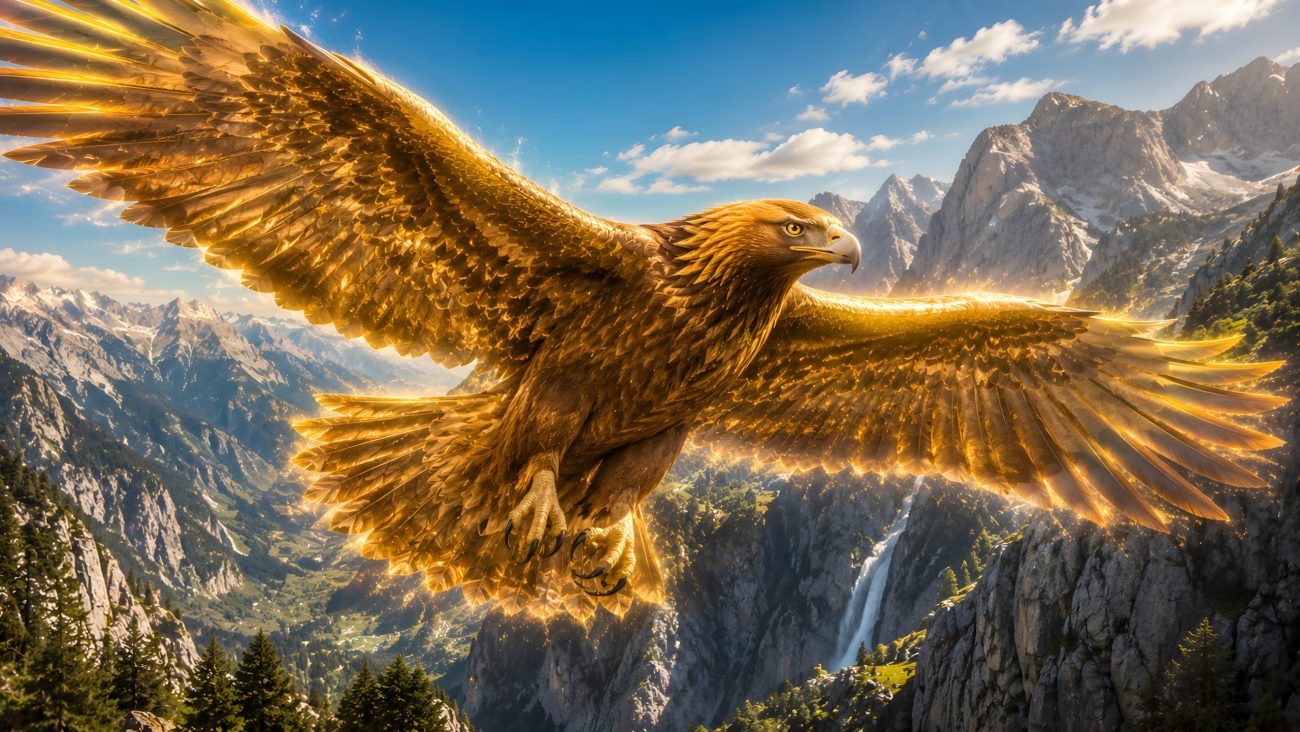
The Mother Eagle is a magical eagle who appears in the Albanian folktale The Barefaced Man and the Pasha’s Brother. While traveling with his companions, the hero discovers a nest of eaglets threatened by a snake climbing the tree to devour them. He kills the serpent, saving the young birds before their mother returns.

When the Mother Eagle arrives, she mistakes the hero for the attacker and swoops down to gouge out his eyes. Before she can strike, her eaglets cry out that he is their savior. Realizing her mistake, the eagle thanks the hero and asks how she may repay him. Although he requests nothing, she plucks one of her feathers and gives it to him, telling him to burn it whenever he is in need, promising that she will come to his aid at once.

Later, the hero faces an impossible task. He must retrieve the Water of Life from a distant cave beneath mountains whose peaks touch the sky. Remembering the eagle’s gift, he burns the feather. The Mother Eagle immediately appears, flies to the distant mountains, obtains the miraculous water, and returns with it, allowing the hero to complete his quest and ultimately triumph over his enemies.


Sources

Jarník, J. U. (1883). Příspěvky ku poznání nářečí albánských (Rada VI, díl 12). In Abhandlungen der Königlich-Böhmischen Gesellschaft der Wissenschaften zu Prag. Tiskem Dra. Edvarda Grégra. Reprinted in Folklor shqiptar (Vol. 1, Proza popullore). (1963). Tirana. English translation by Robert Elsie. Retrieved June 29, 2026, from http://www.albanianliterature.net/folktales/tale_17.html


Giant Falcon

Tradition / Region: Albanian Mythology
Alternate Names: —
Category: Bird


The Myth

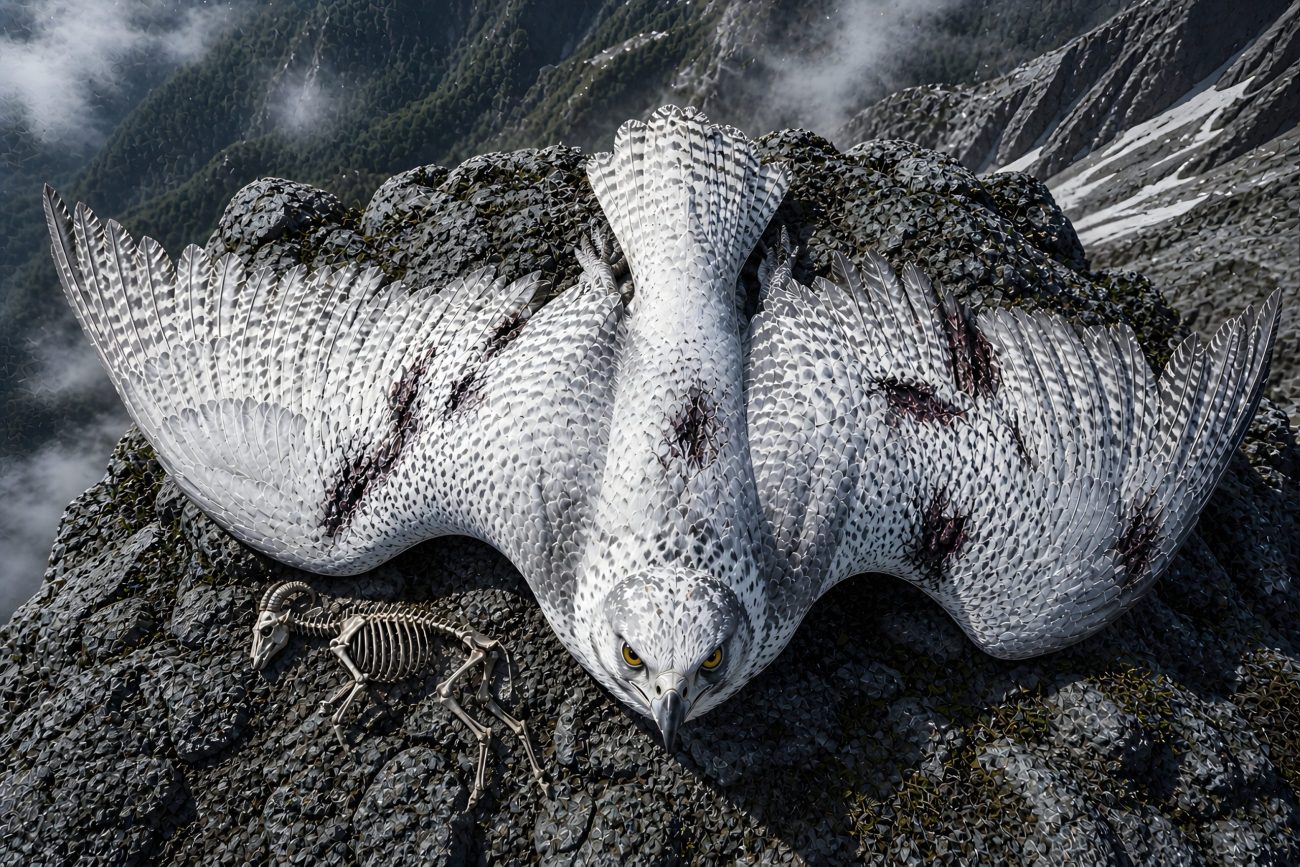
The Giant Falcon is an enormous and ancient bird encountered during a hero’s journey. It serves as a guide and means of transport to a distant, unreachable realm, but demands sustenance and assistance in return.

A young man searching for the half iron being was told by the south wind that he would find a falcon so large it could no longer fly. When he found it, he seized it and demanded information. The falcon agreed to help, but only after being fed and restored, as its wings had weakened with age.

The young man remained with the falcon and provided it with large amounts of meat until its strength returned. Once recovered, the falcon allowed him to climb onto its back and carried him across vast distances to a mountain in another world where the half iron being lived.

During the journey, the falcon required constant feeding. When the meat ran out, it demanded more, threatening to drop him. The young man cut flesh from his own body to sustain the bird until they reached their destination. Afterward, the falcon restored him by returning what it had taken, bringing him back to health.

The falcon later recognized the hero again after his death and revived him using swallow’s milk, restoring him to life and allowing him to continue his quest.


Sources

Albanian Literature contributors. (n.d.). Folktale 4. In Albanian Literature, from http://www.albanianliterature.net/folktales/tale_04.html

Dozon, A. (1879). Manuel de la langue chkipe ou albanaise: Grammaire, vocabulaire, chrestomathie. In Paris: Ernest Leroux (reprinted in Folklor shqiptar 1, Proza popullore, 1963). Translated by Elsie, R.


Eagle Maiden

Tradition / Region: Albanian Mythology
Alternate Names: —
Category: Bird, Nymph


The Myth

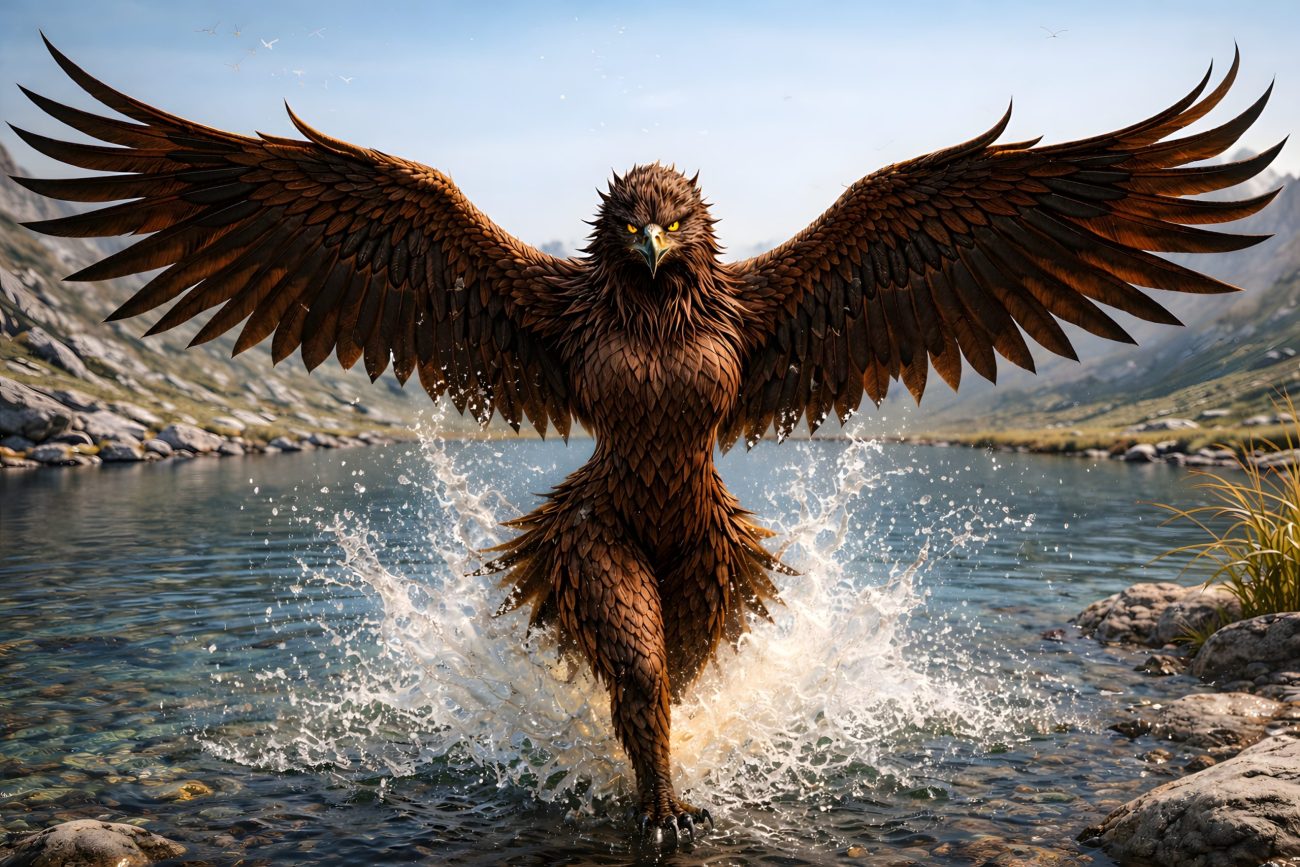
The Eagle Maidens are beings who take the form of eagles and transform into maidens by bathing in water. They are encountered by a traveler during his search for Gjizar the nightingale and possess knowledge of its location.

A youth traveling through a wilderness came upon a house where an old woman lived. She warned him that her daughters would return and devour him, then hid him in a closet with a hole through which he could see. After some time, three eagles arrived, each one wounded. They entered through the window, bathed in a bowl of water, and became maidens. They spoke with their mother and then ate.

The old woman asked what they would do if a man were present, and each maiden swore not to harm the one who had wounded her. The youth was then revealed, and he told them he was the one who had injured them. The maidens did him no harm and asked his purpose. He told them he was searching for Gjizar the nightingale. They said they knew where it was and that he could not reach it on foot.

They told him to remain with them for three months. After this time, they took him to the place where the nightingale was and left him there.


Sources

Albanian Literature contributors. (n.d.). Folktale 14. In Albanian Literature, from http://www.albanianliterature.net/folktales/tale_14.html

Pedersen, H. (1895). Albanesische Texte mit Glossar. In Abhandlungen der philologisch-historischen Classe der Königl. Sächsischen Gesellschaft der Wissenschaften, Vol. 15 (reprinted in Folklor shqiptar 1, Proza popullore, 1963). Translated by Elsie, R.