Giant Eagle

Tradition / Region: Albanian Mythology
Alternative names: Mother Eagle
Category: Bird


The Myth

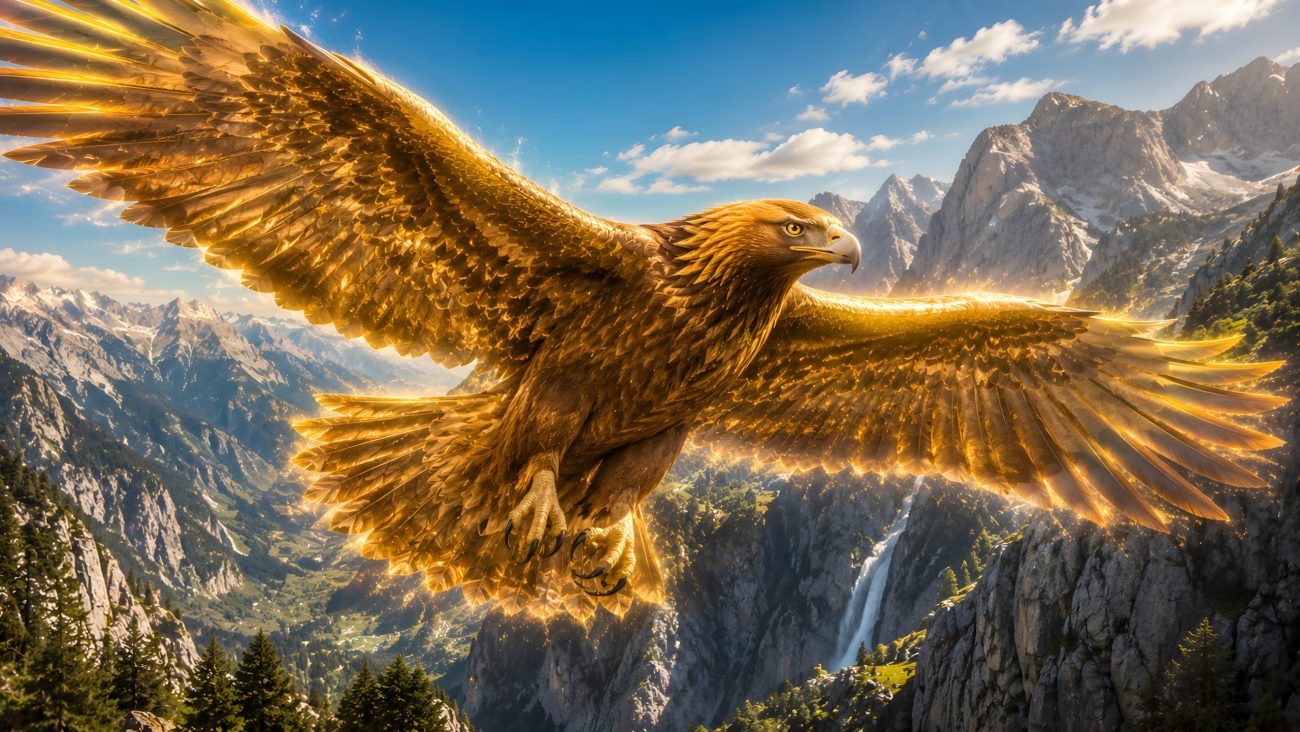
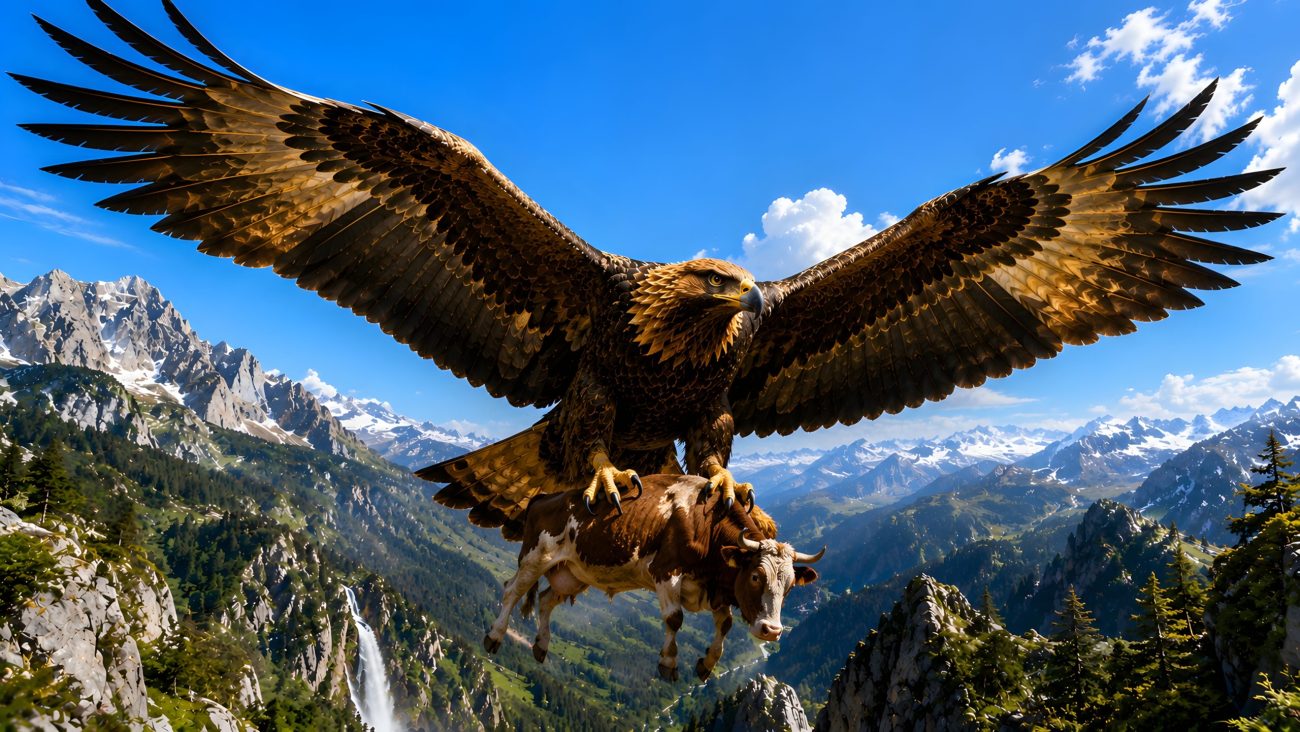
A Giant Eagle appears in the Albanian tale of The Scurfhead after the hero is betrayed by his brothers and trapped in the underworld. Wandering in despair, he discovers a nest of young eagles threatened by a great serpent. Taking pity on them, he slays the snake and saves the eaglets before resting beneath their tree.

When the mother eagle returns, she first believes the sleeping stranger has harmed her young. The eaglets quickly reveal that he is their savior, and the grateful bird promises to repay his kindness. At the hero’s request, she agrees to carry him back to the world above, but only after he gathers enough bread, roasted meat, and water to sustain the long journey through the skies.

The Giant Eagle bears the hero out of the underworld on her back, returning him safely to the surface. Thanks to the eagle’s aid, the Scurfhead survives his brothers’ betrayal, completes his adventures, and is ultimately reunited with the maiden who had remained faithful to him.


Sources

Jarník, J. U. (1883). For the Love of a Dove. In Příspěvky ku poznání nářečí albánských (Rada VI, díl 12). Abhandlungen der Königlich-Böhmischen Gesellschaft der Wissenschaften zu Prag. Tiskem Dra. Edvarda Grégra. English translation by Robert Elsie. Retrieved June 29, 2026, from http://www.albanianliterature.net/folktales/tale_02.html
Kusa Kap

Tradition / Region: Australian Mythology
Alternative names: Kusa Kap
Category: Bird


The Myth

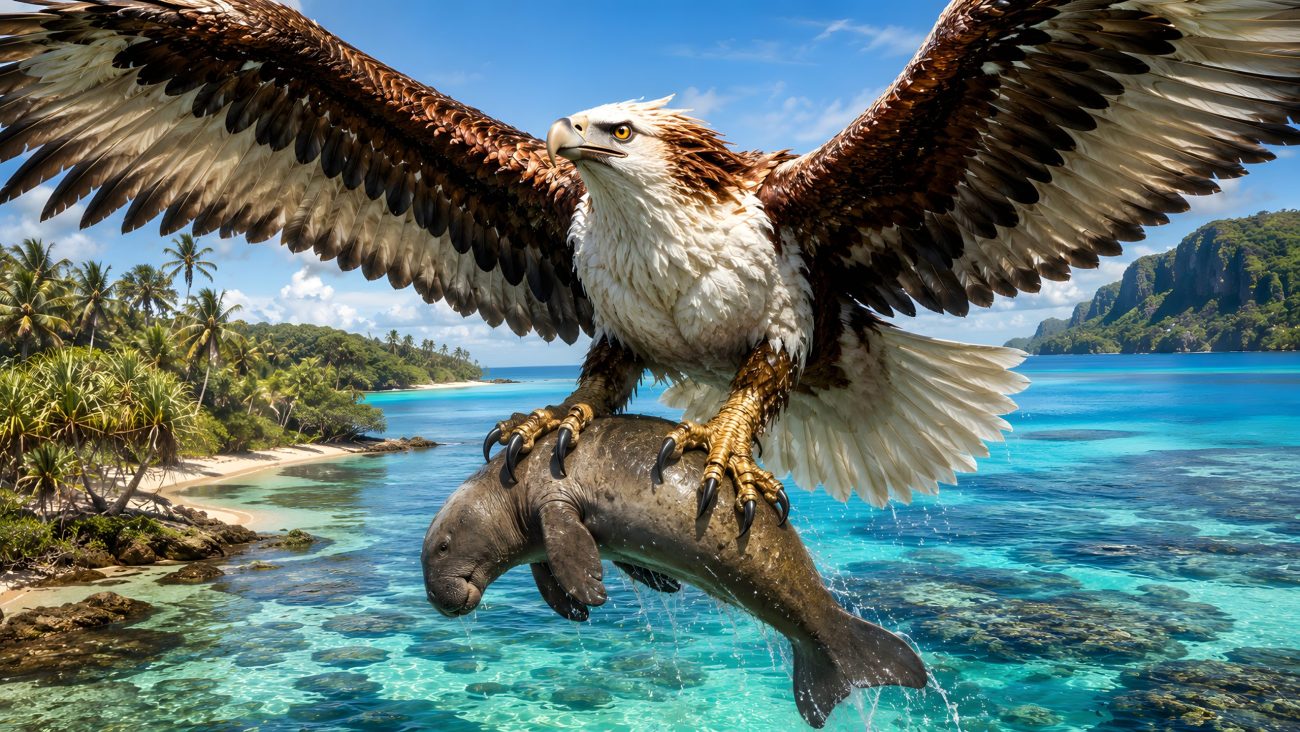
The Kusa Kap is a giant eagle from the traditions of the Torres Strait Islands. After the beautiful Bakar is abducted by the shapeshifting spirit Giz and abandoned on the lonely island of Kusar, she survives by eating the seeds of the kusa plant. In time, she lays an egg like that of a sea eagle, from which hatches the mighty bird Kusa Kap. She raises him as her own son.

Kusa Kap grows with extraordinary speed. Once his wings become strong enough, he flies great distances to gather tools and fire-making materials for Bakar. Later he begins hunting dugongs, carrying the enormous animals away in his talons and providing his mother with food, while sharing the surplus with nearby people.

When Bakar tells Kusa Kap about his father, Kaudab, the eagle flies to Dauan and guides him across the sea to Kusar, where the husband and wife are reunited. Kusa Kap then takes revenge on the evil spirit Giz, carrying her high into the air before dropping her into the sea, where she turns to stone. The giant eagle is remembered as the loyal son whose strength, devotion, and courage restored his family.


Sources

A Book of Creatures. (2021, March 5). Kusa Kap. Retrieved June 29, 2026, from https://abookofcreatures.com/2021/03/05/kusa-kap/


Gu Diao

Tradition / Region: Chinese Mythology
Alternative names: Gudiao
Category: Bird


The Myth

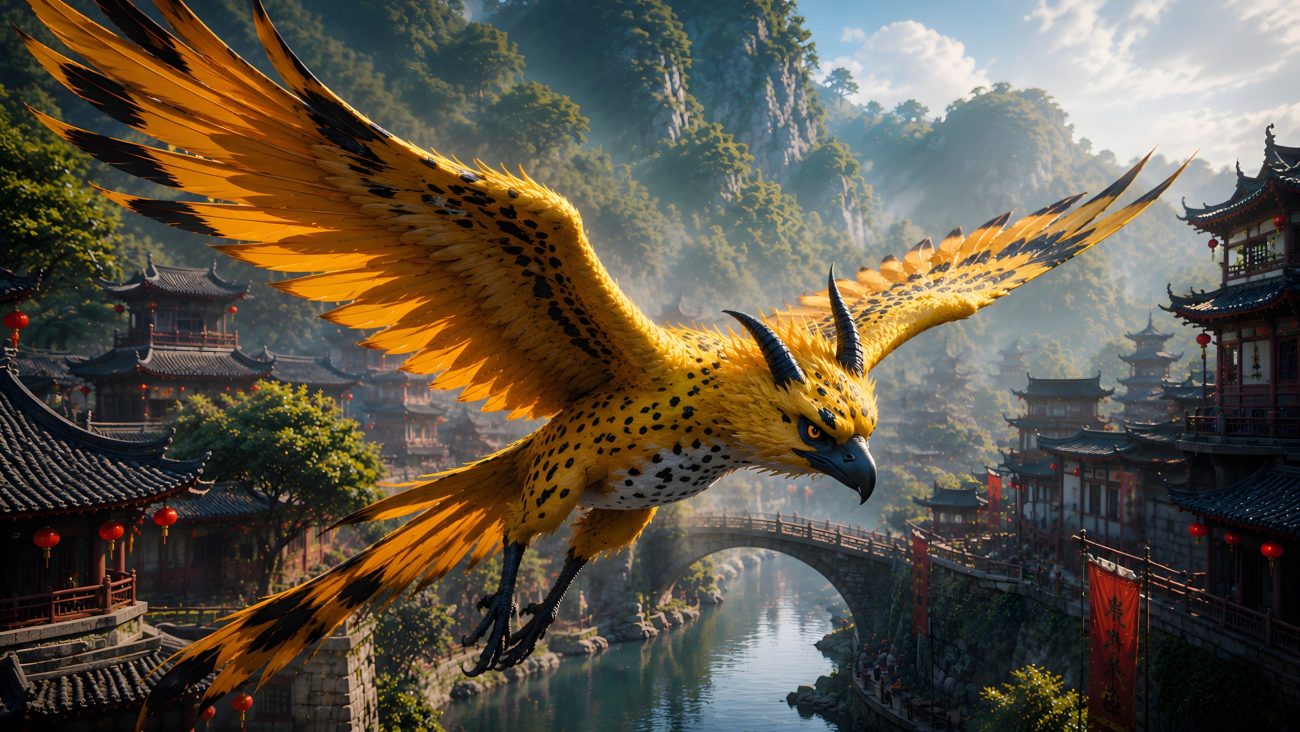
The Gu Diao is a man-eating monster described in the Classic of Mountains and Seas. It is said to live in the Zegeng River beside Mount Luwu. The creature resembles an eagle with horns upon its head, cries like a human infant, and preys upon people.

Later sources offer different descriptions of the Gu Diao. The Pianya also describes it as an eagle with horns, while the Book of Things and Things (Shiwu Ganzhu) portrays it as a leopard-like beast with a bird’s beak, a single horn, and the cry of a baby. Despite these differing appearances, all accounts describe it as a fearsome supernatural creature.


Sources

維基百科貢獻者. (n.d.). 蠱雕. In 維基百科,自由的百科全書. Retrieved June 29, 2026, from https://zh.wikipedia.org/wiki/%E8%A0%B1%E9%9B%95


Golden Queen’s Eagle

Tradition / Region: Swedish Mythology
Alternative names: Eagle of the Mount of the Golden Queen
Category: Bird


The Myth

The Golden Queen’s Eagle appears in the Swedish fairy tale The Mount of the Golden Queen. During his quest to reach the mysterious mountain where the Golden Queen lives, a young herdsman seeks guidance from giants who summon every beast, fish, and bird in the world. While none of the animals know the mountain’s location, the eagle alone reveals that it has seen the hidden realm and agrees to carry the youth there at the giant’s request.

The eagle lifts the young man onto its back and flies over forests, mountains, and the endless sea. During the journey it repeatedly dips him into the ocean, first to his ankles and then to his knees, asking each time whether he is afraid. When the youth finally admits his fear, the eagle explains that the terror he now feels is the same fear the Golden Queen experienced when she secretly placed a letter and a golden band into his pocket while he slept, revealing that the eagle knew of the magical events that had set the quest in motion.

The eagle finally carries the youth to the Mount of the Golden Queen, a towering mountain sealed by a great iron door, before bidding him farewell and returning to its homeland. The youth presents the Queen with the golden band and the mysterious letter, breaking the enchantment upon the mountain. The mountain is transformed into a magnificent castle, and the Golden Queen is freed, fulfilling the purpose for which the eagle had guided the destined hero.


Sources

Stroebe, K. (Ed.). (1921). The Swedish fairy book (F. H. Martens, Trans.; G. W. Hood, Illus.). Frederick A. Stokes Company. Retrieved June 29, 2026, from https://www.gutenberg.org/ebooks/37193


Mother Eagle

Tradition / Region: Albanian Mythology
Alternative names:
Category: Bird


The Myth

The Mother Eagle is a magical eagle who appears in the Albanian folktale The Barefaced Man and the Pasha’s Brother. While traveling with his companions, the hero discovers a nest of eaglets threatened by a snake climbing the tree to devour them. He kills the serpent, saving the young birds before their mother returns.

When the Mother Eagle arrives, she mistakes the hero for the attacker and swoops down to gouge out his eyes. Before she can strike, her eaglets cry out that he is their savior. Realizing her mistake, the eagle thanks the hero and asks how she may repay him. Although he requests nothing, she plucks one of her feathers and gives it to him, telling him to burn it whenever he is in need, promising that she will come to his aid at once.

Later, the hero faces an impossible task. He must retrieve the Water of Life from a distant cave beneath mountains whose peaks touch the sky. Remembering the eagle’s gift, he burns the feather. The Mother Eagle immediately appears, flies to the distant mountains, obtains the miraculous water, and returns with it, allowing the hero to complete his quest and ultimately triumph over his enemies.


Sources

Jarník, J. U. (1883). Příspěvky ku poznání nářečí albánských (Rada VI, díl 12). In Abhandlungen der Königlich-Böhmischen Gesellschaft der Wissenschaften zu Prag. Tiskem Dra. Edvarda Grégra. Reprinted in Folklor shqiptar (Vol. 1, Proza popullore). (1963). Tirana. English translation by Robert Elsie. Retrieved June 29, 2026, from http://www.albanianliterature.net/folktales/tale_17.html


Quauhxouilin

Tradition / Region: Mexican Mythology
Category: Fish, Eagle, Bird


The Myth

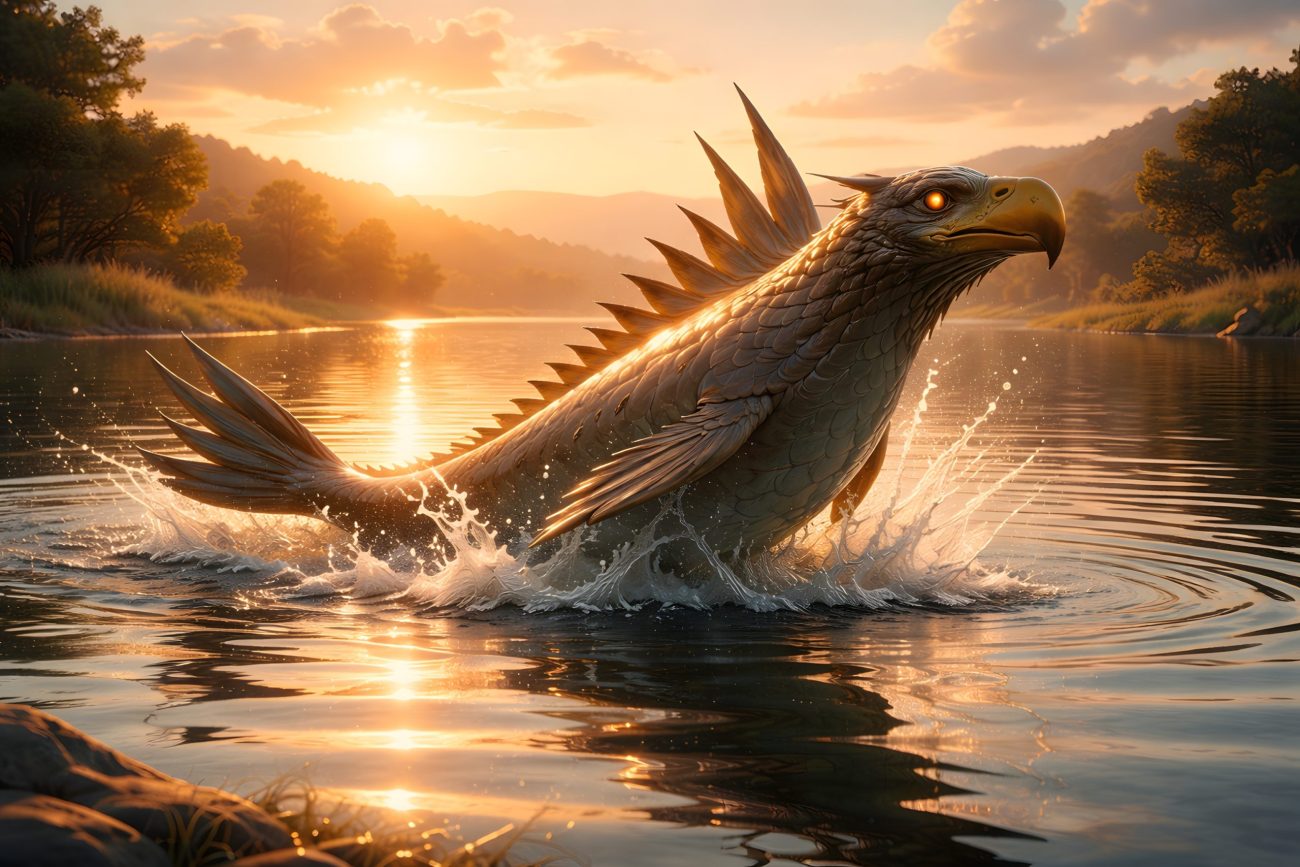
The Quauhxouilin, known as the Eagle-Fish, is a remarkable fish spoken of in Mexican tradition. Its name joins two ideas into one being: quauhtli, meaning eagle, and xouilin, a kind of fish.

This creature bears the head of an eagle, with a curved snout shining golden-yellow, giving it the look of a bird of prey risen from the water. Its body is long, large, and smooth, moving through the water with the same effortless grace as an eagle gliding through the sky.

Unlike ordinary fish, the Quauhxouilin has no scales and no bones. Its flesh is soft throughout, and for this reason it is considered good to eat, valued not only for its strange form but also for its taste.

The Quauhxouilin stands as a fusion of sky and water—a fish shaped like a bird, uniting the domains of river and air in a single living form.


Gallery


Sources

Bestiary.us contributors. (n.d.). Eterari. In Bestiary.us, from https://www.bestiary.us/eterari/


Interpretive Lenses

Religious Readings
  • Christian Ascetic Deep Dive
Philosophical Readings
  • Nietzschean Deep Dive
Psychological Readings
  • Jungian Deep Dive
Esoteric Deep Dive
  • Hermetic Deep Dive
Political / Social Readings
  • Marxist Deep Dive
Other
  • How to Invite The Quauhxouilin