Zwanenjonkvrouw

Tradition / Region: Netherlands (Noord-Holland, Heemskerk)
Alternate Names:
Category: Swan maiden / nymph


The Myth

In Noord-Holland, people tell of the Zwanenjonkvrouw, a woman of extraordinary beauty who can take the form of a swan. She changes between swan and human shape by means of a magical swan shirt, known as her zwanenhemd. When she wears it, she becomes a swan; when it is removed, she remains human.

In many tales, a man discovers the Zwanenjonkvrouw while she is bathing and steals her swan shirt. Without it, she is unable to return to her true form. The man then forces her to become his wife, and she lives among humans, bound by the loss of her garment rather than by her own will.

For a time, she remains with him, but she never ceases to long for her swan shirt. When she eventually finds it again, she immediately leaves her husband without mercy and disappears, returning to her true nature and her former life.

In a legend from Heemskerk, the story ends more tragically. When the man chooses to abandon her in favor of an ordinary human woman, the Zwanenjonkvrouw falls down dead, her life ending the moment she is rejected.

Thus the Zwanenjonkvrouw is remembered as a swan-maiden bound by theft, marriage, and loss, whose fate is sealed by the recovery of her stolen form or by betrayal.


Interpretive Lenses

Religious Readings
Philosophical Readings
Psychological Readings
Esoteric Deep Dive
Political / Social Readings
Other

Rashamen

Tradition / Region: Japan (Edo period)
Alternate Names: Raschamen
Category: Sheep


The Myth

Rashamen was the name used for sheep brought to Japan by overseas ships. Because sheep were unfamiliar, people associated them with foreigners, and the name was said to come from rasha, the woolen clothing worn by Westerners.

In 1776, during the An’ei era, an animal called a raschamen was exhibited as a public spectacle in the districts of Ryōgoku and Asakusa in Edo. People paid to see it as a rare and strange creature from abroad. The animal on display was a sheep, with paint smeared over its body to make it look more unusual.

The spectacle became widely known. The sheep was taken around and shown to crowds, presented as something exotic rather than as an ordinary animal.

The event was later mentioned by Hiraga Gennai in his work Hoheiron Kohen, where he described the rashamen performance and noted that it was simply a painted sheep being displayed to the public.


Interpretive Lenses

Religious Readings
Philosophical Readings
Psychological Readings
Esoteric Deep Dive
Political / Social Readings
Other

Vadzyany Byk

Tradition / Region: Belarusian Mythology
Alternate Names: Water Bull, Vadzyany byk
Category: Cow


The Myth

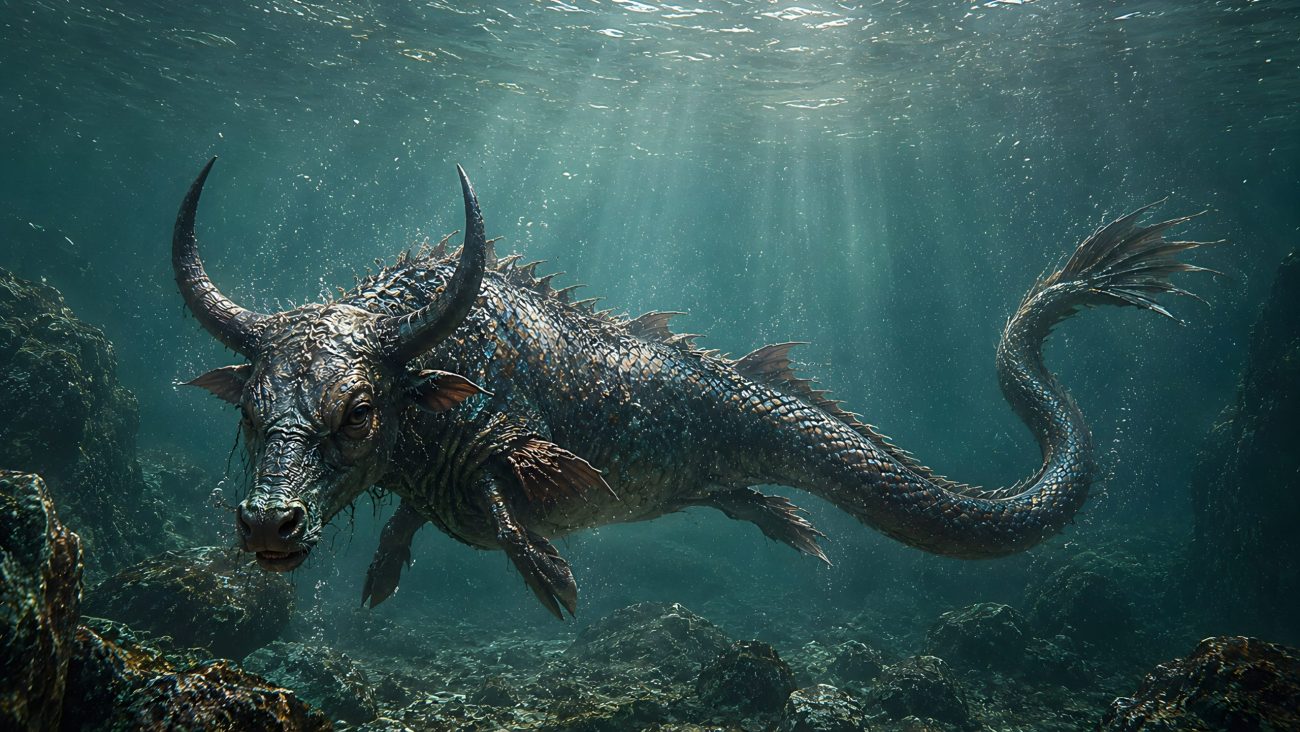
In the lakes of the Ushachi Lakeland, people speak of a creature known as the Vadzyany Byk, the Water Bull. It is said to live beneath the surface of quiet waters, especially in lakes that appear shallow near the shore but suddenly drop into deep, rocky depths. At sunrise and sunset, its presence is announced by a deep, resonant roar that rolls across the water, described as a slow, echoing “woo-woo-woo.”

Those who claim to have encountered the Water Bull describe it as a medium-sized aquatic animal with a powerful body and a broad, spade-shaped tail. It is said to circle the lake endlessly, moving just below the surface. Fishermen tell of seeing ripples and feeling unseen movement beneath their boats, and some recall moments when they were too afraid to cast their lines, convinced that the creature could seize them and drag them into the depths.

The Vadzyany Byk is believed to inhabit dangerous waters filled with large stones and sudden drop-offs, places where drowning is easy and escape difficult. For this reason, it is sometimes called the master of the lake, a being that rules its waters and punishes carelessness. Though many admit they have never seen it clearly, its voice alone is enough to inspire fear and respect.

The Water Bull is also linked to similar beings known as swamp bulls, said to dwell in marshes and wetlands. Its legend appears beyond oral tradition as well, including in stories set in Belarusian landscapes, where such creatures are treated as ancient inhabitants of water and fog.

Rarely seen and never fully understood, the Vadzyany Byk endures as a presence felt more than witnessed — a roaring shadow beneath the surface, guarding the depths of the lake and reminding those nearby that the water is not empty.


Keledones

Tradition / Region: Greek Mythology
Alternate Names: Celedones, Khryseiai Keledones (“Golden Charmers”)
Category: Object


The Myth

In the age when gods still shaped wonders with their own hands, the divine smith Hephaistos forged a set of miraculous beings for the temple of Apollon at Delphi. These were the Keledones, golden singers crafted not of flesh, but of shining metal, alive with sound and enchantment.

The Keledones were made entirely of gold and were said to sing with voices of supernatural power. Some described them as beautiful maidens, others as wryneck birds, and still others as strange bird-women, reminiscent of the Sirens. However they appeared, their song possessed a soothing and bewitching force, capable of charming all who heard it.

They were placed high upon the temple, above the pediment, where their voices rang out continuously. There, the Golden Charmers sang in honor of Apollon, their music filling the sacred space with an otherworldly harmony. Ancient poets spoke of them as wonders beyond human craft, comparing their song to that of the Sirens, though fashioned not to destroy but to enthrall.

Some later writers questioned whether such beings truly existed or whether they were poetic embellishments inspired by earlier myths. Yet the tradition endured: that once, at Delphi, golden singers adorned the god’s temple, their voices echoing across stone and air, forged by divine hands and animated by sacred song.

Thus the Keledones remained in memory as marvels of divine artifice — not born, but made; not living, yet singing — eternal symbols of beauty, craft, and the dangerous power of enchanted sound.


Lady Rokujo

Tradition / Region: Japan (Heian-period court literature)
Alternate Names: Rokujo no Miyasudokoro, Miyasudokoro
Category: Vengeful spirit / living ghost


The Myth

Lady Rokujo was a noblewoman of great refinement, the daughter of a minister and once the wife of the Crown Prince. Widowed at a young age, she later became the lover of Hikaru Genji. Though dignified and proud of her rank, she suffered deeply from jealousy and humiliation, especially as Genji’s affections shifted toward younger women. These unspoken emotions slowly twisted within her.

During the events recorded in The Tale of Genji, her resentment grew so powerful that her spirit began to leave her body without her conscious will. At the Kamo Festival, after being humiliated in a carriage dispute involving Genji’s lawful wife, Lady Aoi, Lady Rokujo’s spirit fully manifested. Invisible yet deadly, it began to torment Lady Aoi, who was pregnant at the time.

Lady Aoi suffered greatly. After a long and painful labor, she gave birth to a son, but her condition suddenly worsened, and she died only days later. Meanwhile, Lady Rokujo realized that her spirit had wandered when she noticed the smell of ritual mustard seeds clinging to her own clothing. Genji himself witnessed her spirit while tending to Lady Aoi. Horrified by what she had become, Lady Rokujo resolved to sever her ties with him.

She left the capital, parting from Genji at Nonomiya, and traveled to Ise with her daughter, who served as a sacred princess. Yet even distance could not quiet her heart. After returning to Kyoto, Lady Rokujo fell ill and died, entrusting her daughter to Genji’s care. Death, however, did not end her suffering.

Her spirit continued to appear, driven by lingering obsession. It haunted Lady Murasaki and later the Third Princess, afflicting them with sickness and terror. Through these hauntings, her bitterness toward Genji was made known again and again.

Only after memorial rites were performed, urged by Genji and carried out for her troubled soul, was it hoped that Lady Rokujo might finally find release. Until then, she endured as one of the most feared figures of courtly legend — a woman whose restrained emotions became so powerful that even death could not contain them.


Interpretive Lenses

Religious Readings
Philosophical Readings
Psychological Readings
Esoteric Deep Dive
Political / Social Readings
Other

Näcken

Tradition / Region: Swedish Mythology
Alternate Names: Strömkarlen, Bäckamannen, Kvarngubbe, Kvarnrå, Forskarlen, Dammapågen
Category: Water spirit


The Myth

In Swedish folklore, Näcken dwelled in lakes, rivers, streams, and mill waters, haunting places where the current moved quietly or gathered strength beneath the surface. He was not a single spirit but a powerful water-being known by many names, feared and respected wherever people lived close to water.

Näcken most often appeared as a naked man, sometimes young and slender, sometimes old and bearded, seated upon a rock or at the water’s edge. His hair was said to be green or woven with foliage, as if grown from the river itself. In his hands he held an instrument, most often a violin, though he was also known to play horns, flutes, or other melodies. His music was said to be irresistibly beautiful. Those who heard it felt drawn toward the sound, their feet carrying them closer to the water without their will.

Näcken was a master of deception. Though water might seem shallow and harmless, he could seize a person’s footing, locking their legs in place and pulling them beneath the surface. Many drownings were blamed on him, and children were warned never to trust the calm of a stream or the beauty of music drifting across the water at dusk.

At times, Näcken took other forms. He could appear as animals — a black or white horse, a bull, a dog, or a cat — and these shapes often bore a subtle wrongness, such as having three legs instead of four. He could also disguise himself as floating objects or tempting treasures, lying in wait for the unwary.

Näcken was not merely a minor spirit, but a powerful force of the natural world, sometimes spoken of as nearly divine. He embodied the danger of water itself: beautiful, life-giving, and deadly. To encounter him was to be reminded that rivers and lakes were alive, watching, and never fully under human control.


Błędne ogniki

Tradition / Region: Polish Mythology
Alternate Names:
Category: Flame


The Myth

In marshes, swamps, and peat bogs, people spoke of small lights that appeared at night, hovering just above the wet ground. These wandering flames were known as Błędne ogniki. They flickered softly, drifting without clear purpose, and were most often seen where the land was treacherous and paths were uncertain.

According to Polish and wider Slavic belief, Błędne ogniki were the souls of the dead. They were commonly said to be the spirits of wicked or dishonest people, especially unjust landowners and fraudulent surveyors who had cheated others during their lives. After death, they were condemned to wander endlessly, glowing faintly as a sign of their unrest and repentance.

The lights were feared by travelers. It was said that Błędne ogniki could lead people astray, drawing them off safe paths and deeper into bogs where they might become lost or perish. To follow the lights was dangerous, and their appearance was usually taken as a bad omen.

In some regions, however, the lights were also linked to hidden treasures buried beneath the earth. In these tales, the glow was believed to come from the lanterns of underground beings guarding their riches. Even so, such encounters were risky, for those who chased the promise of wealth often met misfortune instead.

Thus Błędne ogniki were remembered as restless lights of the night — spirits bound to the land, warning travelers that not every guiding flame leads to safety.


Ba-kujira-tata

Tradition / Region: Japanese Mythology
Alternate Names: Monster Whale Curse
Category: Whale, Ghost


The Myth

During his years working as a kamishibai artist, Mizuki Shigeru once created a paper-theater story called Monster Whale. The tale told of a man who ate nothing but whale meat. Over time, his body began to change, and he slowly came to resemble a whale himself. As the story neared its end, the man was struck by a severe fever. Even after consulting a doctor, no cause for the illness could be found.

While performing this story repeatedly, Mizuki himself fell ill with an unexplained fever. Medical treatment brought no answers, and the sickness lingered. Eventually, he decided to stop performing Monster Whale. Soon after, his fever disappeared as suddenly as it had come.

Mizuki laughed it off at the time, calling it the curse of the monster whale. Yet as years passed, he reconsidered the experience. He came to feel that the story may have touched on something unseen, something that did not reveal itself openly. As the tale of the monster whale concludes in his later writings, collected in works such as Nihon Yokai Taizen, it leaves a quiet warning: though nothing may seem to be happening, there is always something mysterious moving just beyond human sight.


Sources

TYZ Yokai Blog contributors. (n.d.). Bake-kujira (鯨骨霊 / バクジラ). In TYZ Yokai Blog, from https://tyz-yokai.blog.jp/archives/1077754091.html


Zhu Yan

Tradition / Region: Ancient China
Alternate Names:
Category: Omen beast / monstrous ape


The Myth

In the ancient text Classic of Mountains and Seas, it is said that in the Western Mountains there exists a strange beast called Zhu Yan. Its form is like that of a powerful ape, but its head is white and its feet are red. It possesses immense strength and an unsettling presence.

Zhu Yan does not wander without consequence. When it appears in the world, its coming is taken as a sign of catastrophe. The sighting of this beast foretells the outbreak of great war, bringing violence and upheaval wherever its presence is known. Thus, Zhu Yan is remembered not for deeds it performs, but for the disaster that follows in its wake.


Interpretive Lenses

Religious Readings
Philosophical Readings
Psychological Readings
Esoteric Deep Dive
Political / Social Readings
Other

Huldra

Tradition / Region: Norwegian Mythology, Swedish Mythology
Alternate Names: Skogsrå, Tallemaja, Ulda, Hulder
Category: Fox, Forest dweller


The Myth

Deep within the Scandinavian forests, people spoke of the Huldra, a hidden woman who ruled the woods and the spaces between trees. She appeared as a beautiful young woman, dressed like a farmer’s daughter or forest maiden, her voice gentle and her manner inviting. Those who met her often believed they had encountered an ordinary human, for she moved easily among people and spoke their language. Yet the Huldra was never entirely what she seemed.

Those who looked too closely, or who followed her too far into the forest, might glimpse what she concealed. Beneath her skirt could be seen the tail of an animal, often that of a cow or fox, or her legs might be covered in coarse hair. Some said that if she turned her back, it was hollow like the inside of a rotting tree. For this reason she wore long clothing and kept her secrets well hidden, revealing them only to the careless or the doomed.

The Huldra was one of the rå, the wardens of the natural world, spirits who governed forests, waters, and mountains. As skogsrå, she claimed dominion over the woods and all who worked within them. Charcoal burners, who labored day and night tending their kilns, were said to be especially favored by her. While they slept from exhaustion, the Huldra would watch over the burning charcoal, waking them if danger threatened. In return, the men left food for her in a hidden place, knowing that respect earned protection.

Yet her kindness was matched by danger. Men who mocked her, tried to expose her secret, or followed her seduction without respect often lost their way in the forest, fell ill, or were never seen again. Some tales tell of men who were lured into marriage with a Huldra, only to discover her true nature too late. Others say that if she were treated well, baptized, or brought fully into the human world, her tail would fall away and she could live as a woman, though the forest would mourn her loss.

Thus the Huldra remained a presence both alluring and feared — a reminder that the forest was alive, watchful, and governed by powers older than humanity, rewarding respect and punishing arrogance in equal measure.