Tradition / Region: Indian Mythology
Alternative names: Surabhi, Surabhī, Kamaduh, Kamaduha, Sabala, Kapila
Category: Cow, Deity
The Myth
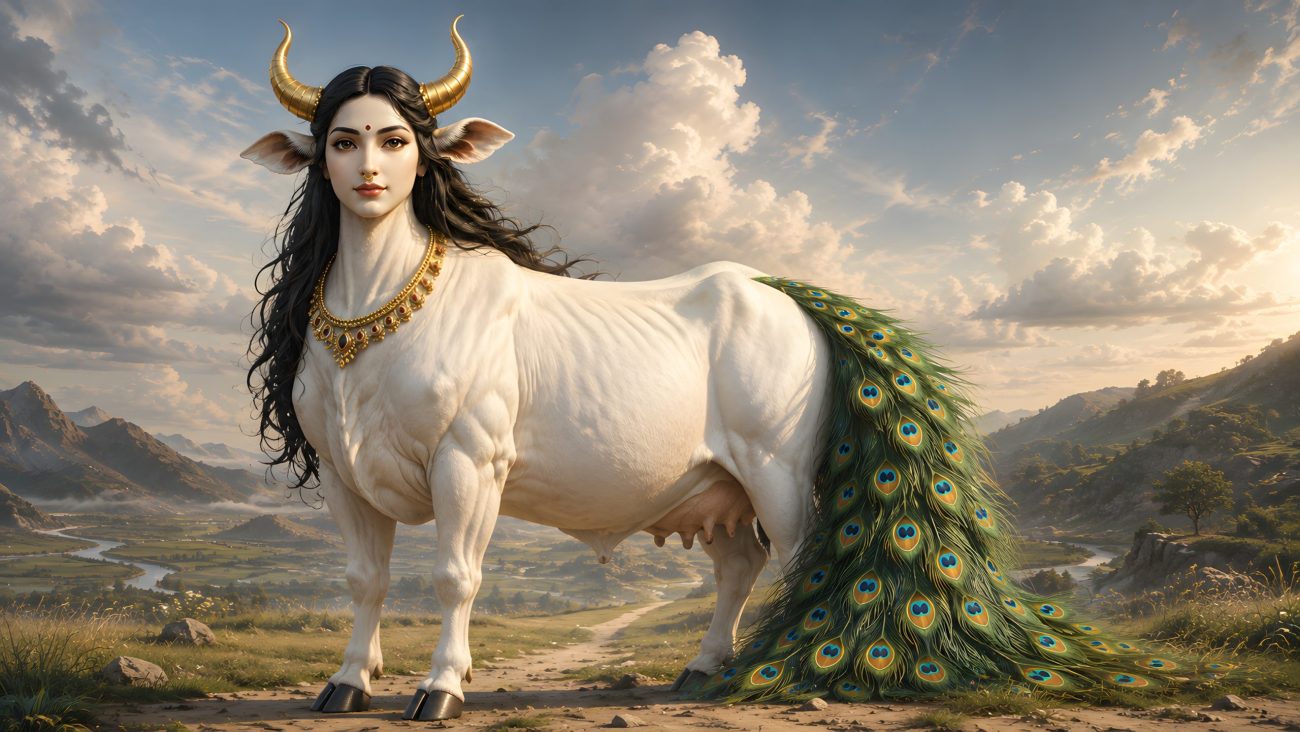
Kamadhenu is a miraculous white cow who provides whatever is desired and is regarded as the mother of all cows. She is associated with milk, prosperity, fertility, and the sacred rituals of the sages. She is sometimes depicted with the head and breasts of a woman, the wings of a bird, and the tail of a peacock, or with numerous gods represented within her body.
Different Hindu scriptures give different accounts of her origin. In the Mahabharata, Kamadhenu-Surabhi emerged from the churning of the cosmic ocean and was given to the great sages. Brahma commanded her to provide milk and ghee for ritual sacrifices.
In other traditions, Surabhi was born from Daksha, from Brahma, or from the divine act of creation. She became the mother of countless cattle and was associated with Goloka, the realm of the cows, as well as Patala.
Kamadhenu was closely connected with the sages who possessed her. She could provide enormous quantities of food and milk and, when threatened, could even produce warriors to defend her master.
One famous story concerns the sage Vashishtha and his miraculous cow Sabala. King Vishvamitra arrived at the sage’s hermitage with his army, and Vashishtha welcomed them with a great feast produced entirely through Sabala’s supernatural power.
Amazed by the cow’s abilities, Vishvamitra offered the sage thousands of ordinary cattle, elephants, horses, and jewels in exchange for her. Vashishtha refused, explaining that Sabala was essential to his religious duties.
Vishvamitra then attempted to take her by force. Sabala returned to Vashishtha and was ordered to defend him. From her body she produced armies of supernatural warriors, who fought Vishvamitra’s forces and destroyed his army.
Another tradition tells of Kamadhenu living with the sage Jamadagni. King Kartavirya Arjuna attempted to seize the divine cow and her calf. After the conflict led to Jamadagni’s death, his son Parashurama took revenge upon the king and eventually destroyed the Kshatriya warriors twenty-one times.
Kamadhenu is also associated with Nandini, another miraculous cow of plenty who lived with Vashishtha. In some traditions Nandini is Kamadhenu’s daughter, while in others the names Kamadhenu, Surabhi, and Nandini overlap.
When Kamadhenu’s son, a bullock, was cruelly overworked and beaten by a farmer, she wept over his suffering. Her tears were seen by Indra, who was moved by her grief and sent rain to stop the torment.
Kamadhenu remains a divine source of cattle, milk, prosperity, and protection, while her miraculous ability to provide nourishment and warriors makes her one of the most powerful supernatural cows in Hindu mythology.
Sources
“Kamadhenu.” Wikipedia: The Free Encyclopedia. Wikimedia Foundation. Accessed August 16, 2026. https://en.wikipedia.org/wiki/Kamadhenu